According to Qualtrics research, while customers continue to prioritise value, those who choose brands for excellent customer service report 94% higher satisfaction and 89% higher levels of trust. Reflecting this trend, improving customer experience is now the top strategic priority for 71% of organisations surveyed by Forrester.
As expectations for faster, more personalised support continue to grow, organisations are increasingly adopting AI-powered customer service solutions. According to Creatio’s Global AI and No-Code Adoption Survey 2025, nearly one in five AI agents worldwide is already deployed within customer service functions. In addition, Servion Global Solutions predicts that by 2028, up to 95% of all customer interactions could be supported by AI, highlighting the continued shift towards more intelligent, automated customer engagement.
This article explores how AI service agents are reshaping customer service, the operational advantages they offer, and the ways organisations are applying them in practice.
Key takeaways
- AI is helping organisations improve customer service by handling routine customer enquiries, automating repetitive tasks, providing data-driven recommendations, supporting predictive service, and anticipating future needs.
- AI can deliver measurable business benefits, including faster issue resolution, increased personalisation, lower operational costs, and improvements in CSAT and retention rates.
- Successful AI adoption depends on selecting the right use cases and technologies, implementing appropriate governance and security measures, maintaining human oversight, and ensuring alignment with brand voice and compliance standards.
- Platforms such as Creatio’s agentic CRM help organisations integrate AI into the customer journey, supporting wider adoption and improved operational efficiency.
What is AI in customer service?
AI in customer service uses technologies, such as chatbots, AI service agents, machine learning algorithms (ML), and natural language processing (NLP), to automate and personalise customer interactions.
These AI-powered tools integrate with customer service solutions to handle routine customer enquiries, provide immediate, personalised responses, and support customers around the clock across multiple channels. By analysing large volumes of interaction data, AI helps organisations respond more quickly, deliver more consistent service and tailor customer experiences to individual needs.
The State of AI Agents & No-Code
Learn how 560+ leaders across the world use AI and no-code to drive innovation today
Benefits of AI in customer service
Integrating AI into customer service operations can deliver measurable business benefits. Organisations report shorter response times, lower operational costs, alongside improvements in customer satisfaction and loyalty.
According to Zowie, AI-powered virtual assistants can automate more than 70% of customer enquiries, providing relevant and personalised responses without human intervention. Meanwhile, Forrester’s 2024 Generative AI report found that chat agents using generative AI tools can increase case resolution rates per hour by up to 14%, while VentureBeat reports that implementing AI in customer service can reduce operational costs by as much as 30%.
Key advantages of AI in customer service include:
- 24/7 support: AI chatbots and virtual assistants provide round-the-clock support for customers and employees across channels, time zones, and languages.
- Cost savings: automating routine interactions with AI agents can help reduce staffing, training, and customer service costs.
- Personalised experiences: generative AI can use customer data to deliver tailored recommendations and context-aware responses, helping to improve customer satisfaction and loyalty.
- Proactive support: by analysing data in real time, AI agents can identify potential churn risks or service failures early, enabling customer service teams to take action before they escalate.
- Faster response times: AI enables instant responses and faster case resolution, helping organisations meet growing customers expectactions for timely support.
- Higher customer satisfaction and loyalty: faster, more accurate support can improve customer satisfaction score (CSAT) and retention.
- Scalability during periods of high demand: AI can handle spikes in customer enquiries, while maintaining consistent service quality without placing additional pressure on customer service teams.
- Multichannel integration: AI helps deliver a consistent support experience across channels, including chat, email, social media, and phone.
- Data-driven insights: AI analyses customer interactions to identify trends, optimise processes, and support decision-making, giving customer service teams actionable insights in real time.
How to Use AI in Customer Service?
AI can enhance customer service in a variety of practical ways, from automating routine requests to anticipating customer needs and supporting customer service teams. The following use cases show how organisations are using AI-powered tools and service AI agents:
1. AI-powered chatbots for tier 0 and tier 1 customer enquiries
AI-powered chatbots are often the first point of contact in modern customer service, handling tier 0 and tier 1 customer enquiries: routine, high-volume requests that typically do not require human involvement. Using conversational AI, chatbots can engage in natural-language conversations and manage thousands of interactions around the clock. They provide accurate responses to common and initial customer questions, offer immediate support with straightforward tasks, such as checking order status, resetting passwords, or scheduling appointments.
According to Gartner, by 2027, chatbots are expected to become the primary customer service channel for around 25% of organisations, reflecting a broader shift towards automated and intelligent support systems.
By automating repetitive tasks and handling routine enquiries, chatbots enable customer service teams to focus on more complex tasks, high-value issues, helping to improve productivity and operational efficiency.
Creatio Service Implementation Bank of Georgia Use Case
Find out more about the benefits of chatbots in the banking industry
2. AI-powered virtual assistants for customer service teams
AI-powered assistance tools provide customer service teams with real-time guidance and insights, helping them to work more efficiently and deliver consistent support.
AI virtual assistants, such as Creatio's AI agents, provide customer service teams with real-time support during customer interactions. Service AI agents can recommend relevant knowledge base articles, similar cases, best practices, and playbooks, helping teams resolve issues more quickly and consistently. They also ensure that customers receive accurate, consistent information by updating records across customer service systems.
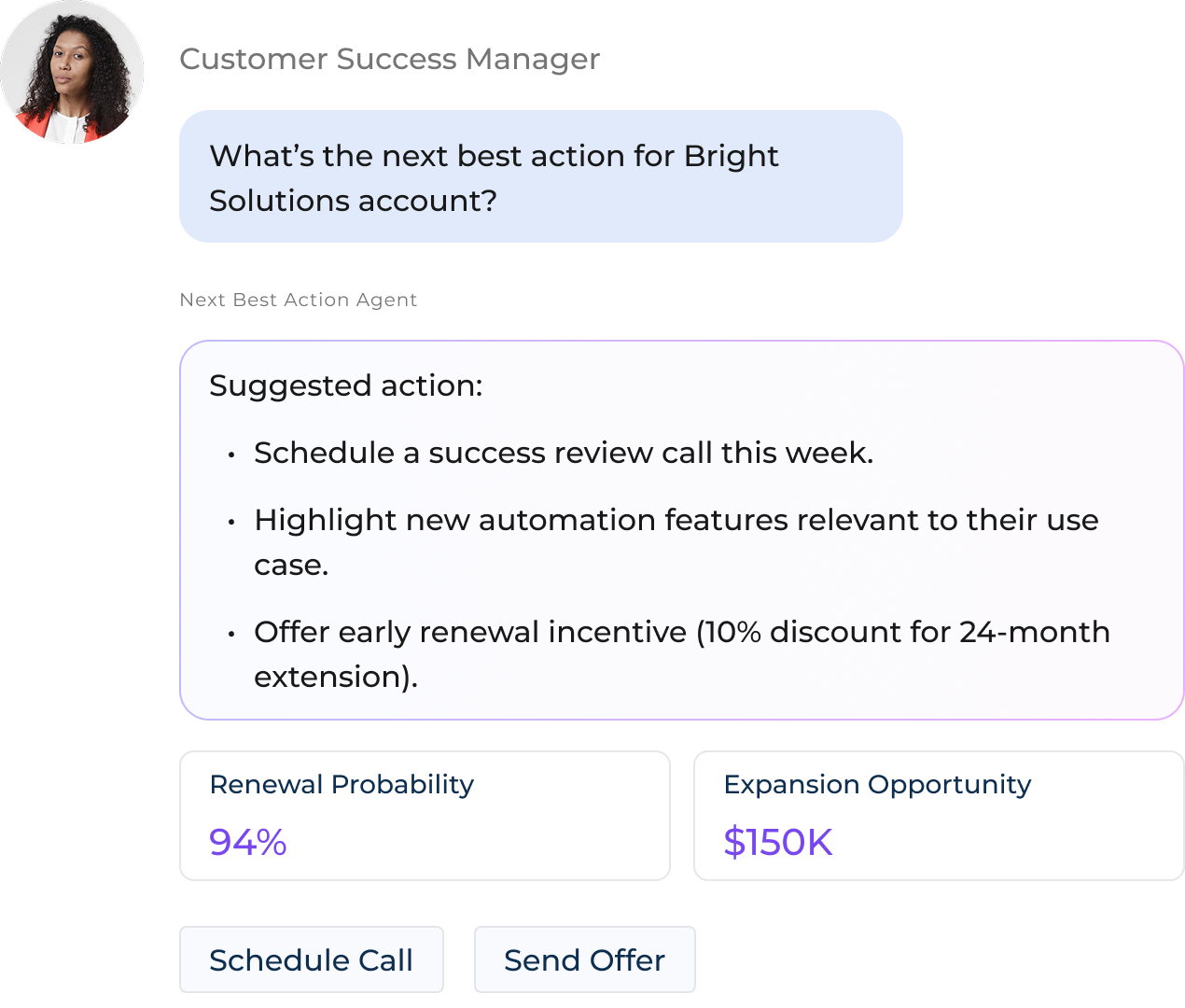
In addition, AI-powered assistance tools can analyse current workloads, status of support agents, and case details to route cases automatically. This ensures each case is assigned to the most appropriate team member, based on their expertise, availability, and the complexity of the issue.
AI agents can also automate the documentation of customer interactions and follow-up tasks. After a call or chat, they can summarise conversations, draft follow-up emails, and create knowledge base articles. This reduces the administrative workload for customer service teams, allowing them to focus on higher-value tasks, such as building stronger customer relationships.
3. Automated case routing and workflow orchestration
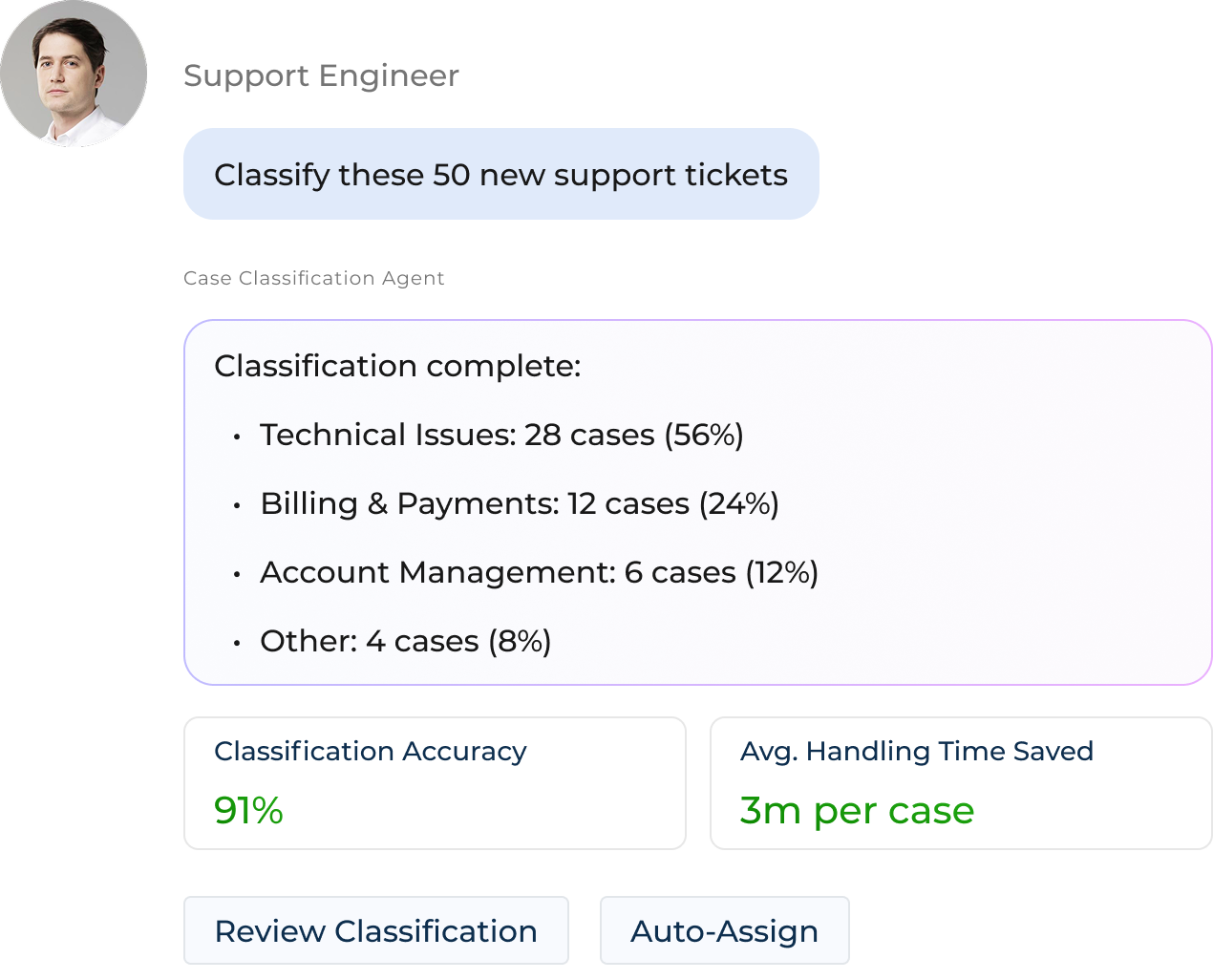
AI agents can improve customer service operations by automating case routing and orchestrating workflows across teams. They can analyse incoming support tickets, assess priority and assign each request to the most appropriate agent, together with a summary of the customer's profile, previous interactions, and suggested responses.
According to Gartner, by 2030, more than 60% of enterprise customer service interactions are expected to be managed entirely by agentic AI, reducing average case handling times by up to 35%.
Beyond case routing, AI systems streamline everyday tasks such as data entry, ticket categorisation, and follow-up communication, allowing customer service teams to focus on complex issues and high-value interactions.
4. Improved call management
AI systems can enhance call management by using voice recognition and natural language processing to understand and route calls effectively. During calls, AI can also provide customer service teams with real-time support by recommending responses and surfacing relevant customer information.
Generative AI can summarise conversations across chatbots and interactive voice response (IVR) systems, making it easier for agents to pick up previous interactions, answer follow-up questions, and avoid asking customers to repeat information.
5. Personalised recommendations
AI can deliver personalised customer experiences by analysing customer data, individual preferences, previous interactions, and engagement patterns. This helps customer service teams recommend relevant solutions, content, or next steps more quickly and efficiently.
A study by Medallia, organisations that deliver highly personalised customer experiences are twice as likely to achieve revenue growth of 10% or more.
6. Sentiment and intent analysis
AI agents for customer service can analyse customer sentiment and intent, helping organisations understand both what customers are saying and how they feel.
Using natural language processing and machine learning, AI can analyse tone, language, and context across conversations to identify emotions such as customer frustration, satisfaction, or urgency, as well as the intent behind each message.
These insights help human customer service teams respond more effectively by prioritising cases that require escalation and routing conversations with negative sentiment to more experiences representative where appropriate.
7. Predictive support
Based on sentiment and intent analysis, AI agents can identify customers who may be at risk of churning and recommend appropriate retention actions in real time.
By analysing emotional tone, intent signals, and behavioural patterns across previous interactions, predictive models can identify customers at risk and recommend proactive actions, such as timely follow-up activities, personalised offers, or escalation to a customer service representative.
8. Forecasting and capacity planning
AI-powered predictive analytics help organisations forecast support demand and optimise resource allocation. By analysing historical customer data, seasonal trends, and behavioural patterns, AI models can predict ticket volumes, identify peak periods, and detect emerging issues. These insights help customer support teams plan staffing levels and workloads more accurately, reducing bottlenecks, minimising wait times, and helping to maintain consistent service quality.
How to implement AI in customer service
AI has the potential to transform customer service, but successful implementation requires careful planning. A phased approach that aligns AI initiatives with business objectives and customer expectations is more likely to deliver long-term value.
Here are five essential steps to guide implementation:
1. Define clear objectives and leadership alignment
Start by defining clear business objectives for AI implementation, supported by measurable success metrics, such as reducing response times, improving CSAT, personalising customer interactions, or lowering operational costs.
Leadership should be involved from the outset to ensure AI initiatives align with wider business objectives. Clear, defined objectives provide a strong foundation for an AI strategy and help guide future improvements to maximise the value of AI tools.
2. Identify and prioritise AI use cases
Evaluate existing customer service processes and workflows to identify inefficiencies and areas where AI can deliver the greatest value. A clear understanding of where AI can improve business performance is essential for successful implementation.
According to Gartner, selecting the right use cases is the biggest challenge in achieving primary AI objectives, cited by 20% of executives and AI leaders surveyed. In a separate Gartner survey, only 10% of customer service and support leaders reported achieving objectives for investments in generative AI.
Prioritise use cases that offer the greatest return on investment while supporting wider business objectives. When evaluating opportunities, consider both the potential impact of AI implementation and any dependencies on existing or planned initiatives.
Start with internal, non-customer-facing use cases, such as case summarisation, sentiment analysis, and knowledge-based article generation. As these use cases do not involve direct customer interactions, they typically present lower implementation risks. External, customer-facing use cases, such as virtual assistants and AI agents for customer communication, require appropriate governance to ensure compliance with ethical and regulatory standards. These are often better introduced as AI capabilities and organisational maturity develop.
3. Select the appropriate AI tools
Choosing the right platform is a critical part of the implementation process. AI tools should integrate seamlessly with CRM systems and communication channels to support unified, data-driven customer experiences. The chosen solution should support multilingual, omnichannel engagement, provide robust data governance and security, and integrate easily with existing workflows as business needs evolve.
Creatio’s agentic CRM offers a comprehensive set of AI capabilities, including role-specific AI agents, workflow automation, and real-time assistance. Extensive customisation options and seamless integration with existing systems support enterprise-wide adoption and enable AI to be embedded within existing business processes.
4. Understand AI limitations and risks
While AI offers significant benefits, it also presents limitations and risks that organisations should take into account. Generative AI models can occasionally produce inaccurate or misleading responses, a challenge commonly referred to as AI hallucinations. In addition, while 64% of customers prefer personalised experiences, only 39% trust organisations to use their data responsibly.
Maintaining human oversight, data quality, and robust compliance and security practices is essential for building trust and ensuring reliability. This requires eliminating data silos and inconsistencies, while adopting platforms that integrate seamlessly across the technology stack and support strong security standards.
Realising the full value of AI depends on a foundation of transparency, strong governance, and clear human oversight, ensuring automation remains aligned with organisational values and customer expectations.
5. Pilot and optimise
Begin with a limited pilot focused on internal use cases to validate accuracy and assess workflow integration. This is particularly important for organisations at an early stage of AI adoption. Once internal use cases have been established and validated, AI can be introduced to customer-facing use cases in line with increasing organisational AI maturity.
Following the initial implementation, AI performance should be monitored continuously, with feedback from employees and customers used to support ongoing refinement. Regular review and optimisation help ensure AI capabilities continue to meet evolving customer needs and adapt to technological developments.
6. Scale and govern
Once the pilot has been successfully validated, AI capabilities can be extended across additional use cases and departments. Ongoing governance should be established to monitor compliance, mitigate risks such as bias or AI hallucinations, and ensure AI remains aligned with organisational standards, brand voice, and service standards.
Creatio Service: improve customer satisfaction with AI agents for customer service
Creatio Service is a leading agentic service platform designed to help organisations deliver consistent, high-quality service — with no limits on AI agents, workflows, or scale.
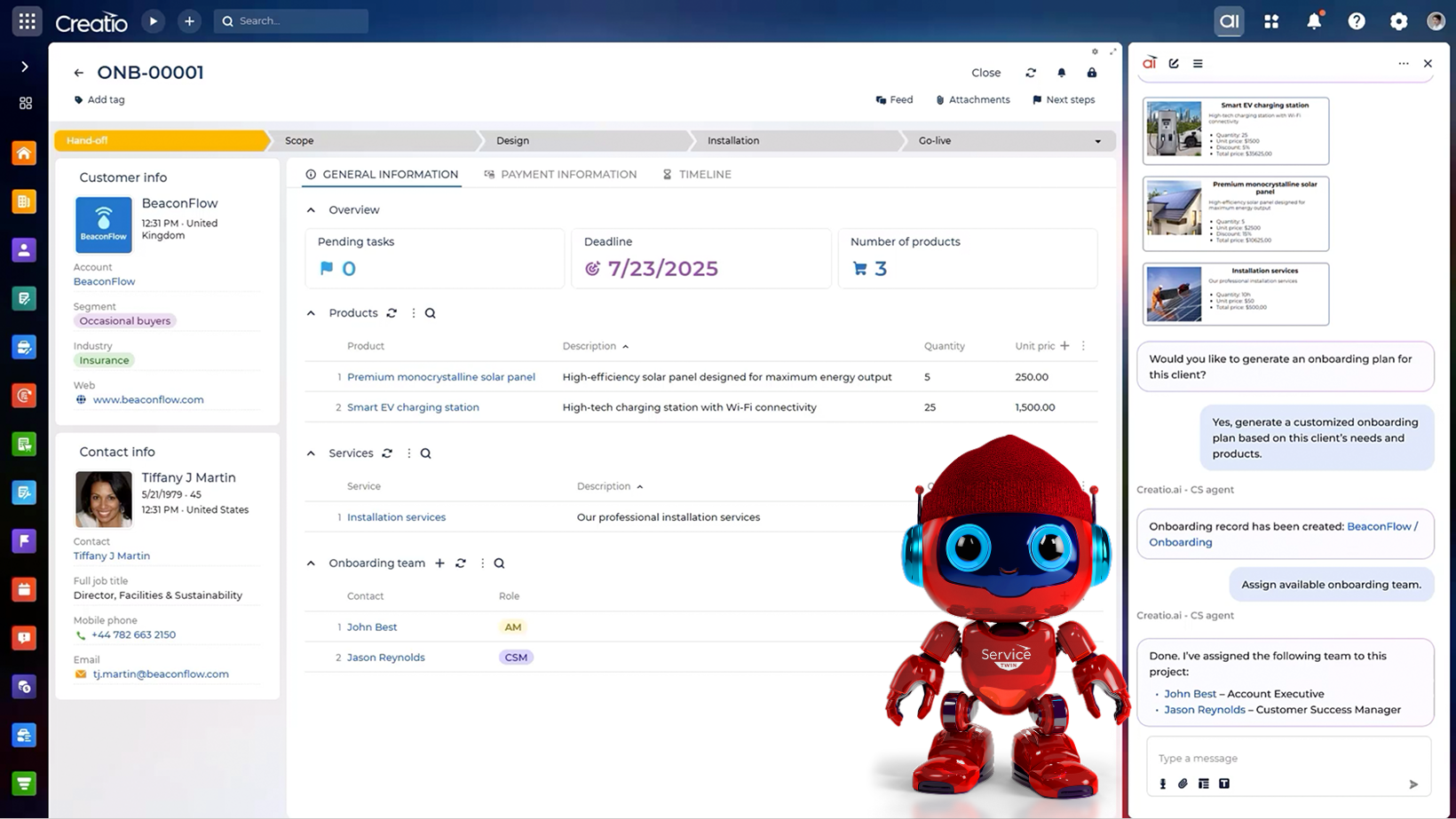
Creatio.ai enhances customer service teams to resolve cases more efficiently by providing intelligent, real-time assistance throughout the support process. A range of ready-to-use AI agents supports service automation, helping organisations improve operational efficiency and deliver consistent customer experience.
Creatio’s AI Service Agents work together to automate routine tasks, accelerate case resolution, and improve the customer experience. The Customer Support Agent handles frequently asked questions and routine customer requests, escalating more complex cases to customer service representatives where appropriate. The Service Playbook Agent recommends next-best actions, empowering teams to deliver faster and more reliable service.
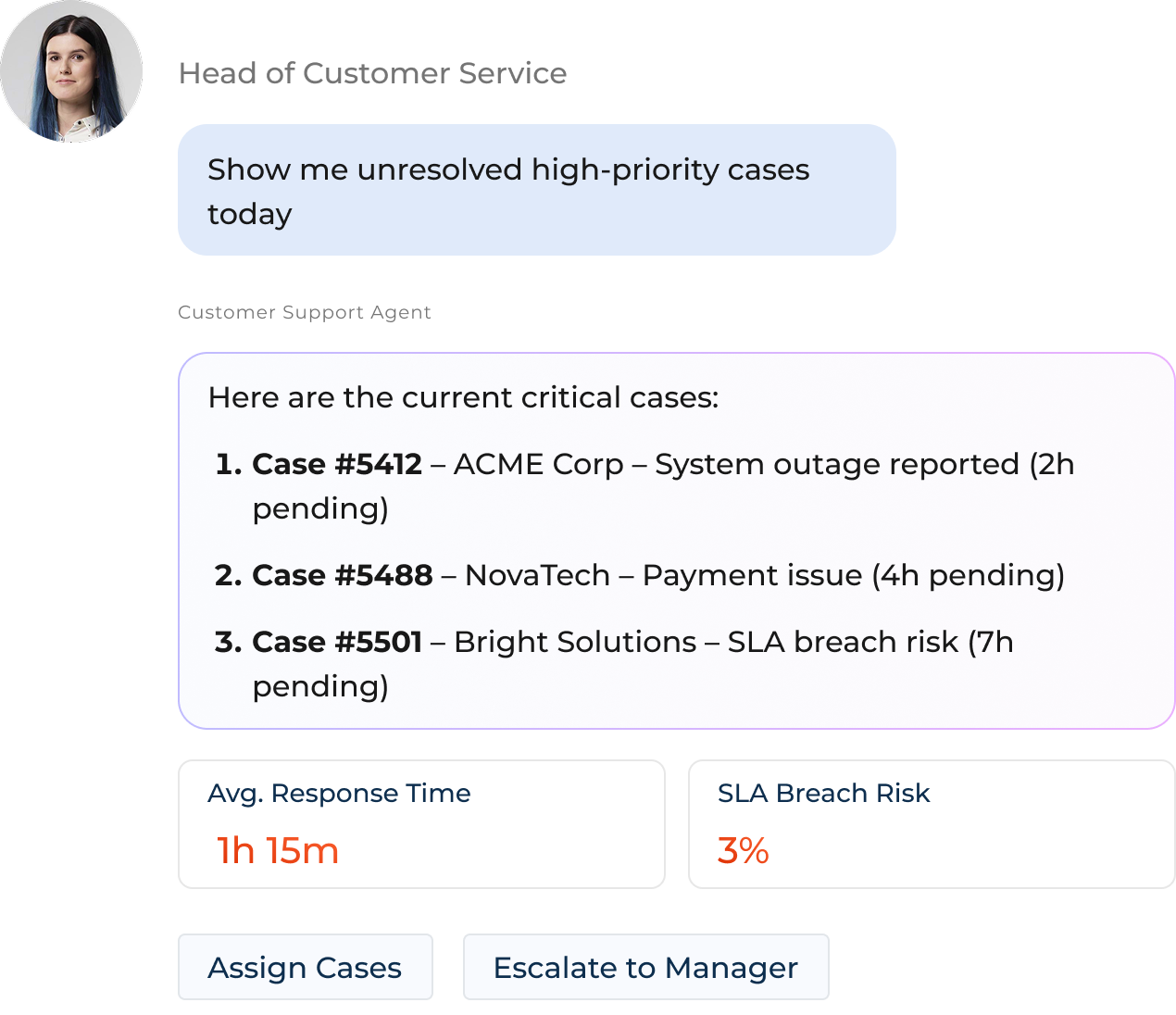
The Case Classification Agent categorises requests, recommends relevant solutions, and routes cases to the appropriate team. The Knowledge Base Agent automatically creates help articles, surfaces relevant content in real time, and keeps documentation accurate and up to date. The Customer Success Agent leverages AI to create personalised onboarding plans, recommend tailored training materials, and analyse engagement metrics to increase AI adoption and customer satisfaction.
Whether the goal is to improve first-contact resolution rates, reduce response times, or deliver more proactive, predictive support, Creatio Service AI agents help customer-facing teams work more efficiently, improve service quality, and strengthen customer loyalty. Industry research highlights the impact of Creatio’s agentic CRM, showing that organisations achieve implementations up to 70% faster and realise a 37% lower total cost of ownership (TCO) compared to legacy systems.
Service AI Agents
Accelerate customer service through real-time insights with Creatio's AI agents
The future of AI in customer service
AI adoption in customer service continues to accelerate across various industries. According to Creatio’s State of AI Agents and No-Code report, AI has become a board-level priority, reflecting a shift from experimentation to strategic adoption. More than 80% of C-level decision-makers believe AI agents will be important or critical to achieving their strategic objectives over the next two to three years.
The next phase of customer service is expected to be shaped by AI-first operations, with intelligent systems taking on a greater share of routine work and customer service professionals focusing on more specialised and strategic responsibilities. Industry forecasts suggest that many service organisations are transitioning toward more autonomous operating models, where AI agents manage a growing proportion of customer interactions, while human experts focus on complex customer issues, oversee AI systems, and continuously improve service processes. The objective is not to replace people with AI, but to combine the speed and scalability of automation with the empathy, creativity, and judgment that people bring to customer service.
According to Forrester, by 2026, organisations that take a structured approach to AI implementation are likely to see measurable improvements in self-service performance, with around one quarter of brands expected to achieve a 10% increase in the resolution of simple enquiries. Many are also expected to expand their use of generative AI-powered chat and voice bots, enabling faster and more natural self-service interactions.
Organisations that adopt AI strategically can improve operational efficiency by reducing response times and costs while building more adaptable, scalable customer service operations that support long-term business objectives.
Summary
AI is reshaping customer service by automating routine enquiries and enabling more personalised, predictive, and proactive support. AI service agents help organisations meet rising customer expectations more efficiently and consistently. Organisations that adopt AI as part of a broader customer service strategy can improve operational efficiency, customer satisfaction, and loyalty, while building the capabilities needed to support future business growth.
As AI technology continues to evolve, long-term success will depend on balancing automation with human empathy, ensuring customer interactions remain efficient, consistent, and appropriately personalised.