Increasing customer expectations for faster delivery and growing operational complexity are forcing manufacturers to rethink how orders are managed throughout the production lifecycle.
For many organisations, spreadsheets, disconnected systems, and manual processes are no longer sufficient to support efficient order fulfillment. Manufacturers order management software addresses these challenges by providing greater visibility, improving cross-functional coordination, and streamlining order management processes.
This guide explains what manufacturing order management software is, explores its key features and benefits, reviews the leading solutions available in 2026, and outlines the main factors to consider when selecting the right platform.
Key takeaways
- Manufacturing order management software is a digital solution that enables manufacturers to manage the entire order lifecycle, from order creation to fulfillment and delivery, within a centralised system.
- Core capabilities of manufacturing order management software include sales order processing, customer and account visibility, production workflow automation, ERP and inventory integration, AI-powered automation, real-time order tracking, and reporting and demand forecasting.
- Manufacturing order management software helps reduce errors, improve order accuracy, shorten order-to-cash cycles, increase customer satisfaction, and lower operational costs.
- Creatio manufacturing CRM stands out for its AI-native architecture, no-code customisation capabilities, and ability to automate complex manufacturing processes within a single platform.
- Software selection should be based on primary use cases, integration requirements, AI capabilities, and customisation flexibility.
What is manufacturing order management software?
Manufacturing order management software is a centralised system that enables manufacturers to plan, execute, track, and optimise the entire order lifecycle, from order creation and production scheduling to inventory allocation, shop floor execution, quality control, and final delivery. It provides a unified environment for managing manufacturing operations and ensuring that efficient flow of orders through every stage of the process.
Key features of manufacturing order management software
Modern manufacturing order management software combines AI-powered automation, real-time visibility, and deep operational integrations to improve order fulfilment efficiency and streamline manufacturing operations.
The following capabilities are commonly found in manufacturing order management software:
Sales order processing
Manufacturing order management software streamlines the management of customer orders from initial order placement through production to fulfillment. Order details are captured automatically, information is validated, and orders are routed to the appropriate teams, helping production begin without delays caused by manual handovers or incomplete data.
Customer and account 360°
A centralised customer view provides access to all relevant account information in one place, including order history, contracts, and communications. This enables a better understanding of customer requirements, improves visibility into active orders, and supports informed customer service throughout the production and delivery process.
Production workflow automation
Manufacturing production often requires coordination across multiple teams, approval stages, and operational tasks. Manufacturing order management software automates these workflows by assigning tasks, triggering approvals, sending notifications, and progressing orders through each stage of production according to predefined rules and processes.
ERP and inventory integration
Efficient production depends on accurate, up-to-date information across inventory, procurement, and financial operations. Integration with ERP software and inventory systems synchronises data automatically across business functions, helping production teams work with consistent and current information.
AI agents for manufacturing order management
Modern manufacturing order management platforms use AI agents to automate and optimise order-related processes. These tools can prioritise workloads, identify potential fulfilment risks, and recommend actions when delays occur. AI agents can also support employees by handling routine tasks such as updating order records, generating customer communications, and responding to enquiries, allowing teams to focus on higher-value work.
Real-time order tracking
Real-time order tracking provides continuous visibility into the status of orders throughout the manufacturing process. Manufacturing teams can monitor production progress, inventory availability, and fulfilment status as orders move through production, making it easier to identify delays and respond promptly to operational issues.
Reporting and demand forecasting
Manufacturing order management software transforms operational data into actionable insights through dashboards and reports. These insights provide visibility into order volumes, fulfilment performance, and delivery trends, supporting more informed decisions about order planning and resource allocation.
Modern platforms increasingly use AI for manufacturing to improve forecasting accuracy and identify potential risks and opportunities for operational improvement.
Benefits of manufacturing order management software
Manufacturing order management software improves the efficiency and accuracy of order fulfilment by streamlining workflows and reducing manual processes. Key benefits include:
Reduced errors and improved order accuracy
Manufacturing order management software reduces reliance on manual data entry and updates, two common sources of errors. By centralising order information and automating data flows across sales, inventory, procurement, and production, it helps ensure orders are processed accurately.
Shorter order-to-cash cycles
Manufacturing order management software streamlines the journey from order receipt to fulfilment by centralising order processing, production coordination, inventory allocation, and fulfilment activities. With fewer manual handovers and greater visibility across the order lifecycle, manufacturers can reduce delays, accelerate invoicing, and shorten the time between receiving an order and payment.
Higher customer satisfaction
Accurate orders, reliable delivery dates, and timely updates are essential to meeting customer expectations. Manufacturing order management software provides greater visibility into order status and production progress, enabling faster communication with customers, more proactive issue resolution, and more reliable delivery performance. AI-powered manufacturing order management capabilities can also automate customer updates, reducing manual work.
Lower operational costs
Manufacturing order management software helps manufacturers reduce operational costs by improving coordination across order processing, production, inventory, and fulfilment activities. Greater visibility into orders, inventory levels, and resource allocation enables more efficient planning, minimises waste, prevents costly disruptions, and improves the use of available resources.
Top five manufacturing order management software solutions in 2026
As manufacturing operations become increasingly data-driven and automated, investment in platforms that combine production planning, workflow automation, inventory management, and AI-powered insights continues to grow.
The following solutions are among the leading manufacturing order management software platforms in 2026:
Software | Best For | Key Strength | Rating (G2) |
| Creatio | Mid-sized and enterprise manufacturers modernising operations with AI-powered automation | AI-native automation, no-code customisation, and end-to-end manufacturing process orchestration | 4.6/5 |
| DELMIAWorks | Small to mid-sized manufacturers seeking a unified ERP and MES solution | Real-time production monitoring and shop floor management | 4.1/5 |
| Oracle NetSuite | Mid-sized and enterprise manufacturers requiring a scalable cloud ERP solution | Comprehensive ERP capabilities with strong inventory and supply chain management | 4.1/5 |
| Epicor Kinetic | Manufacturers with complex discrete and make-to-order production environments | Advanced production planning and manufacturing resource management | 3.9/5 |
| Katana MRP | Small manufacturers looking for an easy-to-use order management platform | Intuitive production planning and inventory management | 4.3/5 |
Creatio
Best for: Mid-sized and enterprise manufacturers modernising operations with AI-powered automation.
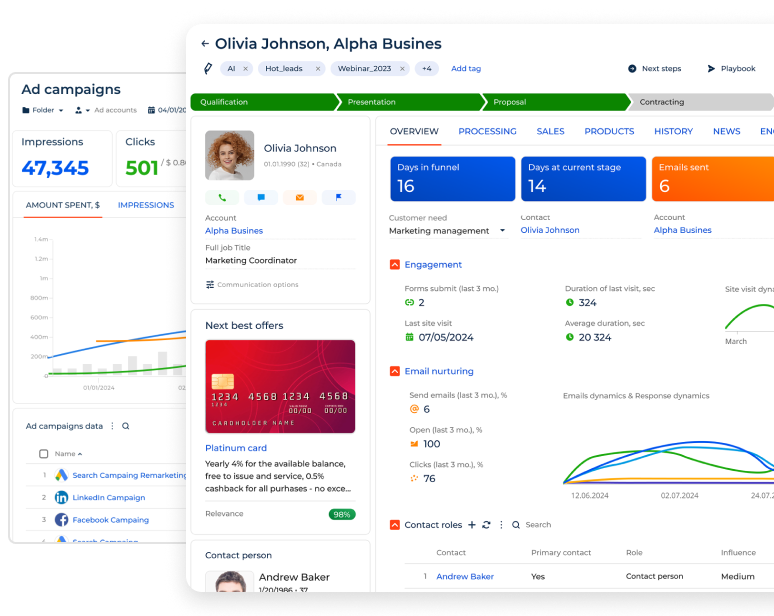
Creatio is a manufacturing CRM and workflow platform powered by AI designed to help manufacturers unify and streamline customer-facing and operational processes. The platform enables the management of sales, customer relationships, order fulfilment, and service operations within a single digital environment. By combining workflow automation with AI-powered capabilities, Creatio helps manufacturers streamline operations and improve efficiency.
Creatio supports the management and optimisation of the entire order lifecycle, from initial enquiry and quotation through to order fulfilment and post-sale service. Order intake, approvals, and routing can be automated to ensure orders progress efficiently through every stage of the process. By connecting customer, operational, and order data within a single platform, Creatio provides real-time visibility into order status across departments, enabling maintenance and operations teams to identify priorities, monitor performance, and respond more quickly to potential issues.
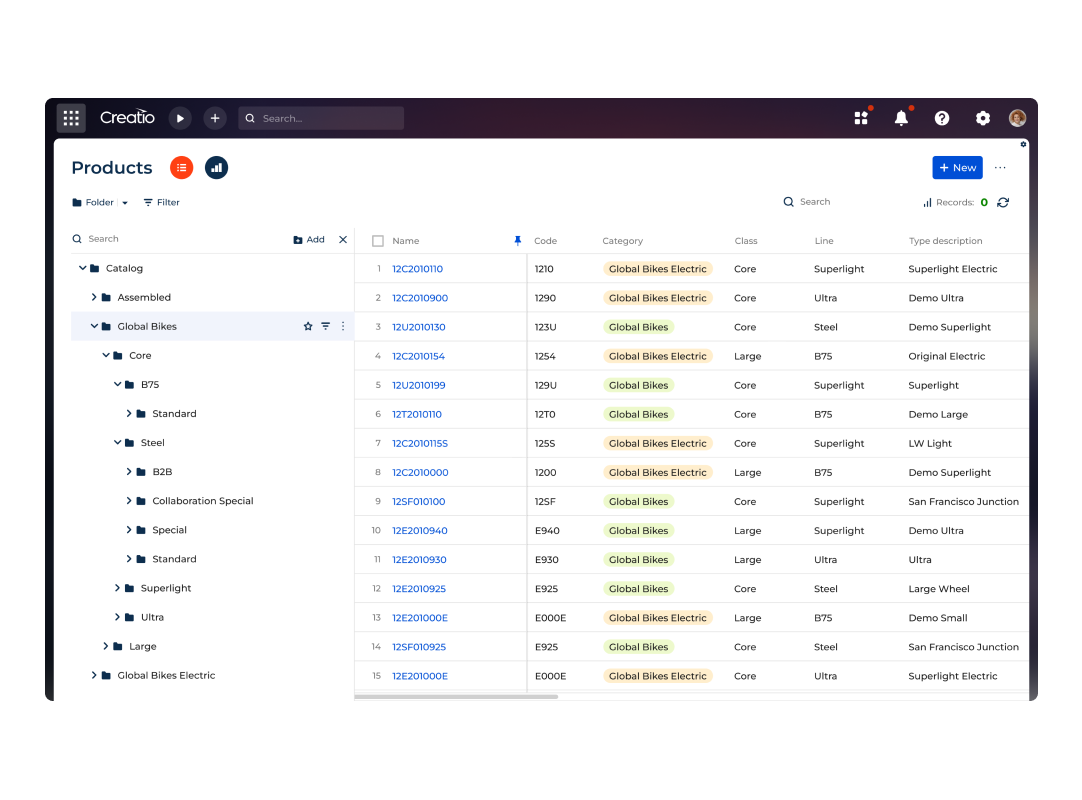
Creatio provides pre-built manufacturing workflows that help accelerate implementation and deliver value more quickly. The platform also offers extensive customisation capabilities, enabling manufacturing processes to be adapted to specific operational requirements and evolving business needs. Creatio's AI-native architecture and no-code development tools make it possible to create new applications and modify existing workflows with minimal development effort, reducing reliance on IT teams and improving organisational agility.
Creatio Manufacturing CRM
Find out how Howdens unified their operations and improved efficiency with Creatio in just 12 weeks
Creatio natively provides generative, predictive, and agentic AI capabilities that enable manufacturers to automate routine work, analyse data, and generate business insights to support informed decision-making. Because AI is embedded within the platform rather than added as a separate layer, AI capabilities can be adopted and scaled more consistently across departments and business processes.
Key features
- Pre-built manufacturing workflows
- AI-powered workflow automation and AI agents
- AI-native engine and no-code designers for fast development
- Customer and account 360° view
- End-to-end order lifecycle management
- Quote and invoice management
- Sales, production, and distribution management
- Procurement and supply chain management
- Rich marketplace of applications and integrations
- Real-time order tracking and operational visibility
- Customizable dashboards, analytics, and reporting
Pros
- Rich suite of powerful features and capabilities
- Highly customizable and scalable
- Intuitive interface and ease of use
- Powerful AI capabilities natively available inside the platform
- Strong ecosystem of integrations and marketplace applications
- Real-time visibility and predictive forecasting
Cons
- Initial learning curve due to the platform's extensive customisation and automation capabilities
Rating
G2: 4.6/5
Pricing
Creatio offers both traditional per-user pricing and an Unlimited Enterprise model that includes unlimited users, workflows, applications, AI agents, and custom objects. Pricing is available through standard per-user plans starting from $40 (~ £30) per user per month, or through a bespoke enterprise-wide licensing model designed to support large-scale automation and AI deployment without licensing constraints.
A New Era AI CRM
Automate campaigns, pipelines, and service flows with Creatio's agentic CRM
DELMIAWorks
Best for: Small to mid-sized manufacturers seeking an integrated ERP and MES solution
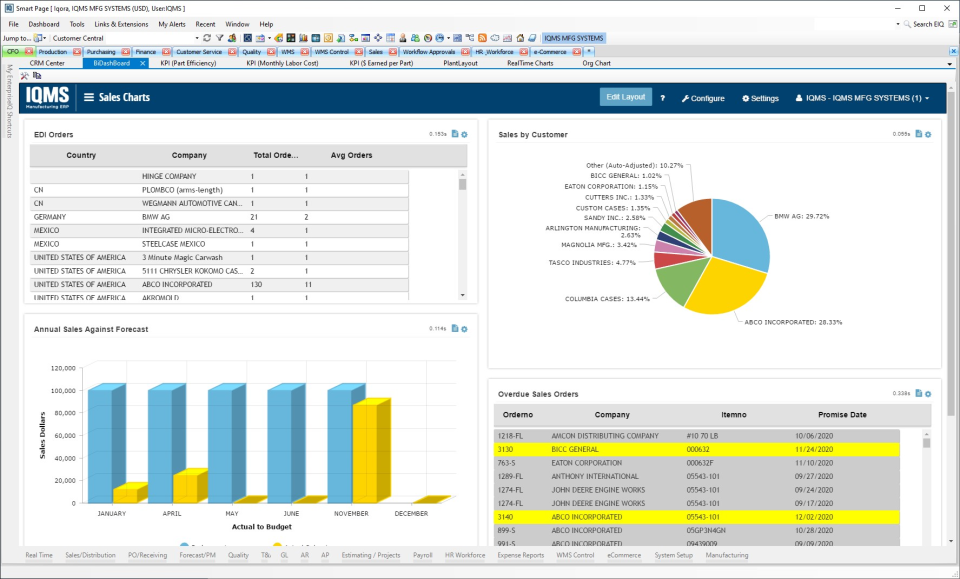
DELMIAWorks is a manufacturing enterprise resource planning (ERP) and manufacturing execution systems (MES) solution designed to manage and monitor manufacturing order processes. The platform provides an integrated environment that supports consistent data flow across departments and centralises operations. This enables more streamlined workflows, improved collaboration, and fewer operational errors.
Key features
- Sales order management
- Raw material planning
- Real-time production monitoring
- Inventory and warehouse management
- Quality management tools
- Production scheduling and shop floor control
- AI capabilities for predictive maintenance and quality control
Pros
- End-to-end operation visibility
- Real-time analytics and predictive insights
- User-friendly interface
Cons
- Extensive, manual configuration
- Insufficient reporting capabilities
- High customisation costs
Rating
G2: 4.1/5
Pricing
Custom pricing available on request.
Oracle NetSuite
Best for: Mid-sized and enterprise manufacturers requiring a scalable cloud ERP software.
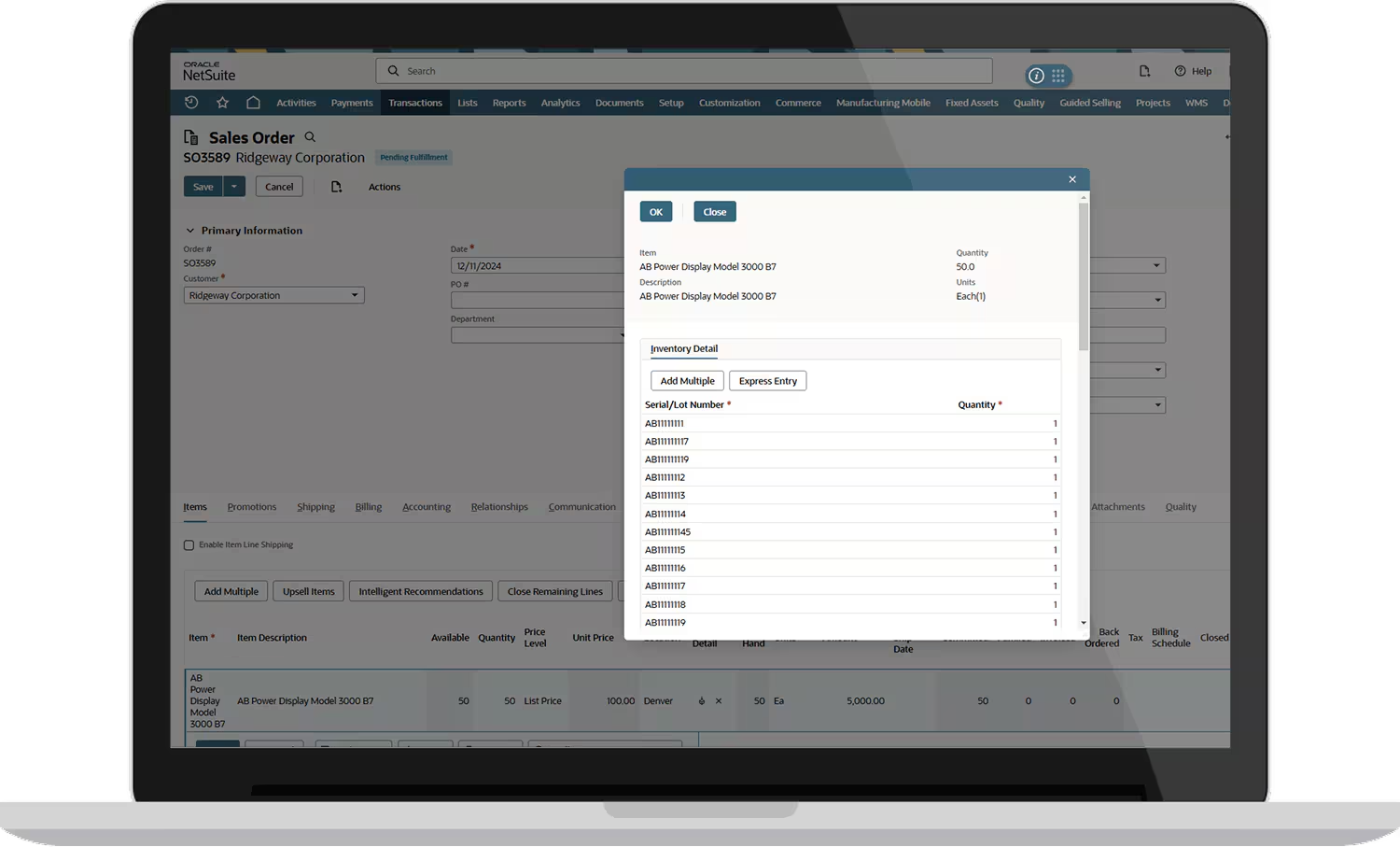
Oracle NetSuite Manufacturing ERP is a cloud-based platform that combines manufacturing and order management capabilities. It supports the management of production, inventory, procurement, finance, and shipping within a unified system. This enables improved operational performance, stronger inventory control, and higher levels of customer satisfaction.
Key features
- Inventory management
- Planning and production tracking
- Shop floor control
- Quality and compliance management
- Supply chain management
- Material planning
- Real-time data analytics
Pros
- Unified system with extensive capabilities
- Strong data management and real-time visibility
- Large partner and implementation ecosystem
- Easy to integrate with other systems
Cons
- Costs can increase as additional modules and users are added
- Limited customisation for complex processes
- Steep learning curve and outdated interface
- Lack of native AI capabilities
- Lengthy implementation timelines
Rating
G2: 4.1/5
Pricing
Custom pricing available on request.
Epicor Kinetic
Best for: Manufacturing businesses seeking solution for discrete and make-to-order manufacturing
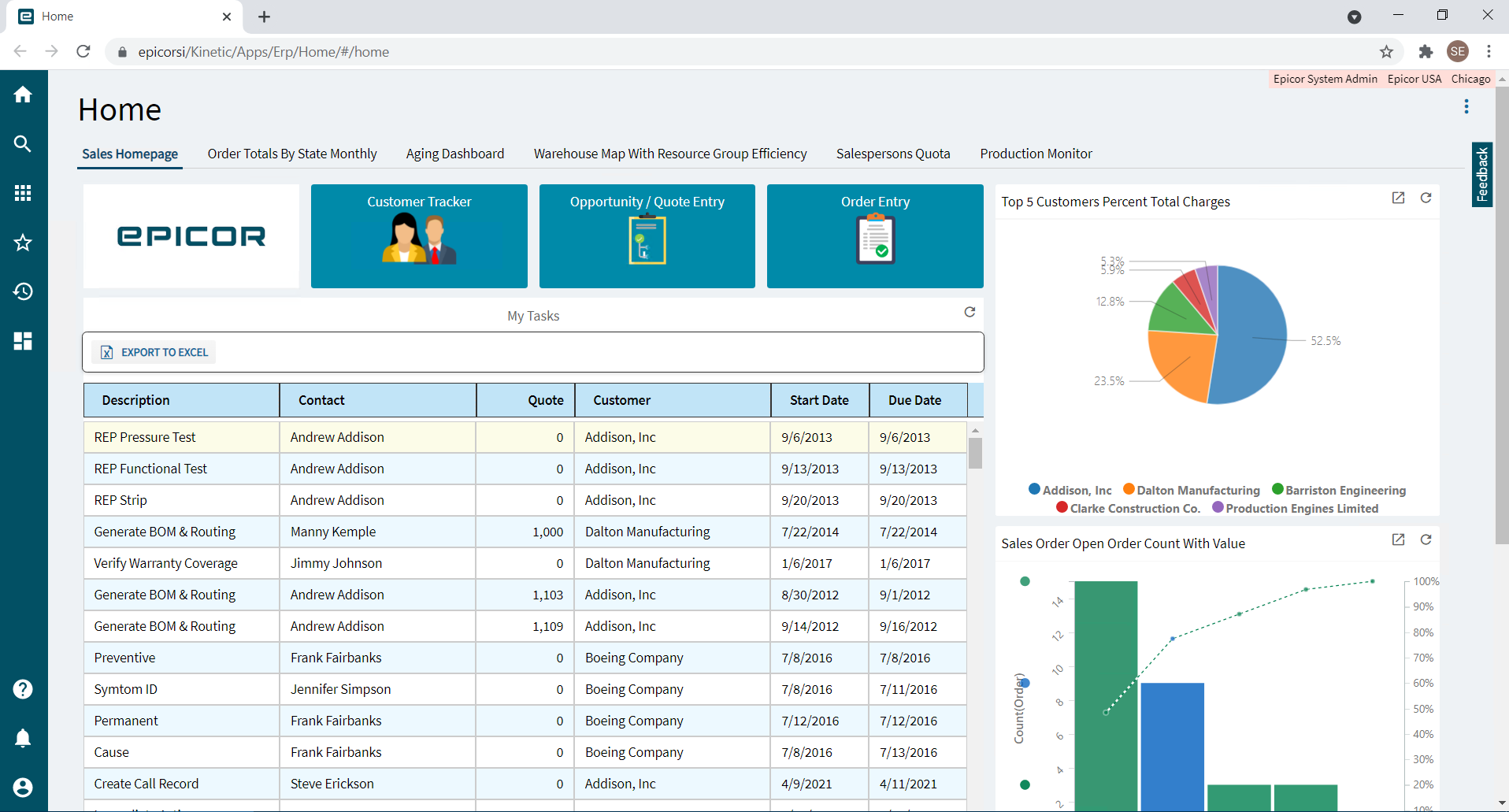
Epicor Kinetic is a manufacturing ERP system designed to support discrete and made-to-order environments. It provides advanced production planning, supply chain management, and operational analytics. Kinetic ensures visibility across the enterprise, enhances customer relationships with eCommerce and dealer portals, and provides insights with advanced forecasting.
Key features
- Real-time production control and job tracking
- Production scheduling and management
- Manufacturing resource planning (MRP)
- Shop floor data collection
- Supply chain management
- Business intelligence and reporting
Pros
- Customisation flexibility
- Strong support for complex production environments
- Extensive integration ecosystem
- Advanced planning and scheduling tools
Cons
- Initial steep learning curve
- Implementation and maintenance can require significant resources
- User experience varies across modules, but can present navigation difficulties
Rating
G2: 3.9/5
Pricing
Custom pricing available on request.
Katana MRP
Best for: Small manufacturers seeking an easy-to-use order management platform
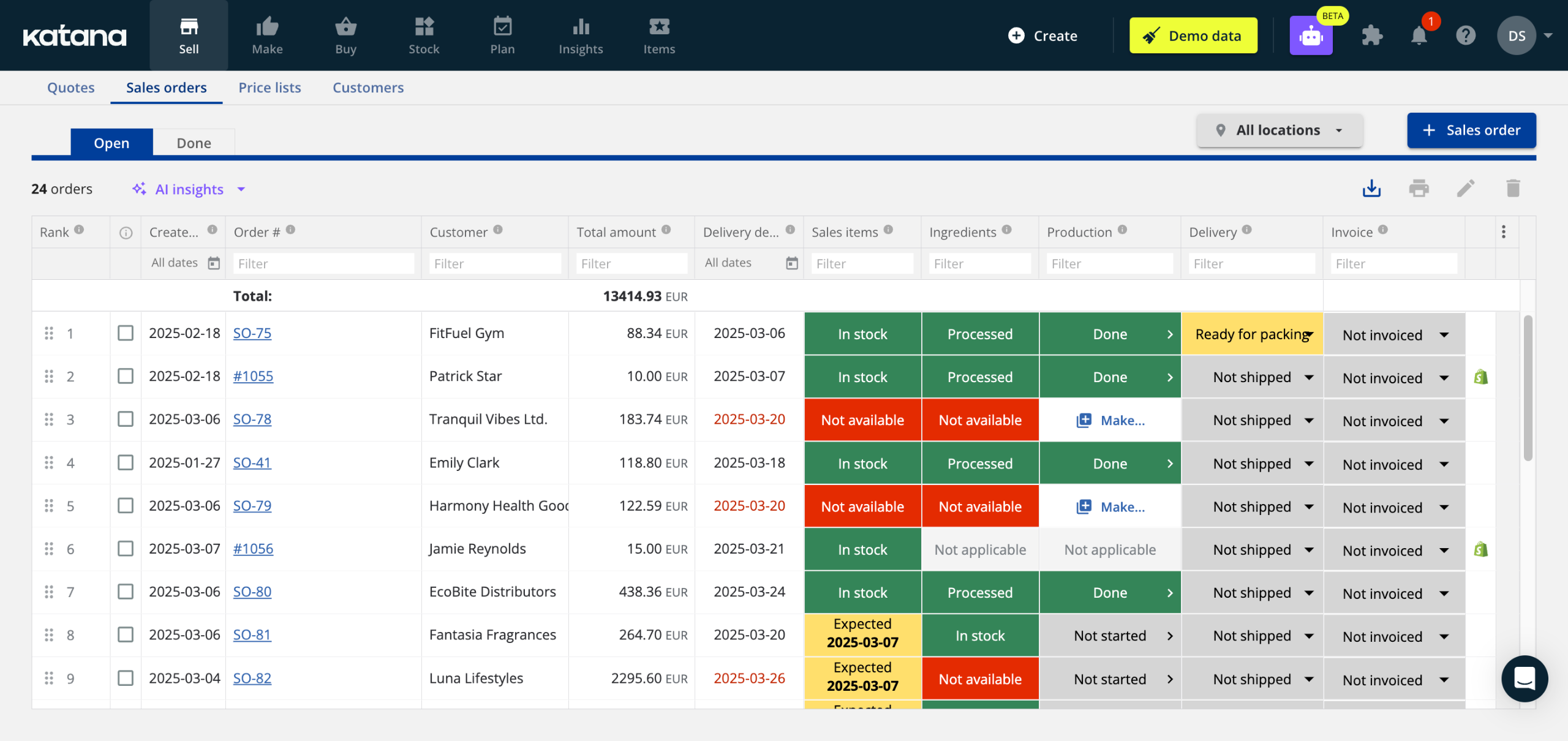
Katana MRP is a cloud-based manufacturing and inventory management platform designed primarily for small and growing manufacturers. An intuitive interface and streamlined workflows make it a popular choice for organisations transitioning away from spreadsheets. Katana brings together sales channels into a single system, enabling more efficient order tracking, fulfilment, and on-time delivery.
Key features
- Omnichannel sales orders synchronisation
- Real-time inventory visibility
- Automated stock movements
- Planning and forecasting
- Margin, revenue, and cost tracking
- eCommerce integrations
Pros
- Easy to implement and use
- Intuitive production planning interface
- Strong inventory visibility
Cons
- Limited advanced ERP functionality
- Lack of AI-powered capabilities
- May not be suitable for highly complex manufacturing environments
- Fewer customisation options than enterprise platforms
Rating
G2: 4.3/5
Pricing
Katana MRP offers a free plan, with paid subscriptions starting from $299 (~ £225) per month.
How to choose manufacturing order management software
The right manufacturing order management software should align with operational priorities while providing the flexibility to support future growth. The following criteria can help guide the evaluation process:
- Define primary use cases. Before comparing vendors, identify the operational requirements the software needs to support. Clearly defined use cases, such as streamlining order processing, integrating disconnected systems, or automating routine tasks, make it easier to assess whether a platform provides the capabilities needed to achieve operational objectives.
- Evaluate available integrations. Manufacturing order management software should integrate with your ERP, inventory, procurement, warehouse, and financial systems to ensure accurate, up-to-date data is available across manufacturing operations.
- Assess AI capabilities. AI tools can help reduce manual work, improve productivity, and support more-informed decision-making. Prioritise platforms that include AI capabilities as part of the core offering.
- Prioritise ease of customisation. Manufacturing processes often vary, so order management software should support straightforward adaptation of workflows, approval rules, and dashboards. Platforms with no-code tools and AI-assisted development enable solutions to be tailored to changing operational requirements without extensive IT involvement.
Summary
Manufacturing order management software helps organisations gain greater control over production processes, improve visibility across departments, and ensure orders move efficiently from intake to fulfilment.
For organisations seeking a modern platform, Creatio provides the tools to automate complex processes, improve operational efficiency, and apply AI across the manufacturing order lifecycle, supporting long-term business growth.