The idea of a fully autonomous factory was once considered closer to science fiction than a practical business objective. As the adoption of AI increases across the manufacturing sector, the focus has shifted from futuristic concepts to practical applications delivering measurable improvements in manufacturing operations.
By applying AI technologies such as machine learning, computer vision, neural networks, and deep learning, manufacturers can analyse real-time data, strengthen quality control, anticipate potential faults, and optimise production processes with limited manual intervention. These AI systems support more intelligent and increasingly autonomous production workflows, enabling manufacturers to improve operational efficiency and respond more effectively to changing conditions.
This article outlines what AI in manufacturing involves, the key operational challenges it can help address, and the most common AI use cases already adopted by leading manufacturers. It also examines emerging trends in enterprise AI heading towards 2026, along with an example of modern manufacturing software designed to support AI-enhanced operations.
Core findings:
- AI in manufacturing applies data-driven intelligence to predict potential issues, automate decision-making, and optimise operations across production and supply chain management.
- The principal benefits of AI adoption in manufacturing include improved efficiency, reduced downtime and operational expenses, enhanced product quality, more resilient production processes, and greater responsiveness to change.
- Common AI use cases in manufacturing include quality control, predictive maintenance, production planning, supply chain optimisation, engineering workflows, as well as energy and resource management.
- Creatio Studio provides an example of an AI-enabled platform for manufacturing, supporting intelligent operations through an agentic no-code platform that connects data, workflows, and teams.
What is AI in Manufacturing?
Artificial intelligence (AI) in manufacturing refers to the use of technologies such as machine learning, computer vision, natural language processing (NLP), agentic AI, predictive analytics, and generative AI to analyse data, automate repetitive tasks and improve manufacturing operations across the entire value chain.
In practice, AI technologies enable manufacturers to move beyond reactive operations towards more predictive and adaptive approaches. By turning operational data into real-time insights and automated actions, AI systems help identify faults and quality defects earlier, optimise production parameters, improve planning accuracy, and support the continues improvement of manufacturing processes.
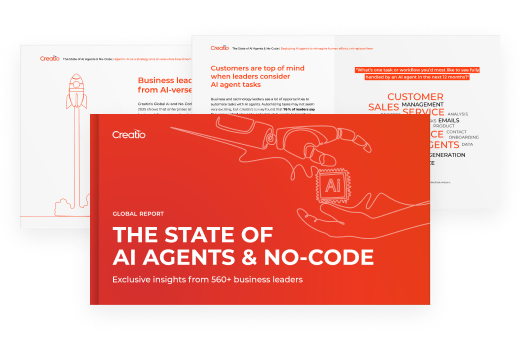
The state of AI agents and no-code
Learn how more than 560 industry leaders worldwide are using AI and no-code to support innovation
Key manufacturing challenges driving AI adoption
According to Markets and Markets, the global market for AI in manufacturing is projected to grow from $34.18 billion in 2025 to $155.04 billion by 2030, illustrating how rapidly AI is becoming a core operational capability across the sector. This expansion is largely driven by persistent operational challenges that traditional systems often struggle to address at scale, including:
- Unplanned downtime and equipment failures that disrupt production
- Inconsistent product quality and high levels of scrap
- Demand volatility and inventory imbalances across supply chains
- Production bottlenecks and inefficient scheduling
- Rising energy, material, and operational expenses
AI-powered systems allow manufacturers to address these challenges through predictive insights, more intelligent automation, and continuous optimisation across production, quality control, supply chain management, and resource planning.
AI in manufacturing: ten key use cases
The practical impact of AI solutions in manufacturing can best be seen through several common use cases already being implemented across production operations.
1. AI-enables quality control
AI-enhanced manufacturing systems are increasingly used to inspect products in real time, detecting defects, deviations, and inconsistencies with greater accuracy and consistency than exceeds tradition manual or rule-based inspection.
A notable example can be seen at BMW Group, where AI-supported quality control is used to optimise highly individualised inspection plans for each vehicle produced, with a new car leaving the production line roughly every 57 seconds. By analysing vehicle configuration data alongside real-time production information, the system determines which quality checks are required, in what sequence they should be performed, and presents them to inspectors through a mobile application.
2. Predictive maintenance and asset management
By analysing machine and sensor data in real time, AI-enabled systems can anticipate potential equipment failures before they occur. This allows maintenance to be carried out proactively, helping to reduce unplanned downtime and extend the operational life of assets.
Predictive maintenance is widely used across the manufacturing sector by both established manufacturers and growing businesses. For example, WattsUp provides an AI-driven predictive maintenance solution for EV vehicle charging infrastructure, helping to minimise downtime and labour costs by ensuring replacement parts are identified and available before failures arise.
3. Process optimisation and scrap reduction
AI models analyse production parameters in real time to optimise cycle times, stabilise processes, as well as reduce scrap and rework, particularly in operations such as moulding, casting, machining, and chemical processing.
Artificial intelligence is also increasingly used to improve scrap recycling processes, where material variability is often high and maintaining consistent quality can be challenging. For example, ArcelorMittal applies AI across the entire scrap lifecycle, from procurement and sorting to impurity analysis and quality prediction. By analysing large volumes of data on scrap composition and the effects of different impurity combinations (such as copper, tin or nickel), AI tools help determine how recycled scrap can be blended to produce advanced steels with consistent properties, supporting both cost efficiency and meaningful reductions in CO₂ emissions.
4. Supply chain optimisation and inventory forecasting
Manufacturers increasingly use AI to forecast demand, optimise inventory levels, and identify potential supply chain disruptions by analysing sales, production, and external data.
For example, organisations such as Walmart and Zara use AI systems to analyse purchasing patterns and sales trends. This supports more accurate demand forecasting, better stock management, and faster replenishment of high-demand products.
5. Production planning and OEE analysis
AI systems evaluate operational and performance data to identify bottlenecks, improve production scheduling, balance workloads, and increase throughput. By examining trends across production lines, manufacturing sites and suppliers, these systems help manufacturers improve overall equipment effectiveness (OEE) and respond more effectively to operational disruptions.
For example, major technology manufacturers such as Lenovo, Microsoft, and Apple use artificial intelligence to assess supplier risk, anticipate potential bottlenecks in manufacturing processes, and optimise production line performance. This supports more resilient production planning and smoother coordination across complex global supply networks.
6. Robotics and intelligent automation
AI is increasingly being used to make industrial robots and collaborative robots (corobots) more adaptable and easier to integrate into production environments. This allows them to assist with repetitive, physically demanding or variable tasks. Rather than relying solely on rigid, pre-programmed automation, AI enables robots to perceive the environment, respond to variations, and operate safely alongside people within manufacturing operations.
For example, Mercedes-Benz has begun piloting humanoid robots in several of it manufacturing facilities to assist assembly-line staff with tasks such as passing components and handling heavy parts. These AI-powered robots are not intended to replace entire production lines but to support human workers, improve workplace ergonomics, and help address labour shortages in highly repetitive operations.
7. Engineering and manufacturing support
AI systems can also support engineering workflows by automating repetitive computer-aided design (CAD), drafting, and documentation tasks, including feature recognition, basic dimensioning, validation, and change-impact analysis. This enables manufacturers to shorten engineering lead times and manage complex workflows more efficiently without increasing reliance on specialised resources.
For example, Siemens integrates advanced multiphysics and AI-based simulation within its Calibre 3DThermal tool to analyse thermal behaviour in complex 2.5D and 3D integrated circuit designs, which form the foundation of signal and custom chips. These capabilities enable engineers to estimate and assess heat distribution, thermal limits, and reliability risks at an early stage of the design process.
8. AI-Driven design and simulation
AI-driven simulation and generative models enable manufacturers to explore different product, demand, and operational scenarios before implementation. This allows organisations to predict outcomes, identify potential risks, and optimise decisions before physical production or distribution begins.
A well-known example is Unilever company, which uses AI models alongside digital simulation and external data sources, including weather data, to improve production and demand planning for its ice cream brands. In Sweden, this approach has already improved forecast accuracy by around 10%, enabling teams to make better-informed decisions about where products should be sold, how much should be produced, which freezer should be used, and when and where goods should be distributed most efficiently.
9. Resource optimisation: energy, materials, and utilities
The use of AI in manufacturing allows organisations to optimise the consumption of energy, raw materials, and utilities across production processes. By analysing usage patterns and adjusting operations in real time, AI systems can help reduce waste, control operational expenses, and limit environmental impact.
For instance, Schneider Electric applies AI to support sustainable water management. AI-based leak detection and circular water management strategies help reduce industrial water consumption and improve resource efficiency across manufacturing operations.
10. Enterprise intelligence, data integration and knowledge automation
AI systems connect and analyse information across manufacturing systems such as MES, ERP, PLM, quality management, and commercial software, helping manufacturers automate data-driven operations including reporting, performance analysis, documentation management, knowledge retrieval, and operational decision-making.
For example, Shell has implemented generative AI and large language models to make decades of internal scientific and engineering knowledge searchable and easier to reuse. This enables researchers to design experiments more efficiently, draw on existing insights, and shorten R&D cycles in areas such as biofuels, electric-vehicle infrastructure, and clean energy technologies.
Improve operational efficiency with Creatio.ai
Reduce operational inefficiencies and maximise productivity with Creatio
Benefits of AI technologies in manufacturing
Manufacturers are using artificial intelligence across a wide range of operations to support highly automated, data-driven production environments. When implemented effectively, these technologies can provide a competitive advantage through greater agility, improved product quality, and more efficient execution.
The main benefits of AI in manufacturing include:
- Increased efficiency and productivity, achieved by automating repetitive tasks and streamlining operational processes.
- Reduced downtime, by identifying potential equipment faults before they disrupt production.
- Improved product quality, enabled by early defect detection and more consistent production processes.
- Lowered operating expenses, supported by more efficient use of energy, materials, and labour.
- Stronger supply chain resilience, through improved demand forecasting and inventory planning.
- Faster innovation and greater flexibility, enabling manufacturers to respond more quickly to changing product requirements.
Case study: Lohmann expands its global operations with agentic CRM
Lohmann, a global manufacturer of high-performance adhesive tapes and bonding solutions, modernised its global sales and operational processes by implementing Creatio’s agentic, no-code platform. The company aimed to replace fragmented regional CRM systems with a single solution capable of unifying commercial teams across multiple regions, improving visibility and collaboration, as well as supporting faster execution. The platform also establishes a scalable foundation for AI-driven sales operations.
Key outcomes:
- Standardised global sales operations across 27 sites in EMEA, the Americas, and APAC
- A unified platform for sales execution, data visibility, and collaboration
- Customer, product, and application data consolidated into a single source of truth to support more informed sales decisions
- Standardised global processes while preserving local flexibility through no-code tools, enabling rapid process changes without custom development or external vendors
- A foundation established for AI-enhanced sales operations, including assistive guidance, forecasting, and next-best-action recommendations
Within 18 months, Lohmann established a globally consistent yet flexible sales environment designed to enhance speed and visibility, while supporting ongoing improvement as the organisation expands using Creatio’s agentic platform.

Creatio gives us something we never had before: clarity. For the first time, we can see where opportunities truly lie and how our solutions perform in real customer applications. That visibility helps us make better decisions—faster.

Michał Wielicki
Global Head of Sales Excellence, Lohmann
Supporting manufacturing operations with Creatio’s agentic platform
Creatio Studio is a leading agentic platform designed for manufacturing organisations seeking to build more adaptive and efficient production operations using no-code and AI. By natively integrating generative, predictive, and agentic AI within a single platform, it enables organisations to coordinate and automate end-to-end production, planning, and operational workflows within one unified system.
With Creatio’s composable architecture and AI-enhanced no-code tools, manufacturers can design, configure, and continually adapt the platform’s functionality to reflect the specific operational processes and business requirements. This level of flexibility enables organisations to expand the use of AI beyond individual applications and integrate intelligent capabilities across day-to-day operations.
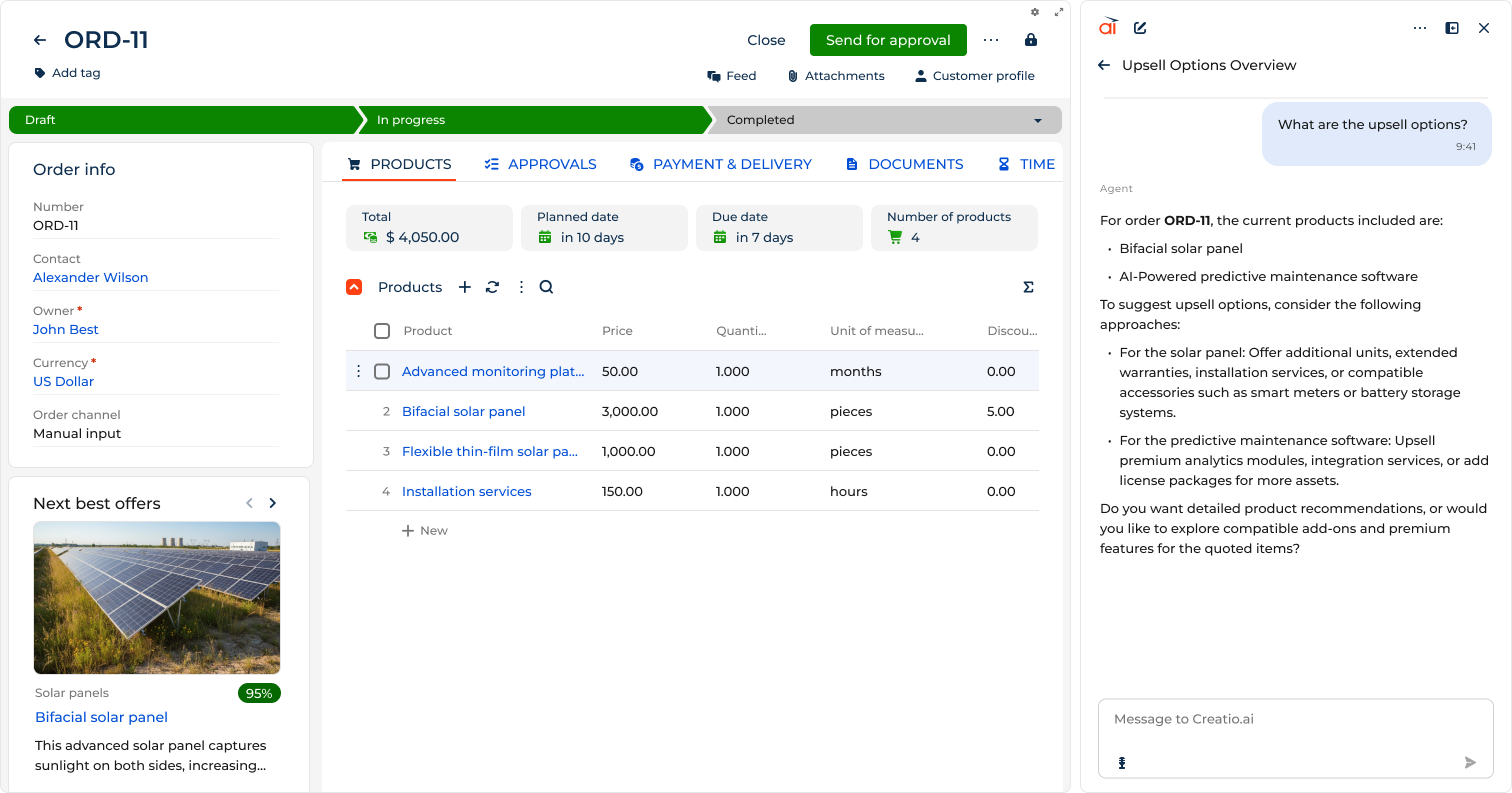
A further strength of the Creatio platform lies in its agentic capabilities. Teams can interact with digital agents through a conversational interface to complete tasks, access insights, and automate processes of varying complexity. Manufacturers can also develop custom AI agents to support specific scenarios, including predictive maintenance coordination, production monitoring, energy and resource analysis, exception management, and operational decision support.
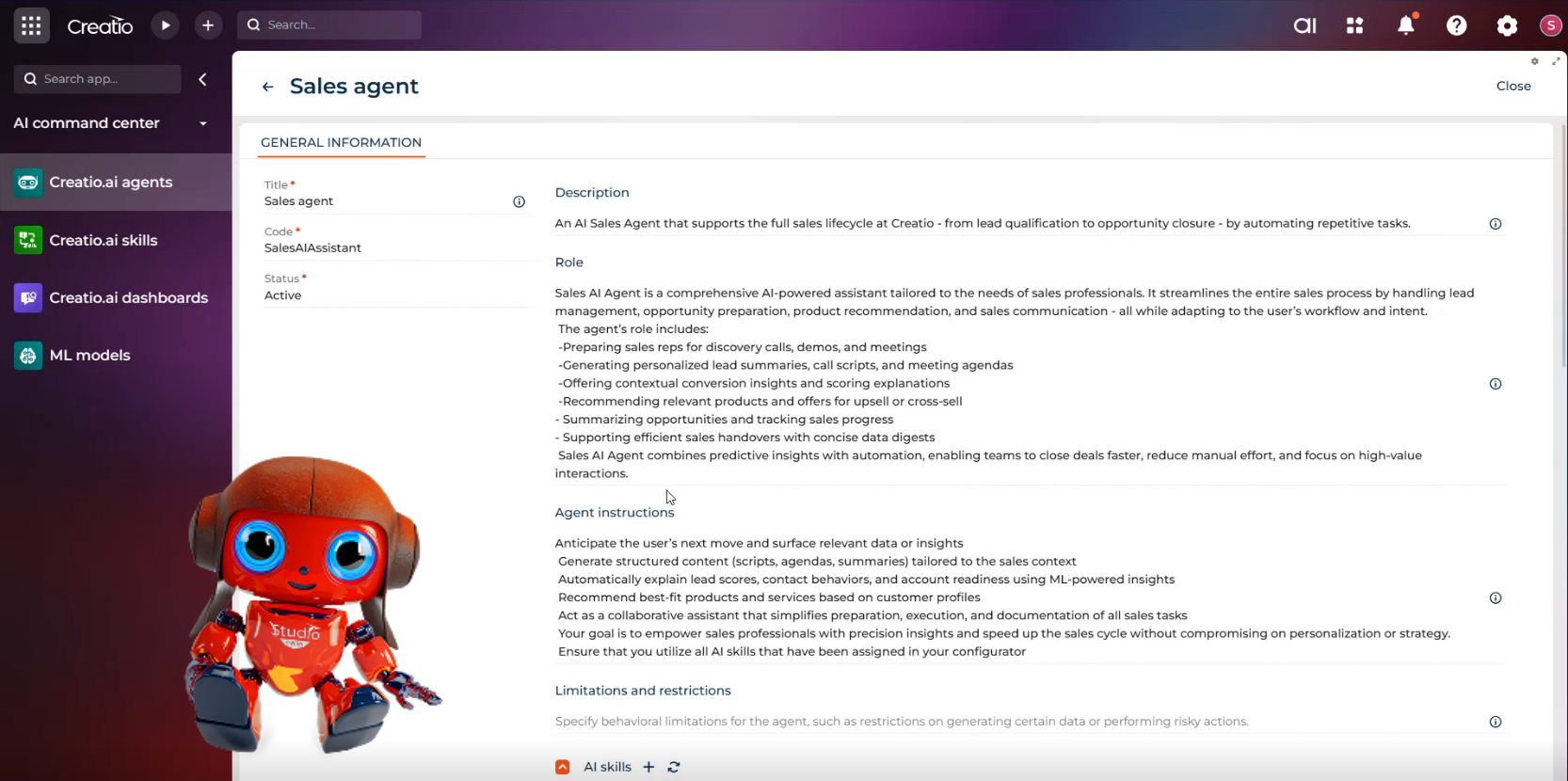
Creatio also provides enterprise-grade governance, security, and compliance controls, helping ensure that AI-powered automation is implemented safely at scale. Through its no-code integration framework, the platform connects seamlessly with MES, ERP, PLM, asset management systems, industrial IoT platforms, and external AI services, allowing manufacturers to modernise operations without maintaining continuity with existing systems.
Creatio core capabilities for manufacturing:
- Agentic workflow automation to coordinate end-to-end processes across production, quality control, procurement, supply chain management, sales, and distribution
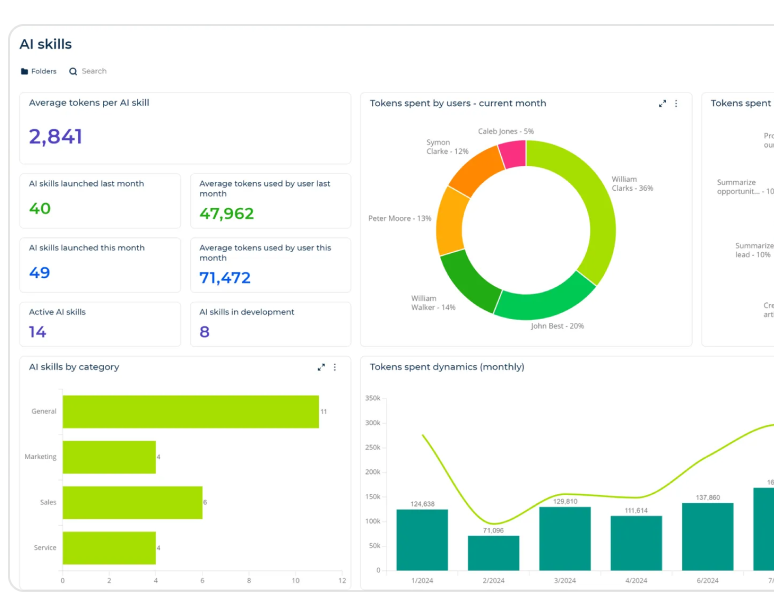
- Real-time analytics and dashboards to monitor production performance, identify bottlenecks, and support data-driven planning and decision-making
- Quote, order, and invoice management to streamline the quote-to-cash process and improve coordination between sales, production, and finance
- Production management capabilities, including lifecycle management, resource allocation, work order management, and performance monitoring
- Procurement management, covering request handling, supplier management, procurement lifecycle management, RFx processes, and contract administration
- Supply chain planning and execution, including inventory planning and control, shipment lifecycle management, and end-to-end visibility
- Customisable AI agents that automate routine tasks such as data analysis, exception handling, reporting and operational follow-ups, with seamless integration into tools such as Microsoft Outlook and Microsoft Teams to support faster collaboration
- Robust integration capabilities connecting manufacturing and enterprise systems, including MES, ERP, PLM, asset management systems, industrial IoT platforms, and data warehouses, within a single platform
- Ready-to-use industry solutions designed for more than 20 sectors, including manufacturing-specific use cases
- Native connectivity with Creatio CRM products including Creatio Sales, Creatio Marketing, and Creatio Service for unified customer-facing and operational processes
- Extensive marketplace with more than 400 applications to extend platform functionality as organisational requirements evolve
Creatio is well suited to medium and large manufacturing organisations seeking an adaptable and cost-efficient AI platform built on a unified architecture. The platform has been recognised by leading industry analysts including Gartner, Forrester, and Nucleus Research, where it has been positioned as a Leader and Visionary in several reports. These recognitions reflect Creatio’s ability to support organisational agility, accelerate digital transformation, and deliver measurable business outcomes at scale.
Agentic automation with Creatio
Power business workflows with agentic, predictive and Generative AI using Creatio.ai
Emerging AI trend in enterprise automation for 2026
1. Intelligent autonomous agents as a new foundation for enterprise operations
In 2026, the use of AI in manufacturing is moving beyond assistive tools towards autonomous agents capable of planning, acting, and learning across complex operational environments. Within manufacturing, these agents can monitor real-time data, anticipate potential issues, coordinate workflows, and carry out actions without minimal human intervention. For example, an agent could automatically reschedule production following equipment failure while adjusting supplier arrangements and delivery schedules accordingly.
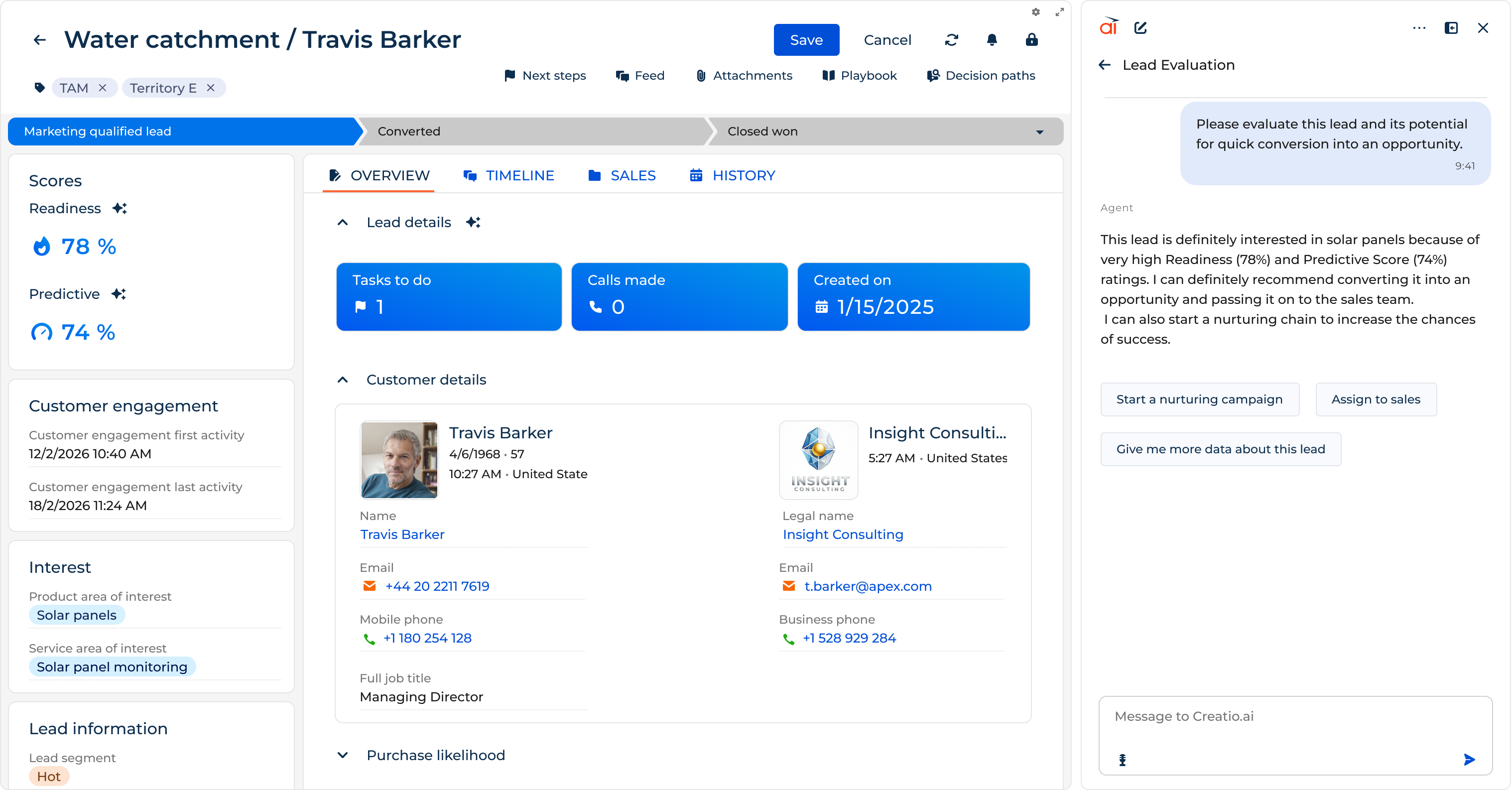
Example of lead management agent by Creatio
By adopting vertical AI agents, smart factories can eliminate coordination delays, minimise downtime, and enable faster, more resilient operations at scale.
2. No-code and AI become the default approach to building and adapting manufacturing systems
With around 67 % of organisations already using no-code in 2025, many are moving into a new phase in which AI-powered no-code platforms become the standard approach for developing and adapting operational systems. In the coming years, manufacturers are expected to leverage these platforms to connect production systems, ERP platforms, quality management, and machine data through visual interfaces, and to automate workflows using simple configurations or natural-language instructions — without relying on lengthy IT development cycles.
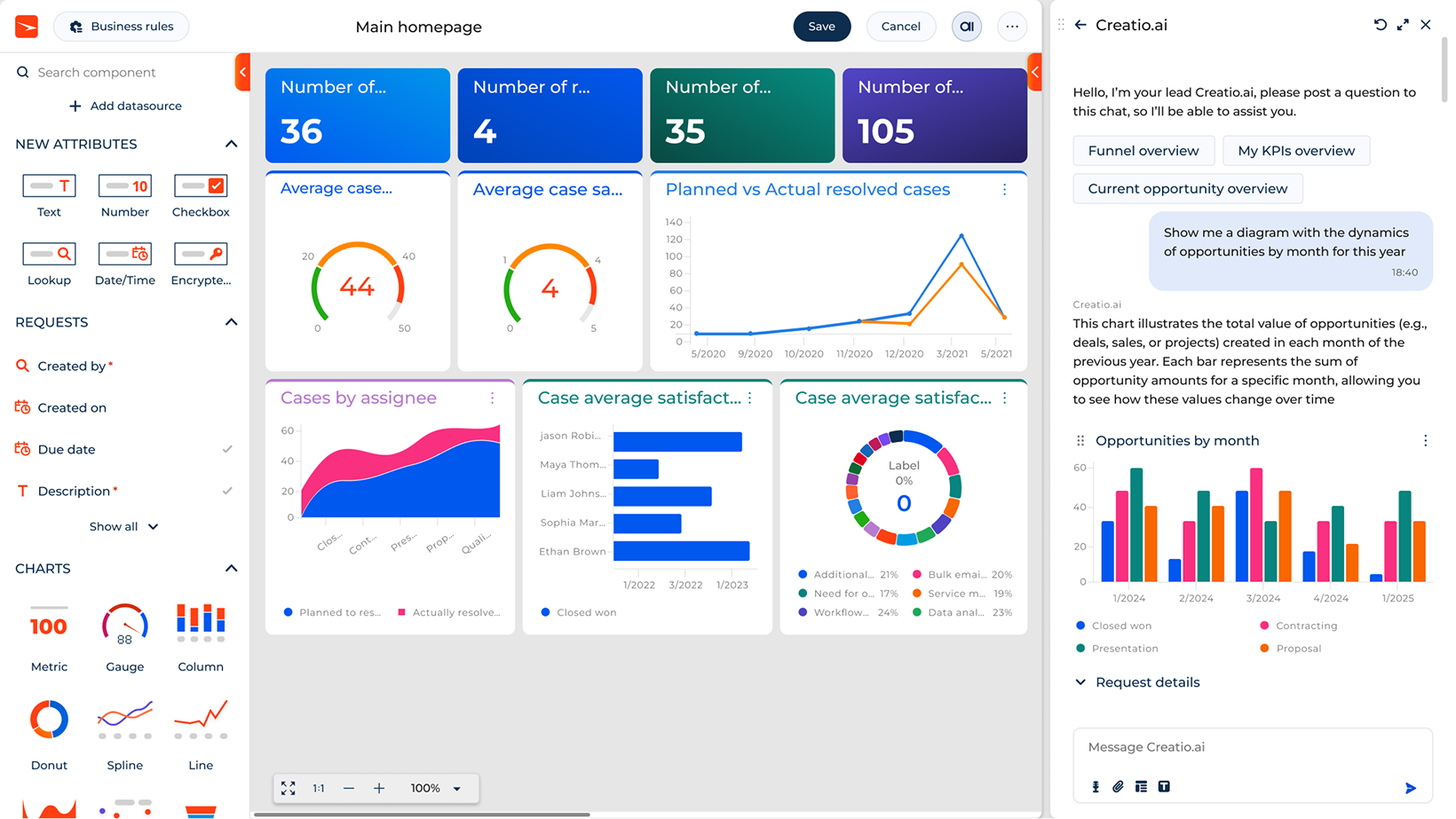
Example of the AI-enhanced no-code development with Creatio
For the manufacturing sector, AI-enhanced no-code solutions make it easier to update operational processes, respond more quickly to disruptions, and support continuous improvement without placing additional strain on IT teams.
3. Multi-agent systems as a core enterprise architecture
Over the coming years, organisations are expected to move beyond the use of individual AI agents towards coordinated multi-agent systems designed around specific industry domains. In manufacturing, such systems are typically organised around core operational areas including production planning, quality management, maintenance, inventory control, and logistics. When multi-agent systems are introduced across different parts of the organisation, manufacturers can optimise closely connected processes across the entire operational chain, rather than relying on isolated or fragmented improvements within individual functions.
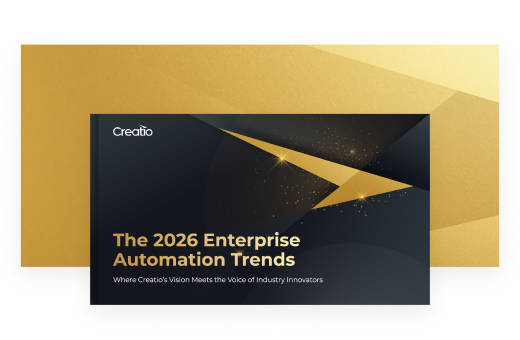
Enterprise automation trends for 2026
Explore the key developments expected to shape enterprise automation in 2026, including perspectives from industry practitioners.
Summary
AI technologies are helping manufacturers become more responsive and data-driven, enabling them to adapt more effectively to changing conditions while improving the efficiency of core processes and operations. Modern AI-native systems can anticipate potential disruptions, automate routine decisions, enhance quality control, and continuously refine operations across production, supply chains, and resource management.
Creatio provides manufacturers with a flexible platform for developing AI-enhanced manufacturing processes aligned with organisational requirements. The agentic no-code platform connects data, workflows, and decision-making within a single system, enabling teams to integrate AI across multiple processes and operational scenarios while evolving systems without lengthy development cycles or complex technical overhead.
Discover how agentic AI can support manufacturing operations with a personalised demonstration from Creatio specialists.