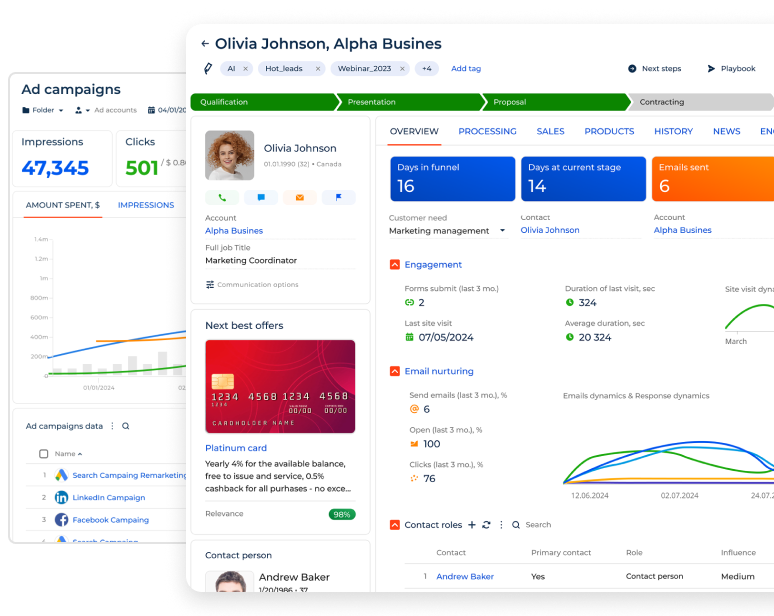
Citizens place considerable trust in public sector organisations to deliver services efficiently and fairly. However, meeting citizen needs, managing complex workflows, and maintaining transparency and accountability can present significant challenges, particularly for national and regional agencies tasked with serving large populations and overseeing a broad spectrum of public services.
Managing interdepartmental coordination, adhering to regulatory requirements, and responding promptly to citizen enquiries all add to the complexity of daily operations in the public sector. What steps can government organisations take to meet these challenges and enhance public services? One effective approach is to invest in a Customer Relationship Management (CRM) system designed specifically for the public sector.
Government CRM software supports the streamlining of internal processes, enhances communications with citizens, and drives greater operational efficiency. This article outlines the transformative potential of CRM solutions in government operations and highlights key considerations for selecting the most appropriate platform.
Core findings:
- Government CRMs are centralised platforms designed to support government organisations in managing citizen relationships, delivering digital services, streamlining workflows, and enhancing transparency across federal, state, and local government levels.
- Government CRM systems offer a range of advantages, including enhanced communication and citizen engagement, more efficients case management, greater transparency and trust, enhanced data-driven decision-making, and better interdepartmental collaboration.
- Key features include service management, workflow automation, self-service online portals, regulatory compliance control, and Artificial Intelligence (AI) capabilities.
- Leading government CRM solutions, such as Creatio, Salesforce Government Cloud, Dynamics 365 US Government, Oracle Government CRM, and Knack, strike a careful balance between security, compliance, and usability, making them well-suited to the complex demands of modern governance.
What is government CRM?
A government CRM is a system specifically developed to support government service agencies in managing interactions with citizens, businesses, and other entities. It provides a centralised platform that improves communication, enhances service delivery, and helps ensure that public services are delivered efficiently and transparently.
Government CRMs consolidate data from a range of departments and service channels, such as contact centres, websites, and in-person offices, into a single, unified database. This allows institutions to monitor and respond to citizen enquiries, service requests, and complaints with greater accuracy, while maintaining a comprehensive, 360-degree view of each constituent. Given the nature of public sector operations, government CRMs are typically designed with robust compliance, data protection, and workflow management features to meet strict national and international regulatory standards.
Advantages of CRM implementation in the government sector
Adapting a CRM system within government organisations can transform how public services are delivered, streamline internal operations, and improve engagement with citizens. By consolidating information and introducing intelligent automation, CRM platforms help governments work more efficiently while raising the level of public satisfaction.
Outlined below are some of the key benefits of implementing a CRM solution tailored to the needs of the public sector:
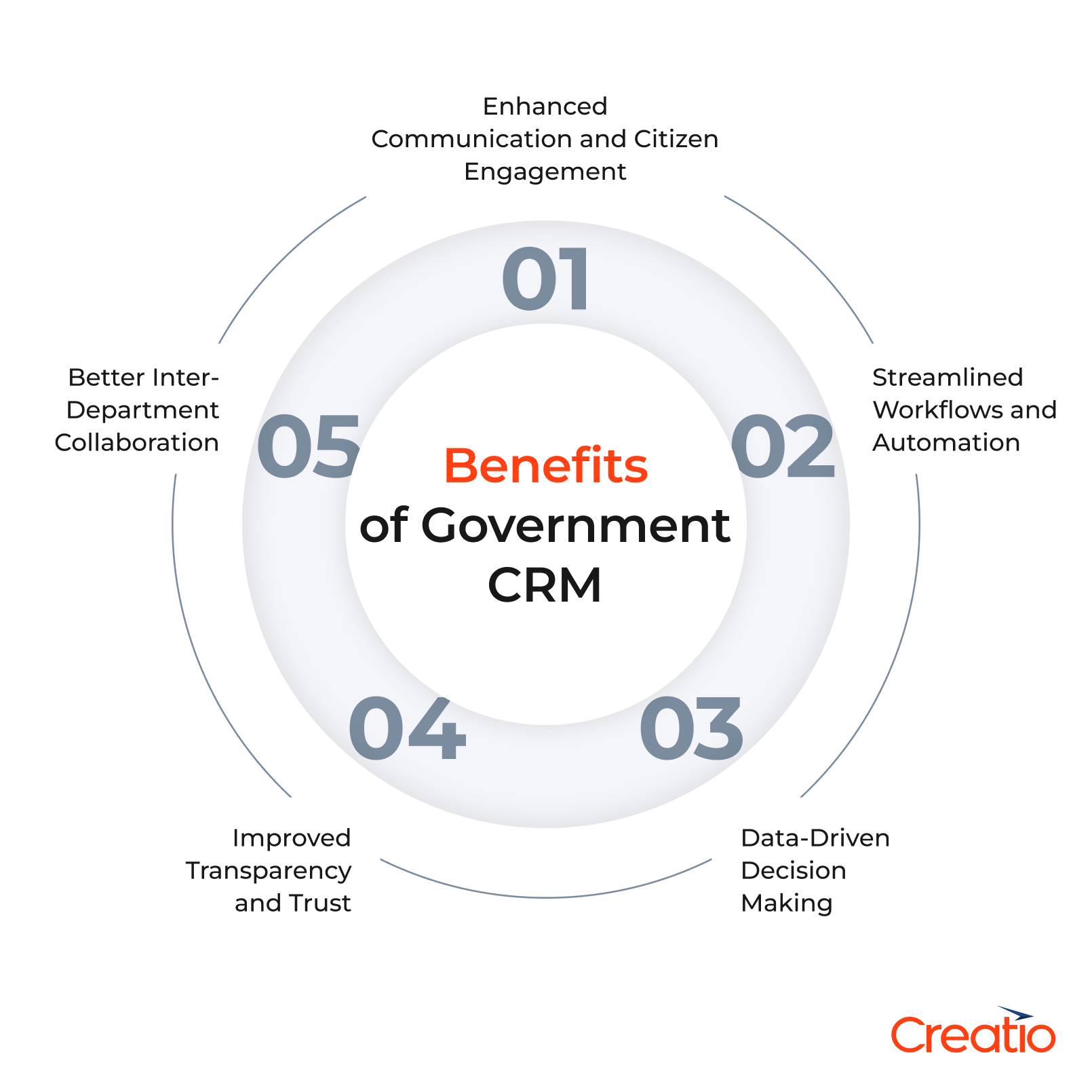
Streamlined processes and enhanced automation
A dedicated government CRM helps reduce administrative burden by automating repetitive tasks such as data entry, document management, case allocation, and status updates. Functions including permit applications, service request tracking, and appointment scheduling can be handled automatically, freeing up employees to concentrate on higher-value activities, such as policy development, strategic planning, and community engagement.
Creatio Implementation
Find out how the City of Boston can handle 1000 cases daily using Creatio’s AI-powered no-code platform.
Improved communication and citizen engagement
A government CRM system enhances communication and foster greater citizen engagement by making interactions faster, more personalised, and transparent. With centralised records and comprehensive citizen profiles, agencies are better equipped to provide timely and relevant responses, leading to higher levels of satisfaction.
Integrated omnichannel communication tools, including email, chat, and phone, allow individuals to engage with government services through the channel that best suits them. Rather than attending a local office in person, citizens can now submit requests, raise enquiries, or receive updates online or over the phone. This is not only saves time for both citizens and staff, but also widens access to essential services, ultimately encouraging stronger engagement and delivering a more seamless, positive experience.
Better interdepartmental collaboration
CRM designed for government enables public sector teams across various departments to collaborate more effectively. By providing a unified platform that consolidates essential information and communication tools, it streamlines cross-departmental working. Automated task routing and real-time notifications ensure that responsibilities are passed on seamlessly, allowing staff to action tasks promptly without the need for additional follow-ups. With shared access to relevant data and integrated communication features, departments can coordinate efforts more efficiently, enhancing the quality and speed of public service delivery.

Our legacy system was brittle. With Creatio, we’ve gained control and flexibility to build and support solutions internally, helping our departments deliver services more efficiently to the people of Boston.

Jay Greenspan
Senior Director, 311 & Basic City Services
Technology at City of Boston
Data-driven decision-making
Government CRM systems consolidate data from disparate sources and communication channels into unified dashboards. This unifies view enables public sector leaders to monitor key performance indicators, identify service gaps, and make well-informed policy decisions. Predictive analytics further supports proactive planning by forecasting demand, guiding resource allocation, and enhancing long-term strategic development.
Improved transparency and public confidence
By recording all interactions and maintaining case histories, CRM platforms offer a clear audit trail for citizen engagement. Public administrators can easily produce reports on service delivery, ensuring compliance with regulatory standards and demonstrating operational integrity. This level of transparency fosters trust and strengthens accountability across government functions.
Five leading CRM solutions for the public sector
Selecting the appropriate CRM is essential for delivering efficient and responsive public services, whether at national, regional, or local government level. The most effective government CRM platforms enable agencies to manage citizen engagement, improve internal workflows, and maintain transparency, all while meeting rigorous security and compliance requirements.
Outlined below are five leading solutions designed specifically to address the unique needs of governmental organisations.
Creatio
Best suited for: government agencies seeking a secure, flexible, no-code CRM with embedded AI to enhance service delivery and streamline public sector operations.
Creatio is an agentic CRM and workflow platform with no-code and AI at its core, designed to support government agencies in streamlining operations and enhancing citizen engagement. The platform includes pre-configured workflows and templates tailored to common government functions, including permit processing, case management, and citizen request handling, enabling rapid deployment and operational efficiency.
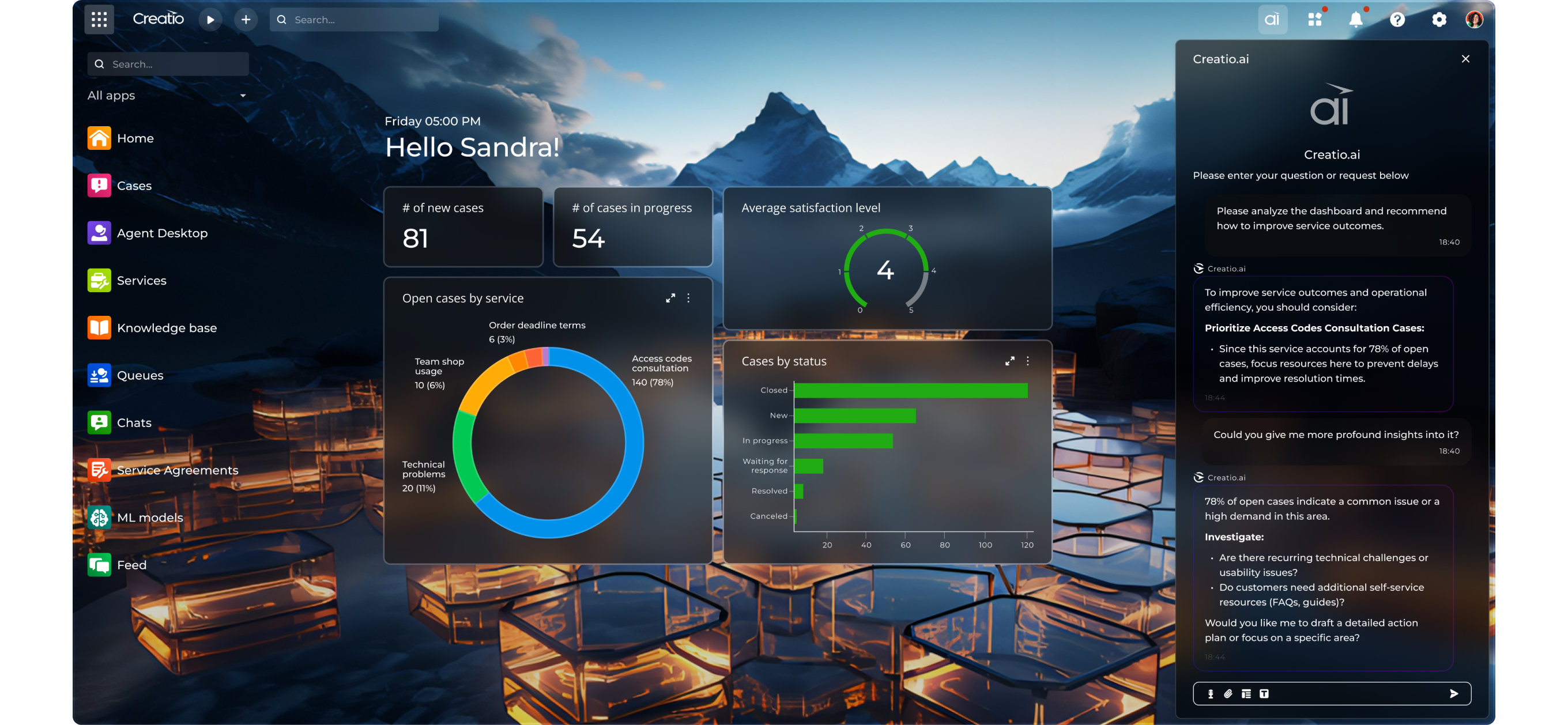
In addition, Creatio offers extensive customisation capabilities, allowing teams to adapt existing workflows or create entirely new ones without the need for coding expertise or heavy reliance on IT support. Thanks to its composable architecture, intuitive interface, and integrated AI capabilities, Creatio empowers government agencies to configure the system in alignment with the unique operational priorities and regulatory requirements, all while maintaining the highest standards of data security.
Powered by Creatio.ai, the platform leverages intelligent process optimisation and AI agents to automate routine tasks, assess performance, and offer recommendations to refine workflows. Creatio AI agents operate as digital coworkers, executing tasks, routing requests, generating reports, and assisting employees with data-driven insights. By leveraging real-time analytics and contextual awareness, they help boost productivity, reduce administrative burden, and enable public sector organisations to function with greater efficiency.
Given the high priority placed on security and compliance within government agencies, Creatio CRM, adheres to stringent data protection standards, providing robust security features such as end-to-end data encryption and role-based access control. Furthermore, Creatio’s integration capabilities allow for seamless connection with third-party applications commonly used across the public sector. Through pre-configured connectors and API integrations, the platform ensures smooth data exchange and consistent communication between systems.
Advantages
- Pre-configured, industry-specific workflows tailored to government operations.
- Extensive customisation through no-code and AI-powered tools.
- Intuitive and user-friendly interface, encouraging broader adoption across teams.
- Built-in AI agents included as standard, with no additional charges.
- Unified ecosystem encompassing all Creatio products, including Sales, Marketing, and Service.
- Comprehensive marketplace offering a wide range of extensions and third-party integrations, enabling seamless connectivity with other government systems.
- Strong frameworks for data protection, regulatory compliance, and AI governance.
Disadvantages
- May involve a learning curve for those unfamiliar with CRM platforms, particularly due to the platform’s extensive customisation capabilities and advanced functionality.
Pricing
Pricing for Creatio CRM begins at £40 per user per month, with no additional charges for access to Creatio AI.
A New Era AI CRM
Automate campaigns, pipelines, and service flows with Creatio's agentic CRM
Salesforce Government Cloud
Best suited for: public sector agencies seeking a secure, compliant, and scalable platform.
Salesforce Government Cloud and Public Sector Solutions help councils deliver responsive services, from case management to constituent engagement, on a single cloud-native platform. The solution combines Salesforce’s core CRM capabilities with features tailored to the needs of the public sector, enabling governmental institutions to manage citizen records and service requests more effectively. It supports improved workflow automation, case tracking, and interdepartmental collaboration.

Advantages
- Pre-configured solutions and templates specifically designed for the public sector.
- No-code tools allow users to build processes, websites, and applications with speed and ease
- AppExchange is a repository with a wide selection of ready-to-use applications.
- AI-powered automation.
- Secure cloud infrastructure.
- Secure integration across data, systems, and AI models.
Disadvantages
- Not purpose-built for the UK government and may require significant configuration or partner implementation to tailor processes to UK public services.
- Can be complex and unintuitive for new users.
- Often, developers' involvement is required to achieve full customisation.
- Performance may slow when dealing with large data volumes.
- Pricing can be high and difficult to predict, particularly with added charges for AI features and advanced functionality.
Pricing
Pricing for Salesforce’s Public Sector Solutions starts at £220 per user per month for basic functionality, and at £520 for solutions powered by AI agents. Additionally, for the Government Cloud, organisations can expect fees that start at 15% of net spend billed annually.
Dynamics 365 Government
Best suited for: public sector organisation already using Microsoft products.
Microsoft Dynamics 365 offers a cloud-native CRM that helps local and central government bodies modernise services, streamline administration, enhance citizen engagement, and improve operational efficiency. Microsoft makes public interactions with government agencies more accessible while protecting citizen data and ensuring regulatory compliance with legal standards, such as GDPR and NIS.

Advantages
- Self-service platform enabling constituents to access information, submit enquiries, and track the progress of the requests.
- Seamless integration with other Microsoft tools, such as Azure.
- Microsoft Copilot enhances agent productivity and improves service delivery through the use of generative AI.
- Three-layer data security model offering robust protection, including role-based, record-based security, and field-based security
Disadvantages
- Designed for governments in the US, Dynamics 365 Government requires specialized configuration and help from local implementation partners to adapt to UK requirements.
- High total cost of ownership, particularly when factoring in customisations, additional modules, and support services.
- Limited of AI capabilities natively embedded within the platform.
Pricing
Available on request.
Knack
Best suited for: small to mid-sized public sector organisation seeking a secure platform to manage citizen services.
Knack is a CRM platform that offers no-code tools for data management and workflow automation. It allows non-technical users to build applications using pre-configured templates and intuitive visual builders, eliminating the need for extensive IT involvement when tailoring solutions to specific requirements. Knack supports the automation of routine tasks, such as sending emails, updating records, and managing deadlines, while maintaining strong security and compliance with strict government regulations.

Advantages
- Robust security measures, including role-based access control and data encryption.
- Infrastructure services and hosting included, assisting with system upkeep and maintenance.
- Self-service portal for citizens, allowing appointment booking and online payments.
- Cost-effective solution for smaller and mid-sized public sector organisations.
Disadvantages
- Limited out-of-the-box functionality compared to comprehensive enterprise-grade government CRM suites.
- Less advanced integration and enterprise-level features.
- Occasional interface issues reporter, including slower load times and bugs in specific use cases.
Pricing
Available on request.
Oracle
Best suited for: Large public sector agencies, including central government, regional authorities, and multi-agency programmes, that require robust security, regulatory compliance, and data sovereignty.
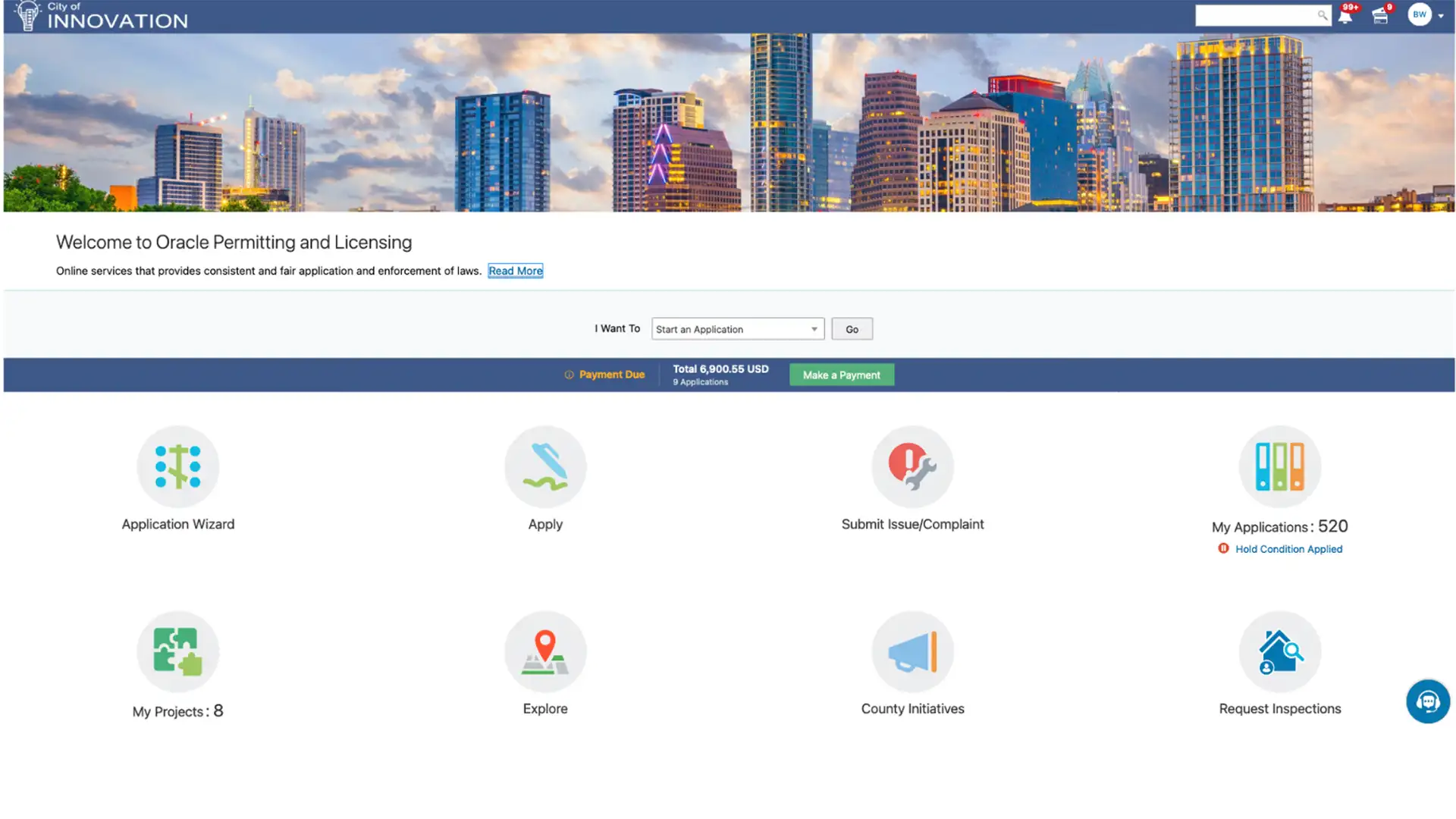
Oracle’s government solutions are designed to help public sector organisations to manage constituent engagement, streamline service delivery, and automate internal workflows. The system offers a comprehensive, 360-degree view of constituents, supports end-to-end case management, and enable self-service via digital portals across multiple channels. Oracle provides secure cloud deployment options designed to meet the data residency, regulatory, and security requirements of UK public sector organisations. Its infrastructure supports compliance with key standards such as ISO/IEC 27001 and the UK Government’s Cyber Essentials.
Advantages
- Robust, government-grade security and regulatory compliance.
- Flexible cloud deployment across multiple regions.
- Seamless integration with other Oracle products as well as third-party applications.
- Highly scalability, capable of handling large data volumes and intensive workloads typical of major public sector organisations.
Disadvantages
- Complex implementation requires significant resources and experienced personnel.
- High costs may make the platform less suitable for smaller agencies.
- Complex customisation compared to modern government CRM systems.
- Significant investment in training, governance, and change management is required to realise full value.
Pricing
Available on request.
Key features to consider in government CRM software
Selecting the right CRM for government use demands more than just standard capabilities. Below are some of the most essential CRM features to consider when assessing a CRM platform tailored for government services:
- Citizen relationship management: centralises constituent data and interaction history across all channels, providing agencies with a comprehensive 360-degree perspective of each citizen.
- Service management: allows government departments to handle citizen enquiries efficiently, monitor case progress, and ensure service delivery is tracked from initial request through to resolution.
- Workflow automation: streamlines routine administrative procedures such as permit approvals, benefits processing, or complaint resolution by reducing manual input and improving response times.
- Self-service online portals: provide citizens with convenient access to manage their service requests, submit applications, check progress, and offer feedback, all without the need to visit or phone government offices.
- Regulatory compliance control: given the highly sensitive nature of public sector data, CRM systems used within government must fully comply with strict data privacy and governance regulations such as UK GDPR, HIPAA, or FedRAMP where applicable. Standard security features typically include role-based access control, data encryption, detailed audit trails, multifactor authentication, and the automatic logging of compliance activities, all essential for safeguarding citizen data.
- Artificial Intelligence (AI): AI agents are increasingly valuable in supporting government personnel by automating routine tasks, retrieving relevant information swiftly, and making faster, more informed decisions. These intelligent tools can offer tailored recommendations, summarise case files, and assist in handling service requests. In addition, AI agents can improve the citizen experience by responding to common queries, delivering real-time updates, and guiding users step-by-step through public service processes.
Summary
A modern CRM system enables public sector organisation to enhance service delivery, improve operational efficiency, and foster more meaningful engagement with citizens. With capabilities such as citizen data management, case tracking, and secure workflow automation, government agencies can respond more efficiently to public needs while remaining fully compliant with regulatory requirements.
Selecting the right CRM begins with a clear understanding of organisational priorities. It is important to consider solutions that provide robust data security, adaptable process automation, and citizen engagement tools. When evaluating providers, factors such as scalability, compliance capabilities, user experience, and integration with existing infrastructure should be carefully assessed.
Investing in the right technology today ensures public services are better equipped to meet the evolving needs of citizens, both now and in the years to come. Explore Creatio for free and discover how it can support digital transformation across the public sector.