





































































The AI Control Plane: Governing and Orchestrating the Agentic Enterprise

Why the next phase of enterprise AI is about governing a fleet — and how Creatio AI Studio is evolving into a control plane for the agentic enterprise.
For the past two years, enterprise AI has been organized around a single question: how quickly can we build useful AI agents?
That question is being answered. Agents are being built, and they work. As they multiply, a second question arrives that most organizations are far less prepared for.
How do we manage all of them?
This is not a hypothetical concern. In Creatio's Q4 2026 survey of 608 IT and business decision-makers, 78% of organizations expect to be scaling AI agents across departments within twelve months, and more than a quarter are already doing it. Seven in ten have moved past experimentation. The average organization now runs agents in nearly four of nine business functions.
Scale changes which problem is hardest. Governance is named as a barrier by 13% of organizations still exploring AI, and by 34% of those with the broadest adoption. It becomes more of an obstacle the further an organization gets, not less. Only 29% report a fully established AI governance framework today.
That gap is a management problem rather than a model problem. The real question is how an enterprise governs, orchestrates, observes, and economically manages a growing population of agents — safely, reliably, and as one system rather than several hundred disconnected ones.
The next enterprise AI problem is fragmentation
Enterprises are moving toward a world with hundreds, and eventually thousands, of AI agents. They will not all come from the same place.
Some will be personal agents that employees create themselves, with tools like Creatio AI Twin. Others will automate complex enterprise workflows. Some will arrive embedded inside SaaS applications the organization already owns. Others will be built by internal development teams on frontier platforms from OpenAI or Anthropic.
Each of these can be genuinely useful on its own. The difficulty appears when they have to operate as part of the same enterprise.
Every one of them raises the same set of questions:
- Who is allowed to use this agent, and what data can it reach?
- Which models can it invoke, and which actions is it authorized to take?
- How is its behavior observed once it is running?
- How much is it permitted to spend?
- When does a human need to approve what it does?
- What happens when it needs another agent, a workflow, or a person to finish its work?
Answering those questions separately inside every platform where an agent happens to have been built does not scale. It recreates a problem enterprises have solved before in other domains, and are now recreating for AI: fragmentation.
That changes the enterprise AI architecture, and it creates the need for a new enterprise layer: the AI control plane.
What is an AI control plane?
An AI control plane is the enterprise layer that governs, orchestrates, and economically manages the AI agents an organization depends on — with full control over the agents it builds, and enforced control over every action any agent takes against enterprise data and processes.
The term borrows deliberately from infrastructure. In networking and cloud computing, the control plane is the layer that decides, and the data plane is the layer that executes. The distinction separates authority from activity.
Most control planes being discussed today govern infrastructure: model access, API traffic, tool calls, agent identity. Those are necessary. Enterprises, though, do not run on infrastructure. They run on work — processes that move across systems, involve multiple departments, require approvals, and end in a business outcome.
An enterprise AI control plane therefore has to govern more than the plumbing. It has to govern work: the agents, the workflows they participate in, the context they draw on, the people who approve their decisions, and the resources they consume. That is Creatio's approach to the AI control plane, and it is the direction we are taking with Creatio AI Studio.
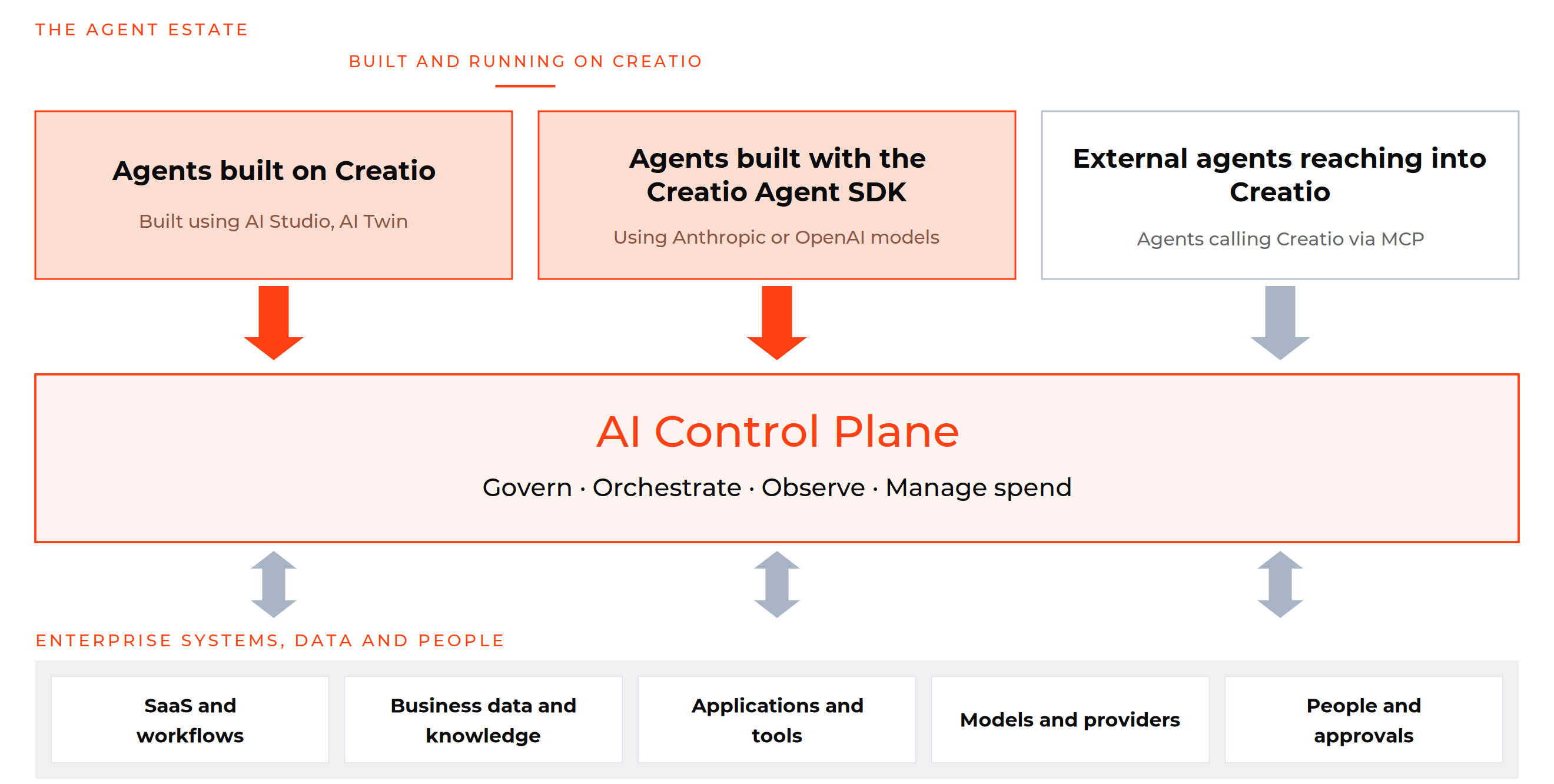
Control is not uniform across that estate, and any honest description has to say so. Agents built and running on Creatio are governed completely, whether they were created out of the box, assembled in AI Studio, described in natural language through AI Twin, or written in code against the Creatio Agent SDK. They all run on the same platform, so models, policy, spend, context and orchestration apply to every one. For agents that run somewhere else, control begins at the moment they reach into enterprise data or processes. That second case is the one that matters most, because it applies no matter who built the agent.
This also separates a control plane from tools enterprises may already be evaluating. AI gateways manage model traffic. Observability tools report on what happened. AI governance platforms document policy, track compliance, and in some cases enforce at the model or API layer. Each solves a real problem at the infrastructure boundary. What none of them sits close enough to the business to do is route a case to the right agent, pause it for a manager's approval, and resume it inside a process. That capability belongs to the layer that understands the work itself.
Governance has to become executable
Most of what the market calls AI governance today is documentation. Policies define which models are approved. They set out what data can be used, which tools and systems an agent can reach, and which actions need human oversight. Each agent gets a written description of what it is allowed to do.
Writing those policies down is necessary. It stops working at scale.
Ten agents can be governed by people who remember the rules. Three hundred cannot. Spread those agents across dozens of teams and thousands of daily actions, and manual enforcement breaks down. A control plane that only reports on what agents did after the fact is a dashboard, and dashboards carry no authority.
Executable governance closes that gap. Policy gets applied automatically at runtime, and the rules can respond to the agent, the user, the model, the data, the risk level, or the workflow context. Some examples:
- Restricting which models a given agent can call
- Blocking sensitive information from reaching an external service
- Requiring human approval before a consequential action
- Narrowing an agent's permissions based on the transaction in front of it


Timing matters as well. Governance belongs across the whole agent lifecycle. It starts before an agent is built. It continues through testing and evaluation. It stays active in production, where quality scoring, drift detection, and outcome measurement show whether an agent still behaves the way it was approved to behave.
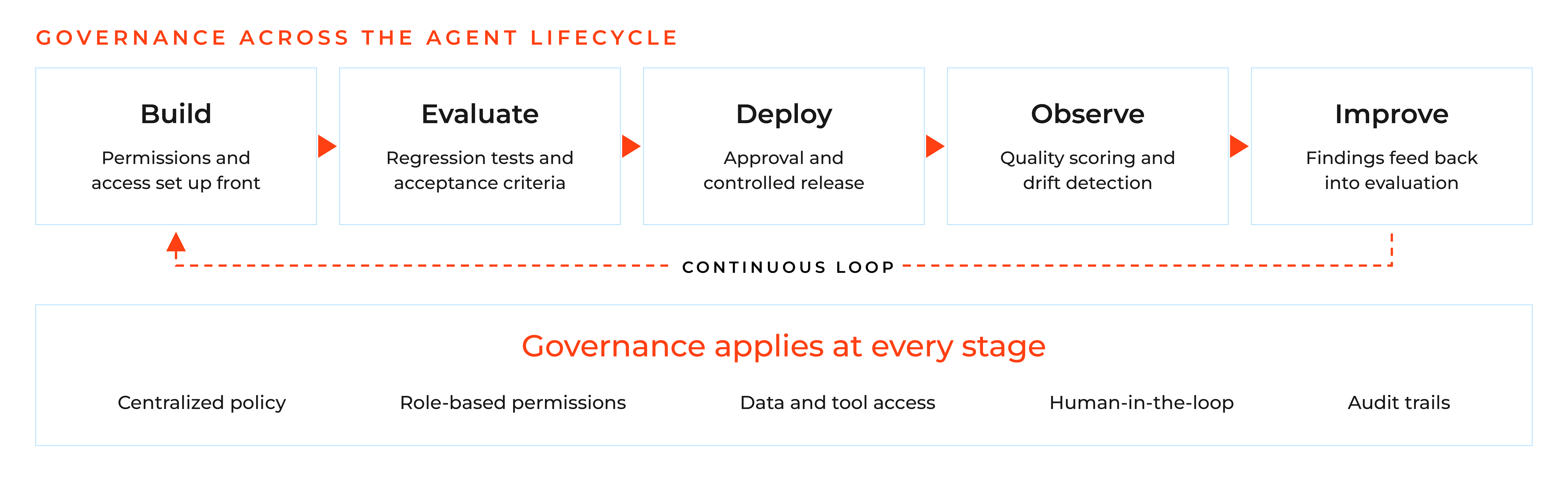
Creatio AI Studio brings governance directly into the agent lifecycle. Centralized policies, permissions, security controls, human-in-the-loop governance, and monitoring are part of the platform from the first release. Governance is not a separate activity that happens after agents are deployed.
Policy automation takes this further. Organizations translate their governance requirements into controls, and those controls get applied and enforced consistently across the estate.
The same controls cover agents that employees create through AI Twin, which keeps distributed innovation inside enterprise boundaries. For the principles and regulatory context behind all of this, see our overview of AI trust and governance at Creatio.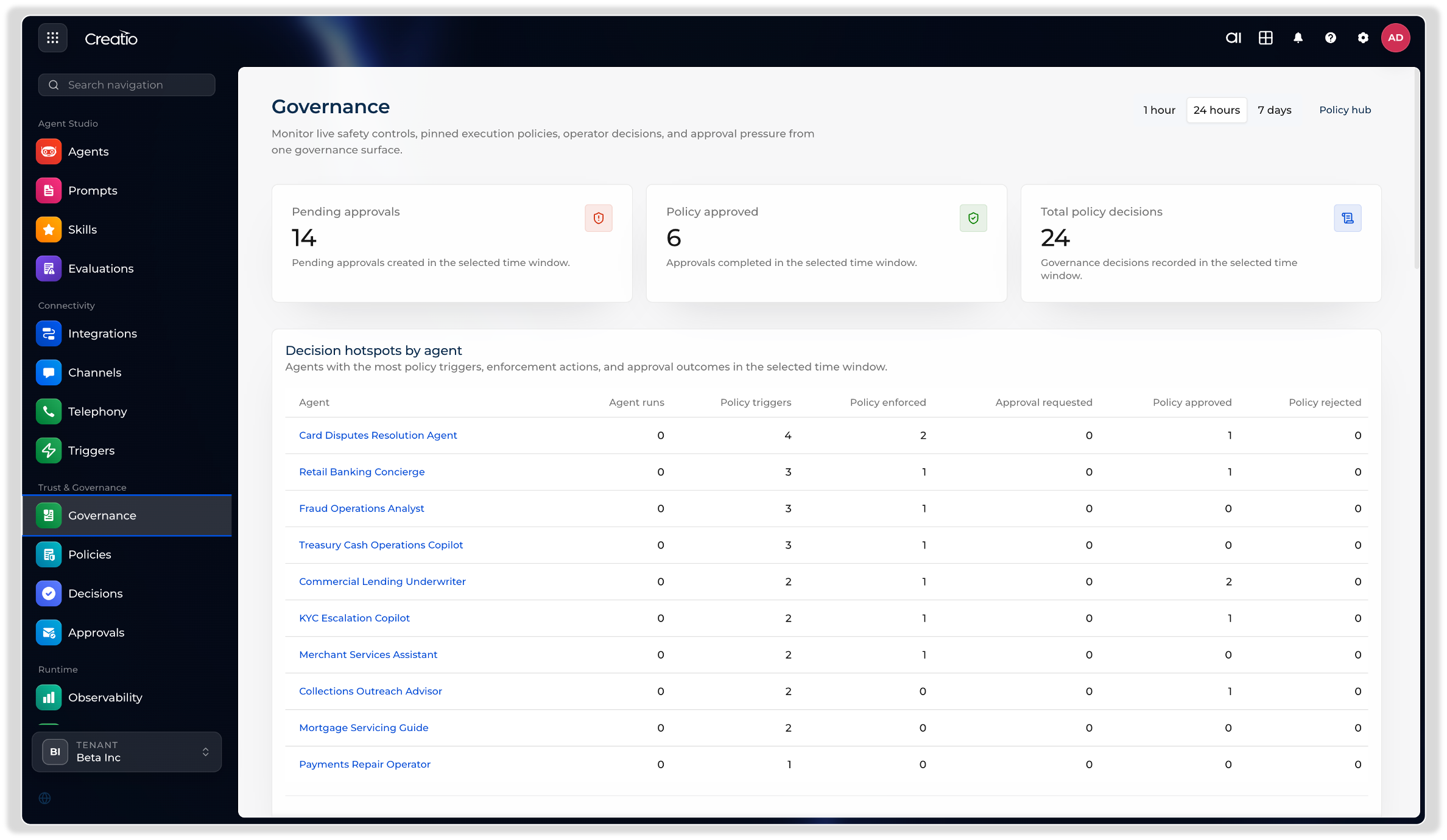
From controlling agents to orchestrating them
Governance answers what an agent may do. Work still has to get finished. That makes context, connection between systems, and orchestration just as important to the AI control plane as governance itself.
Enterprise processes rarely live inside one application. Customer onboarding might touch CRM, document processing, identity verification, core banking, communications, and compliance workflows. Several people approve steps along the way. Putting an agent in front of each system spreads the complexity around without reducing it.
For one regional bank, an onboarding agent brings these steps into a coordinated workflow—extracting information from applications and identity documents, validating required data, identifying missing or inconsistent information, and preparing a structured summary for human review. The result is less manual document handling, faster and more consistent onboarding, and a clearer audit trail, while employees retain control over compliance decisions and final approval. As the deployment expands, the same workflow can connect identity and business verification, e-signature, account funding, and the bank’s core system without creating a new layer of disconnected agents.
Three conditions have to be met before a group of agents can deliver a business outcome:
- Discovery and invocation. Agents need to find and call tools, systems, and other agents.
- Shared context. Agents need the same enterprise knowledge, so they work from one view of the customer or case.
- Orchestration across mixed participants. Agents, deterministic workflows, applications, and people all need coordinating inside the same process.
The third condition is the one most control plane discussions skip. Orchestration usually gets described as agents calling other agents. Enterprises need something harder, because their processes involve participants that are not agents at all:
- A business rule
- An approval queue
- A compliance checkpoint
- A manager who signs off before the next step can run
All of those have to be coordinated alongside the agents.
Creatio starts from that requirement. AI Studio sits on a mature CRM and workflow foundation, so agents take part directly in structured business processes. Multi-agent orchestration coordinates specialized agents, workflows, enterprise applications, tools, and human approvals across one end-to-end process.
Context has to travel with the work
Agents cannot work well without context. Context fragments as easily as agents do.
As agent numbers grow, a quieter problem appears. Different agents end up knowing different things about the same customer. A service agent resolves an issue without seeing the open sales opportunity. It does its job correctly and still reaches the wrong answer.
A control plane has to give each agent secure access to the right enterprise knowledge for the task in front of it:
- Structured business data
- Unstructured knowledge and documents
- Workflow state and conversation history
- The relationships between people, organizations, and transactions
Context needs governing as well. What an agent is allowed to know should depend on who invoked it, what task it is performing, and which policies apply.
Creatio AI Studio connects agents to enterprise data, knowledge, workflows, and retrieval capabilities. Existing access controls stay in force. Agents gain business context without gaining reach they should not have.
Observability: knowing what your agents are actually doing
Governance sets the boundaries. Observability shows what happens inside them.
An agent that passed every test before deployment can still drift. Model behavior changes. Data changes. The business changes around it. Without continuous measurement, an organization tends to learn about that drift from a customer complaint.
Observability at the control plane level answers a different set of questions than traditional application monitoring:
- Is this agent still producing the quality it was approved at?
- Where is it escalating to humans, and why?
- Which steps fail, and what happens to the work when they do?
- Is it delivering the business outcome it was built for?
Creatio AI Studio applies quality scoring, drift detection, outcome measurement, and user feedback to agents running in production. Findings return to the evaluation set, so the next version of an agent is tested against what actually went wrong in the last one.
Enterprises should not have to take AI on trust. They need the instrumentation to verify it continuously, before deployment and in production.
AI spend management in Creatio AI Studio
There is another dimension to this problem that will matter more over time: AI economics.
Cost is already a live concern for organizations running agents. In our survey, optimizing model selection for cost and performance was the leading AI cost concern at 48%, followed by preventing unnecessary consumption at 45% and monitoring usage in real time at 44%. These get far less attention in most governance conversations than they deserve.
AI consumption behaves differently from traditional software licensing. Costs accumulate per token, per model call, per agent execution, and per workflow. That makes them variable, distributed, and hard to attribute.
An enterprise running hundreds of agents loses visibility quickly. Three questions tend to go unanswered:
- Which agents consume the most?
- Is that consumption producing anything of value?
- What happens to the bill when usage triples?
Many organizations handle AI spend as a finance question, reconciled at quarter end. By then the money is already spent.
A control plane brings spend into the same layer as policy and orchestration:
- Visibility into consumption by agent, team, and workflow
- Budgets and thresholds enforced at runtime
- Model routing that matches task complexity to model cost
- Forecasting, so scaling becomes a planned decision
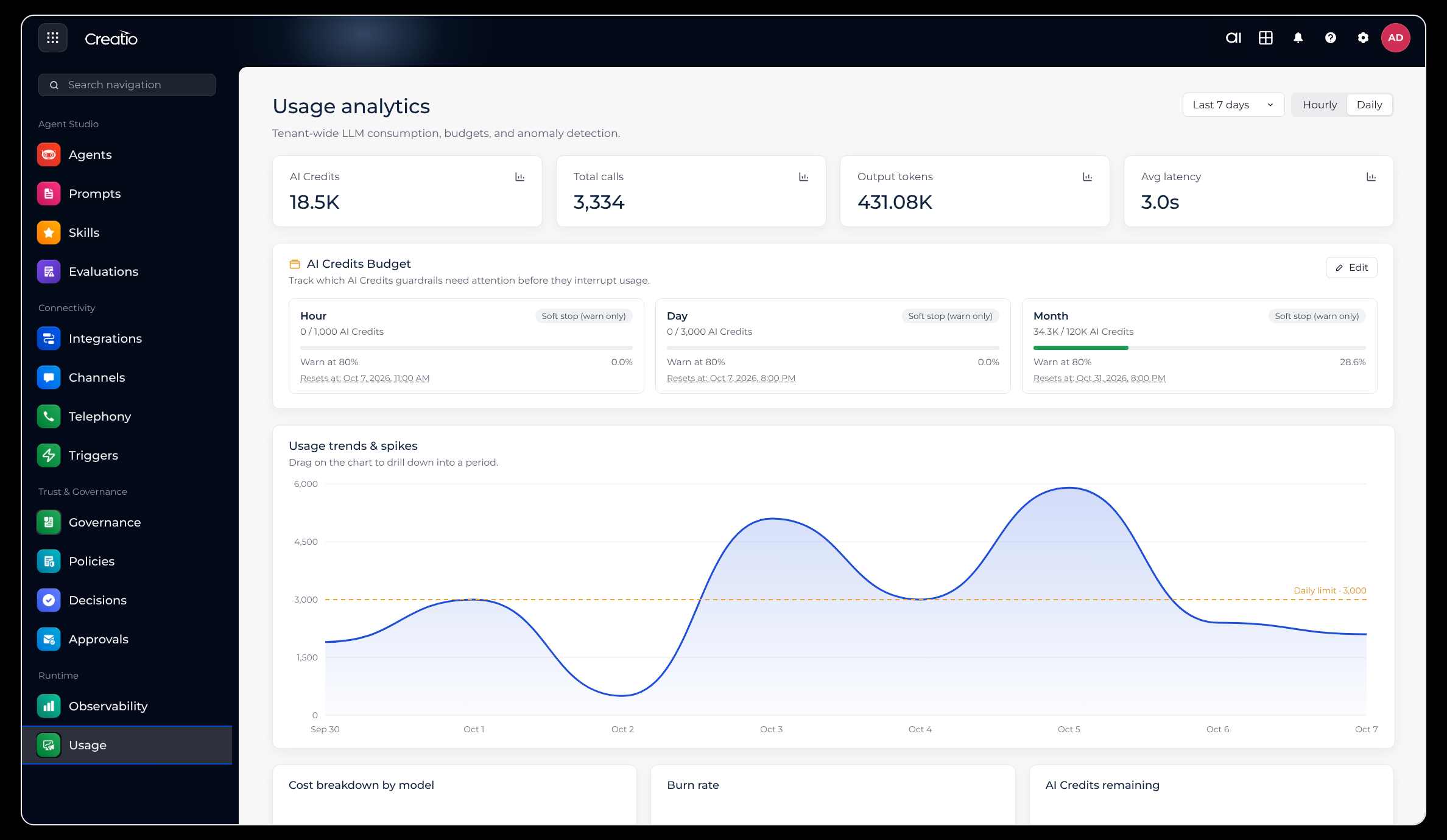
Creatio AI Studio approaches this through pooled AI Credits. Organizations allocate and manage AI capacity centrally, across agents and teams. Consumption no longer has to be tracked separately with every model provider. Spend becomes a governed resource, enforced the same way as data access or model permissions. These controls govern consumption that runs through Creatio. An agent billing to its own provider account sits outside them, which is one more reason the way an agent connects determines how much of it can be managed.
An open control plane for an open AI ecosystem
Enterprises will not standardize on a single AI vendor. A control plane built on that assumption will only ever govern part of the estate. Model choice is the version of openness most vendors already offer. Supporting multiple frontier and open-source models has become table stakes, and Creatio has supported that flexibility for some time.
Agent openness is the harder requirement, and it is where most control plane claims break down. Registering an external agent gives you an inventory rather than control. Routing its model calls through a gateway works only if the people who built it choose to route them, and frontier coding agents generally do not. The control that holds in every case is the one applied where the agent reaches into enterprise data and processes.
AI Studio is designed to provide that common enterprise layer. Agents built and running on Creatio are governed completely, from no-code agents through to agents written against the Creatio Agent SDK using OpenAI or Anthropic frontier technologies. Agents that run outside Creatio are governed at the point they touch Creatio data, processes or approvals, through permissions, human approval and audit. Enterprises can adopt different agent technologies without creating another set of disconnected AI silos.
Build anywhere. Nothing acts on your business data without permission.
Where does your organization stand?
Six questions worth taking to your own team:
- Can you produce a list of every AI agent running in your organization today?
- Can you say what each one cost last month?
- Can one of your agents hand work to a person and pick it back up when they are done?
- Can you apply a new policy across every agent at once, without rebuilding them?
- Would you know if an agent's quality declined before a customer told you?
- Can you enforce a policy on an agent you did not build?
Most enterprises can answer one or two of these today. The organizations that scale successfully will be the ones building toward all six.
Governing the agentic enterprise
The first phase of enterprise AI rewarded speed. Organizations that built agents quickly learned quickly, and that advantage was real.
The next phase will reward control. Agent populations are growing past the point where any one person can track them. Scaling from here depends on being able to govern, orchestrate, observe, and economically manage every agent as one system, whoever built it and wherever it runs.
At Creatio, this is an increasingly important role for AI Studio. It provides a common environment to govern, orchestrate, observe, and economically manage an expanding ecosystem of AI agents.
Governance still gets treated as a brake on innovation. At scale, the opposite happens. Clear boundaries, enforced automatically, let builders move faster, because the guardrails travel with them. Our survey found the same pattern. Among organizations with fully established AI governance, 71% feel very confident about scaling AI. Among those still developing a framework, 17% do.
The same architecture applies with particular force in regulated industries, where every agent action carries an audit and compliance dimension. Creatio has explored what the AI control plane means in a banking context separately.
For most enterprises the first step is smaller than a control plane. Start by listing the agents already running, who owns them, and what they cost. That exercise alone usually reveals whether governance is a policy problem or an architecture problem.
Most enterprises have already proven they can build AI agents. The open question is whether they can govern the agentic enterprise those agents are creating.
