




































































Creatio’s Global Customer Community Shares 2026 Predictions on AI Agents and Enterprise Transformation
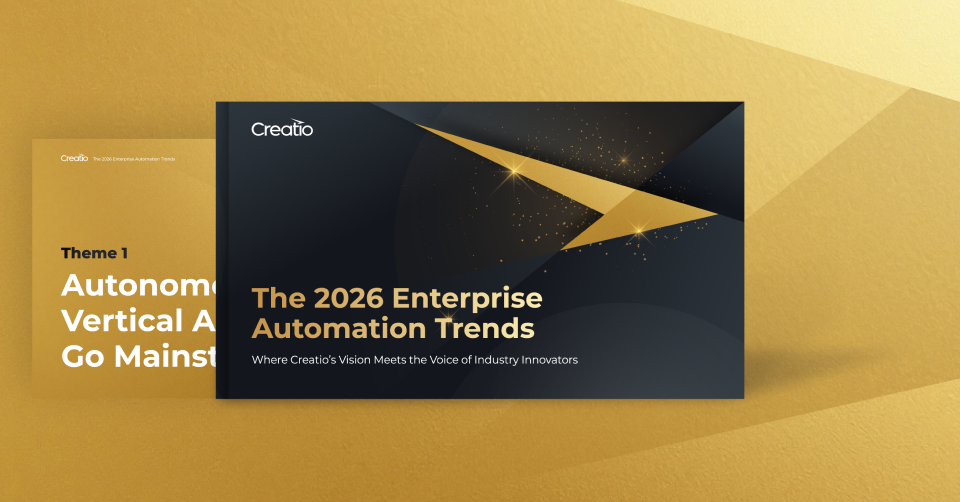
Creatio, a global vendor of an agentic CRM and workflow platform with no-code and AI at its core, today released its 2026 Enterprise Automation Trends, a prediction booklet shaped by voices across the Creatio community. The report brings together insights from leaders across diverse industries, providing a grounded, practitioner-led perspective on how enterprises will evolve in the year ahead.
A clear theme emerges from their contributions: 2026 marks the moment enterprises stop experimenting with AI and begin rebuilding their operating models around it. Leaders describe a decisive shift toward agentic systems, unified customer and operational intelligence, accelerated modernization cycles, and hybrid human–AI collaboration supported by responsible oversight.
“2026 will be the year enterprises will move from experimenting with Agents to design integrated agentic solutions to drive business value,” said Aleksander Pruziński, Partner, Deloitte Digital.
A strong representation from the financial services sector suggests that banking and credit unions are steadily advancing toward AI-driven operations. Leaders from ENT Credit Union, AutoPayPlus, Everwise Credit Union, Bay Federal Credit Union, and Cape & Coast Bank emphasize that AI is becoming increasingly central to daily workflows.
At ENT Credit Union, serving over half a million members, AI is perceived as a quiet but powerful operational engine, with Matt Pincoski, Senior Director of Engagement Systems, describing it as “AI’s real value next year will be in supporting employees behind the scenes. It’s an assistive tool, not a replacement for people.” AutoPayPlus echoes the sentiment. Carl Moor, Director of Integration & Data Strategy, notes that competitive advantage will increasingly depend on “who truly understands their members and delivers real, personalized service,” as systems unify data from CRM, CX, and revenue operations.
That trajectory is evident across other community financial institutions as well. Bay Federal Credit Union, one of the leading regional credit unions on California’s Central Coast, sees AI and automation advancing from isolated pilot programs into mission-critical infrastructure. Richard Roark, SVP & CTO, reinforces this shift, noting that “AI will move to the core operating mode, with a critical ‘human-in-the-loop’ layer to validate outputs, prevent hallucinations, and ensure members always receive accurate, trustworthy information.”
Across the financial sector, leaders underscore that responsible scaling requires disciplined governance. At Cape & Coast Bank, Ken Tingle, FVP Business Intelligence Manager, highlights the need for “stronger data culture and governance” as AI moves deeper into the enterprise. A similar message comes from Everwise Credit Union, where Jennifer Castaneda, CRM Product Manager, emphasizes that “Oversight, accuracy, and monitoring will remain essential to ensure responsible adoption.”
Industrial and consumer-facing companies report comparable shifts as they work to deliver more personalized, context-aware customer experiences. At Constantia Flexibles, the world’s leading flexible packaging manufacturer serving major global brands, this evolution is already underway. CRM Team Leader Jacek Harlejczyk notes that “personalization will be a powerful differentiator… customers want real relationships,” emphasizing that AI will increasingly free teams to focus on high-value, relationship-building interactions rather than administrative tasks.
The travel industry is undergoing a similar recalibration. Novaturas, the largest tour operator in the Baltics, anticipates a steady move toward more dynamic and tailored digital journeys. As Kazimieras Jarmalis, Head of Direct Sales, explains, the “travel industry is moving toward more personalized travel experiences,” enabled by deeper data integration, a shift he describes as evolutionary rather than disruptive.
In the automotive sector, companies are also rethinking how intelligence flows across their organizations. Americar, one of Latin America’s largest automotive distribution and mobility groups, sees AI as a catalyst for unifying previously disconnected processes. Gonzalo Cortez, Head of Digital Products & Innovation, highlights that “the biggest opportunity lies in building AI-first ecosystems that connect all data and workflows,” adding that with no-code and automation, organizations can “innovate quickly without heavy technical dependency.”
Together, these perspectives paint a unified picture of 2026 where organizations are embracing agentic systems, unifying customer and operational intelligence, strengthening governance frameworks, and redesigning workflows around speed, context, and adaptability. As these leaders suggest, the next wave of enterprise transformation will be defined not only by AI’s capabilities, but by how effectively organizations align technology, people, and governance to unlock its full potential.
To explore the full set of insights and read all customer perspectives in detail, access the complete 2026 Enterprise Automation Trends report here.
About Creatio
Creatio is an AI CRM and workflow platform where people and AI agents work together — with no limits on users, agents, or scale. We help midsize and large organizations run customer workflows in the AI era. Headquartered in Boston, MA, with a global team and a large ecosystem of partners, Creatio serves thousands of customers in over 100 countries and automates tens of millions of workflows daily. Genuine care for our clients and partners is at the heart of our DNA.