




































































Agentic CRM: Complete Guide + TOP 5 Agentic CRM Software

Creatio: Agentic CRM to Create, Predict & Automate

Large enterprises have long relied on CRMs to stay connected with customers, centralise customer data and keep sales, marketing, and service teams aligned. But businesses using legacy CRM systems have often struggled to transform scattered records into a single source of truth, making collaboration harder and limiting the insights they can draw from their data. The good news is the business landscape has evolved, and so have the CRM capabilities available today.
We’re now entering the new era of CRM, where platforms don’t just store and organise information; they can act on it. Agentic CRM platforms, built with AI at their core, enable business users to create and deploy AI-driven agents that analyse data in real time, predict customer needs and take autonomous action. This result in higher productivity, smarter decision-making and stronger business outcomes.
In this article, we’ll explore what agentic CRM is, discover key use cases and measurable benefits, and compare the top five agentic CRM solutions that are shaping the future of customer relationship management.
Key takeaways:
- Agentic CRM represents the next evolution of customer relationship management, powered by autonomous AI agents that can interpret data, collaborate and take independent action.
- By adopting agentic CRM platforms, medium and large businesses can increase revenue, shorten sales cycles, remove manual data entry and deliver highly personalised customer experiences.
- With AI and CRM rapidly converging, agentic platforms are set to become a cornerstone of modern business.
- Leading solutions such as Creatio, Salesforce, Microsoft, HubSpot and Zoho already demonstrate how agentic CRM is reshaping the market and setting new standards for the future.
What is an agentic CRM?
An agentic CRM is a customer relationship management system equipped with built-in agentic AI that uses intelligent, autonomous agents to automate tasks and processes. While some agentic CRM platforms have been designed from the ground up with an AI-native core, legacy CRMs are undergoing rapid modernisation, patching agentic AI into older architectures while investigating heavily in building new AI capabilities. In agentic CRM, AI agents aren’t just add-ons; they’re an integral par of the platform. They require full access to, and a holistic understanding of, all CRM objects, workflows, and relationships to operate effectively and autonomously.
An agentic CRM doesn’t just store information or automate predefined steps like a traditional system. Instead, it actively analyses data, makes decisions in real time and takes autonomous actions to enhance customer engagement and improve operational efficiency.


How does agentic CRM work?
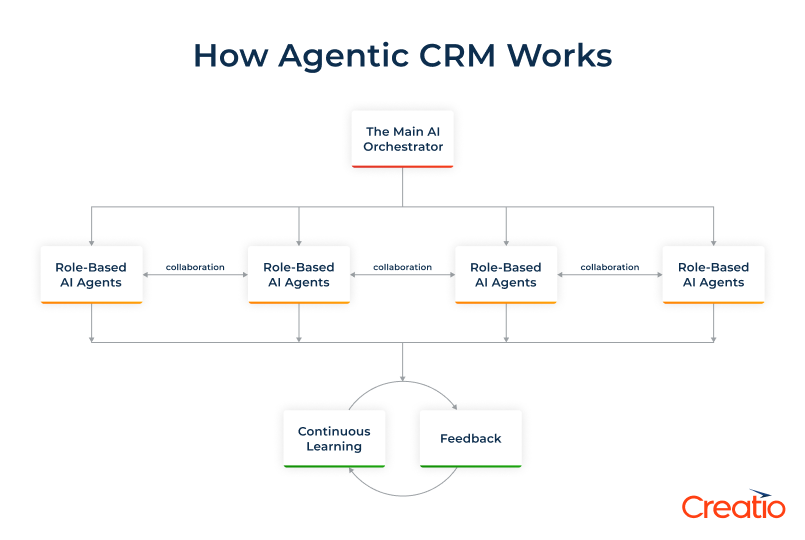
Agentic CRM functions much like an intelligent digital organisation. At the centre is the primary AI orchestrator, the strategic brain of the platform, supported by a network of role-based CRM AI agents. These agents communicate, collaborate and complete tasks much like a coordinated human team, only faster and at a greater scale.
The main AI orchestrator
The main AI within an agentic CRM acts as the command hub, interpreting business goals, breaking them down into smaller, manageable tasks and assigning them to the most suitable AI agents.
Here’s a step-by-step look at how the main AI operates:
- Strategic planning: receives a goal from human users, analyses it and develops a plan to achieve it in the most effective and efficient way. AI can also propose goals based on broader strategic priorities, seek feedback from human supervisors and proceed once approved.
- Data gathering and analysis: collects the customer, marketing and operational data needed to meet the goals, then analyses it to build a complete picture
- Task allocation: breaks the larger objective into smaller tasks and assigns them to the most suitable AI agents.
- Oversight and governance: monitors progress, applies compliance rules and dynamically reallocates resources when conditions change.
Role-based AI agents
Specialised AI-powered agents within an agentic CRM platform take on specific responsibilities under the main AI’s direction. Each agent is equipped with domain expertise and can, depending on AI governance settings, can either act autonomously or request approval from human managers before taking actions.
Common agents within an agentic CRM include:
- Sales agent: scores leads using predefined criteria, sends personalised outreach messages to high-potential prospects and notifies the sales team when a prospect shows strong buying intent.
- Marketing agent: designs and refines personalised marketing campaigns, generates marketing content, adjusts ad spend and monitors campaign performance, fine-tuning materials and channels to maximise ROI.
- Customer service agent: delivers round-the-clock support by answering frequently asked questions, completing simple tasks on behalf of customers, surfacing relevant data for service agents and preparing knowledge base articles.
- Analytics agent: automatically generates dashboards and reports, analyses key data and provides recommendations to help improve overall performance.
Advanced agentic CRM systems also offer industry-specific AI agents designed to handle tasks unique to particular sectors. For example, a financial AI agent may specialise in fraud detection and real-time risk assessment, while a healthcare agent focuses on patient engagement and regulatory compliance.
Multi-agent collaboration
For more complex tasks, the main AI orchestrator may deploy not just one, but an entire team of AI agents working together to achieve a shared goal. This multi-agent system represents the most advanced form of agentic AI.
An agentic CRM platform enables these autonomous AI agents to share data in real time and communicate with each other without requiring extra integration or setup. When a task calls for collaboration across multiple agents, the central orchestrator coordinates their roles, enabling them to exchange context, delegate subtasks, and execute a unified agentic workflow from start to finish. This approach allows complex, cross-department processes to run smoothly without manual intervention.
For example, a marketing AI agent can notify the sales AI agent the moment a prospect interacts with a campaign, triggering immediate follow-up actions.
Feedback and continuous learning
One of the biggest advantages of an agentic CRM is its ability to learn and adapt with every interaction. After each action, the system reviews the outcome and any user feedback, sending this information back to its central intelligence. This ongoing feedback loop allows the main AI to refine its models, update predictive algorithms and adjust its decision-making strategies in real time.
Because the learning happens continuously and automatically, the agentic CRM evolves alongside the business and its customers. It ensures recommendations and actions stay relevant even as market conditions, consumer preferences, and internal processes shift. The result is a self-optimising platform that becomes smarter and more effective with each cycle.
Benefits of agentic CRM
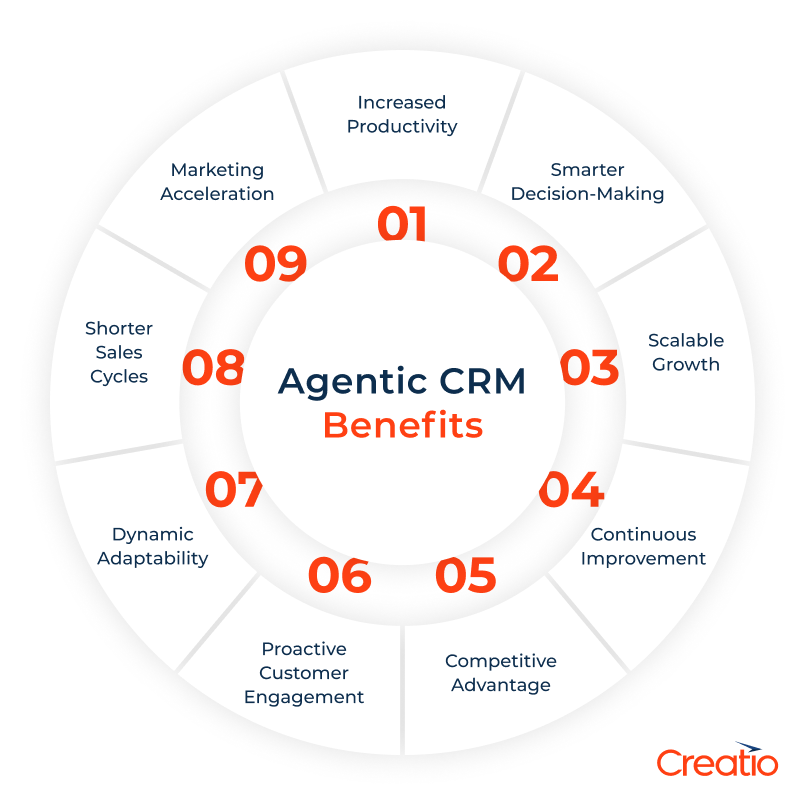
Adopting an agentic CRM platform delivers measurable benefits across customer experience, operations, and business performance.
Increased productivity
By delegating repetitive or analytical tasks to AI agents, teams spend far less time on manual work and more on strategic initiatives. While agentic CRM handles time-consuming tasks like updating databases, scoring leads, or answering customer inquiries, humans can focus on creative and relation-driven work, significantly lifting productivity.
Smarter decision-making
Agentic CRM software analyses data in real time and continuously learn from feedback, enabling more informed decisions. With access to up-to-date insights, businesses can plan more accurately, improve forecasting and optimise operations with far greater confidence.
Scalable growth
An agentic CRM grows effortlessly with your business. As data volumes, client numbers, user counts and operational processes expand, the system without compromising performance. Over time, an agentic CRM can manage complex workflows while maintaining speed, reliability and personalisation, even as the organisation scales.
Continuous improvement
With built-in feedback loops, an agentic CRM system continually learns from every interaction. It becomes smarter over time, improving recommendations, refining workflows and adjusting to changing market conditions, all without the need for manual reprogramming.
Competitive advantage
Businesses that embrace autonomous, multi-agent intelligence can react faster to market changes and customer signals, outperforming competitors still operating on traditional, manual CRM systems.
Proactive customer engagement
Because it can anticipate needs and act autonomously, an agentic CRM engages customers at the right time with the right message, improving customer satisfaction, strengthening loyalty and increasing lifetime value.
Dynamic adaptability
Agentic CRM continually detects changes in customer behaviour or market conditions, adjusting its strategies on the fly. It can shift outreach timing, reallocating campaign budgets or refine product recommendations, all without human intervention.
Shorter sales cycles
With instant lead qualification, prioritised outreach and personalised follow-ups, an agentic CRM removes common bottlenecks in the sales process. This enables sales teams to close deals faster and drive stronger revenue growth.
Marketing acceleration
With built-in marketing intelligence, marketers can create hyper-personalised campaigns, run real-time A/B tests and automatically reallocate budgets across channels. By leveraging agentic CRM capabilities, organisations can lift customer engagement and significantly improve the return on marketing spend.
Five best agentic CRM software
The CRM landscape is changing quickly as AI shifts from a supporting add-on to the core engine behind customer relationship management. Below are five leading AI-powered solutions that embody these agentic capabilities, giving businesses powerful tools to automate decisions, personalise customer interactions and scale with ease.
1. Creatio
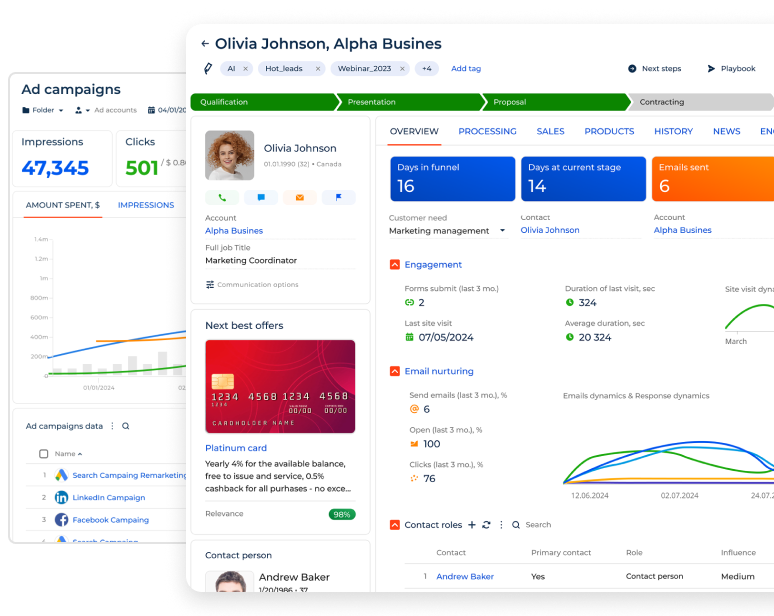
Creatio is an agentic CRM and workflow platform built with AI and no-code at its core. Its AI and AI agents are embedded throughout the platform and can natively understand all CRM objects, workflows and relationships. This agentic foundation delivers exceptional speed and agility, helping teams move faster, focus on creativity and achieve unprecedented results. Importantly, Creatio.ai is at the heart of the platform and is not an add-on wrapped around a legacy solution.
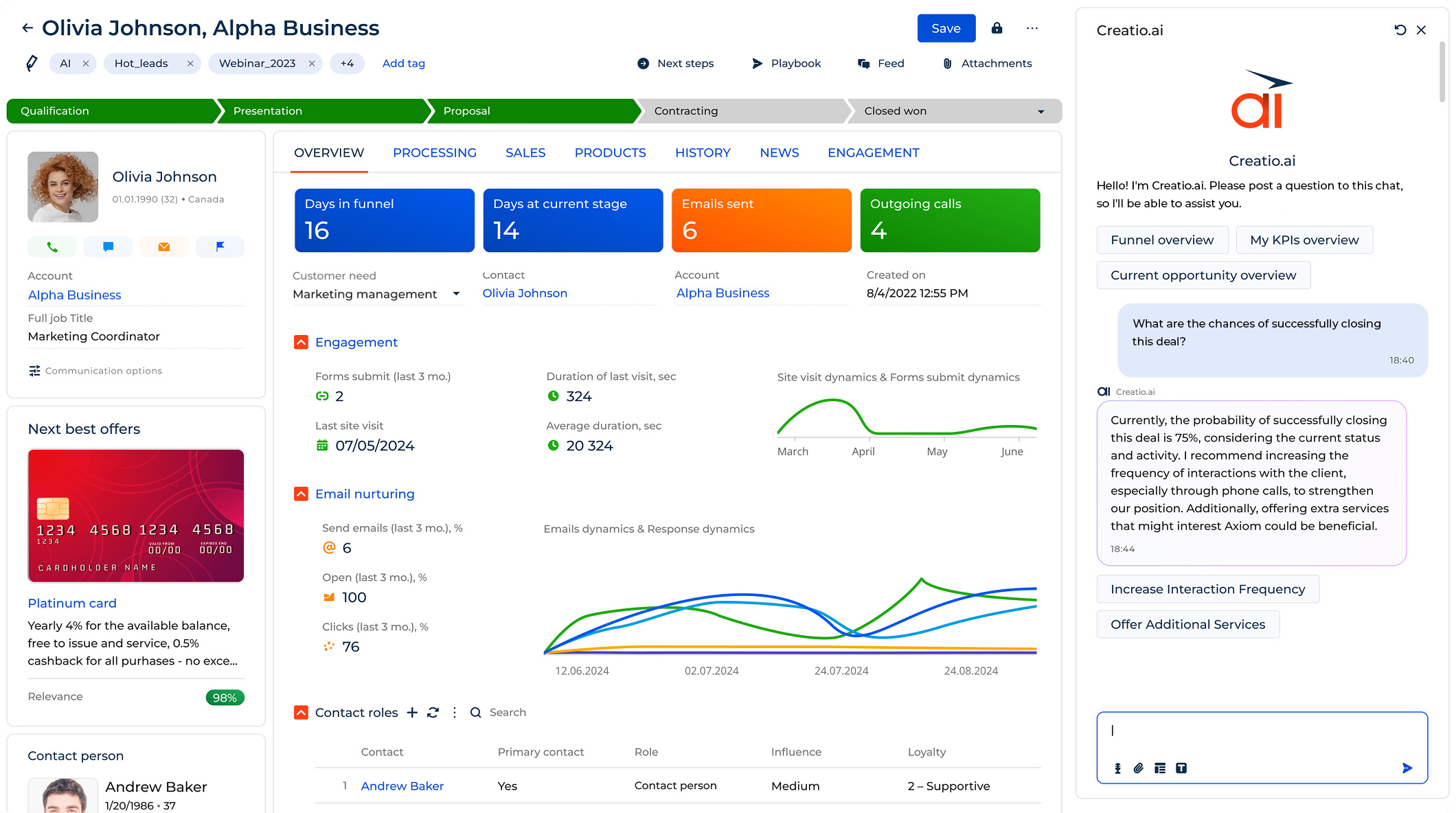
With its unified environment combining AI agents and no-code tools, Creatio enables humans and digital assistants to work in sync. Creatio's AI agents are domain-specific digital assistants embedded into every layer of Creatio's platform. They can understand context, take action and learn within a business setting. These agents are tailored to individual roles and work styles, and can be customised without coding to fit specific workflows and access levels. By adapting to different roles, Creatio’s AI agents can complete multi-step tasks, support informed decision-making and significantly boost employees' productivity and efficiency.
Creatio offers both pre-built and fully customisable AI agents for sales, marketing, and customer service teams. These include content generation agents, account research agents, customer support agents and many more. Alongside its agentic capabilities, Creatio also provides enterprise-grade CRM business applications such as customer 360, lead management, sales forecasting and case management. What truly sets Creatio apart is the combination of AI agents and no-code applications within one unified platform, all at a lower cost and with the flexibility to customise under IT oversight rather than full IT dependency.
Key features:
- Conversational interface: lets users navigate and interact with the agentic CRM using natural language.
- Embedded experience: Creatio’s AI agents integrate seamlessly with everyday productivity tools like Teams, Outlook, Zoom, etc.
- No-code capabilities: visual tools and natural-language actions allow users to update or build new CRM workflows in minutes, without any technical expertise.
- Unified AI automation: combines predictive, generative and agentic automation in a single platform to support smarter decisions.
- AI command centre: enables fast creation and customisation of AI agents and AI skills using natural language and no-code visual tools.
- Role-based and vertical AI agents: tailored agents designed for particular departments and verticals, including financial services
- Sales automation: helps sales reps streamline sales processes and close deals more quickly.
- Marketing automation: empowers marketers to deliver personalised experiences at scale.
- Customer Service automation: equips service teams with intelligent tools to resolve issues faster and keep customer satisfied.
Pros:
- AI agents are built into the core platform with no extra licenses or hidden fees.
- A uniques blend of AI and no-code tools delivers excellent flexibility and ease of use.
- Strong security features and robust AI governance.
- Built-in compliance with data protection laws and industry regulations.
- An extensive marketplace with more than 700 applications that expand Creatio's agentic CRM capabilities.
- Industry-specific workflows and AI agents that offer out-of-the-box functionality.
- Up to 70% faster implementation thanks to no-code tools, prebuilt templates and ready-made integrations.
- Around 37% lower total cost of ownership across deployment, infrastructure and ongoing maintenance.
Cons:
- There can be a slight learning curve due to platforms’ extensive capabilities and customisation options.
Rating:
G2: 4.8/5
2. Salesforce Agentforce
Salesforce’s Agentforce is an agentic layer built on top of Salesforce’s existing CRM system. It allows businesses to build and deploy autonomous agents across sales, service, marketing and commerce. With pre-built actions, industry templates and extensive integrations, enterprises can scale their use of AI agents while maintaining strong governance and visibility. It’s particularly well suited to organisations already using Salesforce and looking to leverage its mature ecosystem of apps, data and integrations.
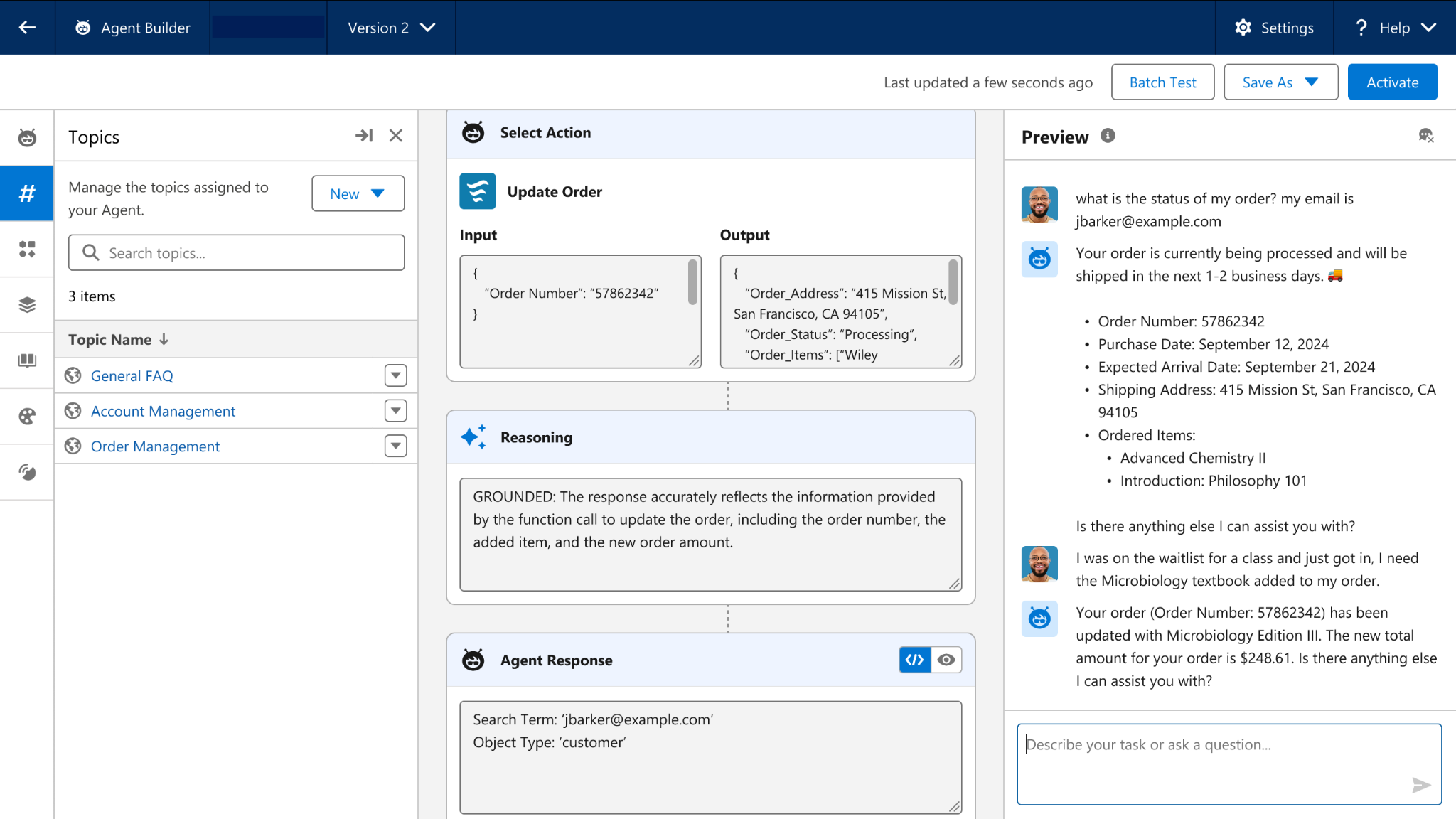
Salesforce Agentforce brings together predictive AI, generative AI and AI agents to help businesses resolve issues faster, deliver more personalised experiences and work more efficiently. Organisations can build and customise AI agents to support tasks such as lead follow-ups, content generation and case management.
Key features:
- Artificial Intelligence: supports the creation of customisable, predictive and generative AI experiences.
- Sales сloud: boosts sales productivity with AI capabilities for lead qualification, forecasting and closing deals.
- Service сloud: streamlines processes, automation and service operations using AI to enhance customer experiences and engagement.
- Marketing сloud: strengthen customer engagement and relationship-building through autonomous capabilities.
- Commerce сloud: blends automation with AI to simplify setting up digital shops and driving online sales.
Pros:
- Offers a comprehensive suite of features, including AI-powered automation, omnichannel support, real-time data insights and self-service options.
- Integrates seamlessly with other Salesforce products.
- Low-code tools allow users to build and customise solutions with minimal technical expertise.
Cons:
- Can have a steep learning curve for new users.
- AI capabilities aren’t natively embedded and often require additional licences.
- More advanced configurations and customisations typically need technical skills or external support.
- Some users report performance slowdowns when working with large data sets.
- High overall costs of ownership, with many advanced features only available on premium licence tiers.
Rating:
G2: 4.5/5
See also: Salesforce Alternatives & Competitors
3. Microsoft Dynamics 365
Microsoft Dynamics 365 incorporates agentic capabilities through tools like Copilot Studio and a range of domain-specific AI agents for sales, service and finance. The platform includes autonomous agents such as the Customer Intent Agent and Sales Chat Agent, along with actionable insights and adaptive workflow automation. It’s a strong option for enterprises that value robust security and seamless integration across the broader Microsoft ecosystem.
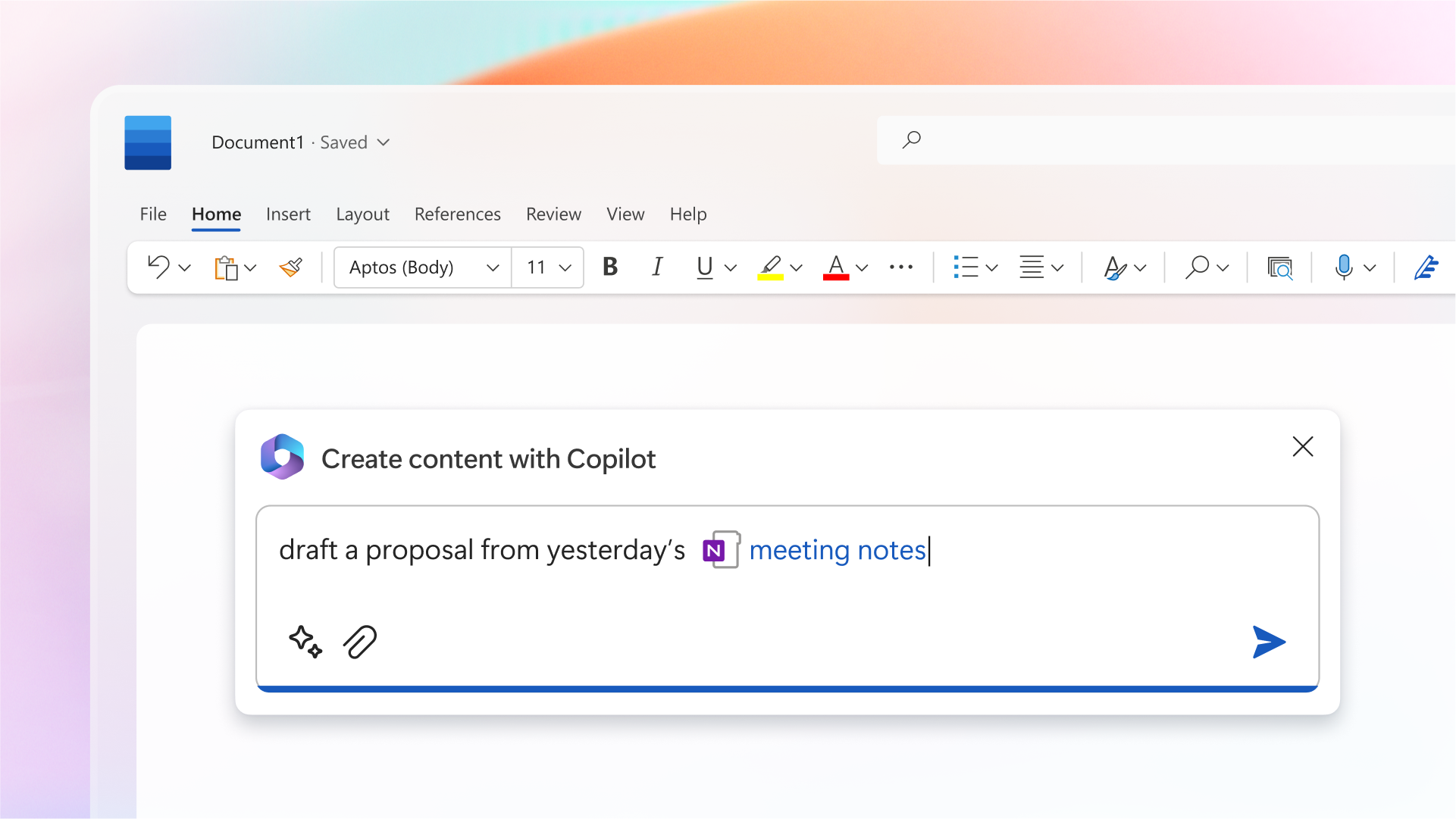
Microsoft Dynamics 365 helps organisations connect teams, processes and data across the organisation to improve operational efficiency and deliver consistent customer experiences. With AI-driven insights, businesses can better understand their customers, personalise journeys and close more deals with greater confidence.
Key features:
- Microsoft Copilot: an agentic AI tool that boosts productivity by automating repetitive tasks like document creation, data analysis and email management.
- Copilot chat: enables teams to build AI-driven agents that connect to organisational data sources and automate key business processes.
- Copilot in Word: integrates work data directly into Word documents to help users draft, refine and edit documents more efficiently.
- Copilot in Outlook: analyses email content to help users manage their inbox and prioritise important messages.
- Dynamic 365 Sales: supports sales teams with AI tools that help close deals faster and strengthen customer relationships
- Dynamic 365 Insights: empowers marketers to deliver more personalised customer journeys with next-generation AI.
- Dynamic 365 Customer Service: assists service teams in resolving issues more quickly using generative AI and intelligent automation.
Pros:
- Integrates smoothly with the broader Microsoft ecosystem.
- Provides a unified platform that connects various departments, processes and data.
- Highly customisable without requiring extensive coding knowledge.
Cons:
- Complex pricing structure and relatively high costs of ownership.
- AI capabilities aren’t natively embedded and often require additional licensing.
- Steep learning curve due to a complex and sometimes unintuitive user interface.
Rating:
G2: 4.4/5
4. HubSpot Smart CRM
HubSpot delivers an AI-powered CRM with a suite of agentic features under its Breeze Agents branding. These include agents for content generation, prospecting, customer responses and automated insight creation. HubSpot is particularly appealing for small to mid-sized businesses that want quick deployment and strong integration across marketing, sales and service functions.
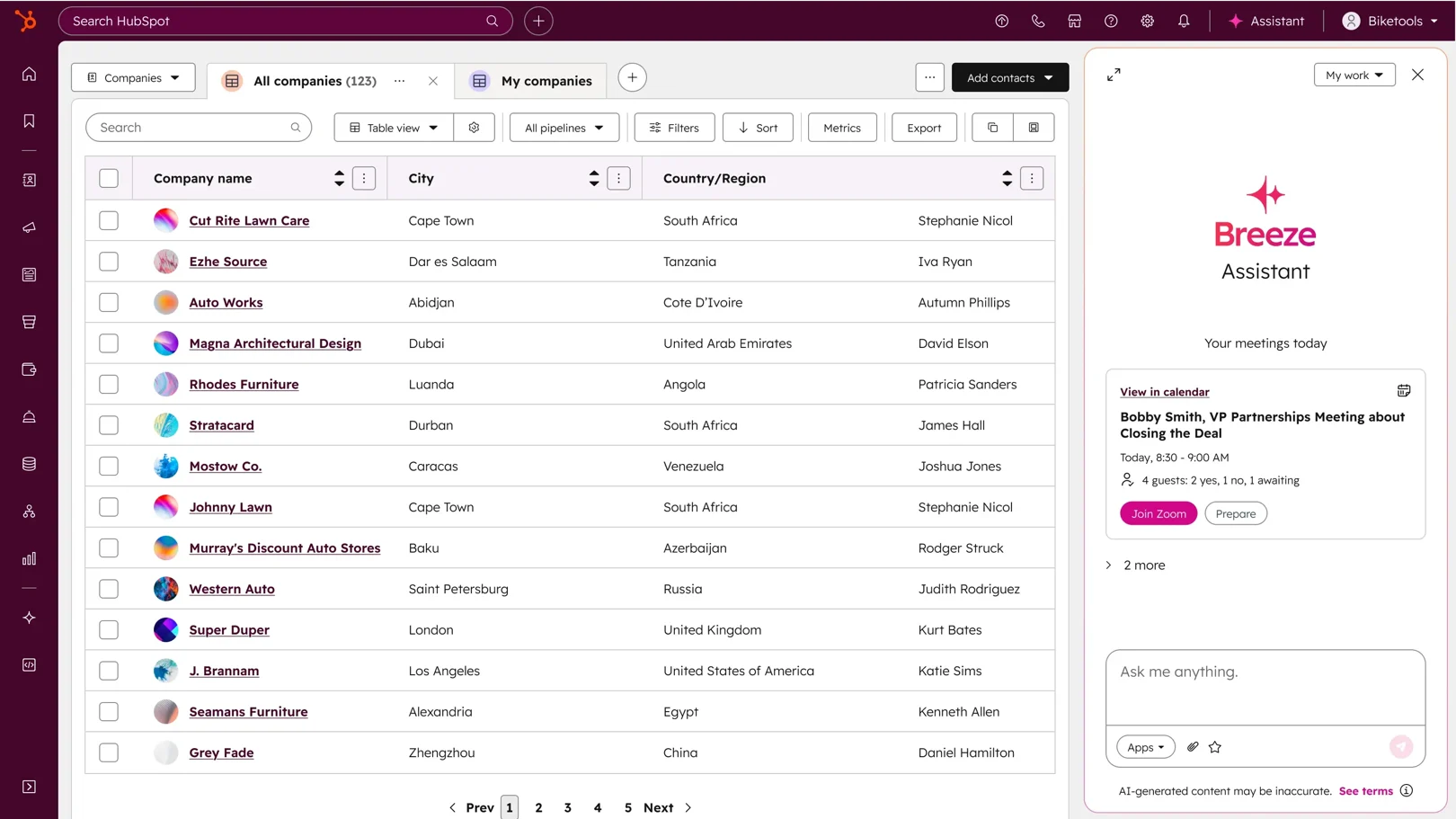
HubSpot’s Smart CRM system brings data, teams and tools to create a single source of customer intelligence. Breeze Assistant taps into CRM data and integrates with the wider business ecosystem to support meeting preparation, content creation and strategic analysis. Businesses can also pair the Smart CRM with Breeze AI Agents, AI-powered teammates designed to automate work across social media, sales prospecting and customer service.
Key features:
- Breeze Assistant: a personal AI assistant that adapts to each user’s work style.
- Customer Agent: automates customer support by responding to common enquiries.
- Prospecting Agent: helps sales teams by automatically conducting prospect research, identifying buying signals and crafting personalised outreach emails.
- AI Blog Writer: creates engaging blog posts from simple prompts.
- Website Generator: builds single-page websites using a free AI-powered builder.
- AI Email Writer: generates sales outreach and marketing emails using generative AI capabilities.
- Conversation intelligence: integrates customer feedback into the CRM to support better coaching.
Pros:
- Integrates seamlessly across the entire HubSpot ecosystem.
- Offers a large marketplace with over 1,000 third-party apps.
- Easy to use, configure and navigate.
- Strong reporting tools that provide clear, comprehensive performance insights.
Cons:
- AI capabilities aren’t natively embedded and often require extra licences or integrations.
- Less suitable for large enterprises due to limited customisation options and a lack of support for more complex workflows.
- Many advanced features are locked behind higher-priced tiers, increasing overall costs of ownership.
Rating:
G2: 4.4/5
5. Zoho CRM
Zoho CRM has evolved into an AI-enabled platform through its Zia suite of agentic features. Zia functions as a built-in AI assistant that goes well beyond basic automation, offering predictive analytics, conversational insights and autonomous task execution across sales, marketing and customer support. While Zoho’s multi-agent orchestration isn’t yet as advanced or customisable as enterprise-focused platforms like Creatio or Salesforce, it still delivers strong performance for a wide variety of use cases.
Zia continually analyses customer data from emails, calls, website visits and social interactions to spot patterns, predict outcomes and recommend the next best action. It can identify anomalies in sales trends, suggest the best time to contact a lead, draft email responses and even interpret sentiment in customer conversations.
Key features:
- Zia AI assistant: delivers predictive sales forecasting, anomaly detection, best-time-to-contact suggestions, sentiment analysis and conversational insights.
- Sales AI agents: enable sales teams to automate core tasks such as sales operations, sales coaching, data enrichment and more.
- Agent studio: allows teams to build their own agents by defining roles and responsibilities.
- Zia module creation: enables teams to build new modules using simple prompts.
- Data management and integrity: includes image recognition (Zia Vision), automatic email data capture and tools to clean and enrich records for more accurate analytics.
Pros:
- Integrates smoothly with Zoho’s suite of apps and a wide range of third-party tools.
- Flexible modules and workflow tools make it easy to tailor the system to unique business processes.
- Combines sales, marketing and support tools within a single unified platform.
- User-friendly interface that’s easy to navigate.
Cons:
- More advanced AI capabilities, including comprehensive predictive analytics, are limited to higher-tier plans.
- AI agents currently focus only on sales-related tasks and can’t be extended to marketing or customer service.
- Limited AI capabilities make Zoho CRM less suitable for larger enterprises.
- Some users report slower performance when handing large datasets or more complex workflows.
Rating:
G2: 4.1/5
Summary
Agentic CRM marks the next era of customer relationship management, moving beyond static data storage to an intelligent, autonomous ecosystem where AI agents collaborate in real time. Guided by a central orchestrator, role-based agents handle sales nurturing, marketing optimisation, customer service, reporting and more, all while sharing data seamlessly and learning from every interaction.
Among the platforms leading this shift, Creatio consistently stands out as a top choice, offering powerful AI capabilities alongside excellent usability and flexibility. Unlike many CRMs that add AI features as optional add-ons, Creatio embeds AI natively, making it a core part of how Creatio's agnostic CRM works.
Agentic CRM platforms represent the future of customer relationship management, ushering businesses into an AI-first economy where intelligent automation and autonomous decision-making deliver long-term competitive advantage.
