







































































Enhance Business Ops with Creatio’s Agentic CRM

CRMs are no longer just static databases that depend on manual entry to store and retrieve customer information. With the rise of CRM AI agents, these platforms have evolved into intelligent systems that users can interact with using natural language, making it easier than ever to complete tasks and access meaningful insights.
Gartner predicts that by 2028, more than 30% of enterprise applications, including CRMs, will feature AI agents. This marks a major shift in how organisations use technology to manage customer relationships and drive business growth.
In this guide, we’ll break down what CRM AI agents are, how they boost user productivity and the real-world benefits of integrating them into your technology stack.
Key takeaways
- CRM AI agents are intelligent digital teammates built into CRM platforms to automate tasks, deliver real-time insights and streamline everyday workflows.
- AI agents let users interact with a CRM using natural language commands, rather than relying solely on manual clicks.
- AI agents support teams across sales, marketing, customer service and operations by saving time, improving data accuracy and enabling more personalised customer experiences.
- Industries like financial services, retail and insurance are already seeing measurable business impact from adopting AI-powered CRM systems.
What are CRM AI Agents?
CRM AI agents are digital teammates built directly into CRM platforms, designed to perform tasks on behalf of users. Powered by artificial intelligence, natural language processing and machine learning, these agents can understand context, carry out multi-step processes and take proactive action with minimal human involvement. Unlike basic chatbots or simple rule-based automation, CRM AI agents learn from every interaction, adapt over time and continually improve their performance.
AI agents in CRM can:
- automate repetitive tasks
- orchestrate workflows
- navigate through the CRM system
- provide insights in real time
- personalise communication across channels
Traditional CRMs vs CRMs with AI Agents
Aspect | Traditional CRM | CRM with AI Agents |
| Data entry & updates | Manual input and update by users
| Automatic data capture from calls, emails and chats, updated in real-time |
| Navigation | Users click through dashboards and menus to find information
| Users ask AI agents using natural language to surface information for them
|
Reporting & insights
| Reports generated manually
| Real-time dashboards and predictive insights delivered automatically
|
| Task management | Follow-ups, scheduling and reminders set manually
| AI agents handle scheduling, reminders and follow-ups automatically
|
Process optimisation
| Workflow changes require manual configuration
| AI agents suggest and even build workflows automatically from natural language input
|
Users interact with CRM AI agents much like they would with a human colleague. Communication happens in natural language, users can type their questions in a chat window or use voice commands.
Instead of digging through menus or manually updating records, a salesperson might simply type, “Recommend the best cross-sell and up-sell opportunities,” while a service agent could request, “Summarise the customer’s last three interactions.” The AI agent interprets the intent, carries out the task and often suggest helpful next steps.
This marks a major shift from the traditional way people have used CRMs. Previously, employees had to navigate dashboards, search through records and manually compile reports just to access insights or complete routine tasks. Summarising a customer’s history often meant reading through pages of notes or stitching together information from multiple tools.
With AI agents, those time-consuming tasks are handled automatically, allowing teams to focus on strategy, smarter decision-making and meaningful customer engagement, rather than spending hours on admin work.
Why should businesses consider using CRM AI agents
CRM AI agents offer businesses far more basic automation. They help organisations streamline day-to-day processes, keep data accurate and up to date, and surface the right insights at the right time to support smarter decision-making. By embedding these capabilities directly into CRM systems, businesses can build more efficient workflows, support employees in their roles and deliver stronger customer experiences.
Let’s take a look at the key benefits of using CRM AI agents:
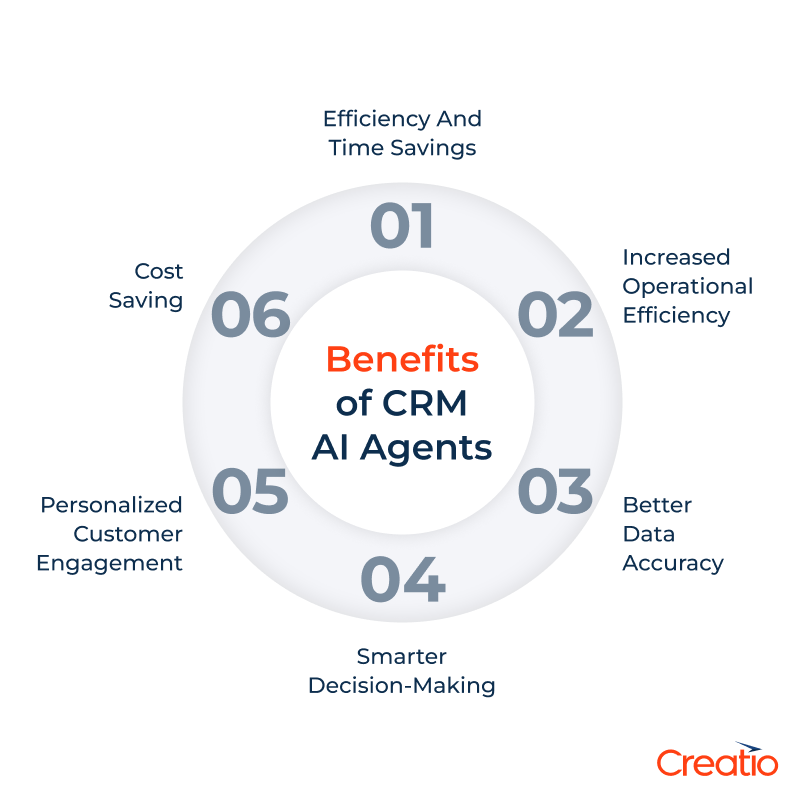
1. Efficiency and time savings
AI agents take care of repetitive and administrative tasks, such as updating records, scheduling follow-ups or summarising interactions, so employees can spend more time on high-value work, like strengthening customer relationships or closing deals.
They also reduce the effort needed to navigate complex CRM menus, eliminating the need to click through multiple screens or manually search for information.
2. Increased operational efficiency
Beyond automating routine tasks, CRM AI agents help organisations operate more efficiently at scale. They can analyse how processes run across teams, identify bottlenecks and suggest improvements that streamline operations.
For example, an AI agent might flag unnecessary approval steps in a sales workflow, recommend shifting resources to busier support queues or propose a more efficient lead-assignment model. By continually monitoring workflows and usage patterns, AI agents don’t just complete tasks — they help design better processes.
3. Better data accuracy
CRM AI agents can automatically capture information and update records without the need for manual entry. After a sales call, customer meeting or support chat, the agent can record key details, such as discussion points, decisions and next steps, and update the CRM instantly.
This removes the common issue of incomplete or outdated records, improves data accuracy, and saves staff from tedious note-taking. As a result, the CRM shifts from being a static database to an intelligent, real-time system that reflects the true state of customer relationships.
4. Smarter decision-making
Rather than relying solely on historical reports, CRM AI agents provide insights and recommendations based on real-time data. For example, they can predict the likelihood of a deal closing, highlight accounts at risk of churn or suggest the next best action to keep a prospect moving forward. This helps teams make smarter decisions that deliver real business impact.
5. Personalised customer engagement
AI agents analyse customer data across multiple channels to tailor messaging, recommend relevant content and anticipate needs. This makes every interaction feel timely and personalised, helping lift satisfaction, strengthen loyalty and create more meaningful customer experiences.
6. Cost saving
By automating repetitive tasks, reducing manual data entry and speeding up core processes, CRM AI agents help organisations lower operating costs. They reduce the need to expand headcount as workloads grow, cut back on time spent navigating systems and minimise errors that can lead to rework or lost opportunities.
CRM AI Agents Use Cases
The true value of CRM AI agents becomes clear when you see how they work in everyday business situations. Acting as digital teammates, they support staff across sales, marketing, customer service and everyday operations. CRM AI agents can be embedded into every process and workflow, helping organisations work smarter, faster and more effectively.
Everyday task automation
CRM AI agents take over the repetitive, day-to-day tasks that often drain employee productivity, such as updating records, sending follow-ups and generating reports. While these tasks are important, they can pull teams away from more meaningful customer interactions. AI agents handle them seamlessly in the background, freeing staff to focus on higher-value work.
- Data entry and update: CRM AI agents automatically capture details from calls, emails and chats, then log the information into the correct fields, keeping records accurate and up to date. This saves users from manually updating every account and significantly reduces errors.
- Scheduling meetings: AI agents can efficiently organise meetings between multiple parts by checking everyone’s availability, sending calendar invites and issuing reminders.
- Sending follow-ups: CRM AI agents can automatically send personalised messages to prospects, customers and business partners, whether it’s to confirm an upcoming meeting or maintain engagement after initial contact.
- Surfacing insights: CRM users can rely on AI agents to pull up important insights instantly, without needing to click through multiple screens to find what they’re after. This significantly speeds up access to information while reducing manual effort.
- Summarising emails and meetings: AI agents can analyse emails and tune in during meetings to draft clear, concise summaries of both current and past conversations. Rather than scrolling long email threads or taking notes during calls, CRM users can let the AI provide the key points on demand.
- Data analysis and report generation: CRM AI agents can rapidly analyse data and generate reports and dashboards based on simple natural-language descriptions. Instead of manually gathering data from different accounts and tools, CRM users can ask an AI agent to do it and even prepare initial insights or conclusions.
Results:
According to research by arXiv, humans working alongside AI agents experienced 73% greater productivity per worker.
Sales enablement
CRM AI agents act as intelligent digital assistants that support sales teams at every stage of the sales cycle. Rather than spending hours on administrative work or searching for information, salespeople can rely on AI agents to automate outreach, surface key insights, and recommend the next best actions to help close more deals.
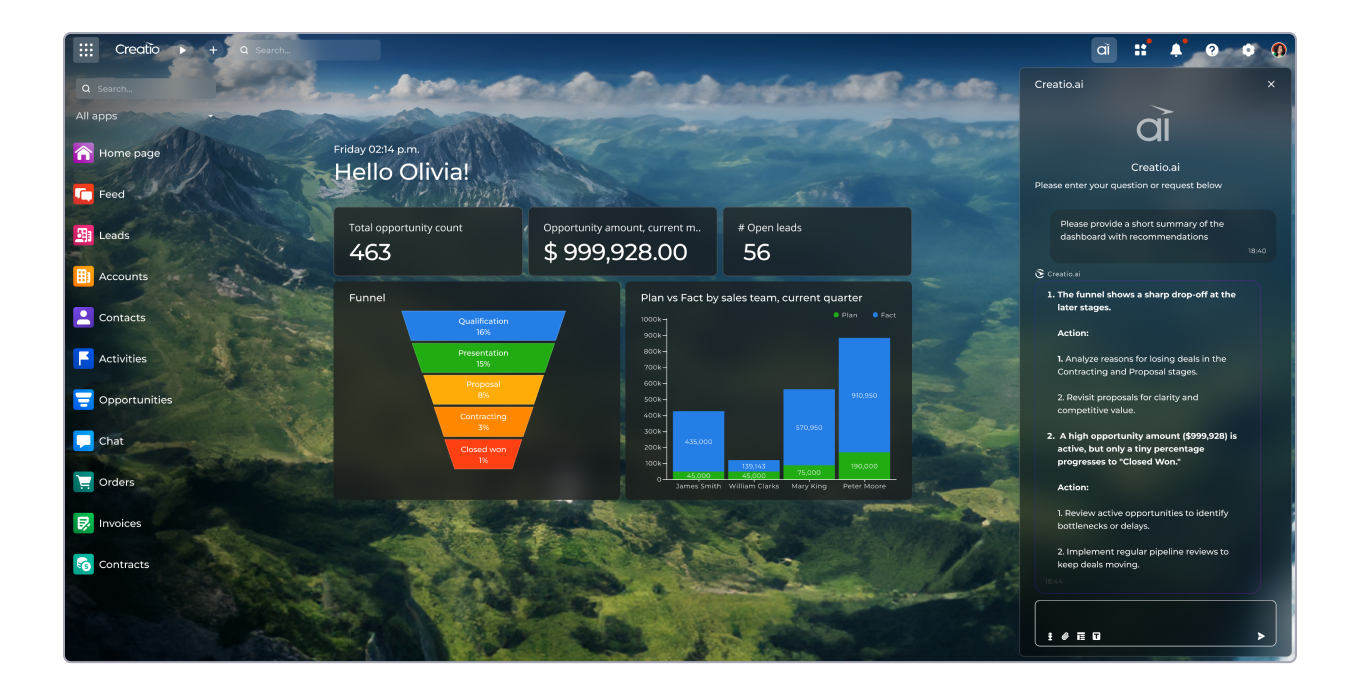
- Lead scoring and qualification: AI agents in CRM can automatically capture new leads and score them using predefined criteria. They analyse relevant data quickly, such as demographic and firmographic details, website behaviour and more, to assess each lead’s potential value and likelihood of converting.
- Personalised outreach at scale: sales teams can use the AI agent’s ability to generate personalised content and automate outreach at scale. CRM AI agents can tailor messages based on lead data, send them through preferred channels and even schedule meetings with sales reps, all without human input.
- Real-time recommendations: AI agents provide next-best step suggestions in real time, helping sales professionals close deals faster and increase deal value with timely cross-selling and up-selling recommendations.
Results:
According to Forbes, businesses that produced AI sales agents into their processes were able to automate up to 90% of all prospecting tasks.
Marketing automation
CRM AI agents streamline marketing operations by personalising and optimising campaigns at scale. Instead of manually segmenting audiences, tracking engagement or crafting A/B tests, marketers can rely on AI agents to analyse customer behaviour, monitor campaign performance and automatically adjust campaigns to maximise ROI.
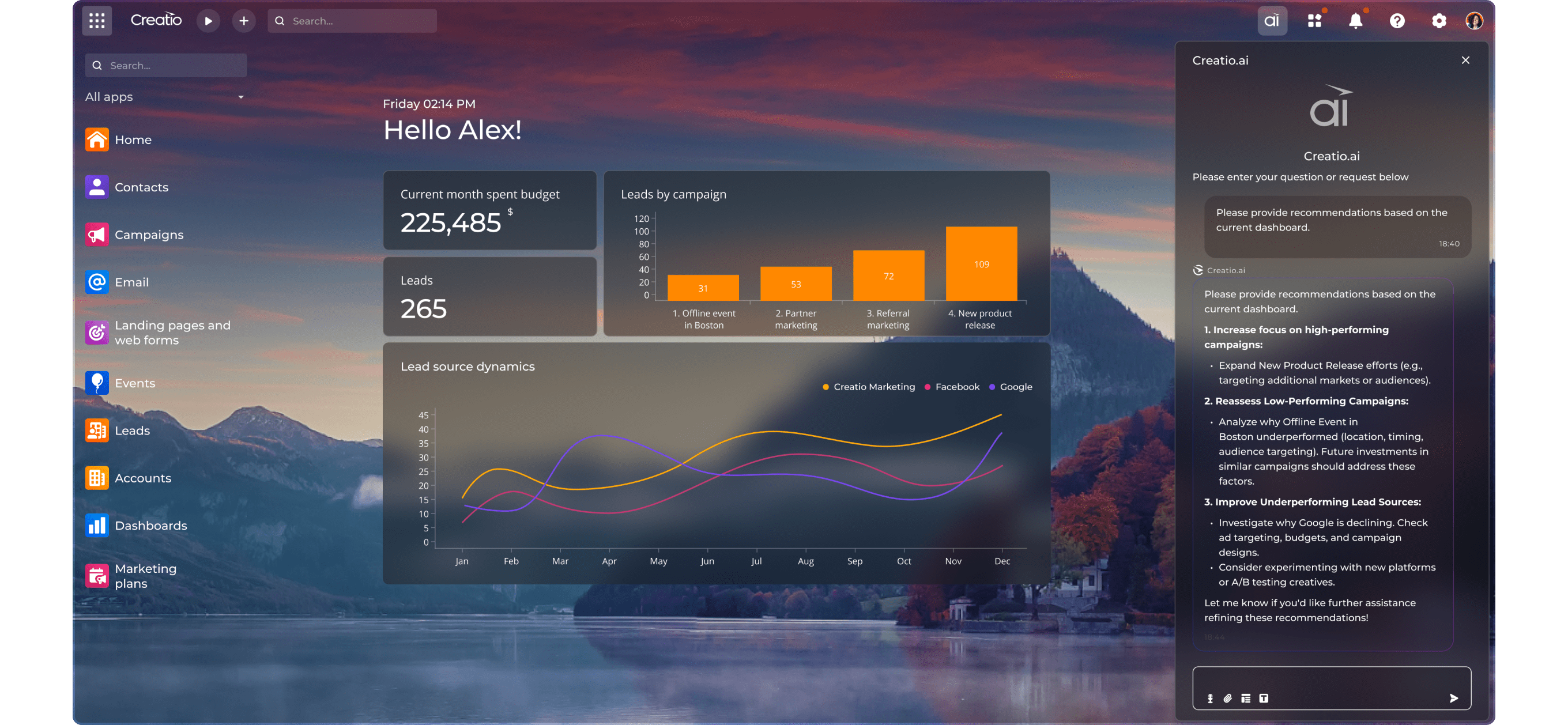
- Audience segmentation: CRM AI agents analyse customer data, including demographics, behaviour, past interactions and preferences, in real time to support more accurate customer segmentation and tailored marketing campaigns.
- Automatic content generation: AI agents can produce a wide range of content for marketing teams, from emails and ad copy to social media posts and long-form articles. They can tailor content to specific personas and deliver it at the right buying stage to drive engagement.
- Campaign optimisation: AI agents within CRM software can autonomously optimise campaigns across email, ads and social media to maximise return on investment. They continuously track performance and adjust campaign elements, such as headlines, CTAs, visuals, delivery channels and budget, to increase engagement and conversion.
Results:
According to McKinsey, using AI agents to personalise marketing efforts can reduce customer acquisition costs by up to 50%, increase marketing ROI by 10-30%, and lift revenue growth by 5-15%.
Customer service support
CRM AI agents help deliver faster, more personalised and more proactive customer support. Instead of human customer service teams spending time searching through knowledge bases, reviewing past interactions or handling repetitive enquiries, AI agents can instantly surface relevant answers, summarise case histories and even resolve common issues on their own.
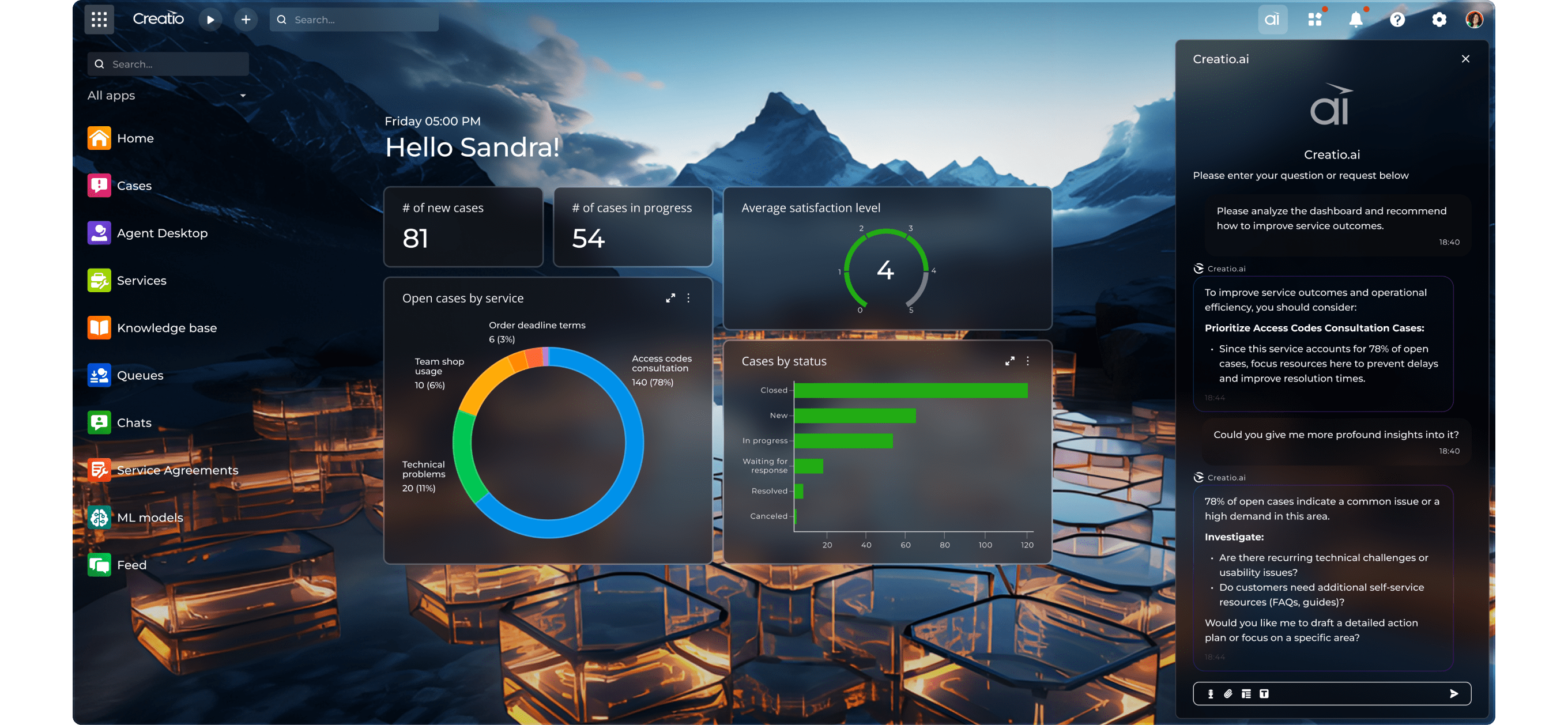
- Answering frequently asked questions: CRM AI agents can respond to customer questions around the clock, offering instant, natural-language support across multiple channels. They can analyse customer enquiries and provide contextually accurate answers based on the company’s knowledge library. For more complex issues, a customer service AI agent can transfer the conversation to the human representative, complete with full context, ensuring a smooth transition and consistent support experience.
- Assisting with case resolution: customer service teams can use AI agents to quickly access important information, including summaries of previous interactions and insights from similar cases. With this context at their fingertips, service agents can provide timely, accurate support without needing to dig through CRM records to find what is needed.
- Sentiment analysis: CRM AI agents help deliver proactive customer support by analysing client sentiment. They can monitor social media mentions, feedback forms and current conversations to determine how customers feel about the company and the support they’ve received so far. To ensure the right cases are prioritised, AI agents flag dissatisfied or at-risk customers, escalate issues to the appropriate teams and recommend timely interventions to lift customer satisfaction and strengthen loyalty.
Results:
Research from the Nielsen Norman Group shows that support agents using AI agents were able to handle 13.8% more customer enquiries per hour.
Industry-specific use cases of CRM AI agents
Beyond the general business benefits they offer, CRM AI agents provide even greater value when tailored to the needs of specific industries. Each sector has its own challenges, from strict compliance in financial services, to faster claims processing in insurance, to personalised experiences in retail.
Here are a few examples of how different industries are using CRM AI agents to deliver measurable results.
Credit unions
CRM AI agents help credit unions strike the right balance between personalised member service and operational efficiency. By adopting AI agents, credit unions can streamline loan processing, enhance member engagement and support compliance with industry regulations.
- Loan processing support: CRM AI agents can access all relevant customer information and quickly verify or summarise key financial details, even from unstructured documents, such as banking statements, insurance records and utility bills. They can also pre-fill required documents, flag missing information and perform risk assessments to help speed up loan approvals.
- Member engagement: instead of sending generic offers, credit union professionals can use AI agents to create tailored product recommendations, such as refinancing options or savings plans, based on member transaction patterns and life events. Based on real data insights, these offers are more relevant to members and are more likely to be met with positive reactions.
- Compliance and reporting: CRM AI agents can automatically generate reports that meet regulatory requirements with minimal manual effort. This helps reduce the risk of errors and ensure audits are completed more quickly and accurately.
Real-Life example: Ent Credit Union & Creatio Agentic CRM
Ent Credit Union, Colorado’s largest credit union, adopted Creatio’s agentic, no-code CRM to streamline member engagement and service delivery. With Creatio, Ent automated more than 340 unique case types, consolidated member data into a single 360-degree view and equipped staff to provide personalised, proactive support.
The results were impressive:
- $1.4 million in annual revenue
- 18.5% increase in new deposit conversions
- 8.5% rise in new loan conversions
By leveraging Creatio’s agentic CRM, which embeds AI agents throughout the entire platform, Ent Credit Union transformed its operations and member experience, achieving measurable improvements in both growth and efficiency.

Insurance
The insurance industry relies heavily on trust, accurate information, and timely service, making it a perfect fit for CRM AI agents. By blending AI-powered automation with human expertise, insurers can elevate customer experience, streamline claims management and improve overall operational efficiency.
- Customer onboarding: AI agents can guide new customers through the onboarding, capture data from applications and verify documents. This cuts down on manual data entry and speeds up time-to-coverage.
- Claims processing: By analysing claim forms, documents and conversations, AI agents can automatically validate data, flag inconsistencies and route claims to the appropriate adjusters. They can also create claim summaries and keep customers updated on claim status in real time.
- Risk assessment and underwriting: AI agents can examine customer profiles, transaction history and external data, such as credit scores or health records, to recommend underwriting decisions and identify potential risks. This significantly speed up what has traditionally been a slow and highly manual process.
Results:
According to BCG, insurers that equipped their service and operations teams with AI agents reported productivity gains of more than 30%.
Retail
In the retail sector, CRM AI agents help businesses deliver personalised shopping experiences while keeping operations efficient. AI agents can tailor product recommendations at scale, automatically respond to common questions and optimise inventory levels to reduce costs and boost profitability.
- Personalised recommendations: CRM AI agents can recommend relevant products in real time based on customer data stored in the CRM, including browsing history, past purchases and personal preferences, helping increase average order value.
- Customer service automation: customer service teams can leverage AI agents to manage common enquiries, such as order status, return policy and order tracking, allowing human agents to focus on more complex issues that require human attention.
- Inventory management: AI agents in CRM can help retailers maintain optimal stock levels while cutting warehousing costs. By predicting product demand using market trends, seasonality, and consumer behaviour, AI agents can fine-tune stock levels to prevent both overstocking and stockouts.

Future of CRM AI agents
CRM AI agents are powerful assistants that automate tasks, capture data and provide intelligent recommendations. As the technology continues to advance, these agents will become more autonomous, proactive and deeply integrated across entire business ecosystems.
From intelligent assistants to autonomous operators
Currently, AI agents support human users by taking care of repetitive tasks and highlighting key insights. The next stage is autonomous execution. Instead of simply suggesting the next best actions, agents will be able to act on them, whether that’s negotiating renewals, sending offers or reallocating service cases in real time without needing human approval.
According to Gartner, by 2028, AI agents will independently handle 15% of daily workplace decisions autonomously.
This shift will turn AI-powered CRMs from helpful tools into true digital co-workers, capable of driving outcomes autonomously.

Zero-click CRM navigation
The future of CRM is moving toward zero-click experiences, where users no longer need to manually navigate the system. Rather than building dashboards, drafting reports or clicking through menus to find relevant information, users will simply describe what they need in natural language, and AI will take care of the rest.
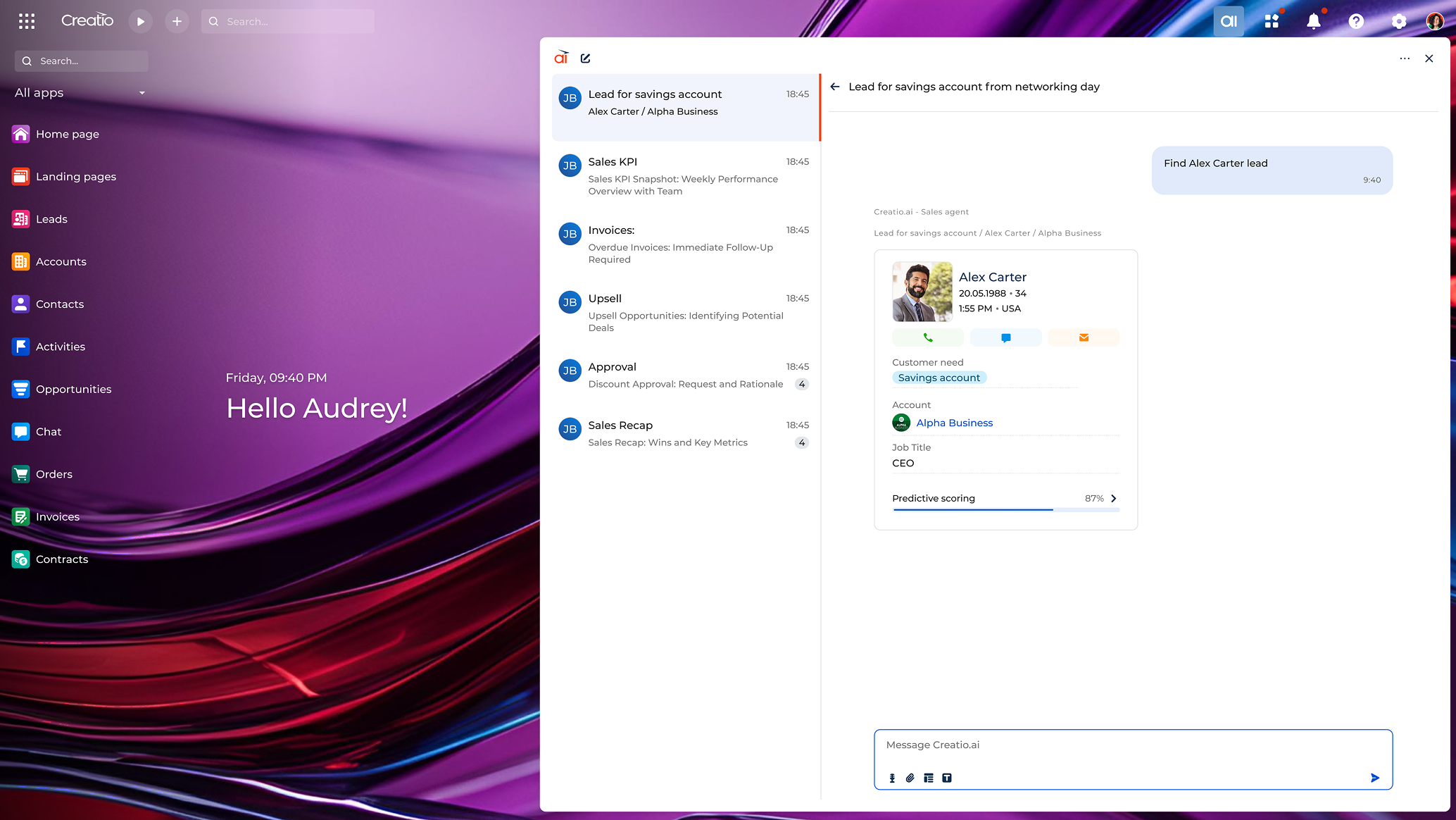
An example of a Creatio CRM zero-click experience
Over time, agents will proactively surface insights and automate actions end-to-end, allowing employees to work efficiently without directly navigating the CRM interface.
Agentic CRM ecosystems
CRM AI agents will increasingly extend their reach beyond the CRM itself, acting as intelligent connectors across an organisation’s entire digital ecosystem. This means they’ll interact seamlessly with productivity tools, ERP systems, collaboration platforms and industry-specific apps.
Some CRM platforms are already moving in this direction, with Creatio leading the way by embedding AI agents directly into email apps, Zoom calls and other productivity tools. As more business applications adopt similar integrations, AI agents will be able to operate seamlessly across an even broader range of platforms, further reducing the need to switch between different tools.
AI agents are redefining customer relationship management
CRM AI agents are reshaping the way organisations manage customer relationships, transforming CRMs from static databases into intelligent, proactive business systems. These intelligent agents automate repetitive tasks, update data in real time and help users interact with the system through natural language, reducing the need for manual navigation.
Organisations that adopt AI agents early will gain more than operational efficiency. They’ll build stronger relationships, deliver more personalised experiences and free their teams to focus on strategy and human connection rather than routine administration.
As AI agents move toward zero-click navigation and truly autonomous decision-making, businesses have a chance to reimagine customer engagement entirely. CRM AI agents aren’t just the future of customer management; they’re the future of how modern businesses operate.
