Agentic AI is emerging as the next significant development in the evolution of artificial intelligence. According to Gartner, agentic AI is one of the top ten strategic technology trends for 2026, reflecting its potential to handle complex tasks, adapt to changing environments, and support human work. Market growth points in the same direction. According to Grand View Research, the global AI agents market is expected to grow from $5.4 billion in 2024 to more than $50 billion by 2030, highlighting increasing demand for AI systems capable of operating with greater autonomy.
This article explores what agentic AI is and how it could transform the way businesses operate.
What is Agentic AI?
Agentic AI is an advanced form of artificial intelligence designed to make decisions and execute tasks autonomously, with minimal human involvement. AI agents are capable of planning, automating tasks, evaluating performance, and optimising workflows.
AI agents analyse large volumes of data to understand user or customer context, make informed decisions, and execute tailored workflows. They can also learn from new scenarios, handle exceptions, address complex challenges, and adapt to changing conditions, helping to optimise workflows and improve processes.
Agentic AI is characterised by several key capabilities:

- Autonomy: AI agents can execute and refine tasks independently, without constant human intervention.
- Reasoning: AI agents can process complex scenarios, evaluate available information and determine appropriate next steps.
- Complex decision-making: autonomous agents can make crucial decisions based on multiple factors and longer-term objectives.
- High adaptability: AI agents continuously learn from new data and adapt to changing conditions, making them well-suited to dynamic environments.
- Comprehension: AI agents can navigate and execute multi-step processes by combining different models, data sources, and external systems.
Agentic AI can reason, plan, and act independently, while still benefiting from human' guidance to remain aligned with business objectives, ethical standards, and compliance regulatory requirements.
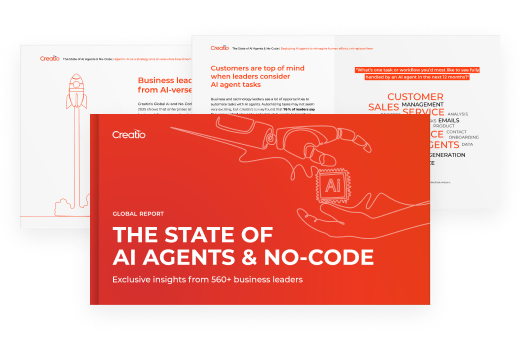
The State of AI Agents & No-Code
Learn how 560+ leaders across the world use AI and no-code to drive innovation today
How does agentic AI work?
Agentic AI operates through a combination of machine learning algorithms, natural language processing (NLP), and large language models (LLMs).
AI agents typically follow five key stages when executing tasks:

- Perception: gathering and processing data from available data sources.
- Reasoning: interpreting tasks and determining appropriate solutions.
- Action: using external tools and software to perform a task based on the formulated plan.
- Feedback and adjustment: monitoring task execution, analysing outcomes, and refining strategies.
- Learning: using insights from each interaction to improve accuracy and efficiency in over time.
The following table explains each stage of the process in more detail:
Step | What happens | How it happens |
| Perception and data gathering | The AI agent gathers and analyses data from available databases and other digital sources using machine learning techniques. | The agent identifies relevant features, objects or key entities within the business environment, such as customer data, performance metrics, and product specifications. This information helps the AI agent understand context and current state of the environment, enabling to determine the appropriate course of action. |
| Understanding tasks | The agent interprets natural language instructions using natural language processing (NLP) technology. | Large language models (LLMs) process the instructions and translate them into structured, actionable representations using techniques such as prompt engineering and template matching. The goal of this step is to break complex tasks down into smaller, more manageable straps that the agent can process and act on. |
| Reasoning | The agent uses an LLM to interpret tasks, generate potential solutions, and coordinate specialised models for specific tasks, such as content generation and recommendations. | The AI agent uses techniques such as retrieval-augmented generation (RAG) to access relevant information from a range of data sources, helping to produce more accurate and relevant outputs. The aim of this stage is to support informed decision-making based on available data. |
| Task planning | The agent breaks down tasks and develops plans of action. | It generates task sequences and maps out the necessary steps while respecting dependencies, including prioritising tasks and deadlines. The aim of this stage is to ensure that tasks are performed in a logical order while reducing the risk of errors. |
| Task execution | The agent begins executing the planned tasks. | The agent integrates with existing enterprise systems and external tools, such as CRM software, e-commerce platform, and analytics tools, to complete actions based on the defined plan. The aim of this stage is to complete the required tasks as effectively as possible. |
| Task monitoring | As the agent executes tasks, it monitors outcomes for signals of success or failure. | Predefined rules help the agent evaluate the outcomes and adjust its approach when issues arise. The aim of this stage is to refine the approach where necessary and reduce risk of avoidable errors. |
| Fallback options | If the agent encounters obstacles or unexpected errors, it refers to fallback options. | The agent uses success and failure metrics to identify alternative paths, helping it continue working towards tasks completion even when errors or changes occur. The aim of this stage is to maintain flexibility and support continued progress when challenges arise. |
| Continuous learning | The agent logs each action, decision point, and outcome. | Data generated through interactions with users and other systems can be stored in the system and used by AI agents to evaluate performance and inform future improvements. The aim of this stage is to use insights from past interactions to refine processes and improve decision-making over time. |
Agentic AI vs. Generative AI
Generative AI was the first type of AI to achieve widespread adoption, with tools such as ChatGPT, DALL·E, and other AI models bringing the technology into everyday use. These systems demonstrated that AI could become accessible to a broad audience, enabling people to generate human-like text, create images, and support tasks such as software development.
Today, attention is increasingly shifting toward agentic AI. Unlike generative AI, which primarily responds to prompts, agentic AI can take autonomous action to achieve defined objectives. Rather than completing individual tasks, agentic AI systems can automate complex workflows, make decisions, plan next steps, and take actions to achieve specific goals.
The following comparison highlights the key differences between generative AI and agentic AI:
Aspect | Generative AI | Agentic AI |
| Purpose | Generate content, such as text, code, images, and videos | Pursue defined goals by planning, making decisions, and executing complex workflows with a higher degree of autonomy |
| Autonomy level | Low: typically requires constant human prompts and guidance | High: can operate with minimal human intervention, make decisions, and execute tasks across complex workflows |
| Adaptability | Output is refined through prompts, instructions and human feedback | Can adapt its behaviour based on feedback, changing conditions, and predefined objectives |
| Example use case | Drafting emails or generating advertising creatives | Managing a sales pipeline or handling customer service enquiries |
| Enterprise impact | Accelerates content production | Automates business processes and supports human-decision-making and operations |
Benefits of agentic AI
Agentic AI helps organisations streamline operations, support better decision-making, and improve productivity.
The following are some of the key advantages of adopting agentic AI across business operations:

Increased efficiency and productivity
Agentic AI improves efficiency and productivity by automating complex processes that would otherwise require significant human involvement. Unlike conventional automation, AI agents do more than follow predefined rules. They can make autonomous decisions, execute tasks, and optimise workflows, allowing employees to focus on higher-value strategic and creative work.
Proactive problem-solving
Agentic AI can do more than automate routine tasks or respond to user instructions. Unlike traditional systems, which often rely on people to react and respond once an issue has been identified, AI agents can monitor operations, analyse patterns, and take proactive actions to prevent or minimise potential issues.
For example, an AI agent could adjust transportation routing by analysing real-time traffic and weather data, without waiting for a human operator to identify a potential disruption.
Enhanced customer experiences
Agentic AI can help organisations deliver more personalised and responsive customer experiences. By analysing customer enquiries, preferences, and context information, AI agents can provide tailored, relevant support and resolve many routine requests without the need for human intervention. AI agents can engage with customers around the clock using natural language, providing immediate assistance, answering questions, and wthere appropriate, performing tasks on their behalf, such as submitting a complaint.
Adopting agentic AI can help reduce waiting times, improve resolution rates, and create a smoother, more engaging customer experience, contributing to higher levels of customer satisfaction and loyalty.
Flexibility and adaptability
One of the key advantages of agentic AI is its ability to adapt to changing conditions with minimal human involvement. Depending on how they are designed, agentic AI systems can respond to new information, evolving business requirements, and changing operating conditions, helping organisations remain effective in dynamic environments..
Data-driven decision-making
Agentic AI supports faster, more informed decision-making by analysing large volumes of data. Rather than relying solely on static reports or manual analysis, AI agents can process and interpret information from multiple sources to identify patters, trends and insights that might otherwise go overlooked. This enables organisations to make better-informed decisions based on timely and relevant data.
Unleash AI-Native Automation
Power workflows using Agentic, Predictive & Generative AI with Creatio.ai
Agentic AI use cases
Organisations can use specialised AI agents, often referred to as vertical AI agents, that are designed for specific roles, functions or industries. These agents help automate and support a wide range of business activities across areas such as marketing, finance, and sales:
Marketing
AI agents can support marketing teams by managing and optimising marketing campaigns with a high degree of autonomy. By analysing audience engagement and performance metrics, marketing AI agents can adjust bidding and refine targeting strategies in real time to help improve campaign ROI.
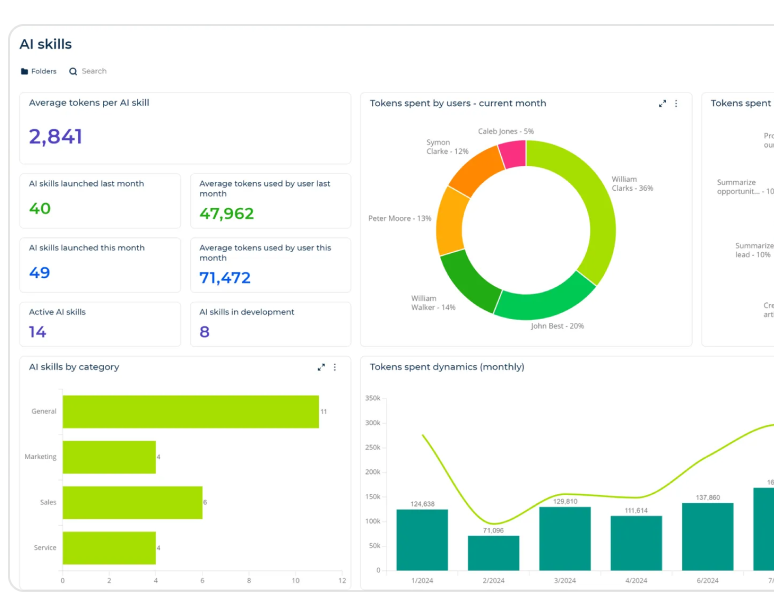
Example of Creatio.ai for marketing
Agentic AI can help automate a range of marketing activities, including:
- Audience segmentation: automatically grouping customers into relevant segments and updating those segments as new data becomes available
- Campaign execution: launching and managing marketing campaigns based on customer behaviour, such as abandoning baskets, resource downloading, browsing specific product categories and visiting pricing pages.
- Campaign optimisation: analysing campaign performance and adjusting bidding strategies, ad placement, channels, and creative variations to improve results.
For example, an e-commerce company could use agentic AI to manage a multi-channel advertising campaign promoting a new product range. An AI marketing agent monitors campaign performance across platforms such as Facebook, Google, and Instagram, identifying that a particular audience segment responds better to video advertising than static images. Rather than waiting for a marketing specialist to review the results and update the campaign, the AI agent can automatically prioritise video adverts for that audience segment. This enables campaigns to respond more quickly to performance data ad can help improve engagement.
Sales
Agentic AI acts as an intelligent assistant, helping sales teams focus on building relationships with clients by automating many routine sales activities. For example, AI sales agents can update prospect records based on calls and conversations, schedule meetings with high-priority prospects, and send follow-up messages automatically.
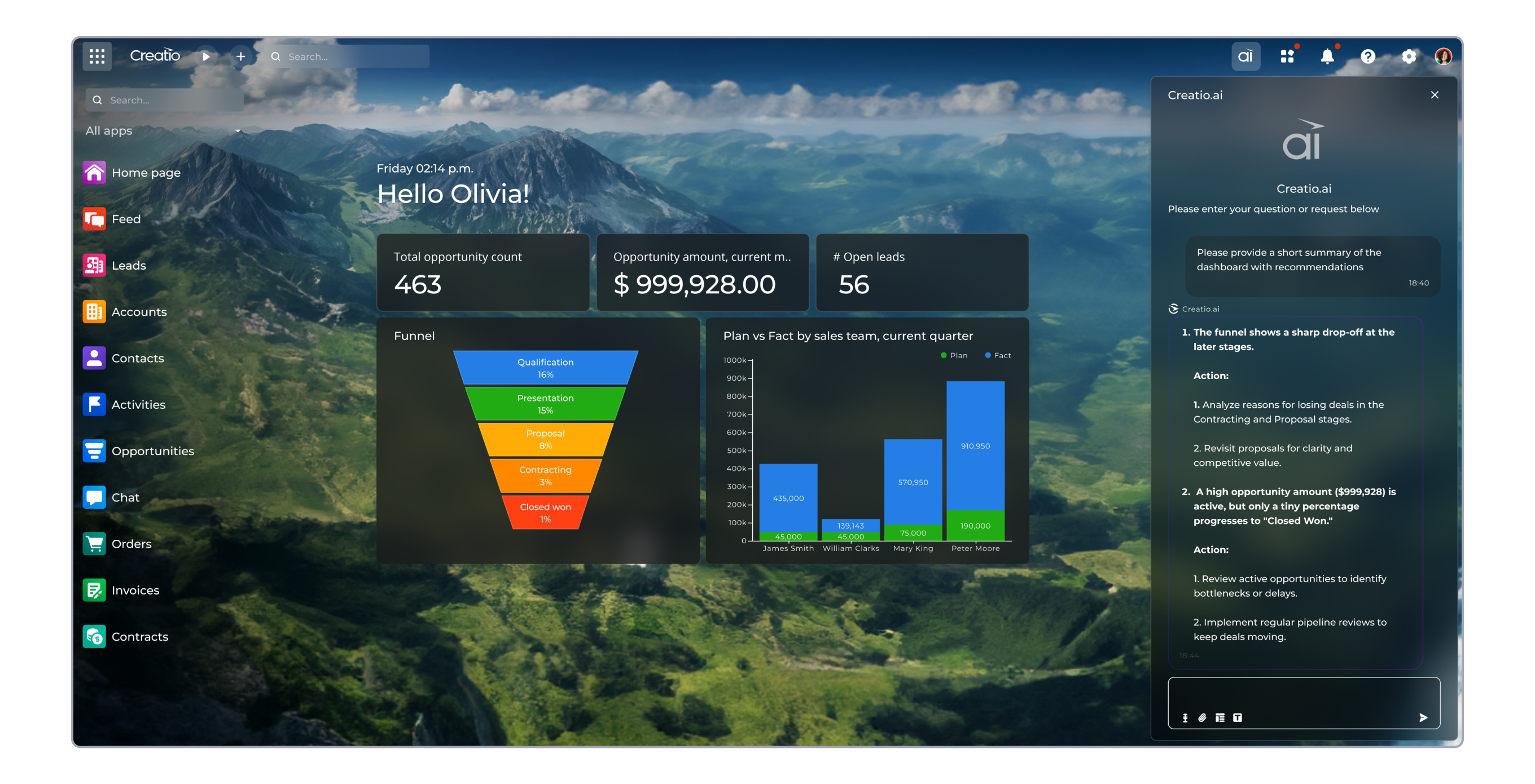
Example of Creatio.ai for sales
Additionally agentic AI can also help automate a range of sales activities, including:
- Lead and opportunity scoring: assessing leads and opportunities to identify those most likely to convert into customers
- Lead assignment: allocating leads to the most appropriate sales representative based on factors such as skills, experience, and location.
- Pipeline management: monitoring the sales pipeline and taking actions to help move opportunities forward, such as sending automated emails or scheduling calls.
- Territory optimisation: assigns field sales representatives to territories or customer visits based on availability, experience, and location.
Agentic AI can automate sales workflows based on a prospective customer’s behaviour. For example, when someone submits a contact form, an AI agent can analyse the available information, enrich the prospect profile using data from connected systems, send a welcome message, schedule a meeting with the appropriate sales representative, and provide relevant insights to support sales conversations.
Customer service
Traditional chatbots help improve customer service by answering common questions and providing support around the clock. Agentic AI extends these capabilities making decisions and executing tasks on behalf of customers where appropriate.
Businesses that adopt AI agents for customer service can help resolve routine issues more quickly, reduce operational costs, and provide more proactive support, while allowing customer service teams to focus on more complex enquiries. According to Gartner, by 2029 agentic AI is expected to resolve up to 80% of common customer service issues autonomously, potentially helping organsiations reduce operational costs by up to 30%.
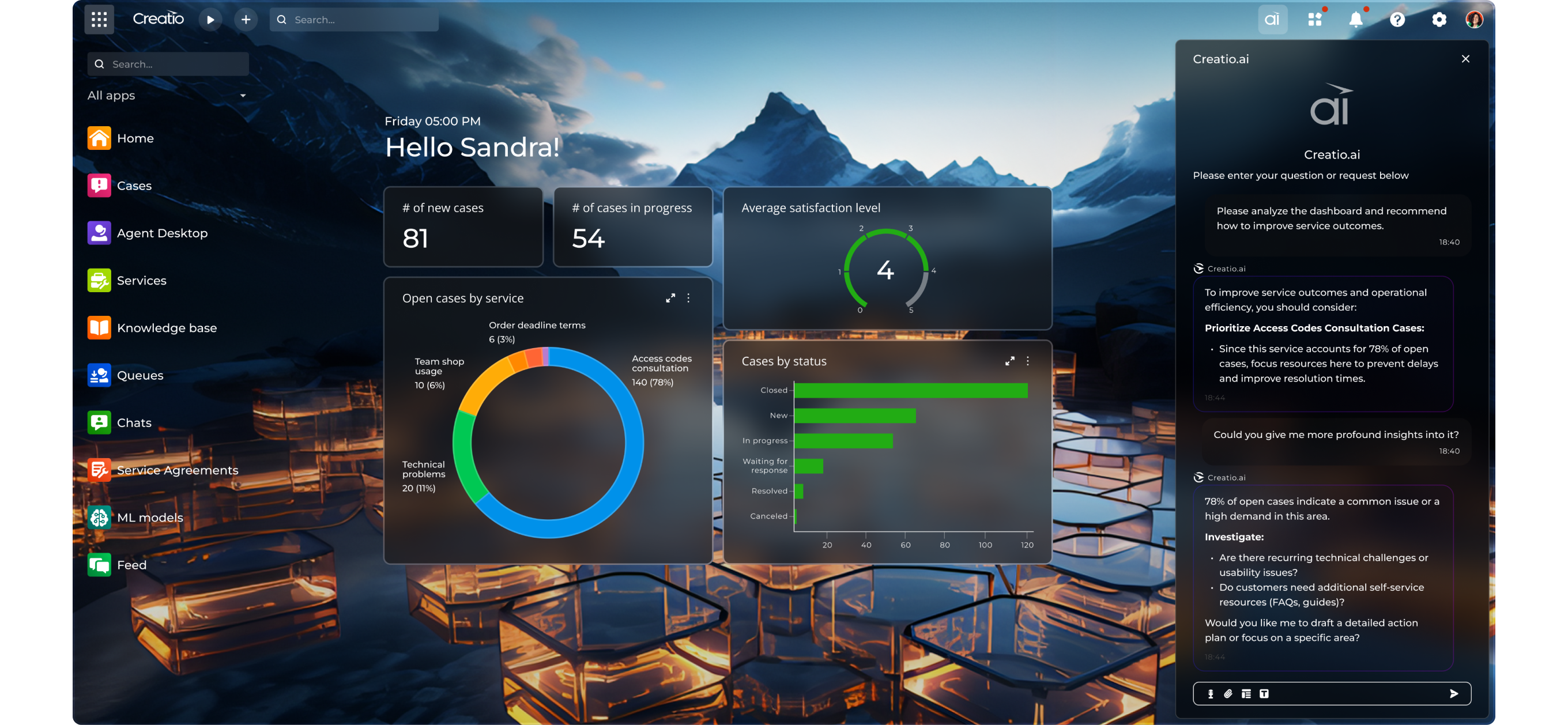
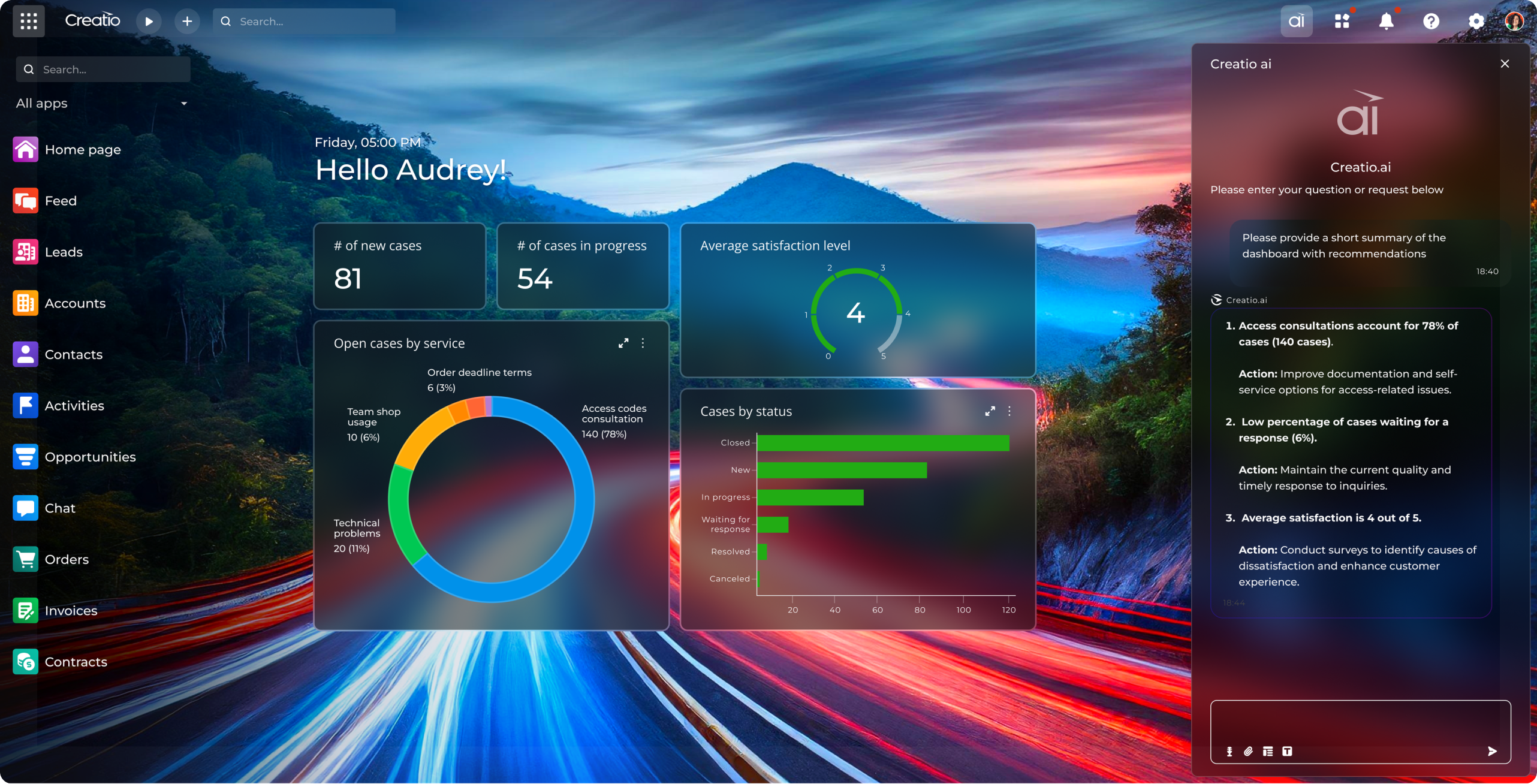
Example of Creatio.ai for customer service
One of the main advantages of agentic AI in customer service is its ability to analyse customer requests, make decisions in real time, and execute actions on their behalf, such as canceling subscriptions, rescheduling appointments, or processing refunds.
For example, an AI agent could process product return requests. Rather than providing generic instructions, it could verify the order details, assess eligibility for a refund, populate a returns form using information already held in the company’s database, prepare a return label, and send the relevant information directly to the customer. Routine requests can often be completed within seconds, without the need for human intervention.
Agentic AI can also help automate a range of customer service activities, including:
- Case routing and prioritisation: analysing the sentiment, urgency, and complexity of each case to prioritise requests and route cases to the most appropriate service representative.
- Service request management: analysing service requests, logging them into the system, assigning the appropriate service representative based on location and availability, and updating customer records using information captured during the service process.
- Case resolution recommendations: searching knowledge bases, previously resolved cases, and other trusted sources to recommend appropriate resolution steps.
- Knowledge base maintenance: analysing resolved cases and recommending updates to keep knowledge base content accurate and up to date.
Finance
Agentic AI can suuport finance departments by autonomously routing financial processes, monitoring risks, and assisting with transactions and invoice management. Unlike predictive AI, which primarily provides insights and recommendations, agentic AI can take action within defined workflows to improve efficiency, accuracy and operational resilience.
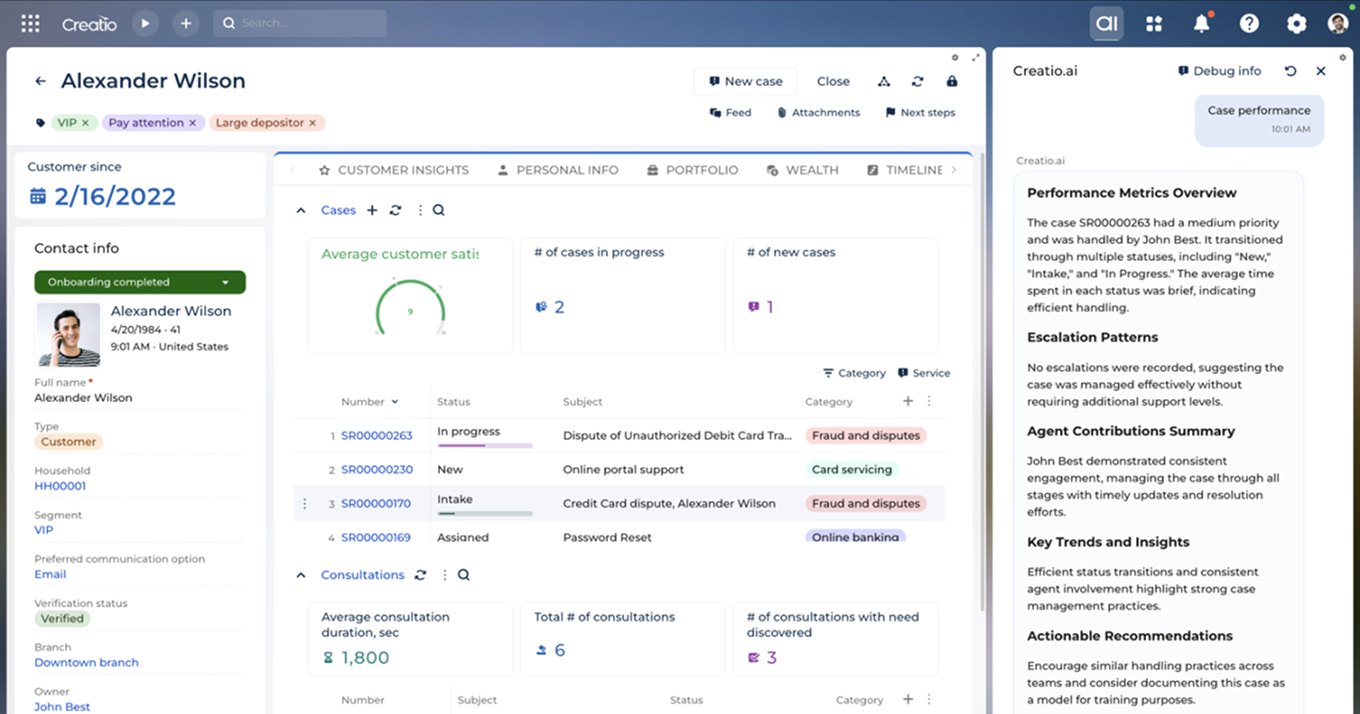
Example of Creatio Finserv AI agent
AI agents for finance can help automate a range of finance activities, including:
- Transaction monitoring and fraud detection: monitoring financial transactions, identifying unusual activity, and triggering predefined actions or alerts to help reduce fraud risk.
- Invoice management: processing invoices, matching them with purchase orders, indentifying discrepancies, and supporting approval workflows.
- Loan processing: helping financial institutions assess loan applications, evaluate creditworthiness, and support leading decisions in line with predefined policies and risk criteria.
- Portfolio management: helping wealth managers and investment firms monitor market conditions and recommend or execute portfolio adjustments in line with clients’ objectives and risk tolerance, where appropriate.
Agentic AI systems can analyse transaction patterns to identify suspicious activity, helping organisations detect potential cyber threats and money laundering. For example, if an AI agent detects an unusual transaction on a customer’s account from a foreign location, it can place the transaction on hold, notify the customer through a mobile application, and request verification before the payment is processed, preventing potential fraud.
Creatio's agentic AI for enterprises: driving business innovation and digital transformation
Agentic AI is reshaping how organisations operate, compete, and deliver value by enabling intelligent, autonomous, and self-optimising process automation. A great example of agentic AI for enterprise needs is Creatio - an agentic CRM and workflow platform with no-code that brings together generative, predictive, and agentic AI. It helps organisations automate end-to-end business processes, enhance customer engagement, and improve operational efficiency through a unified platform.
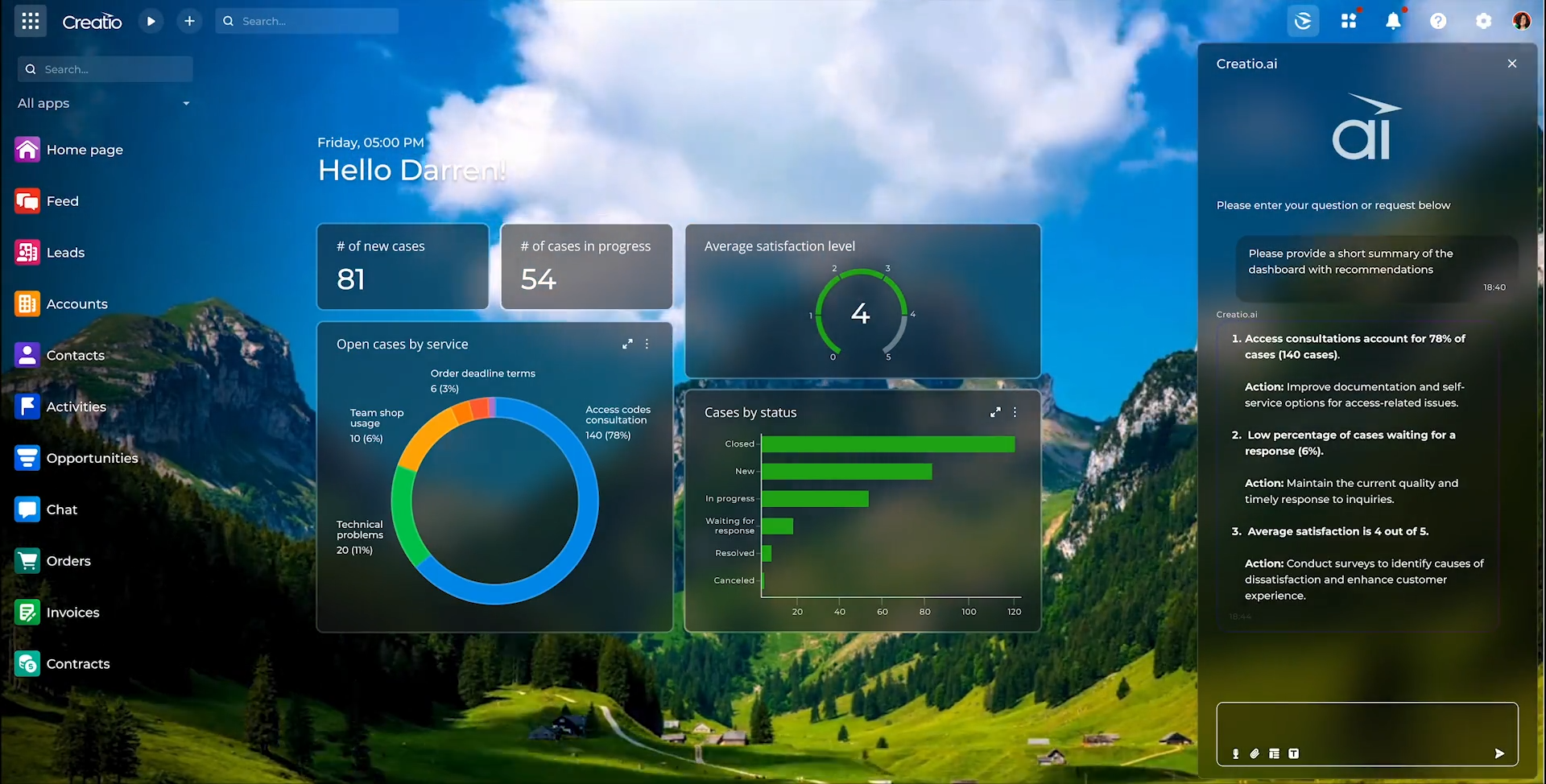
Creatio.ai
Creatio.ai is a virtual AI assistant that executes complex workflows and performs tasks on behalf of users with minimal human oversight. Thanks to native AI capabilities integrated directly into the system, users can benefit from all AI capabilities by using natural language and a simple interface. With built-in awareness of all objects, relationships, data, and processes, Creatio.ai can act upon all the information available on the platform.
AI agents are an integral component of the Creatio platform, delivering insights, prioritising work, and assisting in employees' daily tasks. They monitor the business environment, automate actions, and recommend next steps to enhance employee productivity.
Creatio provides a wide range of AI agents designed for specific job functions:
- Sales: businesses can accelerate deal cycles by using Sales AI agents, such as Account Research Agent, a Meeting Agent, and a Quote Generation Agent to accelerate administrative work, personalise communication, and proactively recommend relevant next steps based on intelligent insights and real-time context.
- Marketing: marketing teams can use dedicated AI agents, including Marketing Content Agents, Email Generation Agents, and Lead Conversion Agents, to scale content creation and automate campaign execution.
- Service: customer support teams can use AI agents to help improve the speed and consistency of case resolution. By leveraging insights provided by a Customer Support Agent and a Knowledge Base Agent, they can streamline communication across channels and provide more personalised customer interactions.
- Finance: financial institutions can use purpose-built AI agents to support a wide range of activities, including customer onboarding, credit scoring, underwriting, fraud prevention, and KYC/AML compliance.
Employees can customise existing AI agents to suit individual preferences and specific tasks, or create new AI agents to meet unique business requirements. With Creatio's composable no-code architecture, users can build new AI agents without writing code and integrate them seamlessly into existing workflows.
Creatio.ai is designed with security, transparency, and accountability at its core. It provides enterprise-ready controls for data privacy and compliance, helping organisations adopt AI without while maintaining governance and trust. With a strong emphasis on human oversight, Creatio.ai incorporates a human-in-the-loop approach to help ensure AI-driven decisions remain transparent, aligned with organisational policies and subject to appropriate human review.
Power Smarter Ops with Creatio.ai
Reduce operational inefficiencies and maximise productivity gains with Creatio
Future of agentic AI
Artificial intelligence is evolving rapidly, from automating repetitive tasks to supporting more intelligent and autonomous systems. As organisations adopt agentic AI more widely, the workplace is likely to evolve, with AI agents taking on increasingly complex responsibilities, working alongside employees and making decisions independently within defined business processes.
The following are some of the key ways agentic AI is expected to develop in the years ahead and the potential impact it could have on organisations:
Growing adoption of agentic AI technology
As adoption increases, agentic AI is expected to reshape business operations by enabling more autonomous workflows and supporting better decision-making capabilities. According to Gartner, by 2028 around 33% of enterprise software applications are expected to incorporate agentic AI, up from less than 1% in 2024. Forrester’s predicts that, over the next three years, confidence in agentic AI will continue to grow, with enterprises increasingly using autonomous agents to manage a significant portion of business processes.
Gartner also forecasts that by 2028, up to 15% of day-to-day work decisions could be made autonomously. Organisations that adopt agentic AI strategically are likely to be better positioned to improve efficiency.
Evolution of agentic AI systems
According to Forrester, agentic AI is expected to evolve from role-specific agents to multi-agent systems capable of coordinating multiple use cases simultaneously. As technology matures, groups of AI agents are expected to communicate and collaborate to execute increasingly complex, multi-step processes.
Forbes suggests that AI agents are likely to evolve from standalone tools into collaborative assistants. As adoption grows, employees are expected to work more closely with AI agents, using them to support day-to-day operations, strategic initiatives and business innovation.
At Creatio, we believe agentic AI should enhance human potential rather than replace it. That’s why our platform is designed to enable seamless collaboration between people and digital talent. AI agents integrate into everyday workflows, adapt to individual tasks and preferences, and help improve productivity by taking on repetitive and time-consuming tasks. This allows employees to focus on higher-value strategic and creative work. By combining human expertise with AI-driven automation, organisations can improve productivity, efficiency, and agility, while building more adaptive business operations.