








































































AI in Finance - How Artificial Intelligence Transforms Financial Operations

Personalize Finance Services Using Creatio.ai

Artificial intelligence in finance initially started as copilots, intelligent tools that enhance productivity, automate routine tasks, and support decision-making. Financial institutions used AI to improve efficiency across customer service, fraud detection, and data analysis, enabling employees to work faster and more accurately.
In 2026, the role of AI is rapidly evolving. It’s no longer limited to assisting humans. It is increasingly capable of acting autonomously through AI agents that can analyze information, make decisions, and execute multi-step workflows across financial operations without waiting for human input. This marks a fundamental shift from AI as a productivity enhancer to AI as an execution layer.
With 63% of the surveyed finance leaders actively using AI in their departments, and 21% already see clear, measurable return on investment, Artificial Intelligence in finance is no longer seen as optional, but as a core capability that will define future competitiveness.
This article explores what AI in finance means today, how it is used across key finance functions, the benefits and challenges of AI adoption, and how the rise of autonomous agents is reshaping the future of financial services.
Key Takeaways
- AI in finance refers to a suite of advanced technologies, including machine learning, generative AI, and natural language processing, that automate core financial processes, enhance productivity, improve accuracy, and support decision-making.
- AI in the financial services industry is evolving from assistive copilots to autonomous AI agents that can analyze data, make decisions, and execute complex workflows across finance functions with minimal human intervention.
- AI is transforming core financial processes, including fraud detection, customer service, credit scoring, risk management, regulatory compliance, financial planning, and capital markets operations.
- AI-powered workflow automation enables financial institutions to streamline end-to-end processes, including customer onboarding, loan preparation and servicing, claims management, payments processing, and regulatory reporting.
- AI in finance supports institutions across all operations, enhancing operational efficiency, increasing productivity, improving decision-making and security, and supporting better customer experiences.
- The future of AI in finance lies in hybrid models, where humans provide oversight, judgment, and control, while autonomous AI agents handle execution, automation, and scale.
- Creatio AI empowers intelligent financial operations by combining CRM agents and autonomous AI agents, helping institutions automate processes, improve decision-making, and deliver better customer experiences at scale
What is AI in Finance?
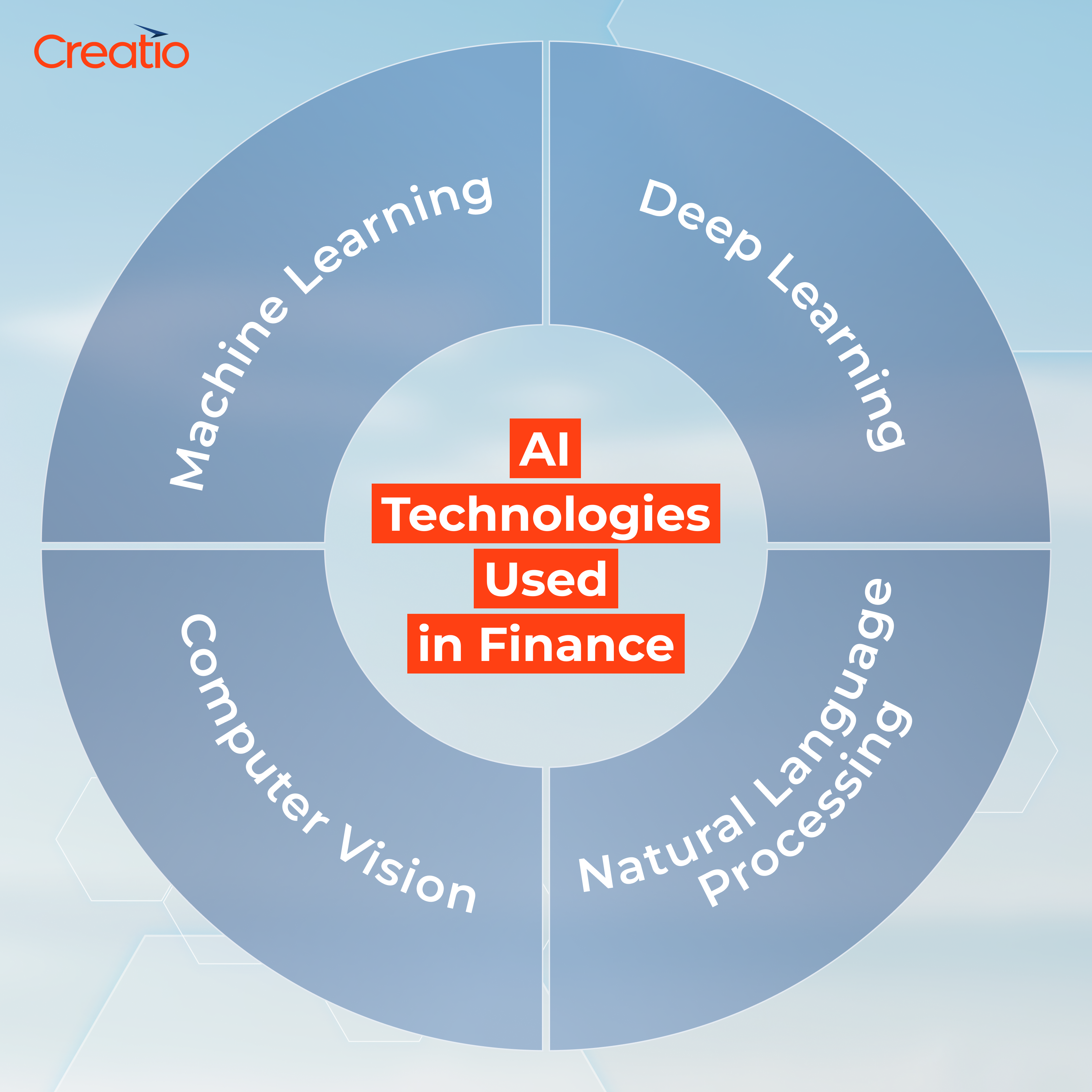
AI in finance refers to the use of advanced technologies, including machine learning, natural language processing, and automation, to improve how financial institutions analyze data, make decisions, and execute operations. It is widely applied in areas such as fraud detection, risk management, trading, customer service, and back-office automation, enabling greater efficiency, accuracy, and regulatory compliance.
In recent years, AI in finance has evolved from primarily generative AI and assistive tools that support human tasks to more agentic systems capable of independently planning, decisioning, and executing multi-step workflows.
Benefits of Finance AI
According to Creatio’s State of AI Agents and No-Code report, Finserv Edition, 87 % of business leaders in the financial industry believe AI agents will augment teams to drive productivity, create growth opportunities for current staff, or create new roles within the organization. Here’s a list of key benefits that AI in finance brings:
Enhancing operational excellence
AI streamlines operations for financial organizations by helping them avoid errors that can easily be made by human workers due to the volume of data and operations. Routine processes, such as data entry, transaction processing, and compliance checks, are prone to mistakes when performed manually. AI systems, however, can execute these tasks with high precision and consistency, ensuring accuracy and reliability.
With its ability to process vast data sets, artificial intelligence improves the accuracy of forecasting, planning, and modeling. For instance, in sales forecasting, AI algorithms can analyze vast amounts of data and identify patterns that humans might miss. This leads to more accurate predictions and better decision-making.
Better customer experience
AI enhances the way finance professionals engage with clients and automates routine customer interactions, making services more accessible. For instance, customers can apply for loans and credit cards and receive immediate responses from an AI chat bot without waiting for an available agent. The same AI bot can flag more complicated cases that require human intervention, ensuring that all customers receive timely and appropriate attention, leading to higher overall satisfaction.
Additionally, AI enables finance professionals to provide more personalized interactions. Marketing departments can use AI-driven data to tailor their campaigns, while sales representatives and customer service agents can offer customized communication and experiences.
For example, in wealth management, an AI assistant can compile data from various systems to prepare comprehensive summaries for client presentations, supporting advisors with accurate and timely information. AI-powered automation can also offer personalized recommendations for customers, creating opportunities for upselling.
Increased productivity
AI increases the productivity of financial organizations by automating time-consuming tasks, such as market research or fraud detection, which reduces the workload on employees and minimizes errors.
According to the McKinsey Global Institute (MGI), gen AI could add between $200 billion and $340 billion in value annually in the banking industry, largely by increasing employee productivity.
Moreover, automated tasks are performed at a higher velocity, meaning a higher volume of operations with fewer resources engaged. For instance, AI-driven algorithms can execute trades at high speed and with precision, optimizing trading strategies and increasing returns while reducing the need for manual intervention.
Improved decision-making supported by data insights
AI supports decision-making in financial organizations by unlocking deeper insights from both structured and unstructured data. It reveals patterns and trends that would be impossible for humans to detect alone. This advanced data analytics enables financial institutions to make more informed, strategic decisions, ultimately improving their performance.
For example, banks can utilize AI algorithms to swiftly analyze market data and news to improve risk management and guide investment decisions and trading strategies.
Improved security
AI systems and machine learning models can spot potential threats more effectively than human analysts due to the real-time calculations and analysis of transactions. By closely monitoring purchase behavior and comparing it to historical data, AI can flag anomalous activity, automatically alert both institution and customer to verify the purchase or transfer in real time, and if needed, take action to resolve it.
How AI is Used in Financial Services
The applications of AI tools in the finance industry are constantly expanding and evolving along with the technology itself. According to Creatio’s research, financial leaders prioritize AI agents to support the frontline functions, with 59% of agents deployed in service, sales, marketing, and customer success teams.
Additionally, according to Deloitte, AI agents in finance are often deployed in financial planning and analysis (52%), sales and profitability management (48%), working capital optimization (46%), and expense management (44%).
Here's a list of current use cases for AI that can bring business value to any financial institution.
Automation of financial workflows
AI in the financial industry can automate routine tasks across front-, middle-, and back-office operations. By combining machine learning, rules-based logic, and agentic AI capabilities, organizations can streamline processes, reduce manual effort, minimize errors, and accelerate execution.
Typical financial workflows that AI can automate include:
- Loan and credit processing - automates application intake, document verification, risk assessment, underwriting support, and approval workflows.
- Customer onboarding - collects and verifies customer data, performing identity checks (KYC), screening against AML watchlists, and policy rules in real time.
- Insurance claims processing - automates claims intake, document analysis, fraud detection, damage assessment, and streamlines approvals or escalations.
- Underwriting - assesses risk by analyzing applicants' financial data, credit history, external sources, and historical patterns to streamline underwriting decisions.
- Payments and transaction processing - automatically routes payments, detects anomalies, reconciles transactions, and handles exceptions in real time.
- Regulatory reporting - collects required data, generates reports, validates accuracy, and submits to regulators.
- Collections and debt management - identifies delinquent accounts, prioritizes outreach, automates communication, and recommends next-best actions.
As AI evolves toward more autonomous agents, these workflows are increasingly handled end-to-end, with minimal human intervention.
Customer service agents and chatbots
Conversational AI and natural language processing enable financial institutions to provide 24/7 customer support through chatbots that handle routine interactions such as checking account balances, answering common questions, providing transaction details, and guiding users through basic processes.
More advanced AI agents for customer service extend these capabilities beyond simple interactions. Instead of just answering questions, they can resolve requests end-to-end, such as disputing a transaction, updating account information, onboarding new customers, or coordinating multi-step service workflows. Gartner predicts that by 2029, AI agents will autonomously resolve 80% of common customer service issues, eliminating the need for human intervention in most routine cases.
For instance, American Express offers a chatbot called Ask Amex to dispute charges. AI agents help resolve flagged legitimate purchases without waiting on hold or dealing with confusing websites. Customers can give the details of the flagged transaction to the AI agent that can help customers explain the transaction, upload receipts, and verify their identity.
Credit scoring and risk assessment
AI can analyze diverse datasets beyond financial data, including social media activity, utility payments, geological patterns, and online behavior, to assess credit risk and customer eligibility.
Beyond individual scoring, AI models also support broader risk assessment and management by identifying transaction patterns, predicting potential defaults, and detecting emerging risks across portfolios.
Fraud detection and prevention
AI-powered fraud detection systems use ML and deep learning models to continuously analyze transaction data, customer behavior, and contextual signals in real time. By identifying anomalies and deviations from usual patterns, AI can detect fraudulent activities such as unauthorized transactions, account takeovers, financial crime, and market manipulation. By leveraging an AI-powered solution, Mastercard boosted fraud detection rates by an average of 20% and reduced false positives by over 85%.
Autonomous AI goes beyond detection to automatically trigger responses, such as blocking transactions, flagging high-risk activities, or initiating investigation workflows. This significantly reduces response time, improves accuracy, and strengthens security across online banking, card transactions, and trading.
According to industry research by Deloitte, insurers using AI and advanced analytics can cut fraud-related costs by 20% to 40%, depending on implementation and insurance type.
Algorithmic trading and capital markets
AI is widely used in algorithmic trading to analyze market trends, identify patterns, and execute trades at speed and scale. By processing vast amounts of historical and real-time data, AI models can detect market opportunities, optimize trading strategies, and respond to market changes faster than human traders.
Regulatory compliance and Anti-Money Laundering (AML)
AI in finance automates compliance processes by continuously monitoring transactions and regulatory requirements. Machine learning models can detect suspicious activities, identify potential money laundering patterns, and flag anomalies that may require investigation.
By automating reporting, screening, and risk assessment, AI agents reduce manual effort, improve accuracy, and enable faster response to regulatory obligations. This allows organizations to stay compliant with evolving local and global regulations while strengthening overall risk management.
Financial planning, forecasting, and predictive analysis
AI in finance helps individuals and advisors make better financial decisions by analyzing goals, spending behavior, income patterns, and risk tolerance. Based on these insights, it can deliver tailored financial advice, personalized budgeting recommendations, savings guidance, and investment strategies.
At the same time, AI-powered tools enhance forecasting and analysis by identifying cash flow trends, predicting future outcomes, and modeling different financial scenarios. This allows finance teams to anticipate risks, optimize strategies, and adjust plans dynamically as conditions change.
Predictive analytics uses AI models to identify patterns in historical data and predict future outcomes. This capability is valuable for financial institutions seeking to anticipate risks and spot new opportunities. It also supports tasks such as cash flow management, where AI forecasts liquidity needs.
More advanced AI-powered systems can continuously learn and adapt, providing proactive insights and recommendations that improve both short-term decisions and long-term financial outcomes.
Personalized marketing and recommendations
AI can provide personalized recommendations for financial products and services, such as investment strategies or banking offers tailored to customer journeys, peer interactions, risk preferences, and financial goals.
Moreover, by analyzing customer journeys, generative AI can help create targeted emails and online campaigns that lead to higher conversions and better business outcomes.
Document processing and data extraction
AI in the finance industry can extract and analyze data from both unstructured and structured sources, such as emails, photos, and documents, to streamline document-intensive processes like loan servicing, claims processing, and investment opportunity discovery.
This report by Forrester describes an insurance company that uses a text analytics agent to rename, file, and categorize documents. According to the firm’s owners, “With AI agents, we were able to remove 25% of responsibility from assistants, allowing them to focus on more meaningful tasks rather than mundane work. Tasks like renaming documents are time-wasting activities that crush everyone’s spirit.”
Cybersecurity
AI plays a critical role in protecting financial institutions by securing IT infrastructure, applications, and access points. It analyzes network traffic, user activity, and system behavior to detect threats such as malware, phishing attempts, unauthorized access, and insider risks.
Unlike traditional security tools, AI can identify previously unseen attack patterns and respond in real time by isolating compromised systems, enforcing adaptive authentication, or blocking suspicious access attempts.
Challenges in Financial AI Implementation
While AI technology can bring incredible business value to financial services organizations and business leaders, there are still some challenges. In this section, we wanted to go through the challenges posed by AI tools and give tips on how to resolve them.
Flaws in communication
Despite the many benefits of conversational AI, customers of financial services companies may perceive it negatively due to imperfections in non-human communication. AI chatbots can come across as too impersonal or formulaic, and their capability to resolve complex issues is limited, leading to frustration and reduced engagement.
To combat these issues, it is crucial to carefully craft and implement sophisticated technology that can handle complex queries and provide personalized responses. Ensure that your bots are capable of understanding and appropriately responding to a wide range of customer interactions and will transfer the conversation to a human agent at the first moment of miscommunication and frustration.
Additionally, regularly updating AI algorithms to better mimic human-like interactions and monitoring customer feedback can help maintain high customer satisfaction.
The need for outstanding development resources
Companies often cite development and logistical problems when talking about the failures to launch their AI projects. Developing bespoke AI technology often requires a lot of talented software engineers, making these tools inaccessible for some organizations.
Companies should prioritize smart resource allocation, choose effective business automation software, and leverage no-code tools to mitigate this issue. Ensure that skilled professionals are directed toward high-impact areas. Selecting robust business automation platforms with powerful turn-key AI tools accelerates the implementation process.
No-code development platforms, like , enable institutions to create their own ML models without requiring extensive coding expertise. This approach not only reduces dependency on specialized developers but also accelerates project timelines and enhances flexibility, ultimately improving the chances of successful AI project deployment.
IT and data infrastructure required for AI
Managing AI workloads with massive data volumes and intensive model training can be prohibitively expensive due to the server power required. Although many institutions opt for cloud infrastructure, stringent regulatory requirements around data security and residency often pose barriers to cloud adoption.
The volume of unstructured data in organizations is another challenge. Clean, representative data for training AI models is essential, as the quality of these models directly depends on the quality of data used. For AI solutions to function effectively, data must be organized in an orderly fashion.
However, many banks have fragmented data architectures spanning decades-old systems. Additionally, integrating modern AI tools with these legacy IT systems can be challenging.
It's recommended to implement robust data management processes to ensure data quality and integrity. You can also utilize customizable business tools that facilitate data governance and the integration of AI with your system.
Data privacy, security, and compliance
Financial organizations handle sensitive financial data daily thus security is a huge priority. AI systems must protect this data and adhere to industry- and region-specific regulations, from credit decisions to trade surveillance. This compliance often involves extensive record-keeping and model documentation.
Ensure AI systems you use have robust security measures to protect sensitive information and are designed to meet specific industry and regional guidelines. Additionally, review the governance capabilities provided by the platforms you use and establish proactive governance procedures.
AI ethics
AI, trained on human-provided data, can inadvertently pick up and incorporate biases into its models, potentially leading to discriminatory decisions. For instance, if historical data around credit scores reflects biases against certain demographic groups, an AI model trained on this data might continue to disadvantage these groups.
To combat this issue, financial institutions should establish robust oversight and clear rules for AI application and implement these strict ethical guidelines.
Creatio AI in the Financial Industry
Creatio AI for finance brings together predictive, generative, and agentic AI into a unified architecture, empowering financial institutions to move from simple automation to intelligent, end-to-end execution of business processes.

Creatio is an agentic no-code platform that combines CRM, workflow automation, and AI into a single system designed to streamline and transform financial services operations. Unlike traditional solutions that add AI on top of legacy systems, Creatio embeds AI directly into the core platform, enabling organizations to design, deploy, and manage AI-driven workflows and agents without coding. At the core of the platform are AI agents - digital teammates that can understand context, make decisions, and execute tasks across workflows.
Creatio provides two main categories of agents:
CRM AI agents
These agents support customer-facing teams across sales, marketing, and service, helping them automate repetitive tasks, gain real-time insights, and deliver personalized customer experiences.
- Sales agents assist with lead qualification, forecasting, next-best actions, and more.
- Marketing agents automate segmentation, lead management, campaign optimization, and content generation
- Service agents classify requests, summarize cases, and support faster case resolution
By automating routine work and surfacing actionable insights, CRM agents help teams focus on higher-value activities and improve overall productivity.
Autonomous AI agents
Designed specifically for financial institutions, these agents automate finance industry-specific workflows across the customer lifecycle and operations.
Key examples include:
- Customer onboarding agents - streamline KYC, data collection, and account setup
- Loan preparation and servicing agents - support underwriting, document and payment processing, and ongoing loan management
- Referral, renewal, and retention agents - drive account and revenue growth
- Operational agents - automate processes that improve efficiency and reduce manual workload
These autonomous agents are built to deliver value in areas such as revenue generation and operational excellence, helping banks and financial institutions scale faster and operate more efficiently. Notably, those agents can be deployed independently of the Creatio platform onto legacy systems, enabling financial organizations to realize the value of AI without complex system replacements or disruptive transformations.
For example, the referral agent analyzes relevant information to identify and act on referral opportunities that might otherwise be overlooked because data is often scattered across different business units, teams, and products. When it recognizes an opportunity, it automatically routes it to the appropriate team with the full context to support effective outreach. To ensure the process moves forward, the agent tracks progress and follows up if necessary.
Creatio also places a strong emphasis on AI governance, security, and human oversight, which is critical in highly regulated industries like financial services. AI agents operate within clearly defined rules, access controls, and audit frameworks, ensuring transparency and compliance with regulatory requirements.
With a human-in-the-loop approach, organizations maintain full control over decisions, approvals, and exceptions, while sensitive financial data is protected through enterprise-grade security and responsible AI practices. This ensures that AI-driven automation remains trustworthy, explainable, and aligned with organizational policies and industry standards.
Find out how Creatio's agentic platform helps financial institutions deploy workflows 70% faster and cut tech costs by 30%.
By combining CRM capabilities with agentic AI and no-code automation, Creatio enables financial institutions to move beyond isolated use cases and orchestrate end-to-end processes across front-, middle-, and back-office operations. This allows organizations to improve efficiency, enhance customer experiences, and adapt quickly to changing market and regulatory conditions.

The Future of Finance AI
The future of AI in finance is defined by a fundamental shift from AI as a productivity enhancer to AI as an autonomous execution layer. While early AI adoption in the financial sector focused on copilots that helped employees analyze data, generate actionable insights, and automate simple tasks, the next wave is driven by autonomous agents that act as digital employees, capable of managing end-to-end workflows.
This shift is already reflected in industry expectations and investments. According to the World Economic Forum, 70% of financial services executives believe AI will directly contribute to revenue growth in the coming years. At the same time, Gartner predicts that the banking industry will invest over $28 billion in AI software by 2027, highlighting the scale of their commitment to AI-driven transformation. Looking further ahead, according to Statista, AI adoption could add up to $170 billion to the global banking sector’s profit pool by 2028, demonstrating its potential to transform the financial sector.
In practice, financial institutions are prioritizing high-impact, high-volume use cases for AI agents. According to Creatio's research, 73% of financial leaders see AI as critical and strategically important in the next 2-3 years. They focus future implementations on administrative and operational workflows (33%), followed by sales and lead management (24%), specialized processes like underwriting and risk (22%), and customer service (18%). This reflects a pragmatic approach centered on areas where AI can deliver clear, measurable value.
However, rather than replacing assistive AI with fully autonomous systems, leading financial institutions are adopting a hybrid approach in which human intelligence and AI agents work together. Humans remain responsible for strategy, judgment, and oversight, while AI agents execute tasks at scale, enabling greater efficiency without losing control.
Summary
AI is becoming a foundational capability in financial services, enabling organizations to improve efficiency, reduce operational costs, and deliver better customer experiences. It is also redefining how financial institutions operate by transforming how work gets done across the entire organization. As adoption accelerates, the key differentiator will not be whether organizations use AI, but how effectively they integrate it into their operating models.
Agentic platforms like Creatio enable this shift by bringing together AI, workflow automation, and CRM in a single environment, helping financial institutions scale innovation with confidence.
