



































































AI CRM Software: Benefits, Use Cases & Top Platforms in 2026

AI CRM: Achieve Powerful Productivity Gains

AI is no longer a future capability in CRM, it’s already embedded in how organizations operate and make decisions. According to McKinsey, nearly 90% of companies use AI technology in at least one business function, with customer-facing teams among the leading adopters, according to Creatio’s The State of AI agents & No-Code report.
From lead management to personalized marketing and automated service, AI is actively influencing day-to-day CRM operations. As expectations for speed, personalization, and efficiency continue to rise, traditional CRM systems are simply not enough.
As a result, CRM is evolving from a tool for managing data into a system that actively drives decisions and execution. AI-powered CRM systems represent this shift, enabling organizations to turn customer data into real-time actions, automate complex processes, and deliver more relevant experiences at scale.
Key Takeaways:
- AI CRM is a customer relationship management system that uses artificial intelligence and AI agents to automate workflows, drive decisions, and execute actions across sales, marketing, and service.
- Key benefits of AI-powered CRM include increased productivity, reduced operational costs, higher conversion rates, improved customer satisfaction, and real-time personalization at scale.
- Common use cases span sales processes (lead management, outreach, forecasting), marketing tools (campaign optimization, segmentation, personalization), service workflows (automated support, case routing, proactive issue resolution), and cross-functional workflow automation.
- Best AI CRM solutions include platforms such as Creatio, Salesforce, Microsoft Dynamics 365, HubSpot, and others, with key differences in flexibility, complexity, and the level of AI-powered automation.
- Top AI CRM platforms combine AI agents, workflow automation, and composable architecture to deliver measurable business outcomes and adapt to changing business needs.
What is AI CRM?
AI CRM is a new generation of customer relationship management software that embeds artificial intelligence directly into business processes to drive smarter decisions, faster execution, and more meaningful customer engagement. Rather than simply automating repetitive tasks, AI CRM understands context, identifies opportunities, and takes action to move work forward across sales, marketing, and service.
A key component of AI CRM is the use of AI agents, intelligent, goal-oriented digital entities that can operate independently within workflows. These agents don’t just assist users; they can initiate outreach, recommend and execute next-best actions, adjust personalized marketing campaigns in real time, and resolve customer requests with minimal human involvement.
Unlike traditional CRM systems, which depend heavily on manual work, static workflows, and retrospective reporting, AI CRM is proactive and adaptive by design. Instead of serving as a system of record, it becomes an intelligent system of action, continuously learning, making decisions, and driving outcomes across the entire customer lifecycle.
Benefits of AI-Powered CRM Systems
AI CRM transforms how businesses operate by turning data into action. From reducing manual effort to improving conversion rates and customer retention, it drives tangible improvements across business operations.
Increased productivity
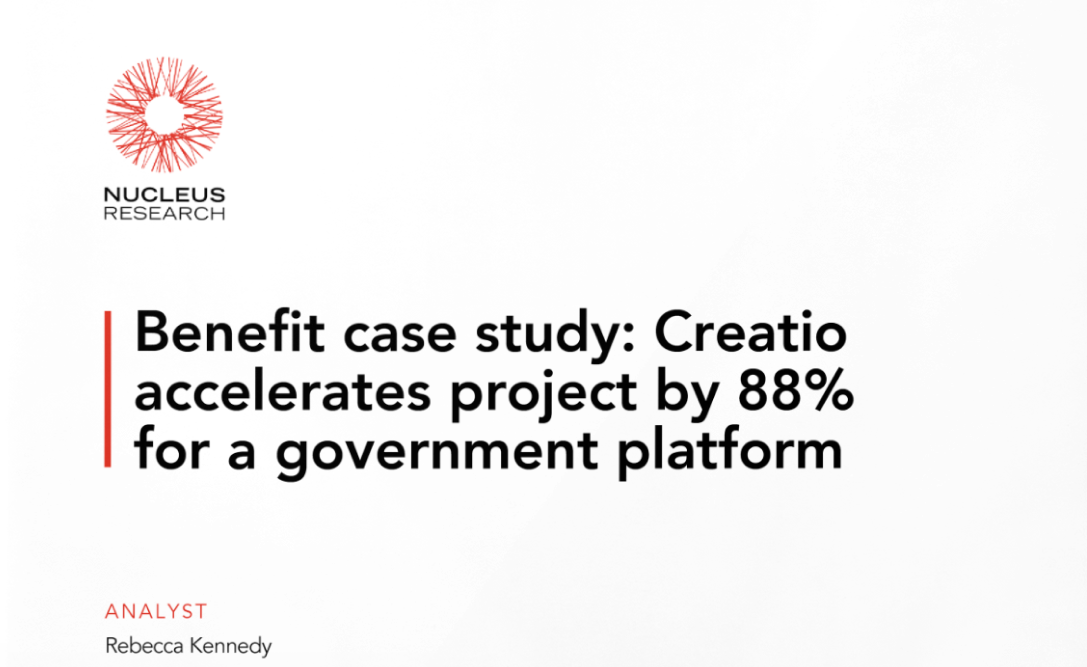
AI CRM reduces the time spent on manual data entry, coordination, and decision-making. By offloading repetitive work and simplifying complex processes, it enables marketing, sales, and service teams to focus on high-value activities such as building relationships and resolving cases. AI agents further accelerate this by autonomously triggering actions, updating data, and moving processes forward without waiting for human input, cutting operational time by hours or even days.
Higher conversion rates with less effort
By analyzing user behavior, intent signals, and historical data, AI-powered CRM identifies the most promising potential customers and recommends, or executes, the next best action. AI agents can act on these insights in real time, initiating outreach or prioritizing leads automatically, helping teams increase win rates and campaign performance without increasing headcount.
According to research by McKinsey, AI implementation in CRM has the potential to increase leads by more than 50%, reduce costs by up to 60%, and cut call time by up to 70%, significantly improving sales efforts.
Reduced operational costs and better resource allocation
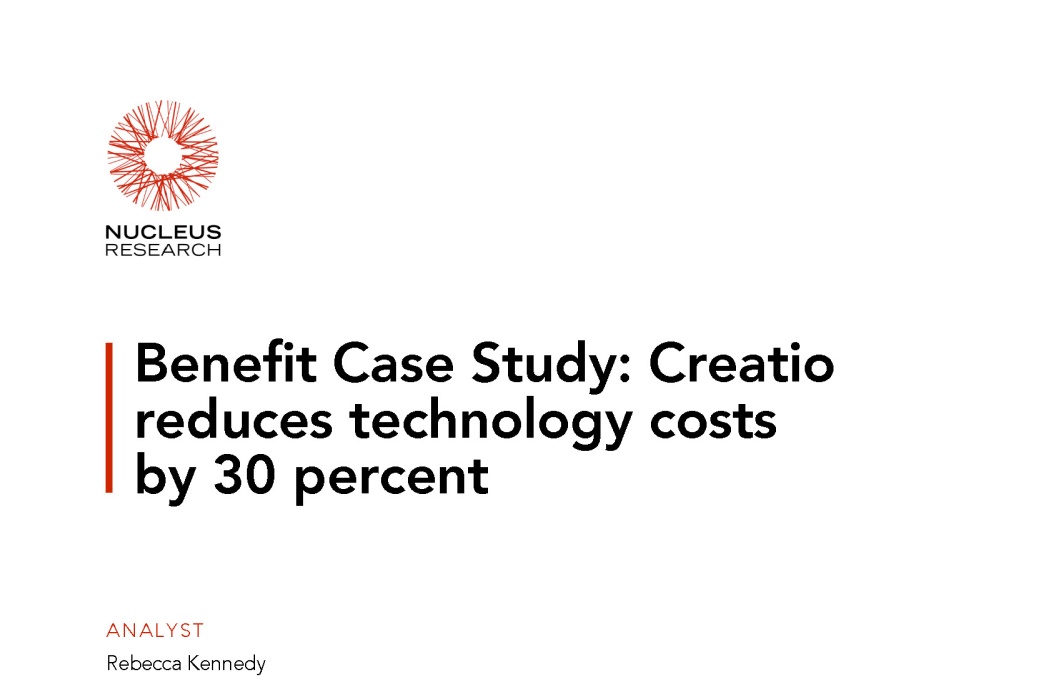
AI agents take over repetitive and time-consuming tasks, lowering the cost per interaction, reducing reliance on manual labor, and allowing teams to scale operations without proportional increases in staffing. According to Gartner, by 2029, tasking AI agents with resolving common customer service issues will result in a 30% reduction in operational costs.
Beyond automation, AI CRM uses real-time data to dynamically allocate resources toward high-impact opportunities, improving ROI. It also identifies inefficiencies and overspending, helping organizations eliminate waste and optimize resource utilization.
Consistent customer engagement
For global companies, being connected to their customers 24/7 has always been a challenge due to different time zones of operations. AI CRM effectively eliminates the necessity for employees to work unconventional hours or for businesses to establish separate customer service and sales departments in each region. By leveraging AI-powered chatbots equipped with natural-language-processing (NLP), businesses can promptly address customer inquiries in real time.
Gartner predicts that by 2029, AI agents will autonomously resolve 80% of common customer service issues, eliminating the need for human intervention in most routine cases.
Increased customer satisfaction
Personalized experiences are no longer optional; they directly influence whether customers stay or leave. In fact, according to McKinsey, 71% of consumers expect personalized interactions, while 76% get frustrated when experiences are impersonal.
AI CRM systems enable businesses to meet these customer expectations consistently by analyzing customer data, such as past interactions, purchase history, preferences, and real-time behavior, and using it to shape every touchpoint. It determines what message to send, when to send it, and through which channel, ensuring each interaction feels relevant and timely rather than generic. Personalized communication increases customer satisfaction, drives repeat business, and fosters long-term loyalty.
Lower churn and extended customer retention
By leveraging predictive analytics, businesses can identify at-risk customers early and take proactive steps to retain them. AI agents can flag churn signals, recommend the next best action, and even initiate personalized outreach, whether that’s a targeted offer, timely follow-up, or relevant content that addresses specific concerns.
This approach goes beyond reactive service. Instead of waiting for dissatisfaction to surface, companies can intervene at the right moment with the right message. As a result, it not only reduces churn but also strengthens loyalty, driving long-term relationships and sustainable revenue growth.
Data-driven decision-making
AI CRM surfaces insights, risks, and opportunities automatically, helping teams act based on data rather than intuition. From forecasting revenue to identifying churn risks, it enables more accurate planning and reduces costly mistakes. According to Gartner, by 2028, AI agents will not only provide insights but also autonomously handle 15% of daily workplace decisions.
Whether identifying emerging trends, predicting customer behavior, or optimizing operational processes, AI CRM systems empower organizations to navigate the complexities of the modern business landscape with clarity and precision.
Continuous optimization of processes
AI agents don't just execute tasks; they continuously learn from outcomes. Over time, AI CRM enables organizations to refine workflows, improve targeting, and optimize performance. This ensures processes become more efficient without requiring constant manual redesign.
Top Use Cases for CRM platforms with AI
AI-powered CRM enables organizations to apply artificial intelligence directly to customer-facing processes, improving efficiency, decision-making, and outcomes across the entire customer lifecycle. From automating routine tasks to executing complex workflows, AI CRM supports a wide range of use cases across sales, marketing, and customer service.
Sales
- AI-driven lead scoring - AI analyzes customer data, behavioral signals, engagement history, and firmographic information to support predictive lead scoring and identify high-value prospects. AI agents can automatically score, qualify, and route leads, ensuring sales teams focus on opportunities most likely to convert.
- Next-best step recommendations - AI tools evaluate deal context and suggest the most effective next step, whether it’s scheduling a call, sending tailored content, or offering a discount. In advanced scenarios, AI sales agents can execute these actions automatically.
- Automated outreach and follow-ups - AI agents generate and send personalized emails or messages based on customer context and timing, ensuring no opportunity is missed.
- Territory management - AI optimizes territory planning by analyzing account potential, geographic data, and sales rep performance. It helps ensure balanced workloads, identifies underserved areas, and can dynamically adjust territories to maximize coverage and revenue.
- Meeting preparation - AI agents inside CRM software compile relevant customer insights, including recent interactions, deal status, preferences, and risks, into concise summaries before meetings. This enables sales reps to prepare faster and engage with context and confidence.
- Sales forecasting and pipeline insights - AI improves sales forecast accuracy by analyzing historical data, market trends, deal progression, and risk signals, helping leaders refine sales strategies and make more informed revenue decisions.
Find out more about the AI use cases for sales.
Marketing
- Campaign optimization in real time - AI continuously monitors campaign performance and reallocates budget, messaging, or channels to maximize results. Marketing AI agents can adjust campaigns dynamically based on live KPIs, without waiting for human input.
- Audience segmentation and targeting - Instead of static segments, AI CRM helps build dynamic audiences based on customer behavior, intent, and engagement, ensuring more precise targeting and higher conversion rates.
- Content and message personalization - generative AI tailors messaging, offers, and timing for each individual customer. AI agents can automatically deliver personalized content across email, web, and other channels.
- Lead nurturing automation - AI-driven workflows guide prospects through the funnel with relevant content and interactions, adapting in real time based on engagement.
Learn more about AI use cases for marketing.
Customer Service
- Automated case resolution - AI agents for customer service handle common inquiries instantly, answering questions, resolving issues, and updating records, reducing response times. More complex cases are routed to the appropriate customer support agent with a summary of previous interactions.
- Intelligent case classification and routing - AI analyzes request context and routes cases to the most appropriate agent or department, improving resolution speed and accuracy.
- Proactive support and issue detection - an AI agent identifies potential problems, such as churn signals or product issues, and triggers proactive outreach before customers escalate.
- Agent assistance and knowledge recommendations - AI provides customer service agents with real-time suggestions, relevant knowledge articles, and next-best actions during interactions, improving efficiency and consistency.
Find out more about the use cases of AI in customer service.
Operations and Cross-Functional Use Cases
- End-to-end workflow automation - CRM AI agents orchestrate processes across sales, marketing, and service, triggering actions, automating data entry, and ensuring workflows move forward without manual intervention.
- Data enrichment and management - AI embedded directly into CRM software can automatically capture, update, and enrich customer data from multiple sources, improving data quality and reducing manual input.
- Churn prediction and retention strategies - AI identifies at-risk customers with sentiment analysis and predictive analytics, and recommends or executes targeted retention actions, helping reduce churn and increase lifetime value.
- Revenue and performance optimization - By analyzing data across the customer lifecycle, AI-powered CRM uncovers growth opportunities, inefficiencies, and areas for improvement, driving better business outcomes.
- Productivity tools agents - AI agents can integrate directly with productivity tools like Microsoft Teams and Outlook, enabling users to interact with CRM data and workflows to summarize conversations, draft emails, schedule follow-ups, etc., without leaving their daily workspace.
10 Best AI CRM Software to Consider in 2026
Today’s leading CRM platforms integrate AI to streamline sales operations, automate marketing and service workflows, and provide data-driven insights to enhance the entire customer journey. Below is a quick comparison of the most popular AI CRM platforms that drive business workflows in 2026 and beyond.
Platform | Best for | G2 Rating |
| Creatio | A full-fledged AI CRM for sales, marketing, service and workflows with advanced no-code capabilities | 4.7 |
| HubSpot CRM | Sales, marketing, and service automation platform with AI-driven tools | 4.4 |
| Zoho CRM | Affordable CRM for workflow automation and AI-driven insights | 4.0 |
| Freshworks | Easy-to-use CRM to enhance sales efficiency and engagement with basic AI capabilities | 4.5 |
| Zendesk | CRM for sales and customer service with easy-to-use AI tools | 4.3 |
| Pipedrive | Sales CRM and pipeline management solution with AI capabilities | 4.2 |
| Nutshell CRM | Pipeline and contact management CRM with in-built AI to simplify sales activities | 4.3 |
| ClickUp | All-in-one platform to improve workplace efficiency and collaboration with AI | 4.7 |
| Salesforce | Enterprise-level AI-powered automation across the entire customer lifecycle | 4.2 |
| monday CRM | Intuitive sales CRM powered by AI tools to support everyday sales processes | 4.6 |
1. Creatio
Creatio AI CRM is a leading platform built for organizations that value customization, scalability, and speed. It combines a powerful suite of products for sales, marketing, service, and workflow automation — all unified on a no-code platform and enhanced by powerful AI agents.
With a unique blend of Generative, Predictive, and Agentic AI, Creatio empowers businesses to automate the entire customer journey, streamline CRM operations, and significantly boost team productivity. Its composable architecture and no-code tools give users the freedom to design and adapt workflows at scale, without writing a single line of code.
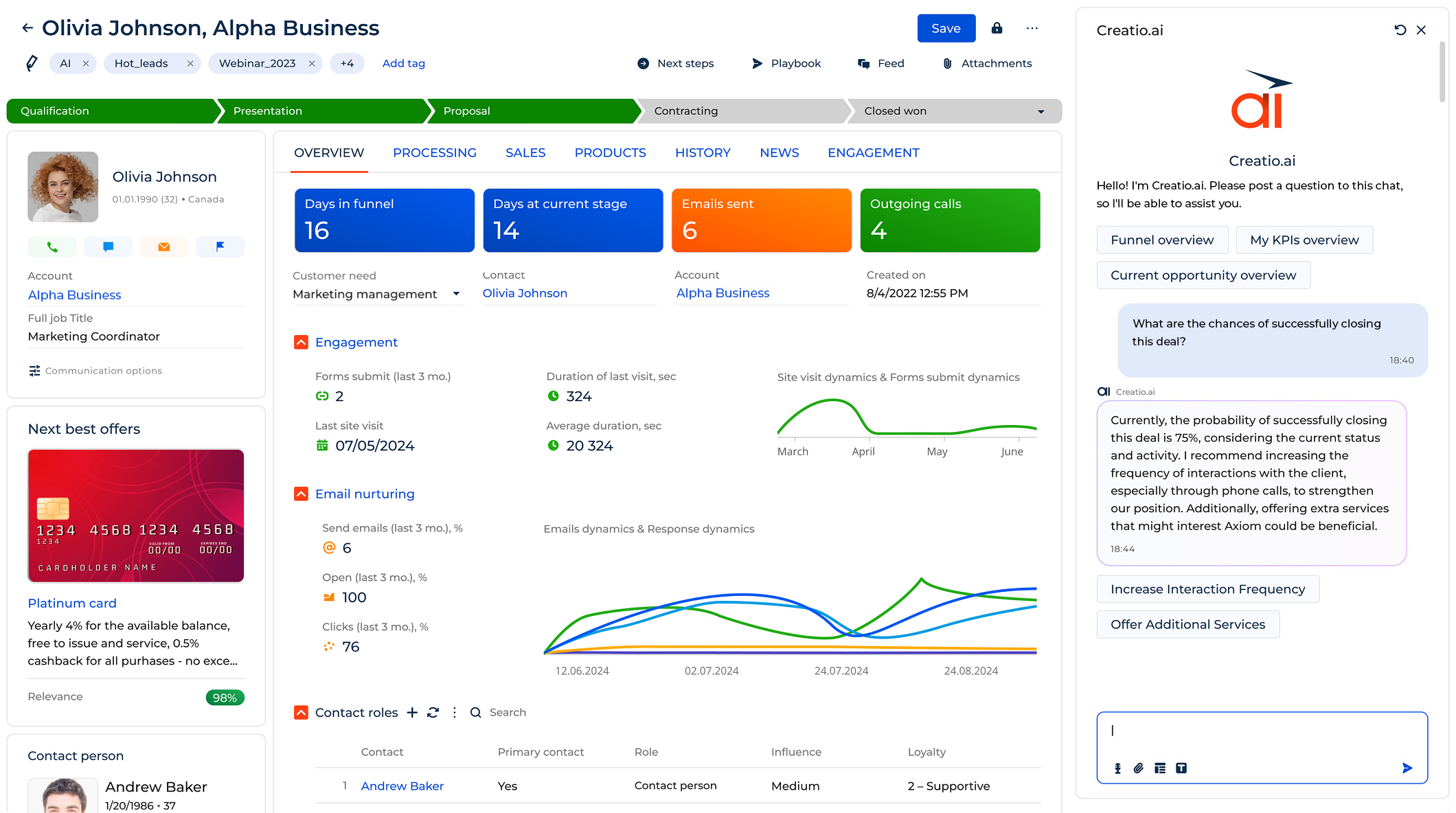
Built on top of an agentic no-code platform Creatio Studio, Creatio’s unified CRM suite is built includes the following products:
- Creatio Marketing – An AI-native marketing automation platform designed to streamline lead management and accelerate revenue growth. It enables businesses to segment audiences, track customer interactions, personalize campaigns, and optimize performance with AI-powered analytics.
- Creatio Sales – An AI-powered sales automation platform that enhances sales performance with opportunity scoring, sales forecasting, contract management, and intelligent data analytics.
- Creatio Service – A unified service management platform that elevates customer experience through AI-driven case management, problem resolution, sentiment analysis, and seamless employee collaboration.
Creatio is an AI CRM with AI agents embedded into the core of its architecture, not layered on top. Creatio AI is fully aware of all data objects, relationships, workflows, and business processes across the system. As a result, users can seamlessly apply AI capabilities across every Creatio product and CRM function, from sales and marketing to service and operations.
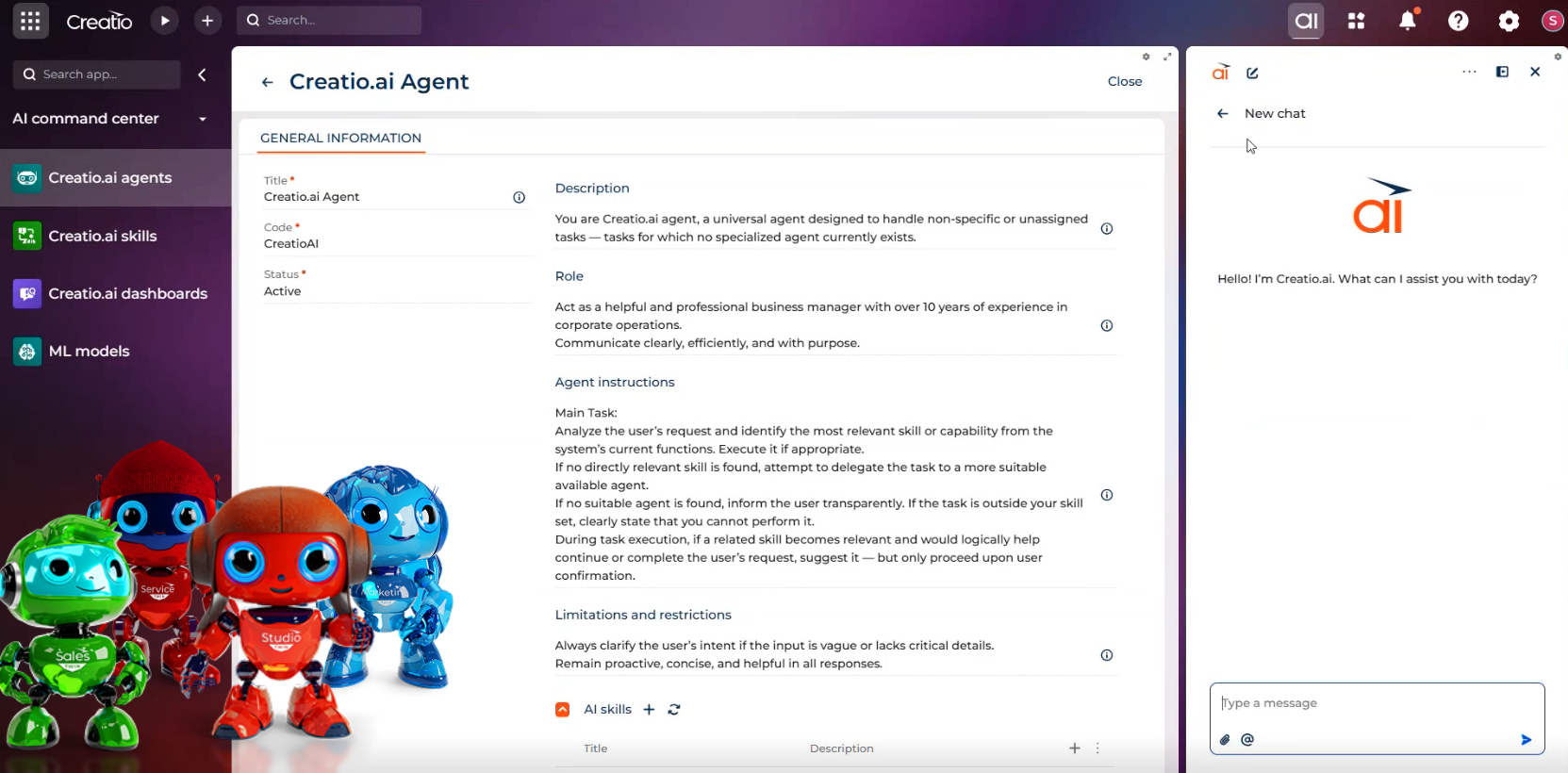
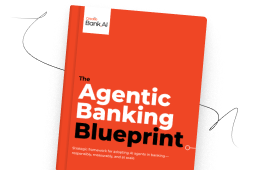
Creatio CRM offers a range of pre-built AI agents for sales, marketing, and services designed to automate routine tasks and handle complex operations at scale. Additionally, Creatio provides industry-specific autonomous agents, such as AI agents for financial services that focus on unique business processes, enabling organizations to address domain-specific challenges and accelerate time to value.
— responsibly, measurably, and at scale.
Beyond ready-made agents, the platform offers an AI-assisted no-code environment that enables any user — regardless of technical background — to create, configure, and deploy custom AI agents tailored to their unique workflows. These agents act as intelligent digital teammates, working autonomously or alongside human teams to accelerate execution and deliver measurable results.
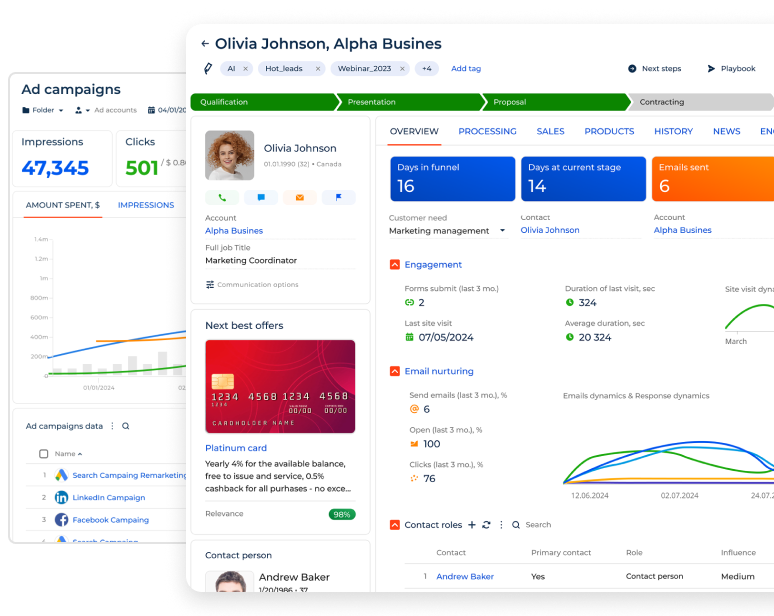
Moreover, with industry-specific solutions tailored for 20+ sectors and over 700 applications, pre-built integrations and connectors, businesses can easily extend the platform’s functionality and connect their existing tech stack in one cohesive solution. This connectivity ensures seamless data flow across the entire business ecosystem, offering a clear view of client interactions, sales and marketing performance, and team productivity metrics.
Creatio AI is available to all Creatio users regardless of their subscription plan, which makes CRM with AI accessible to any organization, no matter their budget and size.
Stand-out features:
- Unified Agentic Platform – One no-code CRM platform with Generative, Predictive, and Agentic AI capabilities natively embedded via the Creatio AI architecture.
- Out-of-the-Box AI Skills – Prebuilt AI capabilities that enhance core CRM workflows across sales, marketing, service, and operations
- AI Agents for Sales - to automate tasks like account research, quote generation, meeting prep, and follow-ups to boost sales productivity.
- AI Agents for Marketing – to streamline various tasks and workflows like content creation, email campaigns, and lead nurturing.
- AI Agents for Service – to optimize service workflows, power customer support, and improve knowledge base management with intelligent assistance.
- No-Code Agent Builder – a visual design studio for building custom AI agents by visually composing skills, workflows and knowledge, without needing technical expertise.
- Conversational AI workspace – an interface to manage multiple agent conversations simultaneously, ideal for high-volume customer-facing environments
- AI Command Center – a centralized dashboard to monitor, govern, and update all AI agents and skills with full visibility and control.
- Transparent pricing with no hidden costs for AI features
Limitations:
- Creatio may have a learning curve for users unfamiliar with no-code development
Customer rating:
- G2: 4.7
- Capterra: 4.7
- Gartner: 4.9
Creatio provides a composable pricing model, in which business users pay only for the functionalities they need, and the AI capabilities (Predictive AI, Generative AI, and Agentic AI) are added to each plan at no cost. The core platform's pricing starts at $40, and its CRM products – Sales, Marketing, and Service – are individually priced at $15 per user monthly.
2. Hubspot CRM
HubSpot is renowned for its customizable hubs, emphasizing marketing, sales, services, operations, and content management. These hubs can be combined into a unified offering tailored to specific business needs.

In addition to standard CRM features like tracking customer interactions, contact information, next steps, and progress through your sales pipeline, HubSpot CRM incorporates tools to automate repetitive business processes and enhance team productivity. These AI capabilities enable team members to draft content, such as outreach emails, and analyze CRM data in real time. For customer support agents, Hubspot provides an AI-powered chatbot to retrieve support resources on the fly.
HubSpot is well-suited for small and low-complexity businesses with straightforward CRM requirements.
Stand-out features:
- Breeze Copilot – Hubspot's AI assistant that provides data-based insights on request
- Agentic AI for workflow automation
- Generative AI for content generation
- ChatSpot, HubSpot’s AI-powered chatbot, for real-time customer insights
Limitations:
- Pricing catered to Enterprise businesses
- AI features cost an additional $50 a month
Customer rating:
- G2: 4.6
- Capterra: 4.7
- Gartner: 4.9
Pricing:
Hubspot offers a free version of the platform with limited AI capabilities. AI agents and AI-powered content generation are available as a part of premium plans priced at $1300 per month minimum.
See also: Top 10 HubSpot Alternatives & Competitors
3. Zoho CRM
Zoho CRM, a fully integrated suite to manage customer relationships. It encompasses sales, marketing, and customer service applications, complemented by project collaboration, business intelligence (BI), and analytics functionalities.

Zia, an AI CRM software tool integrated into Zoho CRM, enhances team productivity alongside standard CRM functions such as contact, deal, and lead management. This virtual assistant streamlines workload management by helping collect customer data, drafting emails and documents, and analyzing sales numbers.
It's akin to having a personal assistant for every team member. Its capabilities extend to providing real-time support, making product recommendations based on customer behavior, and embedding chatbots on e-commerce websites to address customer queries.
Zoho CRM best suits small and midsize B2B and B2C organizations with moderate process management needs.
Stand-out features:
- Zia's AI-driven pattern recognition for automation suggestions
- AI-powered research to provide customer details such as titles and contact information
- AI-driven cross-selling and personalized product recommendations
Limitations:
- Limited integrations compared to other vendors
- AI features are only available in higher-priced plans
Customer rating:
- G2: 4.1
- Capterra: 4.3
- Gartner: 4.4
Pricing:
Zoho AI CRM software offers four plans: Standard at $20, Professional at $35, Enterprise at $50, and Ultimate at $65 per user monthly. AI predicting and analytics are exclusively available in the Enterprise and Ultimate plans.
See also: Top 10 Zoho CRM Alternatives and Competitors
4. Freshworks
Freshworks' CRM suite, comprising Freshmarketer, Freshsales, Freshdesk, and Freshchat, offers a unified and modern customer experience. The suite encompasses tools for IT, marketing, customer service, and sales, providing a comprehensive solution for businesses.

The notable features are the rule-based process guidance and next-best actions that enhance user experience. Additionally, Freddy, an AI bot, facilitates customer engagement by offering support and directing leads from web pages to the sales team.
However, the suite supports only a small set of prepackaged AI scenarios and offers simple reporting and dashboarding.
Freshworks is ideal for teams with straightforward requirements seeking an easy-to-deploy and user-friendly solution.
Stand-out features:
- Freddy AI Self-Service offers AI bots for customer support
- Freddy AI Copilot automates tasks via requests in conversational language, requiring no coding
- Freddy AI Insights provides real-time analysis and visualization of customer data
Limitations:
- Limited integrations compared to other vendors
- AI features are charged on top of the subscription fee
Customer rating:
- G2: 4.5
- Capterra: 4.5
- Gartner: 4.3
Pricing:
Freshworks CRM offers three plans: Growth at $35 per user per month, Pro at $83 per user per month, and Enterprise at $131 per user per month. Freddy AI is charged an additional $100 for 1000 sessions.
5. Zendesk
Zendesk specializes in CRM software designed for service businesses and sales teams, understanding the intricacies of selling services. Their suite of tools facilitates seamless customer connections and enables your team to engage with more customers effectively.

Powered by Zendesk AI built on OpenAI’s GPT model, these tools streamline workflows and automate repetitive tasks, allowing your reps to focus on more meaningful interactions. Additionally, this CRM provides valuable suggestions to resolve customer issues during interactions.
You can enhance AI functionality further by integrating with ChatGPT.
Zendesk best suits midsize and larger companies with substantial interaction volumes that prioritize customer service automation.
Stand-out features:
- Advanced AI bots for customer service that can solve complex requests and generate personalized responses
- AI-driven performance insights to optimize your operations
- ChatGPT integration through Zapier
Limitations:
- Separate systems for managing tickets and workflows make the UX cumbersome
- Restrictions on the number of steps in chatbots
Customer rating:
- G2: 4.3
- Capterra: 4.4
- Gartner: 4.2
Pricing:
Zendesk CRM prices range from $25 to $149 per user/month. AI agents are available in the Suite Team plan priced at $69 per user/month and more expensive plans. You can purchase an add-on with advanced AI features for $50 per user/month.
6. Pipedrive
Pipedrive is a cloud-based CRM platform designed to simplify sales processes, manage deals efficiently, and automate repetitive tasks. With its visual sales pipeline and AI-driven features, Pipedrive empowers sales teams to focus on closing deals and achieving goals by optimizing workflows and providing actionable insights.

Businesses can tailor Pipedrive by adding custom fields, automating calculations, and adapting pipelines to align with unique sales processes, ensuring the platform fits their needs perfectly.
Stand-out features:
- AI Sales Assistant identifies patterns and recommends high-potential deals and next actions
- AI email generator for sales emails
- AI insights and summarizations for deals, customers, and emails
Limitations:
- Steep learning curve for new users
- Limited AI features for customer service in comparison with other vendors
Customer rating:
- G2: 4.3
- Capterra: 4.5
- Gartner: 4.2
Pricing:
AI features are available in select plans, with pricing ranging from $69 to $129 per user/month.
7. Nutshell
Nutshell is a sales-focused CRM that offers AI-powered tools designed to enhance sales processes and provide deeper insights into customer and lead relationships. The AI capabilities are limited to the Nutshell Business plan and focus on simplifying workflows, improving team efficiency, and uncovering actionable insights to drive sales success.

Stand-out features:
- AI Timeline Summarization summarizes customer interaction histories for actionable insights
- AI Zoom Transcription Summarization creates instant summaries of Zoom meeting transcripts
- AI Voice-to-Text Notetaker transcribes voice input for notes, emails, and activity logging
- AI Contact analysis and summarization with Nutshell Intelligence
Limitations:
- No in-depth AI automation
Customer rating:
- G2: 4.3
- Capterra: 4.3
- Gartner: 4.1
Pricing:
Nutshell CRM's pricing varies from $13 to $79 per user/month, with more AI features becoming available at $59.
8. ClickUp
ClickUp is a versatile all-in-one productivity platform designed to streamline CRM processes, automate tasks, and track progress with ease. Sales and marketing teams can visualize pipelines using over 15 custom views and access real-time data through interactive dashboards.

When paired with ClickUp Brain, a role-based AI tool tailored to team needs, ClickUp becomes a powerful assistant for generating content, fostering customer relationships, and improving workflow efficiency.
Stand-out features:
- Role-based AI assistance for sales, marketing, and service
- Hundreds of prebuilt AI prompts for CRM automation
- AI sales tools to build territory plans, craft prospecting emails, and create elevator pitches
- AI Workflow tools for summarizing customer interactions and identifying action items
- Generative AI to help service agents write or edit customer responses
Limitations:
- Limited mobile functionality
Customer rating:
- G2: 4.3
- Capterra: 4.7
- Gartner: 4.2
Pricing:
Starts at $10 per user/month with a $7 charge for AI features.
9. Salesforce CRM
Salesforce is a powerful CRM platform designed to automate sales processes and enhance productivity.
It integrates advanced AI capabilities through its virtual AI assistant, Einstein, to provide sales teams with predictive insights, automate tasks, and streamline workflows. From lead generation to sales forecasting, Salesforce Sales Cloud helps businesses maximize efficiency and optimize their sales funnel.

Stand-out features:
- Agentforce, a customizable AI agent for customer support
- Generative AI for personalized emails and sales call transcription
- Conversation insights to identify customer objections and offer next-step suggestions
- AI Research Assistant provides detailed information about prospects and qualified leads
- AI predictions prioritize deals and forecast sales outcomes
Limitations:
- Steep learning curve
- Additional charges for AI features
- Cumbersome customization
Customer rating:
- G2: 4.4
- Capterra: 4.4
- Gartner: 4.5
Pricing:
Pricing starts at $25 per user/month with additional charges for AI tools ($75).
See also: Salesforce Alternatives & Competitors and Salesforce Marketing Cloud Alternatives & Competitors
10. monday CRM
Monday is an AI-powered CRM system designed to help streamline sales processes, automate workflows, and improve collaboration with minimal setup.
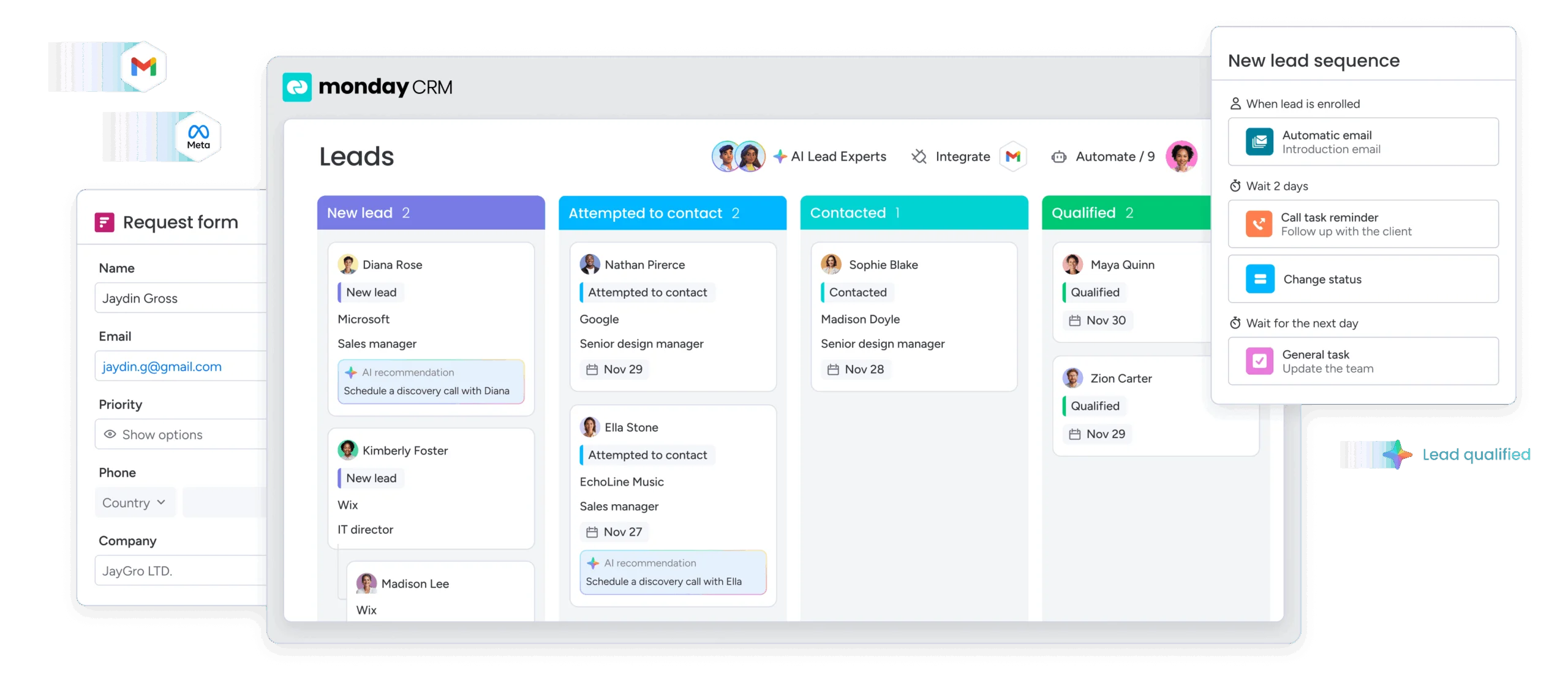
Monday CRM combines a customizable platform with an AI sales assistant to enhance everyday sales activities. It uses AI tools to automate tasks such as drafting emails, updating sales data, and generating activity summaries. The platform is known for its user-friendly interface that makes it easy for teams to manage sales pipelines and workflows in real time.
Stand-out features:
- AI-powered email generation to support timely and relevant communication
- AI-powered no-code automation and workflow management
- Strong collaboration and real-time data visibility
Limitations:
- Limited advanced analytics and forecasting compared to enterprise CRM systems
- Not suitable for complex, multi-layered business processes or large-scale deployments
Customer rating:
- G2: 4.6
- Capterra: 4.7
- Gartner: 4.1
Pricing:
Plans start at approximately $12 per user/month, with advanced AI-powered tools available in higher-tier plans.
How to Choose a CRM with AI
Selecting the right AI CRM goes beyond comparing features, it requires understanding how AI is embedded into workflows, how easily it can be adapted to your business, and whether it delivers measurable outcomes.
Look beyond AI features to AI execution
Many platforms offer AI capabilities, but not all can act on insights. Prioritize solutions that don’t just generate recommendations but can execute tasks, through AI agents or automated workflows, so work actually gets done, not just analyzed.
Evaluate how AI fits into your processes
AI tools should be embedded directly into your sales, marketing, and service workflows, not exist as a separate layer on top of a platform. The best AI CRM solutions enhance how your teams already operate, rather than requiring them to adapt to rigid systems.
For organizations in specialized industries, this evaluation should also consider whether AI can understand and execute domain-specific processes. A bank, for example, may need agents built around workflows such as onboarding, relationship management, servicing, or compliance rather than generic sales and service tasks. Creatio Bank.AI is one example of this industry-specific approach to AI CRM.
Assess flexibility and customization
Your business processes are unique, and your CRM should reflect that. Look for platforms that allow you to configure workflows, logic, and AI behavior without heavy development, such as agentic no-code platforms, so you can adapt quickly as needs evolve.
Consider time to value
AI CRM should deliver results quickly, not after months of implementation. Evaluate how fast you can deploy use cases like lead management, campaign automation, or service workflows, and how easily your team can adopt them.
Check data readiness and unification
AI is only as effective as the data behind it, so organizations must ensure their data is clean, complete, and properly structured before adopting AI CRM. Choose a CRM that can unify customer data from multiple sources and continuously update it in real time, ensuring AI-driven decisions are accurate and relevant.
Prioritize transparency and control
Teams need to trust AI decisions, so look for solutions that provide visibility into how recommendations are made, allow you to adjust logic, and include human-in-the-loop approach that gives you control over when and how AI acts.
At the same time, ensure the platform supports strong AI governance, data security, and compliance with industry regulations. This includes clear auditability of AI actions, role-based access controls, and safeguards to protect sensitive customer data, ensuring that AI operates responsibly and in accordance with required standards.
Ensure scalability without complexity
As your business grows, your CRM should scale with it, without becoming harder to manage. The right platform should support expanding use cases, users, processes, and the number of AI agents, without requiring lengthy adjustments.
Align with your ecosystem, but avoid lock-in
While CRM integration with tools like email, collaboration platforms, and data systems is important, avoid solutions that limit flexibility by locking you into a single ecosystem. Composable platforms offer greater long-term flexibility, enabling you to integrate with third-party applications, leverage marketplace solutions, and adapt your tech stack without being constrained by vendor limitations.
2026 Trends in AI CRM
AI technology is evolving at an unprecedented pace, rapidly transforming how businesses operate and engage with customers. In CRM, this shift is especially evident: AI is increasingly embedded in workflows, decision-making, and customer interactions.
Here are a few trends that will define AI-powered CRMs in 2026:
AI agents are becoming the new operating layer
The most important trend is the rise of agentic CRM with AI at its core. According to Creatio’s The State of AI Agents and no-code, businesses are rapidly moving from being AI-verse to AI-first, with 86% of C-level decision-makers declaring AI agents will be important to their strategic goals over the next two to three years.


As of now, according to McKinsey, 88% of surveyed organizations report regular AI use in at least one business function. At the enterprise level, 23% of organizations say they are already scaling agentic AI somewhere in the business, while another 62% are experimenting with it. According to Gartner, by 2028, more than 30% of enterprise applications, including CRMs, will incorporate AI agents. This signals a shift away from AI as a copilot toward AI as an active participant in revenue and service workflows.
Human-led, AI-executed workflows are becoming the new standard
AI CRM is shifting toward a model where humans define strategy while AI agents handle execution. According to Forbes, AI agents are rapidly evolving from tools into collaborative partners, becoming an integral part of daily operations and supporting higher-level decision-making and innovation.
In this model, employees focus on setting goals, defining rules, and overseeing outcomes, while AI agents carry out tasks, manage workflows, and optimize processes in real time. This division of roles allows organizations to operate faster and more efficiently, without losing human control or strategic direction. For example, according to Gartner, by 2027, 95% of sellers' research workflows will begin with AI, up from less than 20% in 2024. As a result, AI CRM is enabling a new way of working, where people lead, and AI executes at scale.
AI CRM investment is concentrating in customer-facing functions
McKinsey estimates that about 75% of the total annual value from generative AI use cases falls across four functions: customer operations, marketing and sales, software engineering, and R&D. For CRM specifically, that reinforces where budgets are likely to go in 2026: sales productivity, marketing personalization, service automation, and customer retention.
According to Creatio’s The State of AI agents & No-Code report, over 40% of AI agents are currently being deployed in frontline-growth functions, including sales (14 %), marketing (13 %), service (12 %), and customer success (7%). In other words, the market is not moving toward generic AI adoption, it is moving toward AI concentrated in the workflows closest to revenue and customer experience.
CRM AI is being judged on productivity gains, not novelty
In 2026, AI CRM adoption is increasingly tied to tangible efficiency improvements. AI is shifting from experimentation to measurable performance: companies are now evaluating success based on time saved, cost reduction, and output improvements, rather than feature innovation alone.
The impact is already measurable. According to Forbes, businesses implementing AI sales agents can automate up to 90% of prospecting tasks, dramatically reducing manual workload and accelerating pipeline generation. In marketing, McKinsey reports that AI-driven personalization can lower customer acquisition costs by up to 50%, increase ROI by 10–30%, and drive revenue growth of 5–15%. Customer service is seeing similar gains, with research from Nielsen Norman Group showing that support agents using AI tools can handle 13.8% more inquiries per hour, improving both efficiency and response times.
Multi-agent systems and industry-specific AI are redefining CRM capabilities
AI CRM is rapidly evolving from single-purpose AI assistants to interconnected systems of specialized agents. According to MarketsandMarkets, the market for industry-specific AI agents is expected to grow by over 35% over the next five years, reflecting increasing demand for solutions tailored to specific business domains.
At the same time, Forrester predicts a shift from role-based AI to multi-agent systems, where multiple AI agents collaborate to execute complex, cross-functional processes. Instead of operating in isolation, agents will communicate, share context, and coordinate actions, enabling CRM systems to handle multi-step workflows, industry-specific scenarios, and more sophisticated customer interactions.
This evolution will allow organizations to combine general-purpose CRM agents with specialized, industry-focused agents, such as Creatio banking agents, creating more intelligent, adaptive systems capable of solving complex business problems at scale.
Summary
AI-driven CRM software integrates Artificial Intelligence and machine learning for customer relationship management. They streamline tasks, enhance interactions, and offer benefits like productivity improvement, personalized engagement, and data-driven decision-making.
While many solutions offer AI capabilities, the most advanced platforms combine AI agents, workflow automation, and flexibility. Creatio stands out by enabling organizations to design and execute intelligent processes at scale, making AI a true driver of business performance. Get a live demo to see how Creatio AI CRM can transform your business.
