







































































Digital Transformation in Insurance: Technologies, Use Cases, and Implementation Guide

Creatio: Power Insurance Workflows with AI & No-Code

Digital capabilities in insurance have been evolving for years, but only recently have they started to deliver real impact at scale. What started with online portals and basic automation is now extending into fully digital processes across underwriting, policy administration, and claims handling.
With the rise of advanced technologies such as artificial intelligence and machine learning, insurers are moving beyond simply digitizing interactions and starting to rethink how operations are designed and executed end-to-end. According to KPMG, 85% of insurers believe that AI will give them a competitive edge over those that do not adopt it, underscoring the growing urgency to modernize.
In this article, we explore the core technologies shaping digital transformation in insurance, the key benefits and most impactful use cases, and how these innovations drive efficiency, growth, and better customer experiences across the insurance industry.
Key Takeaways:
- Digital transformation is becoming essential for insurers looking to improve operational efficiency, modernize customer experiences, and stay competitive in a rapidly changing market.
- Core benefits of digital transformation in insurance include faster claims handling, lower operational costs, improved risk management, greater scalability, and more personalized customer experiences.
- Technologies such as AI, automation, cloud computing, analytics, IoT, and embedded insurance are reshaping how insurers manage risk, automate operations, and deliver digital-first services.
- Creatio is a leading AI CRM and workflow automation platform that helps insurance companies accelerate digital transformation by connecting CRM, insurance operations, AI tools and agentic automation, and no-code capabilities within a single platform.
What is Digital Transformation in Insurance?
Digital transformation in insurance is the strategic use of digital technologies such as artificial intelligence (AI), machine learning (ML), cloud computing, and workflow automation to modernize how insurers operate, deliver services, and engage with customers.
Rather than simply digitizing paper-based tasks, digital transformation focuses on redesigning insurance workflows end to end — replacing manual and disconnected operations with faster, more automated, and data-driven processes to streamline routine work, improve decision-making and operational efficiency, and deliver more personalized customer experiences.
For example, digital transformation allows insurers to:
- reduce underwriting time from days to minutes with AI-driven risk assessment;
- automate claims processing and routing in real time;
- provide customers with digital self-service experiences across channels;
- connect policy, claims, and customer data into a unified view.
As insurers continue investing in efficiency, innovation, and competitive advantage, spending on digital technologies is accelerating across the industry. According to Forrester, insurance technology spending in the US alone is projected to increase by $173 billion in 2026.
Major Drivers of Digital Transformation in Insurance
Insurance providers are accelerating digital transformation to improve efficiency, meet rising customer expectations, and stay competitive in a rapidly changing market. The main drivers behind this shift include:
- Rising customer expectations: Customers increasingly expect fast, personalized, and digital-first experiences across onboarding, claims, and customer service.
- Pressure to improve operational efficiency: Insurers are looking to reduce manual work, streamline workflows, and lower operational costs while handling growing volumes of data and requests.
- Demand for greater agility and innovation: Insurers need to launch products faster, adapt to changing market conditions, and compete with digital-native insurers and insurtechs.
- Growth of AI and intelligent automation: Advances in AI, data analytics, and workflow automation are enabling insurers to improve underwriting, accelerate claims management, and support more data-driven decisions.
Key Digital Technologies Transforming the Insurance Industry
Digital transformation in insurance may sound like a broad strategic concept, but in practice, it is driven by technologies reshaping how insurers operate, manage risk, and deliver customer experiences. Below are some of the core technologies driving innovation across the insurance industry today.
Technology | Role in the Insurance Industry |
| Artificial Intelligence (AI) & Machine Learning (ML) | Analyze large volumes of structured and unstructured data, automate decision-making, and improve operational accuracy across core insurance services. |
| Internet of Things (IoT) & Telematics | Connected devices and sensors provide insurers with real-time behavioral and environmental data from vehicles, homes, and other insured assets. |
| Cloud Computing & SaaS | Allow companies to modernize legacy infrastructure, improve scalability, and integrate digital services more efficiently across complex business processes. |
| Data Analytics & Big Data | Help insurers extract actionable insights from customer, operational, and risk data to support faster and more informed decision-making. |
| Robotic Process Automation (RPA) | Automate repetitive and rule-based administrative tasks across insurance workflows and back-office operations. |
| Blockchain Technology | Enable secure, transparent, and tamper-resistant data exchange between insurers and external parties. |
| Embedded Insurance | Integrate insurance products directly into third-party digital experiences and purchase journeys. |
7 Real-World Digital Transformation Cases in Insurance
Digital Onboarding & eKYC
Insurance companies are using digital customer onboarding and electronic KYC technologies to automate customer verification, document collection, identity checks, and policy application workflows. Tools such as AI-powered document processing, biometric verification, workflow automation, and digital portals help insurers reduce onboarding time, improve compliance, minimize manual work, and create a faster experience for policyholders.
Smarter Underwriting
Underwriting remains one of the most time-consuming insurance processes, with nearly 40% of underwriters’ time spent on administrative and non-core tasks. AI-powered underwriting workflows help insurers automate risk assessment, reduce manual reviews, and accelerate policy approvals by analyzing customer and risk data in real time.
For example, Munich Re, in its whitepaper, has introduced an AI-augmented underwriting solution that uses point-of-sale risk assessment to support instant decisioning, improve straight-through processing (STP), streamline application and medical review workflows, and enhance customer triaging. The solution allows insurers to reduce underwriting costs and improve customer experience.
Claims Automation
Insurance companies are increasingly using AI and workflow automation to streamline claims intake, customer communication, document processing, and claims resolution. According to industry research, nearly 29% of working hours in insurance can be automated with generative AI, helping insurers reduce manual workload and improve operational efficiency.
For example, Allstate uses generative AI to automate customer communications during claims processing. According to the company, AI now helps generate most of the roughly 50,000 daily claims-related communications handled by its insurance representatives, allowing teams to respond faster and focus more on customer support and decision-making.
Fraud Detection
The combination of AI, machine learning, and advanced analytics helps insurers detect suspicious patterns, identify anomalies, and flag potentially fraudulent claims earlier in the process. By analyzing claims data and uncovering hidden connections between individuals, addresses, businesses, and policies, insurers can improve fraud prevention, reduce losses, and accelerate investigations.
For example, Zurich Insurance introduced an AI-enabled fraud detection platform that analyzes claims activity across multiple lines of business, helping claims teams investigate suspicious activity faster and strengthen fraud prevention without holding up processes for genuine claimants.
Self-Service Portals and AI Chatbots
Self-service portals and AI-powered chatbots are changing how customers interact with insurers. Instead of waiting on calls or relying entirely on agents, policyholders can check coverage details, submit claims, update information, and get support through digital channels whenever they need it. For insurers, this means faster service delivery and lower pressure on support teams.
Aviva, for example, is to introduce an AI-powered ‘virtual agent’ to support phone-based claims journeys, helping customers get answers faster and reducing wait times during the claims process.
Personalized Pricing and Products
Insurers increasingly use real-time data, analytics, and telematics to create more personalized pricing models and tailored insurance products. This allows providers to align premiums more closely with customer behavior, usage patterns, and individual risk profiles.
One of the best-known examples is Progressive’s Snapshot program, which uses telematics data such as driving behavior, mileage, braking patterns, and time of day to personalize auto insurance pricing based on actual driver risk.
Unified Workflows and Connected Operations
Unified workflows help insurers connect underwriting, claims, customer service, compliance, and policy operations within a single digital environment. This improves visibility across teams, reduces paperwork and manual coordination, accelerates service delivery, and enables more consistent customer experiences across the insurance lifecycle.
For instance, Heritage Life used Creatio to unify policy operations, customer workflows, and historical records on one platform, helping the company streamline claims and policy servicing processes, increase customer satisfaction, and reduce turnaround times.
Business Impact of Digital Transformation in Insurance
- Faster claims handling through automated claims intake, routing, and real-time processing.
- Reduced operational costs thanks to fewer manual tasks and more efficient underwriting and servicing workflows.
- More connected customer experiences with faster responses, self-service options, and personalized interactions across channels.
- Stronger risk management supported by real-time analytics, predictive insights, and improved fraud detection.
- Faster product launches that help insurers respond more quickly to changing customer needs and market conditions.
- Better scalability that allows insurance companies to grow operations without adding unnecessary complexity or overhead.
Barriers Slowing Down Insurance Services Transformation
Despite growing investment in modernization, many insurers still face significant barriers that slow down their digital transformation journey.
- Legacy infrastructure – Insurance businesses often operate with outdated legacy systems and legacy architectures that make it difficult to support innovation, integrate new digital tools, automate workflows, and scale operations across the business.
- Data silos – Many insurers still store customer, policy, and claims information across separate systems shaped by years of regulatory and operational complexity. As a result, teams often lack a unified view of data, making collaboration, decision-making, and customer service less efficient.
- Compliance complexity – For insurers, modernization cannot come at the expense of compliance. As organizations adopt AI, automate workflows, and connect data across systems, maintaining transparency, auditability, data security, and regulatory alignment becomes significantly more complex.
- Cybersecurity risks – As insurers integrate more digital tools into their operational workflows, they also become more exposed to cyber threats. The growing use of cloud platforms, APIs, AI systems, and connected data ecosystems increases the risk of data breaches, ransomware attacks, and operational disruptions, which makes cybersecurity fundamental to any business transformation strategy.
- Skills gaps and resistance to change – Many insurers still face limited expertise in emerging technologies and AI-driven operations. At the same time, employees may be hesitant to adopt new tools and ways of working. According to recent Gallup research, 50% of employees still do not use AI in their role, although this marks a significant improvement from 80% in 2023.
At the same time, the insurance sector faces growing pressure to enhance customer interactions, modernize operations, and adapt faster to changing market and regulatory demands. To keep pace, organizations need to move beyond incremental improvements and build operations that are agile, data-driven, and designed for continuous change.
How to Approach Digital Transformation in Insurance
Successful digital transformation in insurance rarely happens through one large-scale modernization project. In fact, most insurance companies see better results by modernizing high-impact processes step by step without disrupting business operations or compliance.
#1. Focus on High-Impact Workflows First
Start with the processes that create the biggest operational bottlenecks or customer friction. For many companies, these include underwriting, claims handling, onboarding, policy servicing, and compliance-heavy workflows. Prioritizing a few high-impact areas helps deliver faster results and reduce exposure risks.
#2. Modernize Legacy Systems Gradually
Outdated core systems remain one of the biggest obstacles to transformation across insurance. Instead of replacing infrastructure all at once, many insurers are taking an incremental approach to modernization. For example, Accenture recommends simplifying monolithic architectures — large, tightly connected systems built as a single structure — into more composable and modular environments to reduce implementation risk and maintain business continuity.
#3. Apply AI and Automation to Everyday Insurance Operations
The most effective digital transformation initiatives focus on solving operational problems, not just adopting new technologies. AI and workflow automation can help insurance providers speed up underwriting, automate claims routing, reduce manual work, and improve responsiveness across teams.
#4. Start Small and Scale Strategically
Rather than attempting enterprise-wide transformation from the start, insurers should begin with targeted pilot projects tied to measurable business outcomes. Early wins help organizations build internal alignment, refine processes, and scale transformation more effectively.
#5. Build Internal Digital Expertise
Technology alone does not drive transformation. Insurers also need teams that can work effectively with digital tools and AI-driven systems. According to McKinsey, leading insurers aim to keep 70–80% of digital talent in-house to strengthen long-term digital capabilities and reduce reliance on external vendors.
How Creatio Enables Insurance Transformation
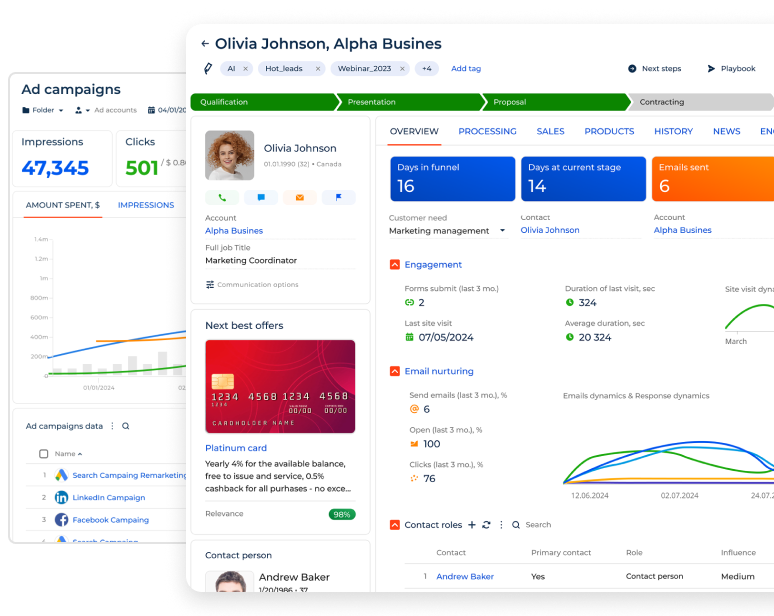
Creatio helps insurance companies accelerate digital transformation by unifying customer operations, workflows, and AI automation within a single AI CRM and workflow automation platform. Instead of relying on disconnected systems and manual coordination, insurers can manage underwriting, onboarding, claims, servicing, compliance, and customer interactions through connected and automated workflows.
Insurance companies can use Creatio CRM — an AI CRM and workflow automation platform for marketing, sales, and service — to streamline customer acquisition, relationship management, and operational execution with no limits on AI agents, workflows, or scale. Sales and marketing teams can capture, nurture, and convert leads from multiple channels, manage referrals and opportunities, identify cross-sell and upsell opportunities using AI recommendations, and automate repetitive tasks with built-in CRM AI agents.
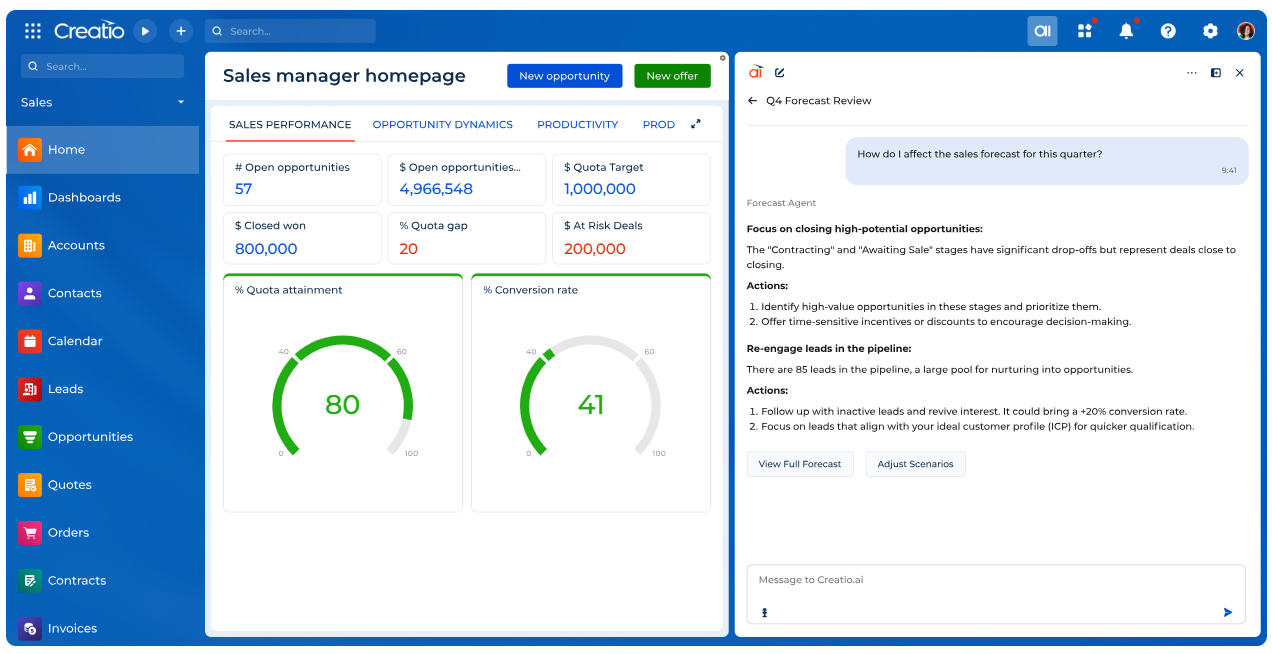
At the operational level, insurers can accelerate onboarding, claims processing, servicing, risk management, and underwriting workflows using AI agents and no-code automation tools. This helps teams reduce manual work, improve response times, and deliver more connected customer experiences across the insurance lifecycle.
For more advanced customization and process automation, insurers can use Creatio Business & AI Studio — an AI platform for building applications, workflows, and AI agents using AI coding agents and no-code visual designers. The platform enables organizations to create scalable and customizable insurance applications faster, without extensive development complexity.
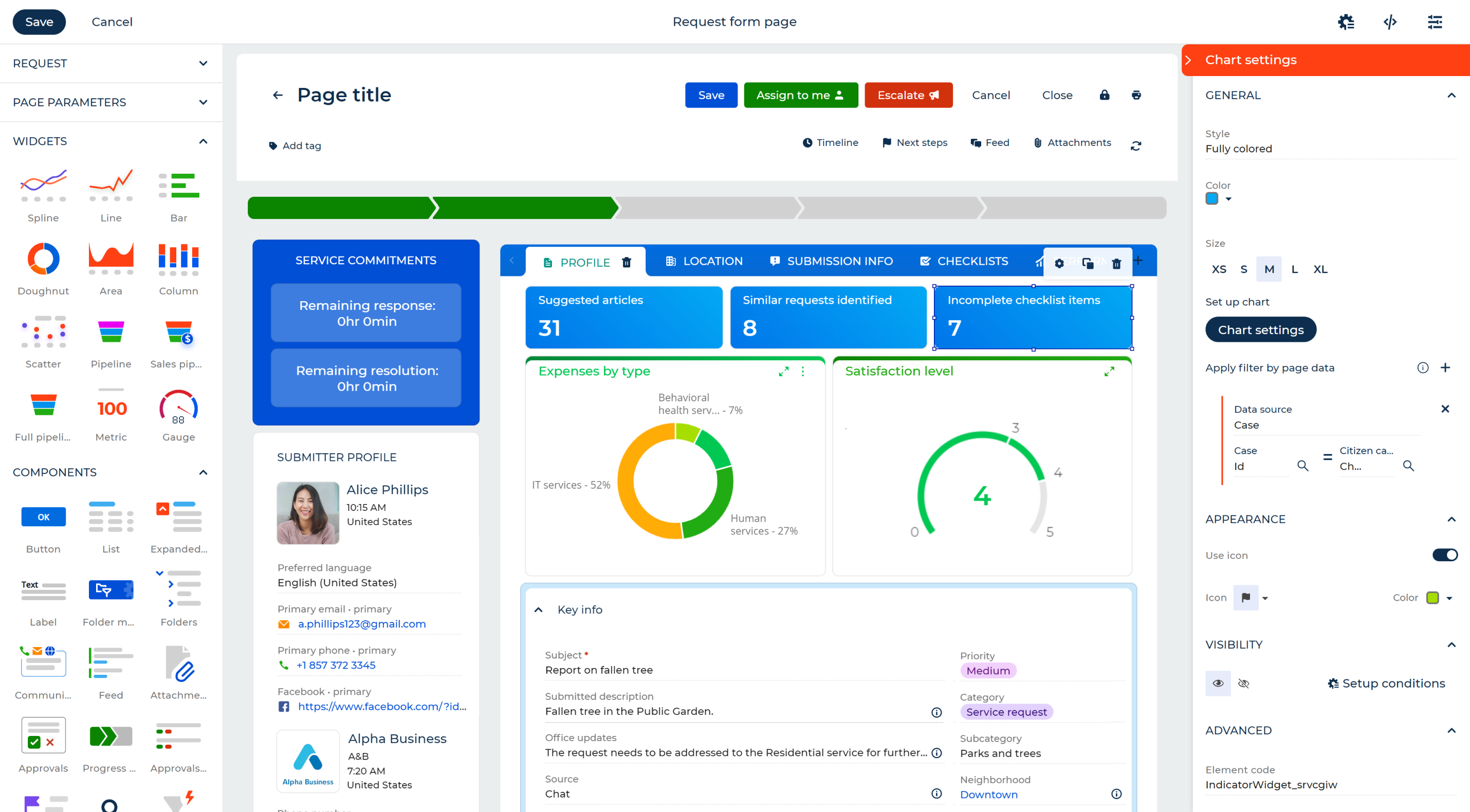
With Creatio, insurance companies can:
- Unify customer, policy, claims, and service operations within a single platform
- Automate underwriting, onboarding, claims handling, servicing, and compliance workflows using AI and automation tools
- Accelerate decision-making and operational execution with AI agents and AI-powered insights
- Rapidly adapt workflows and launch new processes using AI coding agents and no-code visual designers;
- Reduce manual work and improve collaboration across teams through agentic automation
- Improve operational visibility, efficiency, and customer responsiveness across the entire insurance lifecycle.
One of Creatio’s key advantages is flexibility. Insurance companies can adapt workflows, build new applications or AI agents and modify processes without heavy coding or long implementation cycles, making it easier to respond to changing business, customer, and regulatory requirements.
Importantly, Creatio follows a human-in-the-loop approach to AI adoption. While AI agents can automate routine tasks and operational workflows with minimal human intervention, insurance professionals remain in control of approvals, oversight, and final decisions, helping ensure accuracy, compliance, transparency, and trust. Creatio also supports enterprise-grade security and compliance requirements. Its data processing centers comply with major international standards, such as GDPR, ISO 27001, HIPAA, SOC 1, and SOC 2.
Last but not least, Creatio is consistently recognized by leading industry analysts, including Gartner and Forrester, for its CRM and no-code innovation, industry expertise and agentic AI capabilities.
Emerging Trends in Insurance Digital Transformation
As insurers continue investing in modernization and intelligent operations, the focus of digital transformation is also evolving. According to Forrester, insurers are increasingly prioritizing technologies and strategies that improve operational efficiency, strengthen customer experience, and enable more scalable, AI-driven operations.
In its recent research, Forrester highlighted several key trends shaping the future of digital transformation across the insurance industry.
1. Move From Isolated AI Pilots to Integrated Multiagent Systems
Insurers are shifting focus from experimental AI pilots to technologies that improve everyday operations at scale. Agentic AI and workflow orchestration solutions enable providers to streamline underwriting, claims triage, customer service, and other complex workflows while maintaining compliance and governance standards.



2. Prepare Employees to Work Alongside AI
As AI becomes more integrated into everyday operations, insurers need to equip employees with the skills to work effectively with AI-assisted systems. Teams across underwriting, claims, and service functions will increasingly be responsible for reviewing, interpreting, and overseeing AI-driven decisions while maintaining human-in-the-loop accountability. In addition to improving productivity, AI can also help insurers address ongoing talent shortages by supporting knowledge sharing and reducing repetitive manual work.
3. Prioritize End-to-End Customer Experience
Customer experience is becoming a key competitive differentiator across the insurance industry. Insurers are investing in technologies that support seamless omnichannel interactions, faster self-service experiences, proactive communication, and more connected experiences for customers, agents, and brokers.
Summary
Digital transformation is redefining how insurance companies operate, manage risk, and deliver customer experiences. Powered by technologies such as AI, machine learning, data analytics, and robotic process automation (RPA), it enables insurers to modernize legacy processes, improve operational efficiency, and respond faster to evolving customer and market demands.
Creatio helps insurance organizations accelerate digital transformation through a unified AI-native CRM and workflow platform — with no limits on users, agents, workflows, or scale. With built-in AI capabilities, AI coding agents and no-code visual designers, insurers can build agentic workflows, streamline operations, improve coordination across teams, and scale innovation with greater speed and flexibility.
