The financial services sector is undergoing swift and significant change, driving by evolving client expectations, stringent regulatory requirements, and intensifying market competition. To maintain a competitive edge, many financial organisations are adopting industry-specific CRM platforms to improve operational efficiency and enhance client engagement. According to research by Gartner, CRM ranks one of the top three most valued technologies within the industry, with significant further investment projected.
This article examines the core functions of CRM software in the financial industry, exploring its role in shaping customer interaction and supporting the delivery of financial services.
Core findings:
- Finance CRM systems are purpose-built to manage the complexities of client relationships, regulatory compliance, lending procedures, onboarding journeys, and more.
- Modern finance CRM platforms offer substantial advantages by consolidating client data, supporting more personalised engagement, strengthening compliance efforts, and improving efficiency across departments.
- Teams within service, sales, and marketing function particularly benefit from AI-enabled CRM tools, which help streamline operations, enhance client interactions, and enable more informed, timely decision-making.
- Among the leading CRM solutions for financial services are Creatio, Salesforce, Microsoft, and HubSpot, each offering robust functionality and tailored workflows designed to meet industry-specific requirements.
What is a finance CRM?
A finance CRM is a Customer Relationship Management designed specifically to meet the distinct requirements of the banks, credit unions, and other financial institutions. Its core objective is to assist financial advisers in establishing, sustaining, and enhancing relationships with their clients
Finance CRMs also play a key role in streamlining operations by incorporating industry-specific workflows for compliance management, Know Your Customer (KYC), and Anti-Money Laundering (AML) processes. They further support automation across client onboarding, lending, and customer support processes.
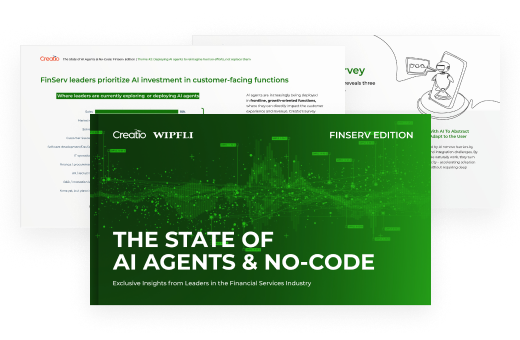
Furthermore, modern CRM platforms now integrate AI agents tailored for the financial industry, enabling the automation of routine tasks and delivering data-driven insights to support more efficient working practices. According to research by Creatio, 73% of financial leaders view AI agents as either critical or strategically important to their organisations over the next two to three years.
The State of AI Agents & No-Code: FinServ Edition
Learn how financial leaders use AI agents and no-code to fuel smarter transformation
Why do financial institutions need a CRM?
Amidst fierce competition, evolving client demands, and rapid digitalisation, CRM proves indispensable in the financial services industry. The figures are compelling: in 2021, sales of bank CRM software totalled $9.5 billion (~£7.06 billion), with projections pointing to significant expansion. By 2031, forecasts suggest a surge to $39.2 billion (~£29.1 billion), reflecting an annual growth rate of 15.7%.
Financial advisers depend on CRM systems for numerous of compelling reasons, pivotal to their success and profitability:
- A unified view of client data and customer interactions: consolidates all customer and member information, including communication history and financial records, into a single platform, ensuring every department has access to up-to-date data.
- Stronger client relationships and improved retention: enables financial professionals to provide tailored service and timely financial advice, helping to build trust, deepen relationships, and encourage long-term client loyalty.
- Faster onboarding and lending decisions: provides tools to automate processes such as credit assessments and document verification, significantly speeding up client onboarding and loan approvals while reducing administrative workload.
- Integrated support for KYC, AML, and audits: eases the burden of regulatory compliance with integrated tools for identity verification, transaction monitoring, and reporting.
- Improved cross-sell and upsell visibility: supports the identification of new revenue opportunities by analysing customer profiles, life stages, and product usage. This enables sales representatives to offer timely and relevant product or service recommendations.
- Greater operational efficiency across front, middle, and back office: eliminates data silos between departments, enhancing collaboration, reducing redundant processes, and enabling full visibility across the entire client journey.
How different financial departments utilise CRM
CRM solutions for financial services are versatile tools that can be applied across various departments within a financial business. These systems can be tailored to fit the specific processes of different organisations, such as banks, credit unions, insurance companies, or investment firms, thereby simplifying daily tasks and enhancing overall departmental effectiveness.
Below is a closer look at key departments commonly found within financial organisations, and how modern CRM for financial services, enhanced by AI agents, helps streamline day-to-day operations.
Marketing
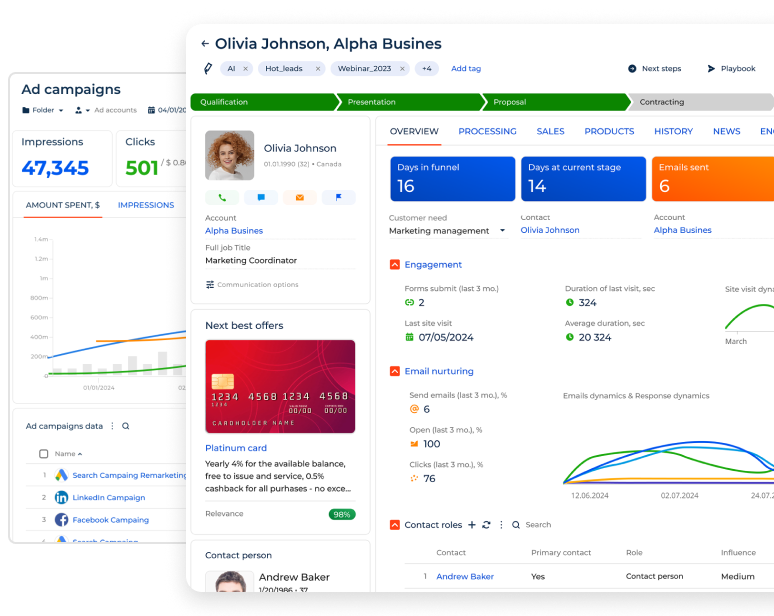
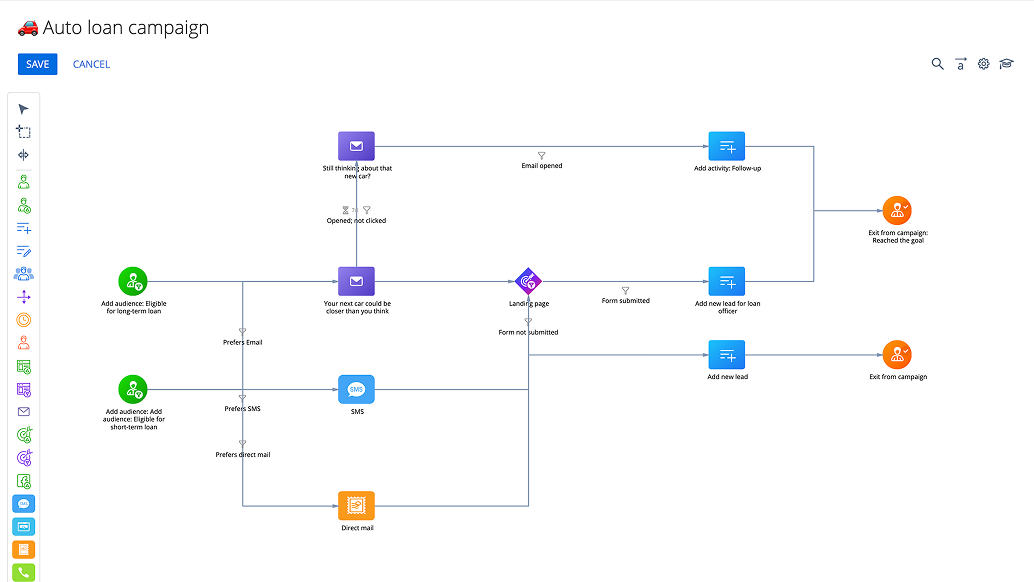
A financial CRM equips marketing teams with the tools to deliver precisely targeted, personalised communications across all channel. It simplifies core activities such as campaign management, lead nurturing, email marketing, and digital advertising, ultimately supporting the generation of more qualified leads and improved audience engagement. Marketing AI agents further enhance efficiency by generating bespoke content at scale, delivering timely communications to prospects, and automatically refining campaign performance and budget allocation to maximise return on investment.
Sales
A financial CRM consolidates client interactions, leads, and opportunities, providing sales teams with real-time access to accurate and up-to-date customer data. This comprehensive view allows sales representatives to tailor conversations and offer recommendations aligned with to each client’s specific needs. Such platforms also streamline core sales processes, including lead management, pipeline tracking, and follow-up activities, thereby reducing administrative workload and helping to progress opportunities more efficiently. AI agents for sales enhance productivity further by automating routine tasks, prioritising high-value prospects, generating tailored proposals, and suggesting the most appropriate next steps, ultimately allowing sales teams to concentrate on building long-term customer relationships and closing deals.
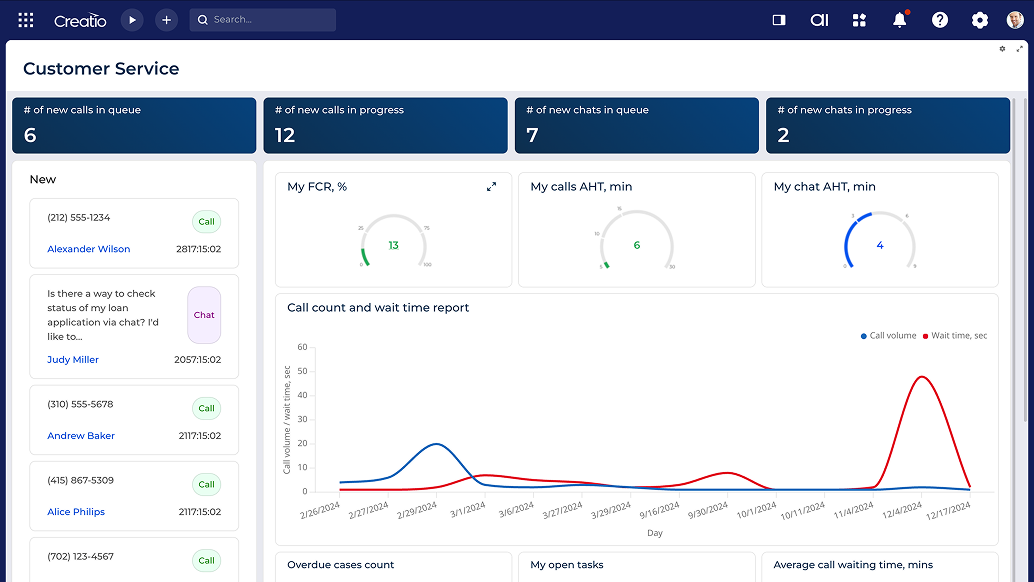
Customer service
A financial services CRM assists customer service teams by automatically routing enquiries to the appropriate channels and equipping agents with a comprehensive view of client information, interaction history, and product usage, enabling faster, more accurate resolution of queries. Customer service AI agents can manage routine requests independently, while more complex cases are escalated to service representatives, accompanied by recommended next steps and relevant knowledge base articles, ensuring faster, more consistent support.
Front-office
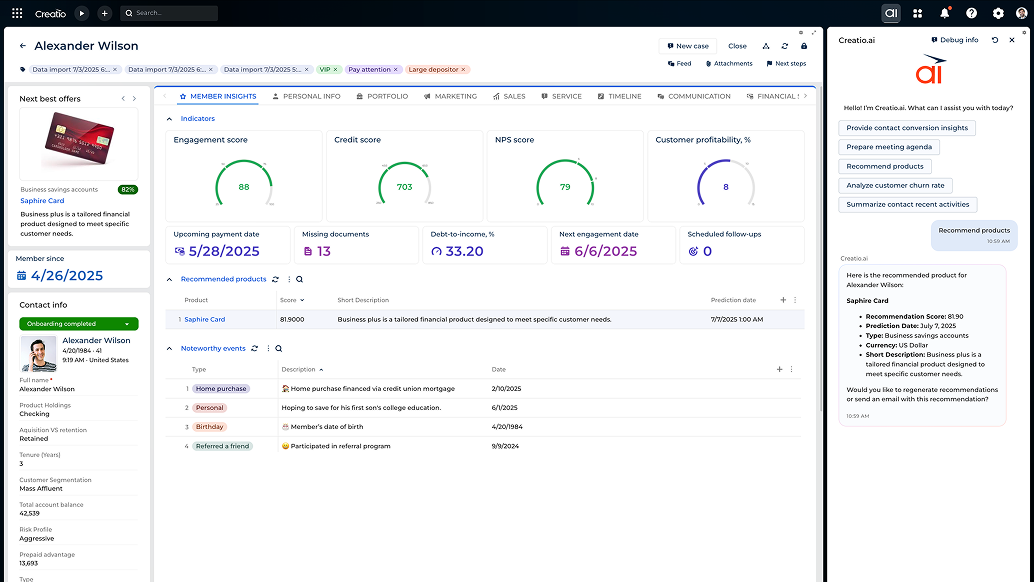
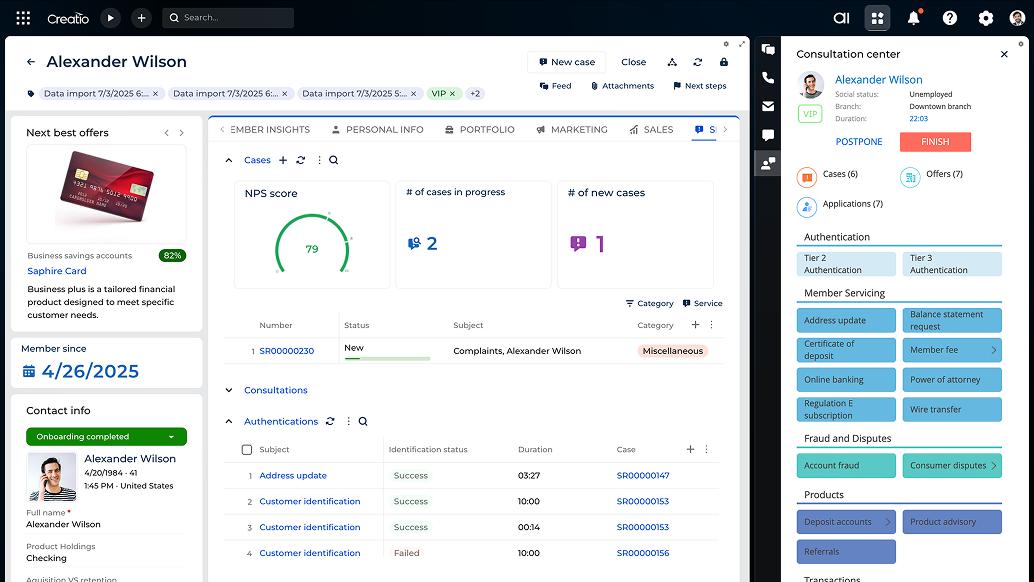
Financial CRM systems are widely adopted by front-office professionals such as relationship managers, financial advisors, and portfolio managers to deliver personalised financial guidance and strengthen client engagement. AI agents complement this by analysing large volumes of behavioural data and portfolio trends to produce tailored recommendations and product suggestions. These AI-powered insights enable advisors to deliver more relevant guidance, anticipate client needs, and enhance the overall client experience.
Loan origination and underwriting
Within lending departments, a finance CRM system simplifies loan origination by consolidating applicant data, documentation, and communications into a single platform, making it easy for teams to monitor applications from initial enquiry through to approval. AI agents support the process by automation routine tasks such as data input, document verification, and status updates, minimising manual effort and improving turnaround times. With access to comprehensive borrower profiles and financial histories, underwriters are better equipped to assess risk and make informed lending decisions.
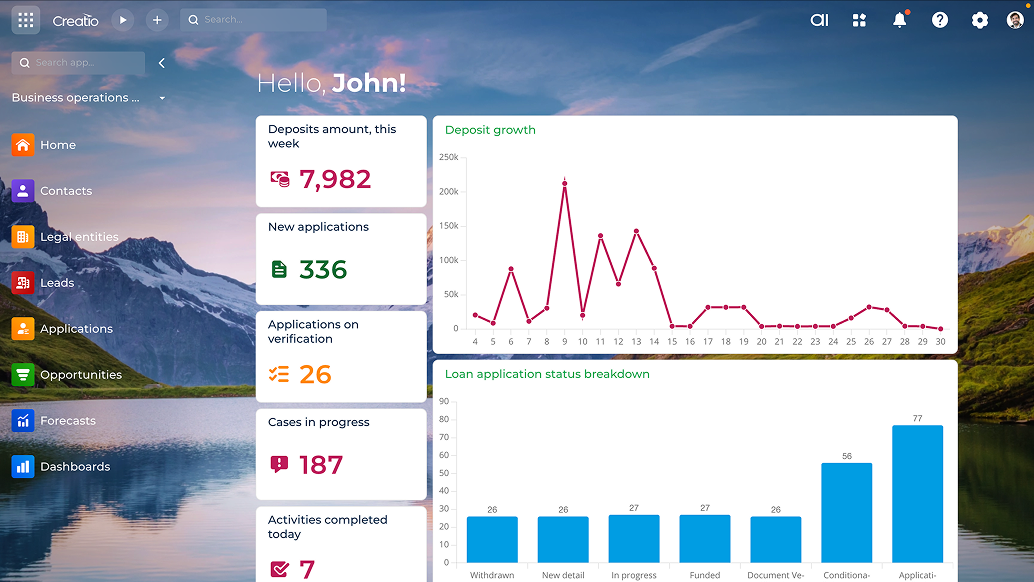
CRM systems in a financial advisor businesses are not confined to client-facing teams. Their value extends to back-office functions including finance, legal, human resources, and beyond. By streamlining internal workflows and enabling secure data sharing, CRM technology enhances productivity and collaboration across the entire organisation.
Benefits of a CRM for financial services
Finance CRM provides numerous advantages to financial advisers, elevating their operations and customer interactions. Below are the primary advantages of CRM for financial services:
- Improved lead and pipeline management: a comprehensive 360-degree view of each account, centralised lead tracking, and AI-supported prioritisation enable teams to concentrate on the most promising opportunities.
- Greater customer retention and wallet share: personalised offerings, timely engagement, and actionable insights delivered by AI agents help to foster client relationships and encourage broader adoption of services, creating opportunities for cross-selling and up-selling.
- Enhanced customer experience and engagement: finance-specific AI agents support tailored communication, faster response times, and proactive assistance, resulting in a more consistent and satisfactory customer journey.
- Quicker response and onboarding times: automated workflows, unified data access, and intelligent insights enable financial professionals to provide more efficient support, accelerate approvals, and streamline onboarding processes.
- Fewer errors and improved regulatory compliance: standardised processes and secure data management help minimise errors and support adherence to regulatory requirements. AI-driven tools assist in identifying anomalies, highlighting compliance risks, and ensuring information remains accurate and complete.
- Stronger collaboration across departments: a unified financial CRM platform promotes seamless information sharing across sales, service, lending, operations, and compliance teams.
- More pipeline visibility and revenue predictability: real-time analytics and AI-driven forecasting offer clearer insights into business performance, enabling leaders to anticipate market shifts, plan with confidence, and allocate resources more strategically.
Creatio's Finance CRM Implementation
Find out how ENT Credit Union achieved an over 18% increase in new deposit conversions and an 8.5% uplift in new loan conversions, driving a $1.4M YOY increase in annual revenue with Creatio financial CRM.
Core features of a modern finance CRM
Financial institutions require more than standard customer management tools. They need systems capable of supporting intricate workflows, strict regulatory obligations, and highly personalised client experiences. Below are the essential features that characterise leading financial CRM platforms:
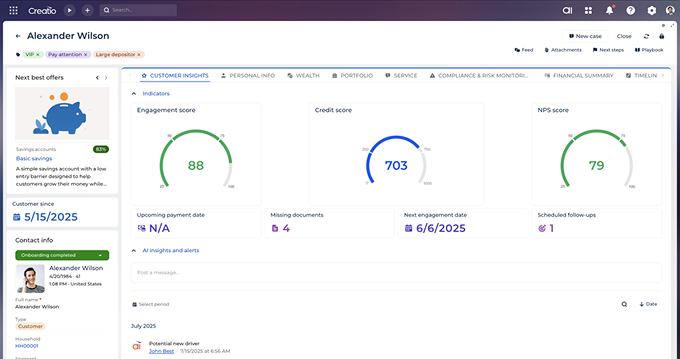
1. Customer 360
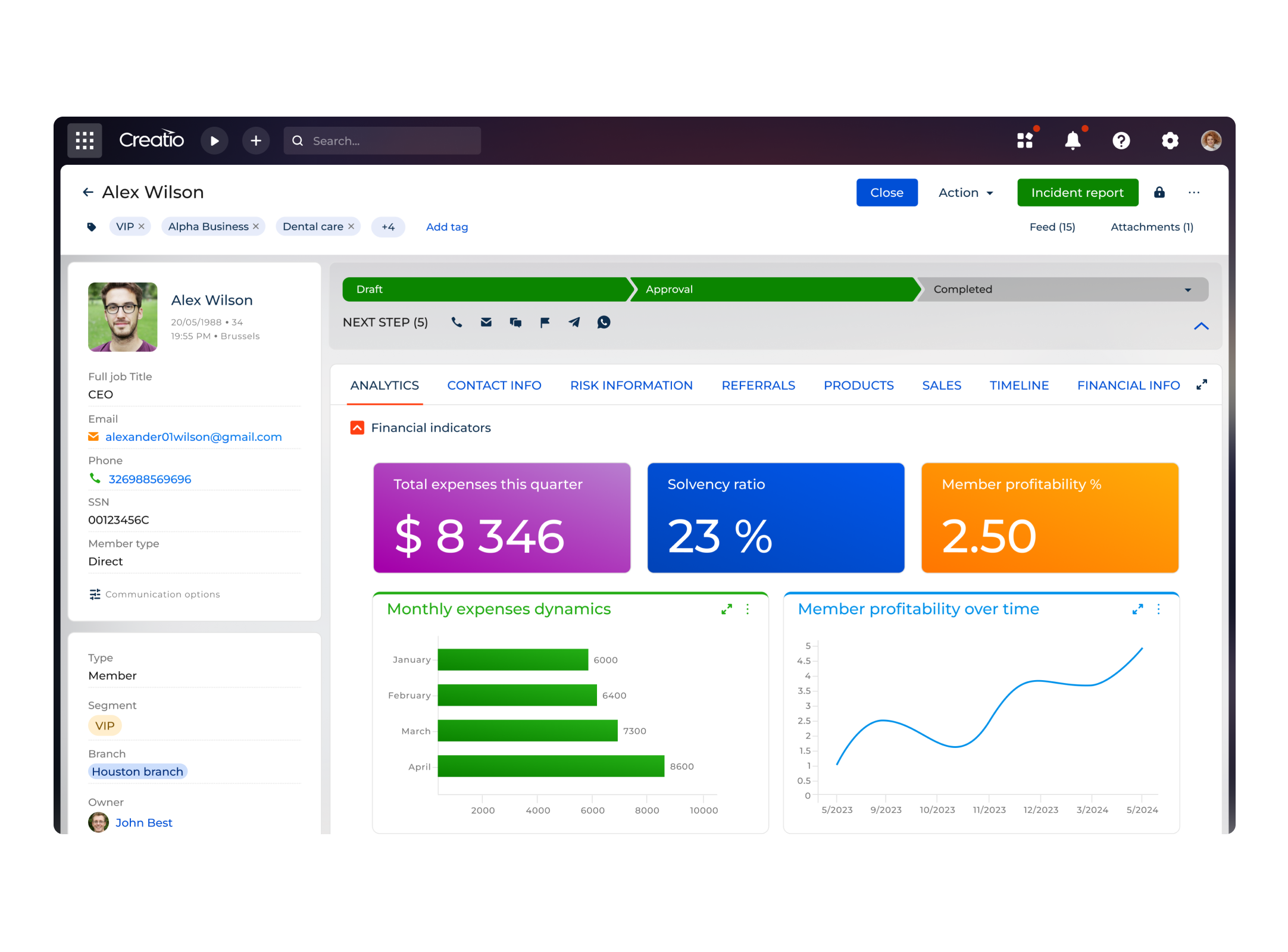
A finance CRM consolidates all relevant client data, including financial accounts, interactions, products, objectives, household relationships, and documentation, into a single, comprehensive view. AI agents can notify financial advisors of significant life events, such as the arrival of new dependents or a change in employment status. This approach ensures that all departments are working from accurate, up-to-date information, helping to foster deeper relationships and support better-informed decision-making.
2. Pipeline and opportunity management
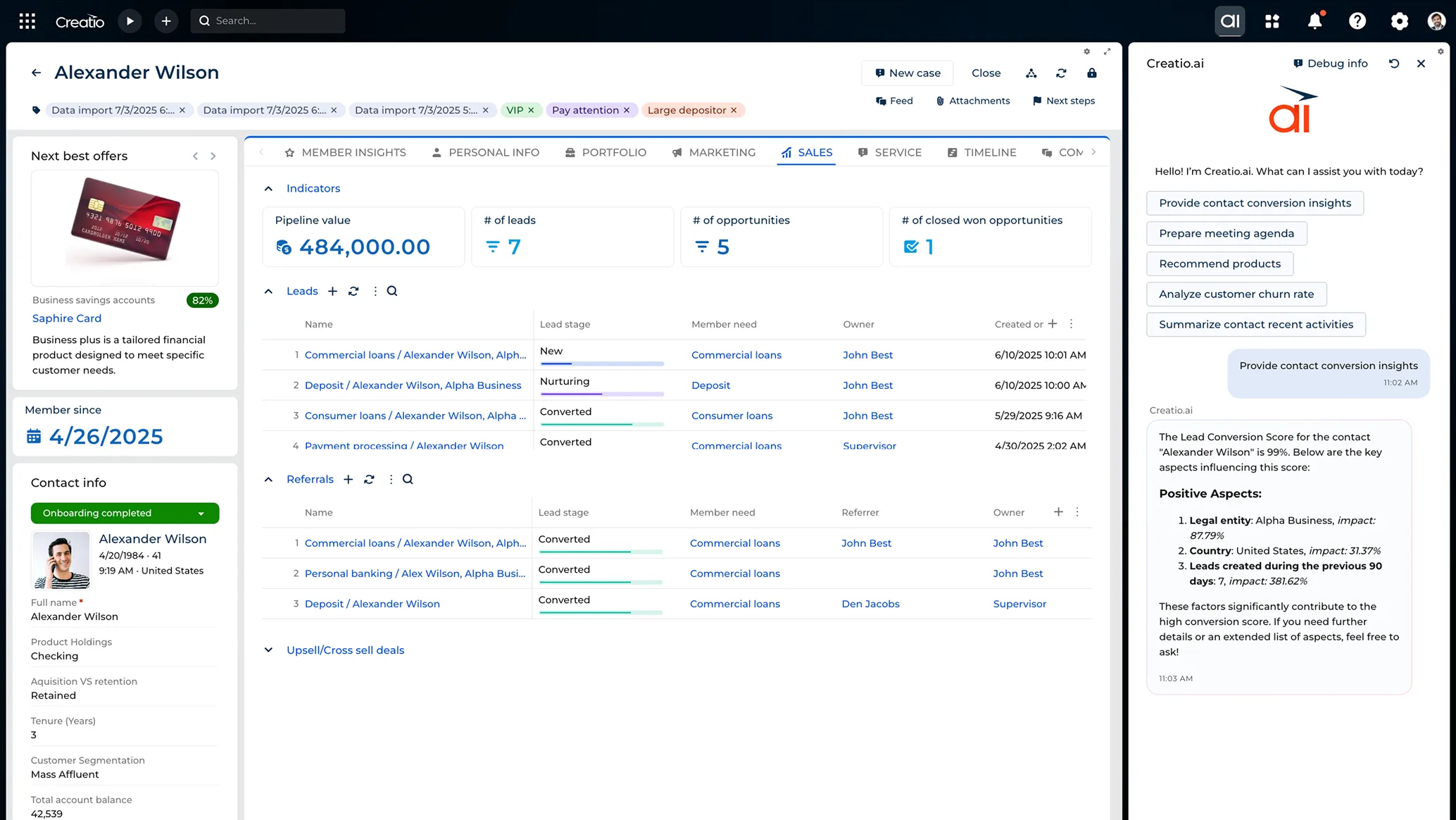
Sales teams are able to monitor leads, opportunities, and deal progress through a centralised pipeline, with clear visibility of next steps and projected revenue. AI-driven scoring and recommendations support more effective prioritisation, helping teams focus on the most opportunities most likely to convert.
3. Onboarding and account opening workflows
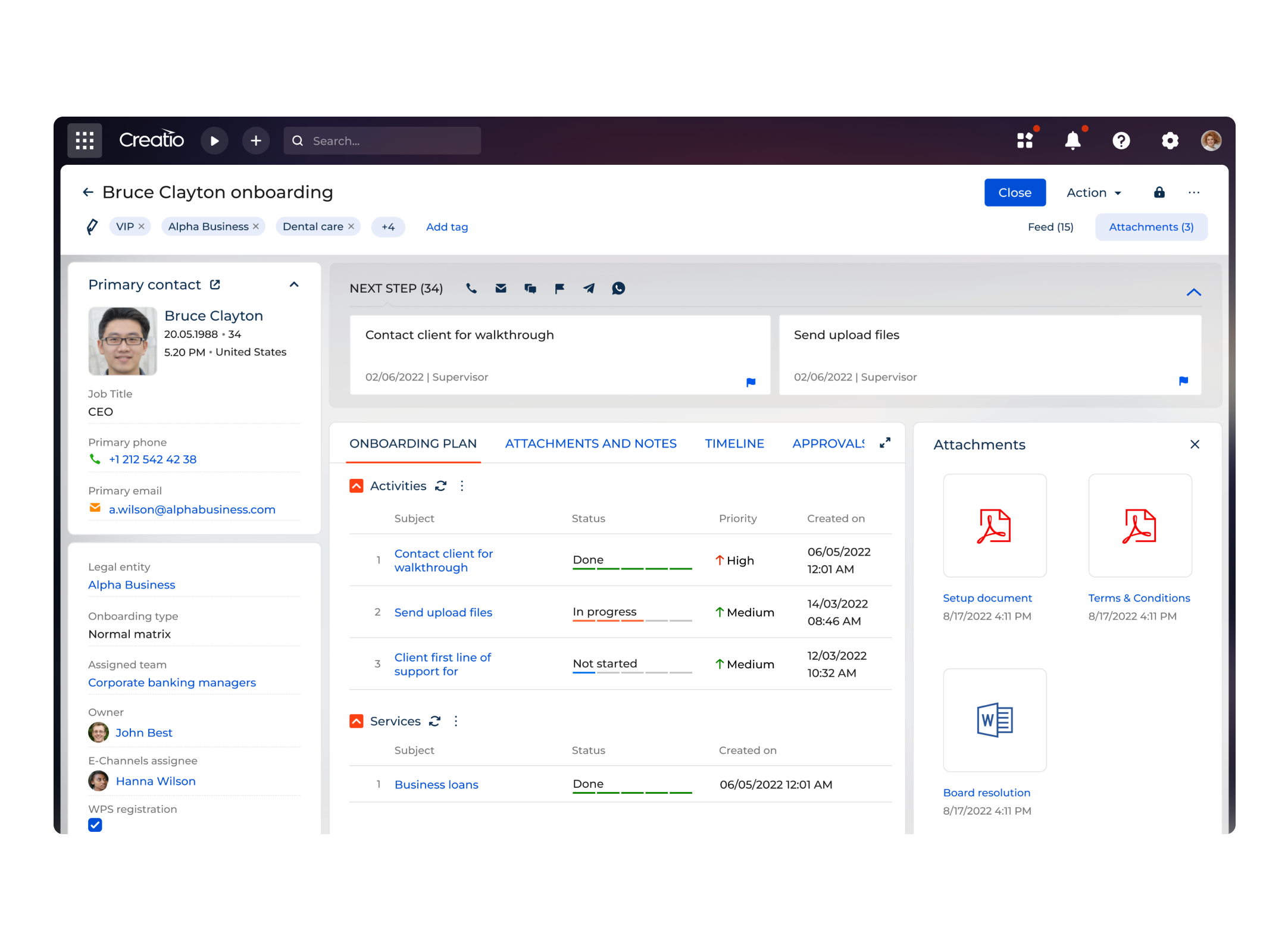
Automated onboarding workflows simplify the account opening process by guiding both clients and internal teams through required steps, documentation, and approvals. This reduces manual errors, shorten time to value, and ensures a consistent, compliant onboarding experience.
4. KYC, AML, and compliance support
Built-in KYC and AML tools streamline identity verification, risk assessment, and ongoing monitoring. Features such as audit trails, automated alerts, and AI-powered anomaly detection support regulatory compliance while reducing operational risk. Additionally, AI agents can automatically route potential fraud cases and escalate issues based on assesses risk levels.
5. Lending and underwriting workflows
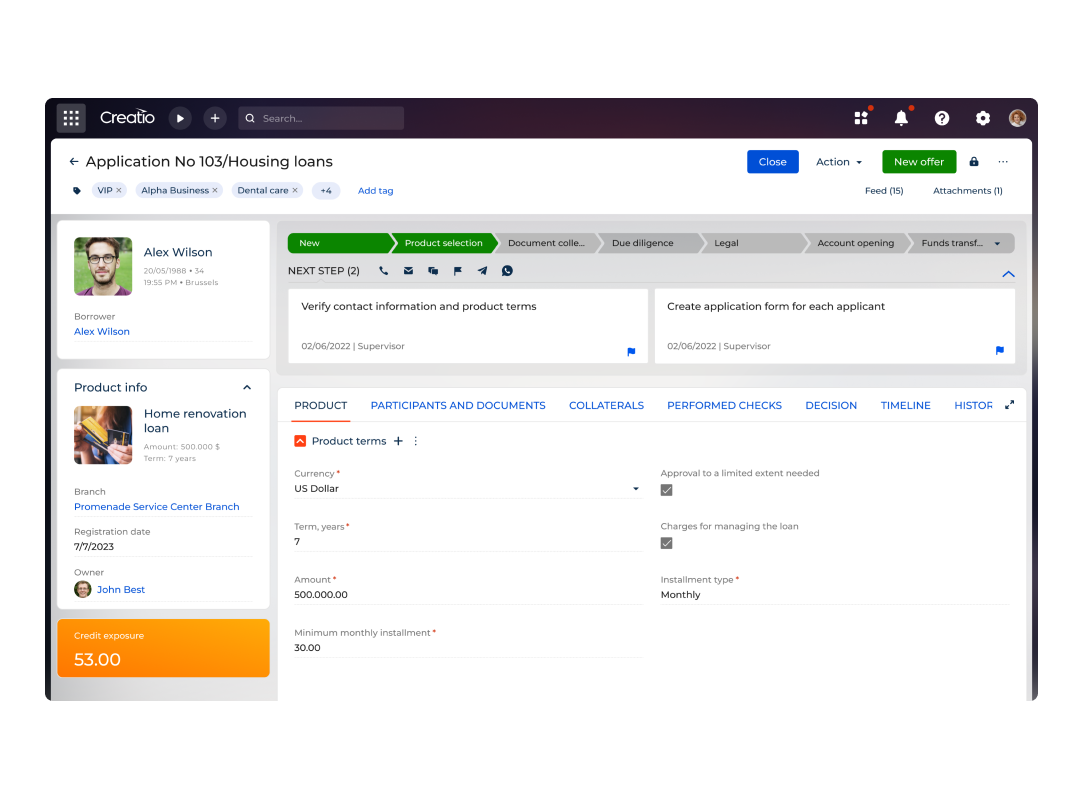
CRM systems tailored for financial sector support the entire loan lifecycle, from initial application through to underwriting and final approval. By centralising borrower data and applying AI-powered risk assessment, financial institutions can make more accurate and timely credit decisions while reducing manual intervention.
6. Integrated omnichannel communications
Financial CRM systems facilitate client engagement across a renege of channels, including email, phone, SMS, live chat, and digital platforms, ensuring a consistent and seamless experience. With automated routing and full interaction history readily available, teams can respond more efficiently and with greater context.

Creatio allowed us to achieve a streamlined and holistic view of customers. With the new system, if a customer interacts with the commercial department, this information is visible to the retail or wealth management sides. This visibility enables better coordination and more informed responses, ultimately enhancing the overall customer experience.”

Chris Bladen
Operations Analyst, First United
7. Document management
Secure document management is essential in financial services. A CRM system consolidated client documents, application forms, compliance records, and contracts within a single, secure environment. Featured such as automated version control, access rights, and e-signatures help to streamline collaboration and reduce administrative workload.
8. Analytics and reporting
Dashboards and reporting tools offer real-time visibility into key metrics such as sales performance, client behaviour, portfolio health, and operational KPIs. AI-enhanced analytics identify emerging trends, flag potential risks, and uncover new opportunities for growth that might otherwise be overlooked through traditional reporting methods.
9. Automation and AI-assisted workflows
Automated workflows streamline routine tasks across service, sales, and marketing processes. AI agents enhance processes by delivering personalised recommendations, identifying risks, forecasting likely outcomes, and initiating next-best actions at every stage of the client journey.
Research conducted by Creatio reveals that 87% of business and technology leaders in the financial sector view AI agents as a key enable of productivity, a catalyst for new growth opportunities, or a means of creating entirely new roles within the organisation.
Ten leading CRMs for financial services in (2026)
Selecting the most suitable CRM for a financial institution can be a complex task, given the wide range of options available. To support a well-informed decision, the list below highlights ten of the leading CRM solutions for financial services in 2025, highlighting core strengths, notable features, and key considerations.
Software | Best for | G2 rating | Starting Price |
| Creatio CRM | Financial service institutions seeking a comprehensive CRM platforms with built-in no-code and AI functionality | 4.7/5 | £40 per user per month |
| Salesforce Financial Services Cloud | Large-scale financial institutions requiring extensive features and seamless integration capabilities | 4.3/5 | £325 per user per month + £700 for AI capabilities |
| Microsoft | Organisations already operating within the Microsoft ecosystem | 4.6/5 | £65 per user per month for Microsoft Dynamic 365 + £20,000 per tenant per month for Financial Services Cloud |
| HubSpot CRM | Expanding finance businesses in need of sophisticated marketing tools | 4.4/5 | £70 per user per month |
| Zoho CRM | Small to medium-sized finance firms looking for a configurable and adaptable CRM solution | 4.1/5 | £35 per user per month |
| Wealthbox CRM | Wealth management practices and independent advisers requiring a system tailored to their needs | 4.5/5 | £59 per user per month |
| Oracle | Major retail and corporate banks aiming to harness AI-powered insights for better decision-making | 4.1/5 | Available upon request |
| Redtail CRM | Financial advisory companies focused on nurturing long-term client relationships | 4.3/5 | £39 per user per month |
| Pipedrive | Smaller financial firms or advisory teams, primarily requiring efficient sales enablement tools | 4.3/5 | £49 per user per month |
| BUSINESSNEXT | Financial advisors with unique processes | 4.0/5 | Available upon request |
1. Creatio
Creatio Financial Services CRM is a best-in-class agentic CRM and workflow platform with no-code and AI at its core, designed to support banks, credit unions, insurance providers, and other financial institutions. It provides pre-configured industry workflows for client onboarding, KYC/AML, lending, servicing, and more, whilst also allowing organisations to tailor processes without the need for coding.
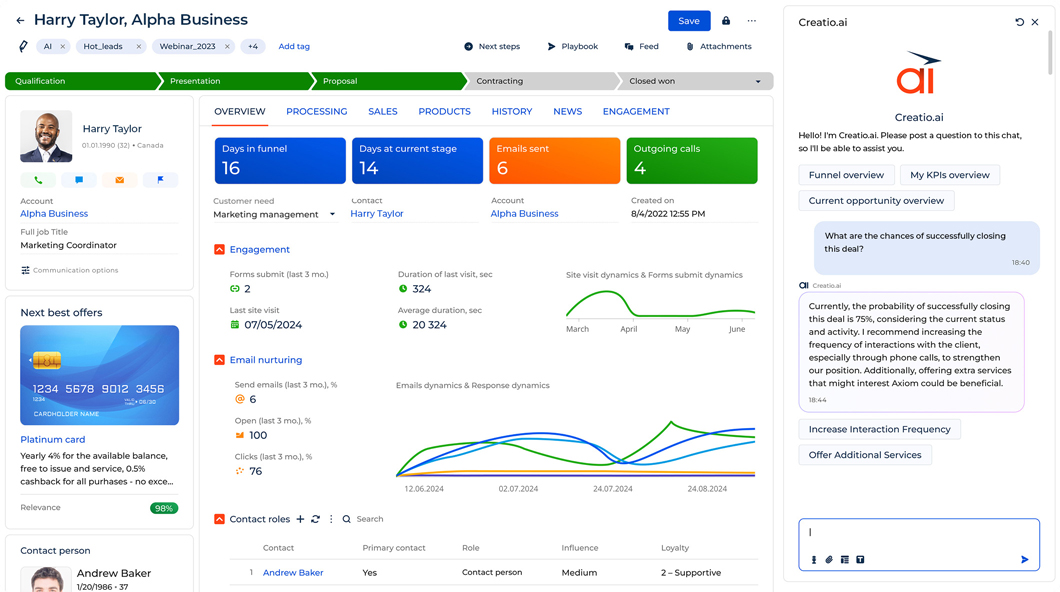
With Creatio, financial institutions can provide more tailored customer experiences, improve up- and cross-selling, and deliver end-to-end workflows across the customer journey. The platform helps accelerate the launch of new financial products, centralise customer data and applications, and enable business teams to innovate through intuitive no-code tools. Financial services AI agents enhance productivity by automating routine tasks, uncovering key insights, and recommending next-best actions. Creatio's CRM solution supports stronger customer relationships, improved sales outcomes, and sustainable growth across the financial services sector.
Distinguished features:
- Pre-configured workflows tailored to banking and financial services, covering areas such as contact management, client onboarding, lending, underwriting, pipeline tracking, risk oversight, and regulatory compliance.
- Sales, Marketing, and Customer Service applications to streamline front-office operations.
- No-code customisation, supported by an intuitive interface, a library of pre-built templates, and a composable architecture to accommodate unique organisational processes.
- Advanced AI agents designed to automate routine tasks, surface actionable insights, and support data-driven decision-making.
- Seamless integration with core banking and third-party applications, enabled by a rich Marketplace of connectors that expand CRM capabilities
- Enterprise-grade security, strong AI governance, and integrated compliance modules, including KYC/AML and audit trails, to meet the demands of a highly regulated financial environment.
Limitations to consider:
- The breadth of functionality and high level of customisation may present a slight learning curve for some users.
Pricing:
From £40 per user per month, with full access to all CRM and AI capabilities included at no additional cost.
A New Era AI CRM
Automate campaigns, pipelines, and service flows with Creatio's agentic CRM
2. Salesforce Financial Services Cloud
Salesforce is an enterprise-grade financial CRM solution powered by AI, designed to consolidate customer information from core banking, wealth, and insurance platforms. It enables professionals across the financial services sector to gain deeper understanding of client interactions, deliver more personalised experience, and streamline operations across departments. With its robust data insights, integrated AI tools, and seamless connectivity with the wider Salesforce ecosystem, Financial Services Cloud supports financial organisations in improving customer satisfaction, driving sustainable growth, and meeting regulatory requirements with confidence.
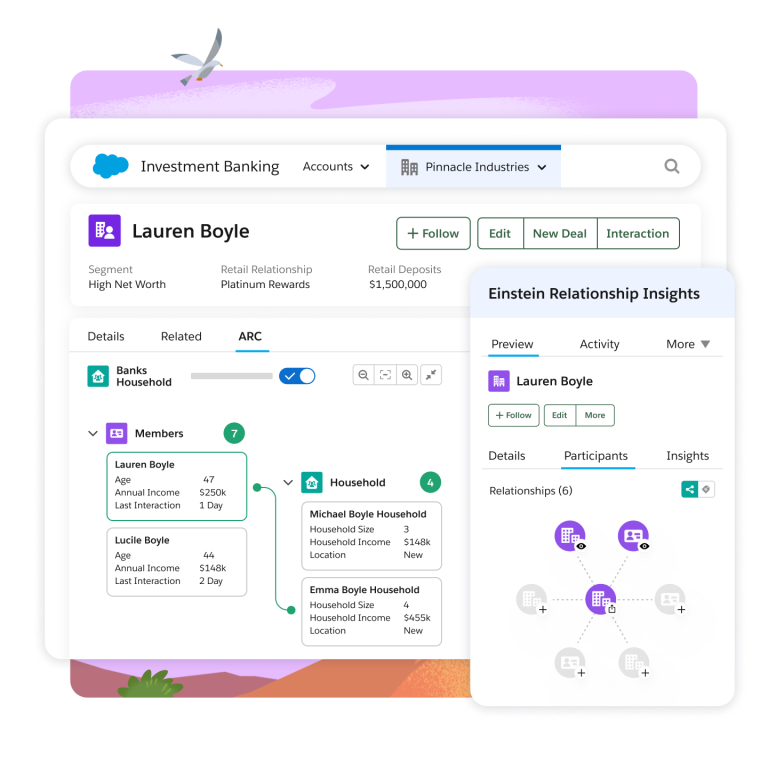
Distinguished features:
- Pre-configured templates for processes such as customer onboarding, financial planning, account management.
- AI capabilities through Agentforce, designed to automate tasks, streamline operations, and enhance the overall customer experiences.
- Seamless integration with the broader suite of Salesforce products.
- Enterprise-level security and compliance.
Limitations to consider:
- High overall cost, particularly when factoring in additional chargers for advanced functionality such as AI agents, digital lending, collections, and compliance.
- Implementation can be time-consuming and may require support from in-house IT teams or Salesforce consultants.
- The user interface may feel unintuitive at first, resulting in a steeper learning curve for some users.
- Complex customisation processes can delay realisation of value.
- System performance may slow noticeably when handling large volumes of data.
Pricing:
Pricing for Salesforce Financial Services Cloud begins at £325 per user per month, with full access to advanced AI features requiring an additional at £750 per user per month.
See also: Salesforce Alternatives & Competitors
3. Microsoft
Microsoft Cloud for Financial Services represents an all-in-one suite of integrated solutions, featuring Microsoft Azure, Microsoft 365, Dynamics 365, Microsoft Teams, and Power Platform, designed to meet the distinctive demands of the financial industry. It empowers financial advisers to efficiently manage extensive volumes of financial data, facilitating the delivery of exceptional experiences, empowering staff, and combating financial crime.
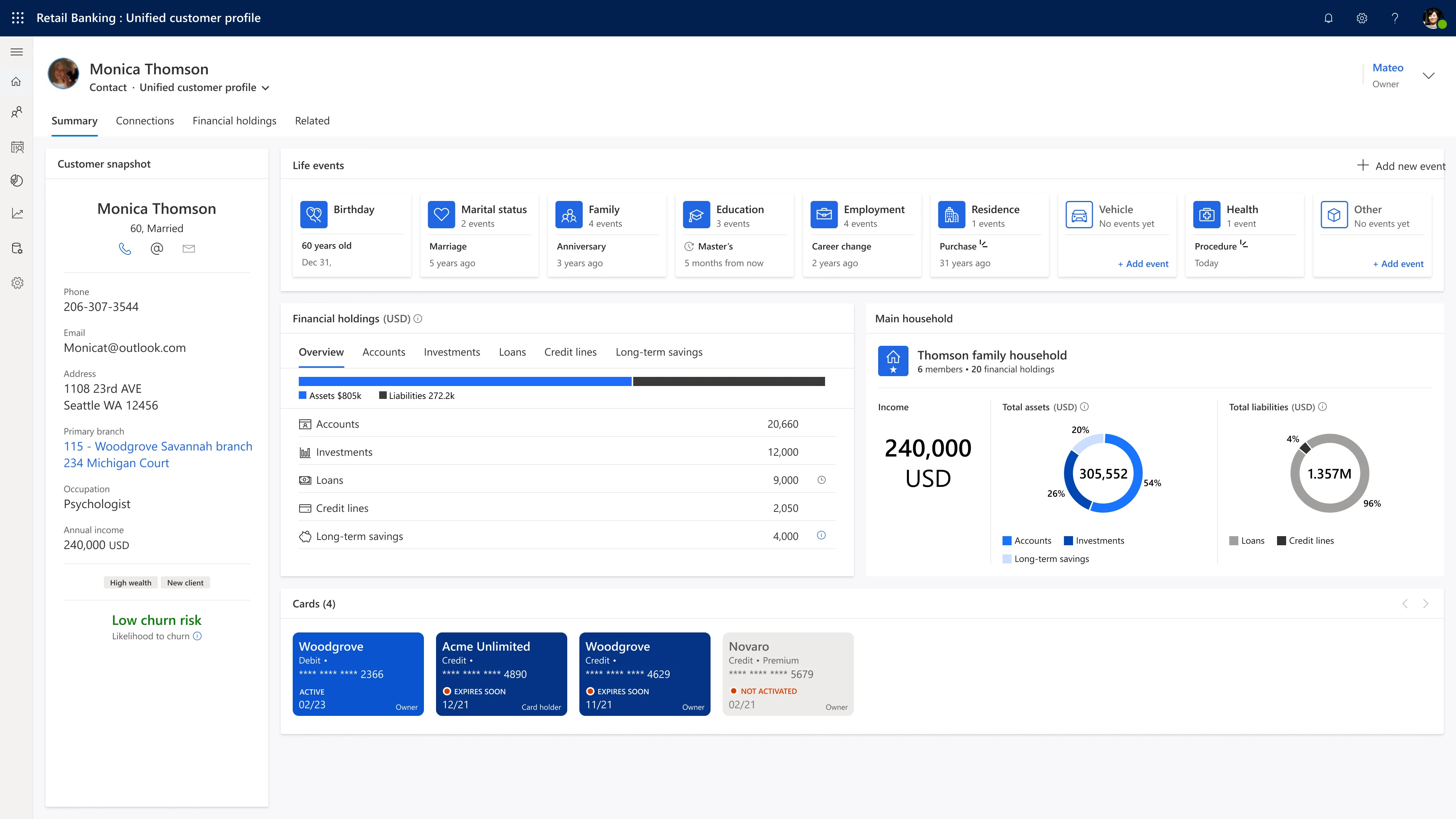
Distinguished features:
- Seamless integration with Office 365, Teams, Power BI, and Azure.
- Pre-configured, AI-powered solutions tailored to banking, insurance, and capital markets.
- Modular deployment options across sales, service, and financial operations.
- Strong capabilities for data analytics, customisation, and enterprise-grade security.
Limitations to consider:
- Total costs of ownership can be high, particularly at scale.
- Implementation and customisation may prove complex and resource-intensive.
- Financial services cloud is an add-on, requiring additional licensing on top of Microsoft Dynamics 365.
- Licensing structure can become intricate and expensive as usage scales.
- Availability is limited to selected countries.
Pricing:
Pricing for Microsoft Cloud for Financial Services starts at £20,000 per tenant per month, with required licences for Microsoft 365 Dynamics beginning at £65 per user per month.
4. HubSpot CRM
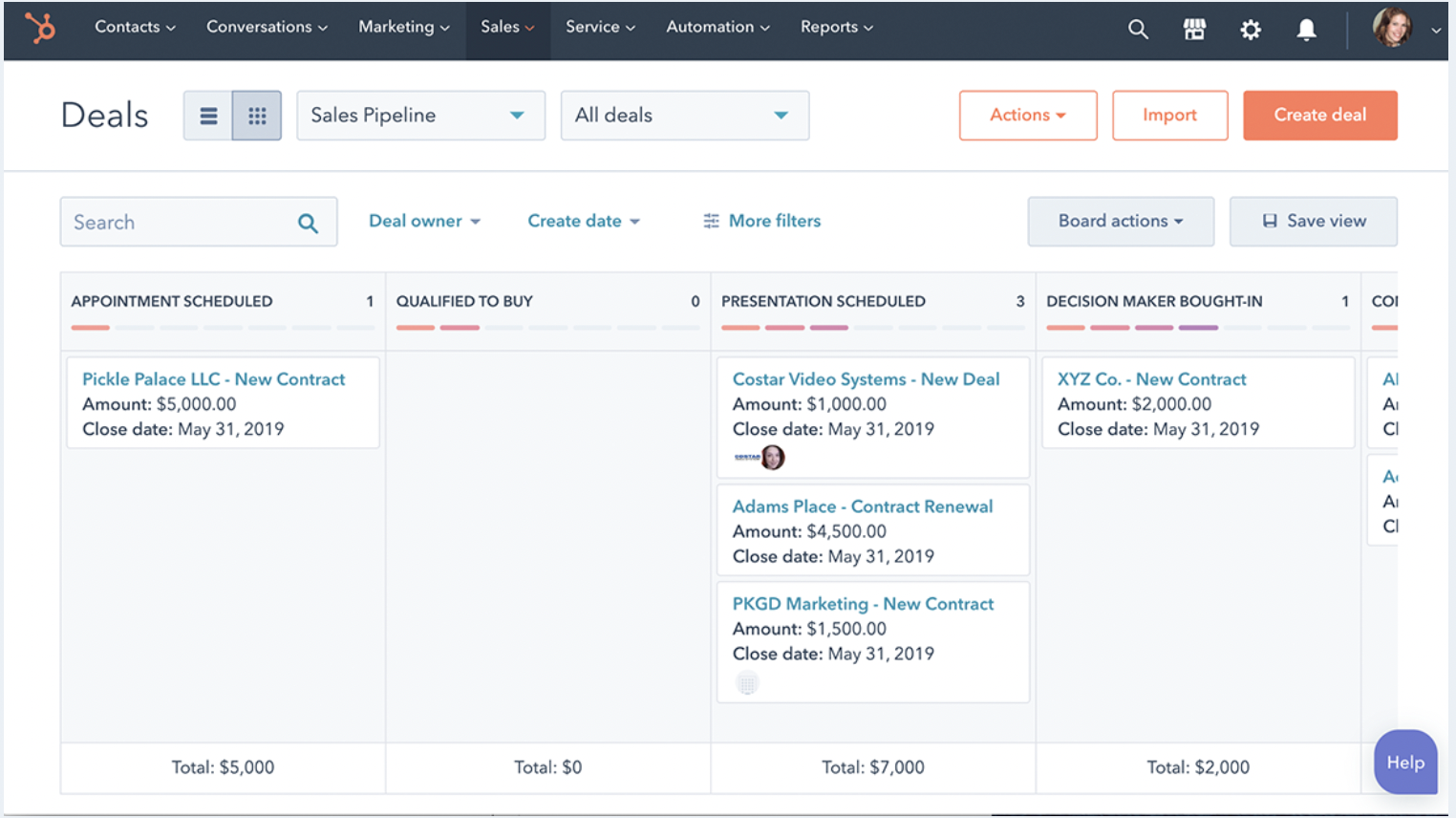
HubSpot is a widely used, CRM that appeals particularly to smaller or fast-growing financial firms seeking combined marketing, sales, and service functionality. Known for its user-friendly interface, HubSpot support both outbound and digital-first growth strategies. The unified platform enables financial advisers to manage, track, and develop client relationships more effectively, helping to strengthen engagement and deliver a more consistent customer experience.
Distinguished features:
- Straightforward to adopt, with a free tier available and strong capabilities for marketing automation and delivering a consistent customer experience.
- Integrates effortlessly with other HubSpot tools, supporting smooth data sharing and internal communication across departments.
- Intuitive interface and seamless scalability.
- Includes HubSpot Breeze, AI assistants and agents designed to automate routine tasks, produce content, streamline social media campaigns, and manage customer data.
- Built-in pipeline management, email tracking, and outreach tools.
- Analytics and reporting functionality supports informed, data-driven decision-making.
Limitations to consider:
- Not tailored specifically to the financial services sector, with limited out-of-the-box workflows for regulatory processes such as KYC, AML, or compliance processes.
- Access to more advanced features requires higher-tier plans, which may result in significantly higher costs.
- May not include the complex product origination tools required by larger or more specialised financial institutions.
Pricing
HubSpot’s pricing varies depending on the product suite selected. Sales and Service Hubs start at approximately £70 per user per month, while the Marketing Hub begins at £625 per month, based on standard packages.
5. Zoho CRM
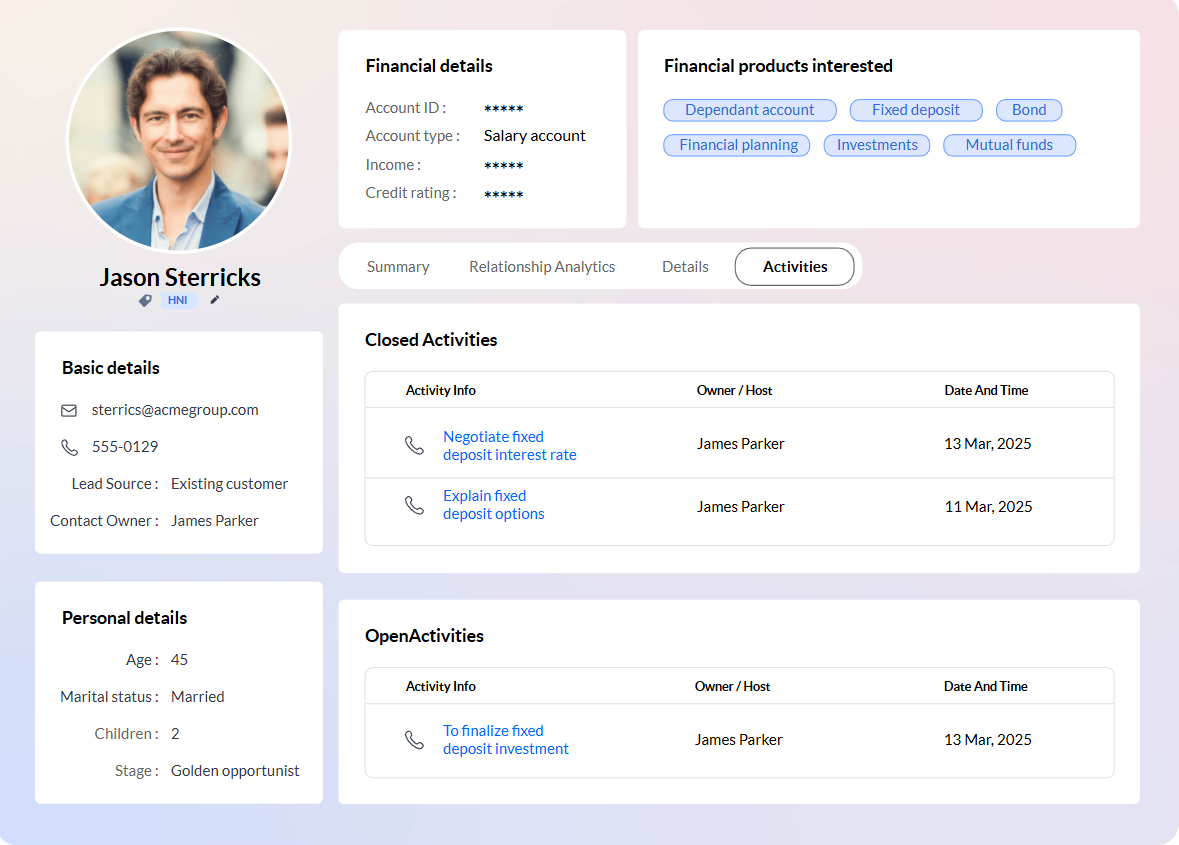
Zoho CRM is a tailored solution for banking and financial services, particularly suited to small and medium-sized organisations seeking integrated sales and marketing functionality. As part of the broader Zoho ecosystem, it enables organisations to build a more comprehensive operational framework as needed. The platform helps boost productivity through automation, customisable workflows, and AI-powered insights.
Distinguished features:
- Comprehensive customer view with tools for lead management and nurturing.
- Automated customer onboarding and integrated KYC verification.
- Personalised wealth planning and investment recommendations aligned to life milestones.
- Loan Origination System supporting loan application from initial submission to disbursal.
- API-based integration with fintech platforms for streamlined operations.
- Analytics dashboards offering actionable insights and support for regulatory compliance.
Limitations to consider:
- May not be well-suited to larger organisations requiring more advanced functionality and higher security standards.
- Customisation and integration with third-party applications can be time-consuming and technically demanding.
- Certain features are restricted unless upgrading to a more costly plan.
- Interface may feel outdated, with some important features hidden within complex menu structure.
Pricing:
Zoho CRM plans with AI capabilities begin at £35 per user per month.
6. Wealthbox CRM
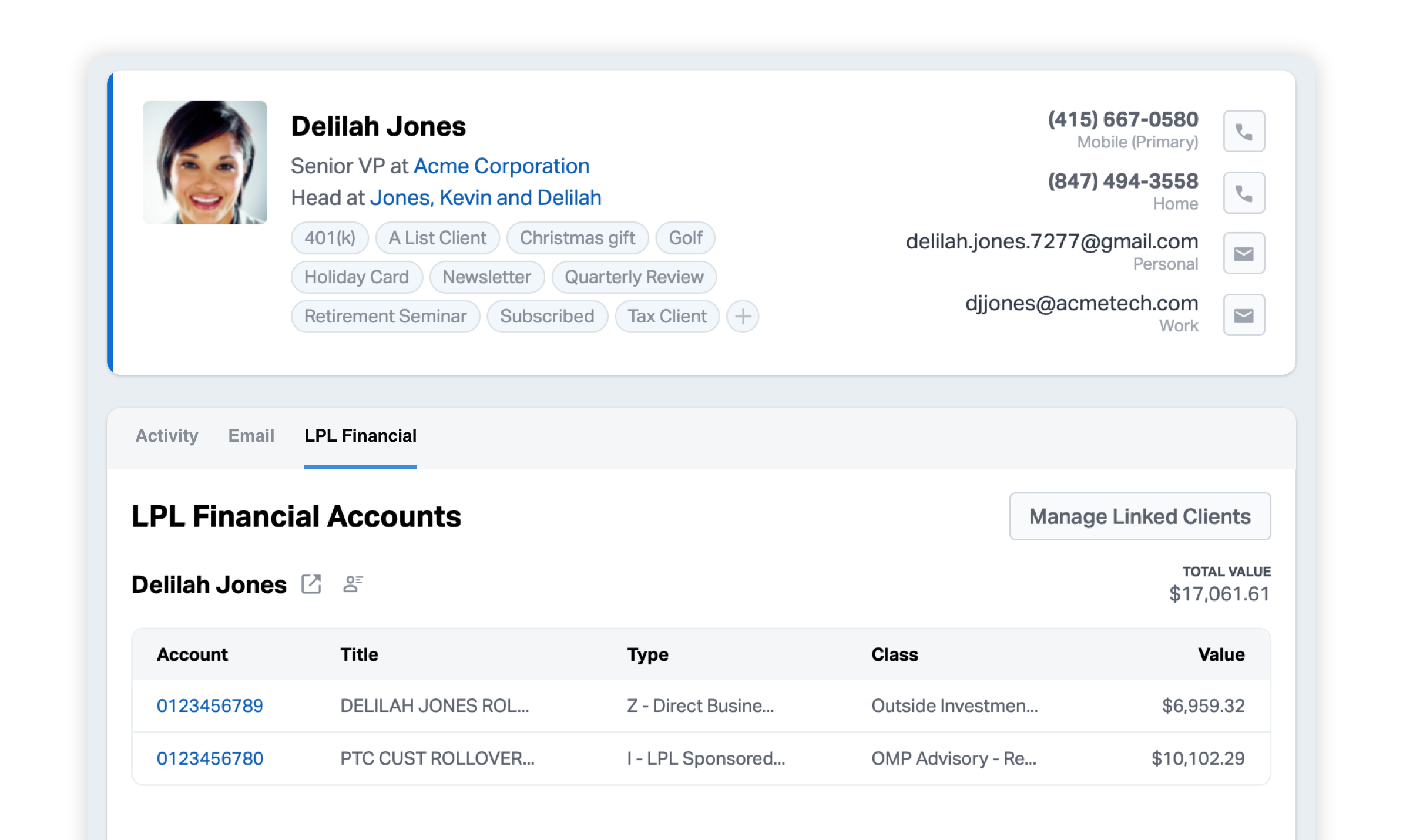
Wealthbox is a purpose-built software solution designed for financial advisors and wealth managers seeking a straightforward approach to client management and day-to-day task tracking. Its core strength lie in relationship management and activity monitoring, with integrations for essential adviser platform and custodians systems. The platform is particularly well-suited to advisory teams, rather than broader banking or lending institutions.
Distinguished features:
- Robust contact management, enabling teams to track and share client activity updates across the entire organisation.
- Automated workflows supported by customisable templates to help improve operational efficiency.
- Wealthbox Mail provides two-way email synchronisation for simplified email management and performance analytics.
- An intuitive drag-and-drop interface to build and oversee the sales pipeline.
- Strong security measures, including permission-based visibility and SOC 2 certification.
Limitations to consider:
- May not meet the advanced requirements of banks or credit unions.
- Offers fewer options for customisation and automation when compared with enterprise-grade platforms.
- Scalability may be constrained as the firm grows or needs more complex workflows.
- Lacks certain financial compliance tools and support for profuct origination.
Pricing:
Wealtbox pricing begins at £59 per user per month for its standard CRM functionality.
7. Oracle
Oracle CX for Financial Services enables retail and corporate banking institutions to modernise operations and deliver a truly digital client experience. With a comprehensive, unified view of customer data, financial organisations can manage client interactions, build personalised relationships, and offer financial solutions tailored to individual needs.
Distinguished features:
- Guided selling and self-service product recommendations, supported by conversational chatbots.
- Automated workflows for onboarding and account origination.
- Built-in generative AI and machine learning to provide insights into business, customer, and wealth or cash management.
- Configurable dashboards featuring intuitive no-code design elements that leverage machine learning.
- Oracle Banking Routing Hub, enabling integration across a wide range of domains and product systems.
Limitations to consider:
- Implementation can be complex and resource-heavy.
- May require significant customisation for specific advisory or niche workflows.
- Licensing fees can be considerable, potentially making the solution less suitable for smaller firms.
Pricing:
Oracle’s pricing model is based on the specific products and services selected, with details available upon request.
8. Redtail CRM
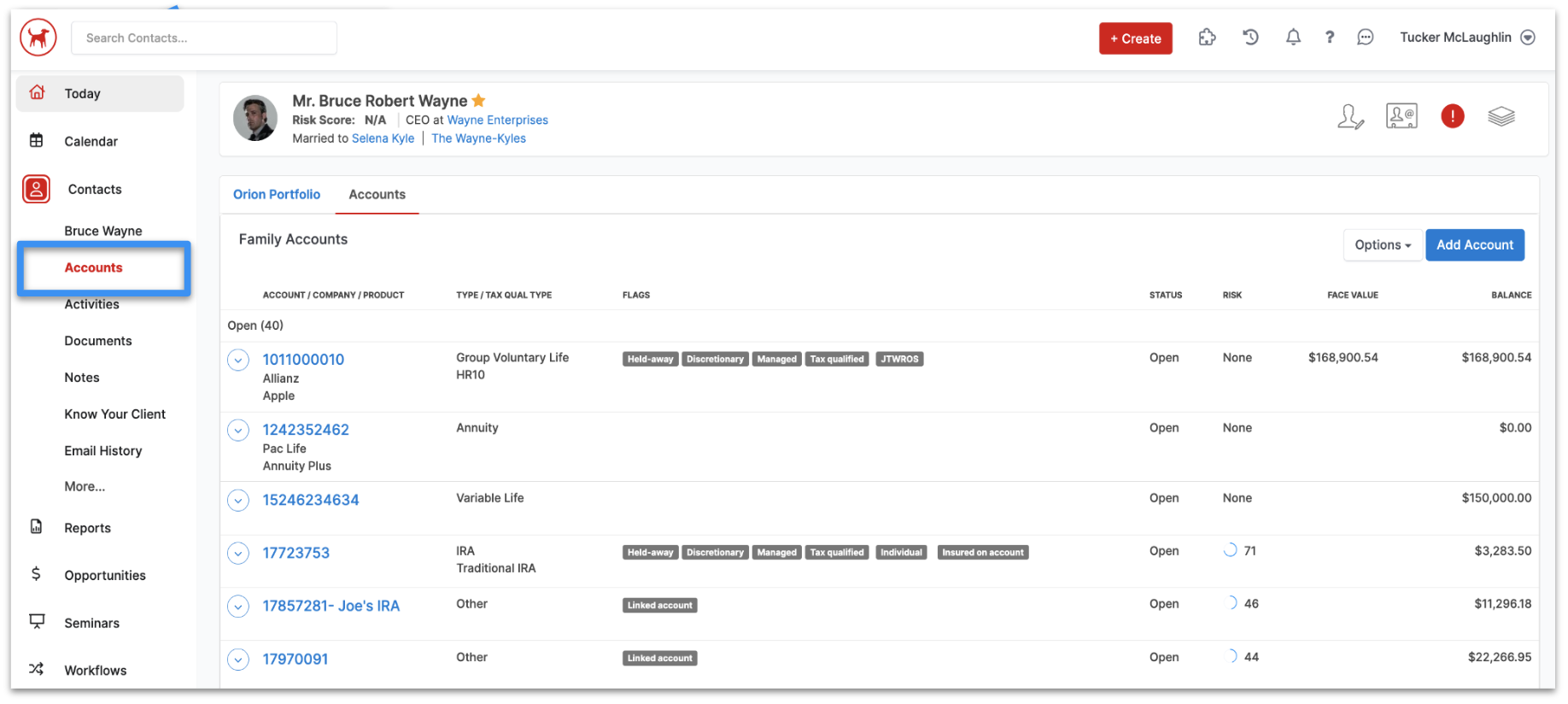
Redtail is a financial CRM solution widely used by wealth managers and financial planning firms to strengthen client relationships and support regulatory compliance. It offers core CRM capabilities along with tools for straightforward workflow management and record-keeping. The platform is specifically designed with financial advisors in mind and is best suited for smaller, independent firms rather than larger, multi-department financial institutions. As such, it may not be the most appropriate choice for banks or credit unions.
Distinguished features:
- Pre-configured advisory workflows covering opportunity tracking, client onboarding, reviews, communications, and financial planning tools.
- Comprehensive view of all client and household data within a single interface.
- Integrated calendar and task management tools to schedule, assign, and monitor client appointments.
- Compatibility with widely used advisory platforms such as Orion, Schwab, and eMoney.
Limitations to consider:
- Lacks more advanced automation or AI-driven analytics typically required at enterprise level.
- Offers limited functionality beyond advisory-specific workflows, which may not meet the needs of broader teams.
- Not intended for use by banks, building societies, or credit unions.
Pricing:
Redtails is priced from $39 per month, covering up to five users.
9. Pipedrive
Pipedrive is a sales-focused CRM solution developer to streamline pipeline management, track deals, and support day-to-day sales activities. Although it is not tailored specifically for the financial services, it offers intuitive workflows, configurable pipelines, and accessible tools for managing prospects and client engagement. Its visual interface allows teams to monitor deal progress with clarity, while integrated AI features support opportunity prioritisation, outcome forecasting, and the recommendation of next actions, helping to improve consistency and overall sales effectiveness.

Distinguished features:
- Visual sales pipeline interface with drag-and-drop functionality and customisable stages.
- Automation tools to streamline core sales processes.
- AI-powered Sales Assistant offering next-steps recommendations and deal prioritisation.
- Integration marketplace with access to over 400 third-party applications.
Limitations to consider:
- Does not include pre-configured financial services workflows, such as underwriting or client onboarding, as standard.
- Many advanced capabilities are only available on higher-tier pricing plans.
- Less suitable for managing the full customer lifecycle, including marketing, service, and regulatory compliance, when compared with comprehensive financial CRM systems.
- Reporting dashboards customisation is more limited than some enterprise-grade alternatives.
- May not scale as effectively for larger organisations with complex requirements.
Pricing:
Pipedrive CRM, which includes a full suite of sales tools, starts at £49 per user per month.
10. BUSINESSNEXT
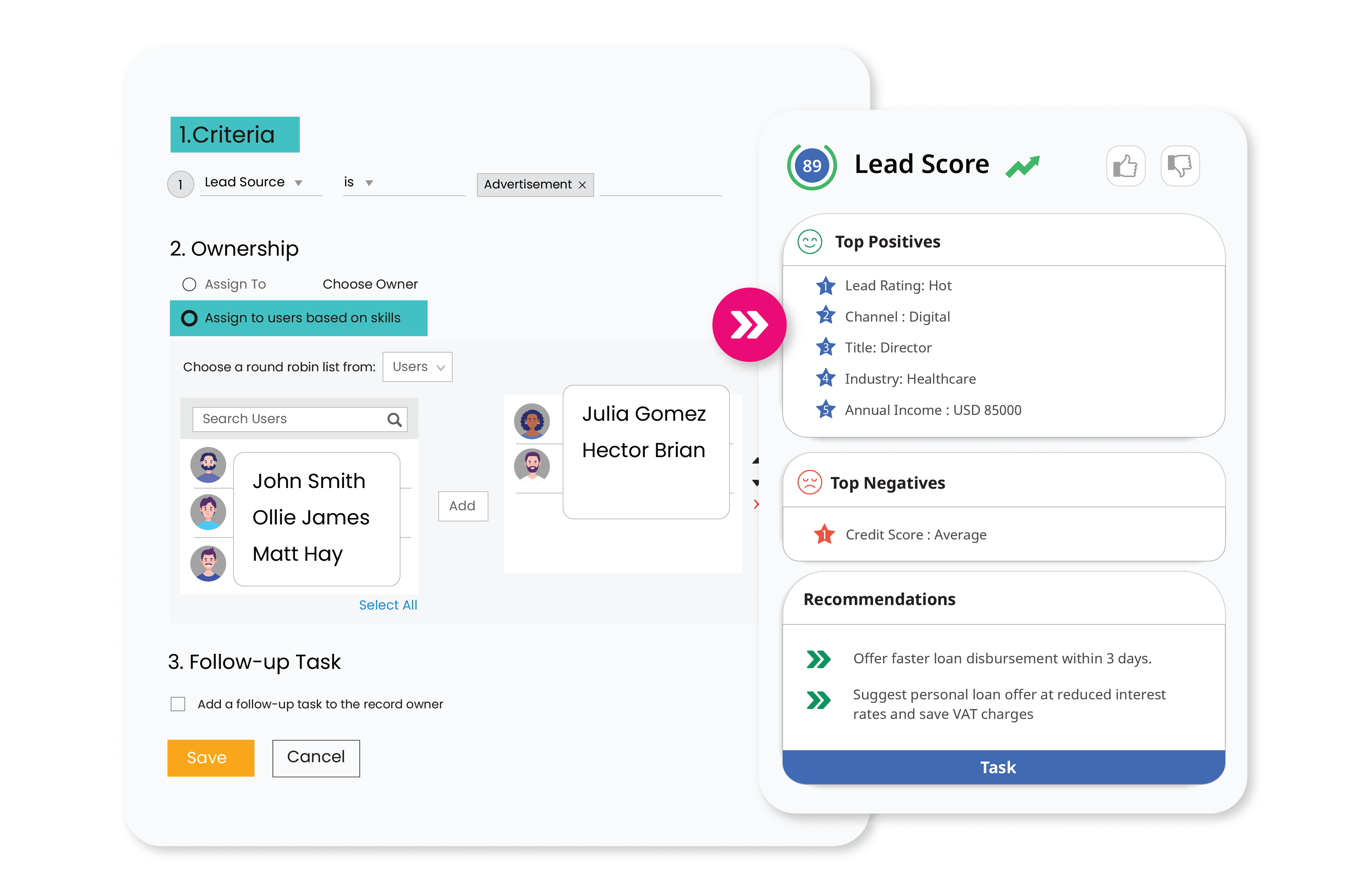
BUSINESSNEXT is a CRM suite developed specifically for financial advisors. It enables the transition to autonomous banking through a composable set of platforms, including CRMNEXT, DATANEXT, CUSTOMERNEXT, and over twelve pre-configured solutions. With integrated AI capabilities, BUSINESSNEXT helps financial institutions convert leads more effectively, tailor the offerings, and streamline day-to-day operations.
Distinguished features:
- 360-degree views of members and customers, with lead management tailored specifically for financial institutions.
- AI-driven opportunity management, real-time insights, and next best actions for sales teams.
- Automated workflows, an intelligent knowledge base, and generative AI-powered chatbots to enhance customer service delivery.
- Composable platform architecture featuring ready-made connectors and modules for lending, onboarding, and digital engagement.
Limitations to consider:
- As a specialised CRM tailored to the financial sector, deployment and support may vary by region or market, often requiring local configuration.
- The platform’s ecosystem and third-party marketplace are more limited when compared to those of larger providers.
- Some users have noticed that initial setup can be complex, with occasional delays in system performance.
Pricing:
Pricing depends on organisational size, product scope, and deployment requirements. It is available upon request.
How to select the appropriate finance CRM
Choosing the most suitable CRM systems is a significant decision for financial institutions and advisers alike. To ensure the solution meets an organisation’s needs, it is important to assess the following key considerations:
- Requirements and objectives: begin by outlining core workflows, current challenges, compliance obligations, client volumes, and product complexity. This ensures clarity around the functionality required to meet organisational goals.
- Feature scope: it is essential to select a CRM with sector-specific features, including client onboarding, KYC/AML compliance, lending operations, service management, analytics, and strong data protection measures.
- AI capabilities: platforms offering native AI functionality provide significant advantages, such as enhanced productivity, improved decision-making, and the ability to deliver highly tailored customer experiences.
- Customisation and adaptability: preference should be given to systems that include no-code tools, allowing workflows, data models and interfaces to be configured with minimal reliance on IT resources.
- User adoption and support: opt for CRM platforms that offer comprehensive training materials, onboarding assistance, and responsive support services to ensure a smooth implementation and encourage consistent user engagement.
- Ease of use: an intuitive interface is essential for reducing the learning curve, particularly for staff less familiar with digital tools. Systems that facilitate quick access to key features and information can significantly improve day-to-day efficiency.
- Integrations: the selected CRM should integrate effortlessly with existing business systems, including accounting platforms, planning tools, document management, portfolio management solutions, and third-party financial data providers.
- Security and compliance: due to the sensitive nature of financial information, the platform must meet high standards of security, including data encryption, access controls, audit trails, and adherence to relevant data protections regulations such as UK GDPR.
- Scalability: the CRM should offer the flexibility to accommodate future growth in terms of users, data volumes, and functionality, supporting the evolving needs of the organisation without requiring major system changes.
- Pricing: transparent pricing structures are essential for accurate budgeting and long-term planning. Solutions with clear, upfront costs and no hidden charges are generally more sustainable and easier to manage.
Summary
Modern financial institutions require CRM platforms not only to meet evolving client expectations, but also to maintain a competitive edge and support sustainable growth. These systems consolidate customer data, streamline processes across key departments, and enhance regulatory compliance with integrated KYC and AML functionality. With the addition of AI agents, no-code customisation, and advanced analytics, finance CRM systems enable more personalised client engagement, reduce manual workloads, and improve operational efficiency.
Among the leading CRM platforms for financial institutions, Creatio distinguishes itself as the top-tier choice for organisations seeking a comprehensive solution, advanced flexibility through no-code tools, and robust AI capabilities. Whether for banking, credit unions, wealth management, or insurance company, Creatio CRM offers pre-configured workflows and sector-specific tools tailored to industry requirements. Find out for yourself and get a free live demo with Creatio’s experts.