





































































AI Agents for Credit Unions: Use Cases, Benefits and How to Get Started

Automate Credit Union Workflows with Creatio Bank.AI

AI adoption is gaining momentum across financial services. According to Creatio's State of Enterprise AI Adoption Report, 80% of surveyed financial institutions have moved beyond AI experimentation, and 87% of financial services leaders expect AI agents to expand workforce capacity or augment teams.
For credit unions, this shift presents an opportunity to scale operations and member services without a proportional increase in headcount. Going beyond traditional chatbots, AI agents can automate workflows across lending, onboarding, member servicing, and retention, helping credit unions compete with larger financial institutions while maintaining the personalized service that sets them apart.
In this article, we’ll explain the most valuable AI agent use cases for credit unions, leading AI agent platforms to consider, and key steps for implementing them securely within existing operations.
Key Takeaways
- AI agents help credit unions improve operational efficiency by automating routine member requests, lending tasks, and back-office workflows.
- Member service and lending are key use cases, including 24/7 support, onboarding, loan underwriting, fraud detection, and personalized product recommendations.
- AI agents can support growth without proportional staff increases by reducing manual workloads and enabling employees to focus on complex member needs.
- Security, compliance, and integration are critical when deploying AI agents in credit unions, particularly for workflows involving sensitive member data and financial decisions.
- The top AI agent platforms for credit unions include Creatio Bank.AI, interface.ai, Eltropy, Kore.ai, and Zest AI, each offering capabilities for member engagement, service automation, lending, and operational workflows.
What Are AI Agents for Credit Unions?
AI agents for credit unions are AI-powered software systems that can reason, plan, and take actions to complete tasks across member services, lending, onboarding, and internal operations. They use business data, enterprise applications, and connected tools to execute multi-step processes with varying degrees of autonomy, operating within defined rules, permissions, and human oversight.
While traditional chatbots typically respond to inquiries, AI agents can act on information and advance workflows toward specific outcomes. For example, a Relationship Manager Agent can help teams identify member needs, prepare for interactions, and coordinate follow-up activities.
Some agents can operate more autonomously, handling entire sequences of tasks without waiting for instructions at every step. Creatio’s Referral Agent, for example, can independently track new referrals, initiate follow-ups, monitor progress, and involve humans when personal engagement or approval is required.
For credit unions, this comes at a time when staffing constraints and growing demand for 24/7 digital services are putting pressure on traditional operating models. As agentic AI matures, institutions can automate more of the routine, manual work across departments and systems, helping them compete with larger banks and preserve the exceptional member-focused service.
Top Use Cases of AI Agents in Credit Unions
AI agents can support credit unions across the entire member lifecycle, from acquisition and onboarding to lending, servicing, and retention. Their value goes beyond automating individual tasks: they can manage multi-step workflows, act on information from connected systems, and coordinate work between employees and departments.
1. Member Acquisition, Growth & Retention
According to Debbie’s 2026 Member Acquisition Cost Report, the average cost of acquiring a new credit union member reached $565, up 15% year over year. With acquisition becoming more expensive, credit unions need to make better use of existing member relationships, referrals, and opportunities to grow deposits and product adoption.
AI agents can support these efforts through:
- Referral management: Referral AI agents can identify potential referral opportunities, match prospects with appropriate employees, and manage follow-ups through conversion, helping turn member recommendations into new relationships.
- Next-best-offer recommendations: Next Best Offer Agents can analyze member needs, financial behavior, and life events to recommend relevant products, such as auto loans, credit cards, or savings accounts.
- Churn prevention: Retention agents can recognize warning signs such as declining account activity, reduced deposits, or disengagement and trigger targeted outreach before members leave.
- Renewal management: AI agents can monitor upcoming CD maturities and loan renewals, present relevant options, and initiate timely conversations to retain deposits and lending relationships.
- Relationship management: Relationship Manager Agents can prepare member profiles, highlight important account changes, and suggest talking points ahead of meetings, helping employees provide more informed financial guidance.
These applications allow credit unions to engage members based on their actual financial needs and behaviors rather than relying solely on scheduled campaigns or reactive outreach.
2. Member Onboarding & KYC
For credit unions, onboarding involves more than opening an account. Unlike traditional banks, credit unions must also establish membership eligibility, often based on employment, geographic location, or association with a qualifying group. AI agents can support this process while helping institutions meet identity verification and compliance requirements.
Key applications include:
- Digital account opening: Onboarding AI agents can guide applicants through account selection, prefill available information, explain membership requirements, and help complete applications without branch visits.
- Identity and document verification: Verification agents can extract details from government-issued IDs, compare them with application records, and initiate identity checks through integrated verification services.
- Fraud and discrepancy detection: AI agents can identify conflicting personal information, unusual application patterns, or potential identity fraud and refer suspicious applications for investigation.
- KYC case preparation: KYC and document processing agents can assemble identity verification results, screening findings, and outstanding compliance requirements into a single case for review.
By addressing missing information and verification issues earlier, credit unions can reduce onboarding abandonment and accelerate account activation without weakening compliance controls.
3. Lending & Underwriting
Loan origination involves multiple stages, from application intake and borrower verification to underwriting and disbursement. AI agents can help credit unions move applications through these stages with fewer delays, particularly in document-intensive products such as mortgages, auto loans, and personal loans.
Credit unions can apply AI agents to:
- Loan application intake: Lending agents can guide borrowers through product-specific applications, collect required information, and follow up on outstanding documents to prevent incomplete applications from stalling.
- Document extraction and verification: AI agents can extract income, employment, and financial information from pay stubs, tax returns, and bank statements, then compare it with borrower declarations.
- Eligibility checks: Agents can assess preliminary requirements such as membership status, product criteria, and application completeness to determine whether a loan is ready for underwriting.
- Underwriting preparation: AI agents can compile borrower financial profiles, debt obligations, credit information, and supporting evidence into draft credit memos, allowing underwriters to focus on risk assessment and lending decisions.
- Loan servicing: Loan servicing agents can address payment questions, provide payoff information, coordinate permitted account changes, and notify members about relevant loan events.
This approach can shorten loan processing cycles and help credit unions handle more applications without proportionally increasing administrative staffing. Credit approval and other consequential lending decisions remain subject to established policies and applicable regulatory requirements.
4. Member Service & Contact Center
Credit unions often compete with larger banks on the quality of their member relationships, but delivering personalized support across branches, contact centers, and digital channels can be resource-intensive. AI agents can handle routine requests independently while supporting employees during interactions that require judgment or personal attention.
Common applications include:
- 24/7 autonomous voice and chat agents: Conversational agents can authenticate members, answer balance and transaction inquiries, and complete supported requests through voice or digital channels, including outside business hours.
- Account and card servicing: Account Servicing Agents can process permitted account updates and statement requests, while card servicing agents can help members freeze lost cards, request replacements, and check card status.
- Service request management: AI agents can turn member inquiries into actionable service cases, assign ownership, track resolution progress, and provide status updates without repeated calls.
- Internal knowledge assistants: Employee-facing agents can retrieve relevant policies, explain product conditions, and provide contextual guidance during live conversations, reducing time spent searching internal resources.
- Dispute resolution: AI agents can initiate transaction disputes, gather supporting evidence, track investigation deadlines, and keep members informed about case progress.
These capabilities can improve first-contact resolution and shorten handling times while allowing contact center employees to concentrate on complex financial questions, complaints, and sensitive member situations.
5. Back-Office, Fraud & Compliance
Beyond member-facing activities, AI agents can support the operational controls that keep credit unions running. Their role is particularly valuable in processes involving large volumes of documents, transaction alerts, regulatory requirements, and time-sensitive follow-ups.
Practical applications include:
- Document processing: Document Processing Agents can classify incoming forms, extract structured data, and populate internal systems, reducing manual data entry across administrative workflows.
- Fraud and AML alert triage: Investigation agents can examine flagged transactions in context, connect related account activity, and assemble evidence for analysts to assess potentially suspicious behavior.
- Smart collections: Collections agents can segment delinquent accounts by payment history and risk indicators, initiate policy-compliant outreach, and support payment arrangement workflows where authorized.
- Compliance monitoring: AI agents can check transactions and operational activities against predefined controls, identify potential policy breaches, and surface issues requiring compliance attention.
- Regulatory reporting: Reporting agents can aggregate required information from banking and operational systems, perform reconciliation checks, and prepare draft regulatory submissions with supporting audit trails.
For operations and risk teams, these applications can reduce investigation backlogs, improve control consistency, and make regulatory preparation less labor-intensive. Sensitive determinations, required approvals, and regulatory accountability remain with authorized personnel.
Benefits of AI Agents for Credit Unions
AI agents help credit unions serve more members, strengthen relationships, and scale operations without proportionally increasing costs. Their value extends beyond automation, supporting the credit union mission of people helping people.
- 24/7 service availability at a lower cost: Members can access support around the clock without requiring equivalent increases in contact center staffing. PYMNTS research found that consumers who recently left a credit union were 122% more likely than average consumers to want AI chat support.
- Faster member onboarding and lending: Another advantage of AI agent adoption for credit unions comes from shorter processing cycles, fewer delays, and quicker access to financial products, which improve the member experience and help credit unions handle growing application volumes.
- More time for high-value member interactions: Less administrative work allows employees to focus on financial guidance, complex requests, and relationship-building rather than routine transactions.
- Higher member retention and wallet share: More relevant, timely engagement helps credit unions strengthen loyalty, increase product adoption, and grow existing relationships. Ent Credit Union reported 18.5% growth in new deposit conversions and 8.5% growth in new loan conversions following its Creatio-powered CRM transformation.
- More consistent service and stronger governance: Standardized processes reduce manual errors and service inconsistencies across branches and digital channels, while traceable actions support compliance reviews and audits.
- Greater scalability and cost efficiency: With agentic platforms, organizations can support membership growth and adapt faster to changing needs without proportionally expanding operational resources. A Nucleus Research financial services case study reported 70% faster workflow delivery and 30% technology cost savings with Creatio.

Challenges and Risks of Implementing AI Agents in Credit Unions
Deploying an AI agent for a single task is one thing. Giving it access to member records, connecting it to core banking systems, and allowing it to execute workflows is another. For credit unions, the real challenge begins when AI moves beyond isolated pilots into everyday financial operations.
According to Creatio's State of Enterprise AI Adoption Report: Financial Services Edition, security and compliance concerns increase from 45% among early-stage AI adopters to 57% among AI leaders. This suggests that scaling AI introduces new operational demands rather than simply resolving the challenges encountered during experimentation.
1. Moving From AI Assistance to Autonomous Actions
An AI assistant that provides an incorrect answer creates one type of risk. An agent that acts on incorrect information can create a much larger problem, particularly when updating member records, initiating account changes, or handling financial transactions.
Credit unions need to define what agents can do independently, which actions require authorization, and how employees can review, interrupt, or reverse agent-initiated workflows.
2. Connecting Existing Banking Systems
An agent's ability to complete a task depends on the systems it can access. A credit union might have member information in its core banking platform, relationship history in CRM, and loan applications in a separate origination system.
This is a substantial obstacle across financial services: 47% of surveyed institutions cite data quality and system integration as barriers to scaling AI. For credit unions, disconnected systems can leave agents unable to complete even relatively straightforward member requests without manual intervention.
3. Maintaining Member Trust as AI Takes on More Responsibility
Credit unions handle sensitive financial information and operate under strict regulatory requirements. As AI agents become more involved in member-facing and operational processes, protecting data, ensuring accurate outcomes, and maintaining accountability become increasingly important.
The Creatio Bank.AI report identifies security concerns as the leading barrier to AI scale, cited by 52% of financial institutions. Credit unions must therefore consider not only whether an agent can complete a task, but whether its access, decisions, and actions can be appropriately controlled and audited.
4. Managing the Real Cost of Scaling AI
An initial AI pilot may require relatively limited investment. Enterprise deployment introduces additional costs for system integrations, AI consumption, security controls, monitoring, and ongoing maintenance.
The research shows that budget concerns increase from 27% among early-stage adopters to 46% among AI leaders. For credit unions, this makes it essential to evaluate the total cost of operating AI agents at scale, not just the cost of launching the first use case.
5. Redesigning Work Around People and AI Agents
As AI agents take on more responsibilities, credit unions must redefine workflow ownership, human oversight, and employee roles. This becomes increasingly important at scale: according to Creatio's research, change management concerns rise from 24% among early-stage adopters to 35% among AI leaders.
Clear responsibilities, employee training, and effective human-AI collaboration are essential to scaling AI without compromising the personalized service credit unions are known for.
AI Agents and Regulatory Compliance: What Credit Unions Should Know
Credit unions can adopt AI agents without waiting for new AI-specific regulations. According to the National Credit Union Administration (NCUA), there are currently no standalone NCUA regulations governing AI. However, existing requirements for safety and soundness, consumer protection, information security, and third-party risk management still apply.
The NCUA supervises AI use within its existing regulatory framework, focusing on how credit unions manage risks rather than which technologies they adopt. For AI agent deployments, this means addressing several key compliance considerations:
- Third-party vendor due diligence: Evaluate AI providers' security practices, data handling, reliability, model risks, and operational controls before deployment. Outsourcing AI capabilities does not transfer regulatory responsibility away from the credit union.
- Human oversight and escalation: Establish clear approval thresholds and escalation procedures, particularly for lending decisions, suspicious activity investigations, and sensitive account changes. Higher-risk actions should remain subject to appropriate human review.
- Auditability and explainability: Maintain records of agent actions, data sources, approvals, and exceptions. Credit unions should be able to reconstruct how consequential outcomes were reached and provide explanations where required by applicable regulations.
- Fair lending and financial crime compliance: AI-assisted lending must comply with applicable fair lending requirements, including the Equal Credit Opportunity Act. Agents supporting fraud detection and BSA/AML processes must operate within established monitoring, investigation, and reporting controls.
- Member data protection: Apply appropriate information security safeguards, access restrictions, and data retention controls to protect sensitive financial information throughout agent-driven workflows.
- Internal AI governance: Establish a documented AI governance policy with defined responsibilities for risk assessment, deployment approvals, performance monitoring, and incident response. Depending on the credit union's size and complexity, oversight may sit with an existing risk committee or a dedicated AI governance group.
The key principle is that credit unions remain accountable for AI-driven activities, even when agents operate autonomously or are supplied by third-party vendors. Effective governance should therefore be built into agent workflows from the outset, rather than added after deployment.
Best AI Agents for Credit Unions: Top Platforms and Providers
Vendor | Best for | Standout capabilities |
|---|---|---|
| Creatio Bank.AI | Credit unions seeking to automate the entire member lifecycle with AI agents, CRM, and no-code workflows | AI-native CRM with Customer 360, no-code workflow automation, prebuilt AI agents for credit unions |
| interface.ai | Organizations automating contact centers and transactional member service | Agentic Voice AI, banking transaction self-service, automated collections outreach |
| Eltropy | CU institutions managing member communications across channels | Unified text/voice/video communications, AI-powered member conversations, appointment management |
| Kore.ai | Financial organizations developing custom AI agents for banking and operational workflows | Enterprise AI agent builder, multi-agent orchestration, prebuilt banking AI applications |
| Zest AI | Credit unions focused on automated loan underwriting and credit risk management | Machine learning credit underwriting, application fraud detection, LuLu lending intelligence |
Creatio Bank.AI Agents for Credit Unions
Creatio Bank.AI is an AI-native CRM and workflow platform that helps credit unions attract new members, grow existing relationships, and serve more members without proportionally increasing staff workloads. It connects a 360-degree member view with enterprise AI agents and no-code automation, enabling credit unions to manage the member lifecycle without replacing their core banking systems.
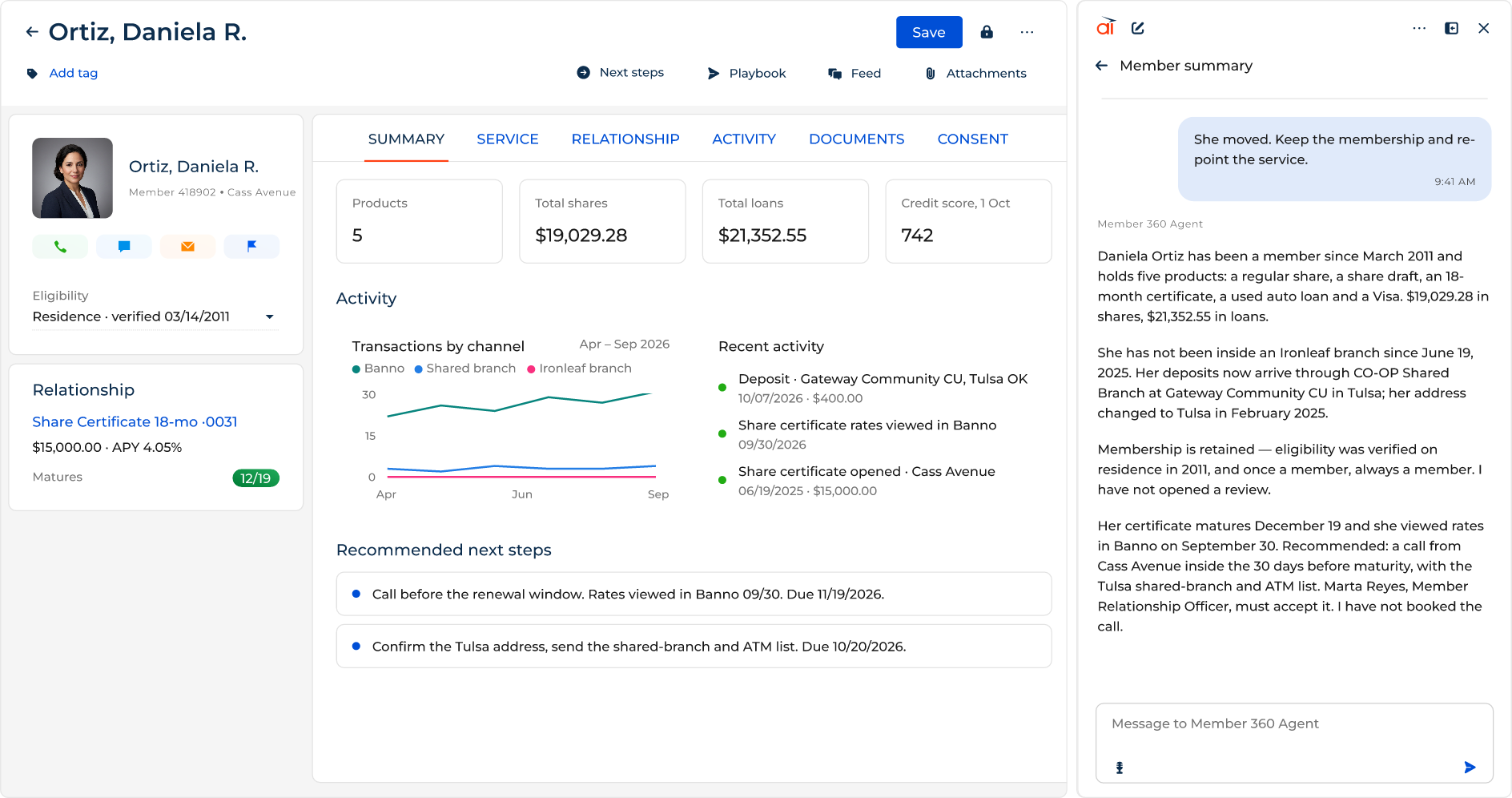
Creatio Bank.AI: Member 360
Bank.AI offers prebuilt agents for member acquisition, onboarding, servicing, and back-office operations. Using Creatio AI Studio, credit unions can customize these agents or build new ones for CU-specific needs. Business and IT teams can also adapt CRM applications and workflows to their internal processes, reducing the need for custom development as requirements change.
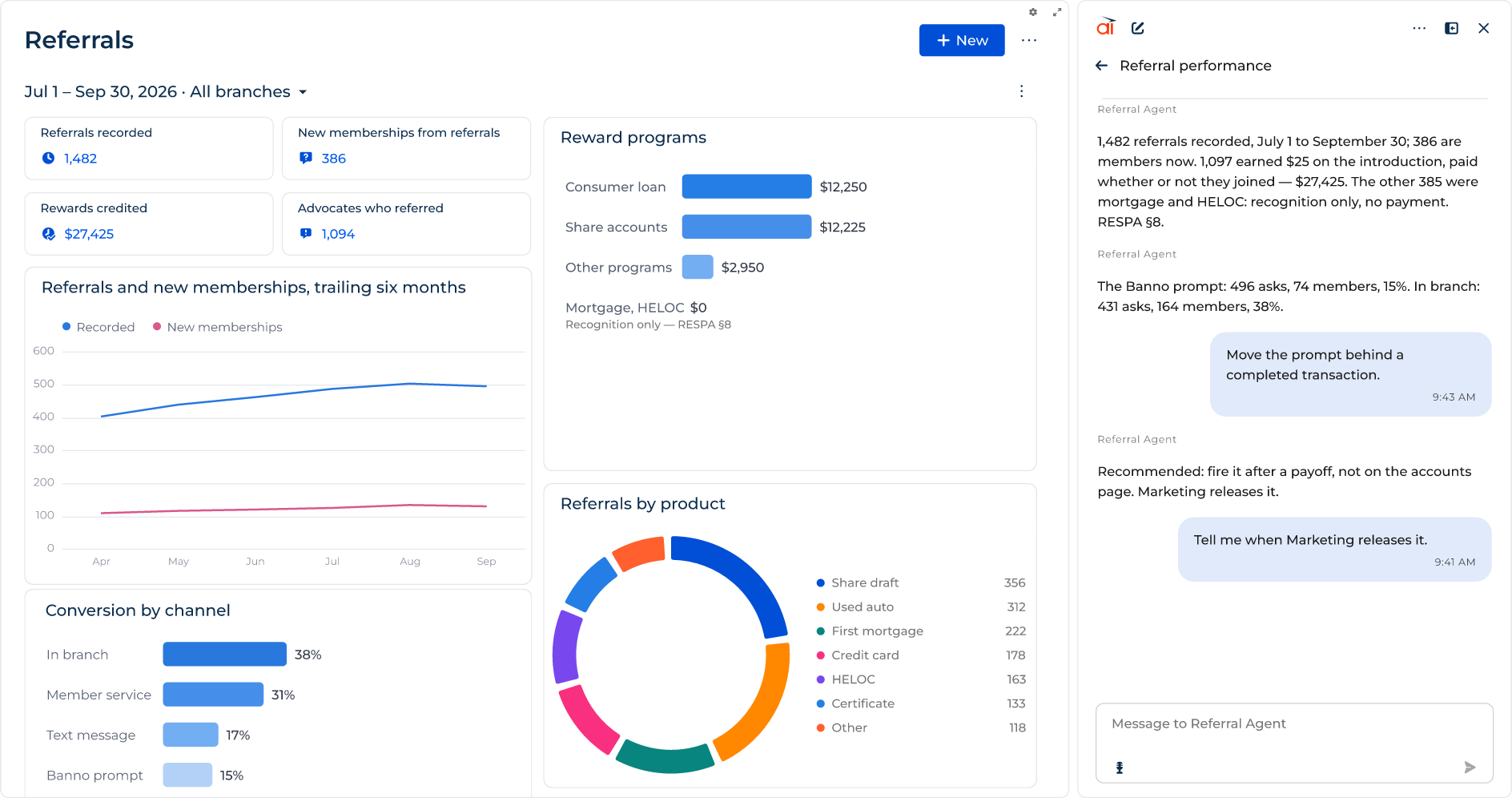
Creatio Bank.AI: Credit Union Referral Operations
For example, AI agents can help credit unions convert indirect auto loan borrowers into primary banking members through targeted onboarding and product recommendations. In servicing, Card Servicing and Dispute Resolution agents can coordinate related requests, reducing handoffs and resolution delays.
Ent Credit Union deployed Creatio for 1,200 users in 3.5 months, automating more than 340 service case types. Its CRM transformation delivered 18.5% higher new deposit conversions, 8.5% higher new loan conversions, and approximately $1.4 million in year-over-year revenue growth. These results reflect CRM and workflow automation rather than AI agents specifically.
Creatio supports enterprise security requirements through SOC 2 Type II and ISO 27001 certifications, GDPR-related data protection capabilities, and cloud or on-premises deployment options. Built-in AI governance enables institutions to define agent permissions, enforce policies, and require human approval for sensitive actions. Activity monitoring and audit trails help risk and compliance teams review agent actions, approvals, and exceptions.
Key features
- Member growth and retention agents: The Referral Agent manages referrals and follow-ups, the Next Best Offer Agent recommends relevant financial products, and the Retention Agent identifies members at risk of leaving.
- Member servicing agents: The Account Servicing Agent handles routine account requests, the Card Servicing Agent supports card-related services, and the Dispute Resolution Agent assists with transaction disputes.
- Onboarding and document processing agents: The Customer Onboarding Agent guides new members through application requirements and follow-ups. The Document Processing Agent extracts and validates information from documents used in onboarding, lending, and back-office operations.
- Connected banking workflows: Agents work with Creatio's Customer 360, Contact Center Desktop, Case Management, and banking workflows for KYC, risk management, and regulatory reporting.
- No-code agent development: Creatio AI Studio enables credit unions to customize prebuilt agents, create new ones, and coordinate tasks between employees and AI agents.
Pros
- Easy customization with less IT dependency, using no-code tools and AI coding agents
- Faster workflow delivery and lower application management costs.
- Integration with existing core banking and financial systems.
- Built-in AI governance, human approvals, and audit trails.
- Dedicated AI agents working across the end-to-end member lifecycle.
Cons
- Steep learning curve for users not familiar with no-code.
- Legacy banking integrations may require additional development.
- Advanced agent workflows depend on accurate data and established business processes.

interface.ai
interface.ai is an agentic AI platform built for credit unions and community banks to automate member interactions across voice, chat, and digital channels. It provides dedicated AI agents that answer inquiries, authenticate members, and complete supported banking transactions without requiring contact center employees to handle every request.
Its primary focus is conversational banking and contact center automation, helping financial institutions provide 24/7 member support, reduce routine service workloads, and improve response times. The platform also offers AI agents for employee assistance and collections, with core banking integrations that enable account access, supported transactions, and escalation to employees when needed.
Key features
- Agentic Voice AI to automate inbound calls, member authentication, account inquiries, and supported banking transactions.
- Agentic Chat AI, providing 24/7 digital support through web and mobile banking channels.
- Agentic Employee AI to assist staff with information retrieval, member inquiries, and service workflows.
- Smart Collections AI to support automated payment reminders, delinquency outreach, and collections follow-ups.
- Core banking integrations enable secure access to member accounts, transaction processing, and escalation to employees.
Pros
- Banking-specific voice and chat AI agents.
- 24/7 member support and transactional self-service.
- Core banking integrations for supported account operations.
- Automated collections and employee assistance capabilities.
- Documented credit union deployments and contact center results.
Cons
- Primary emphasis on conversational banking and contact center operations.
- Limited native CRM and broader BPM capabilities compared with alternative platforms.
- Automation depth depends on core integrations and implementation scope.
Eltropy
Eltropy is another agentic AI platforms for CUs and community banks, that connects text messaging, voice, video, chat, and secure digital communications to help financial institutions engage members, automate routine inquiries, and manage conversations across channels.
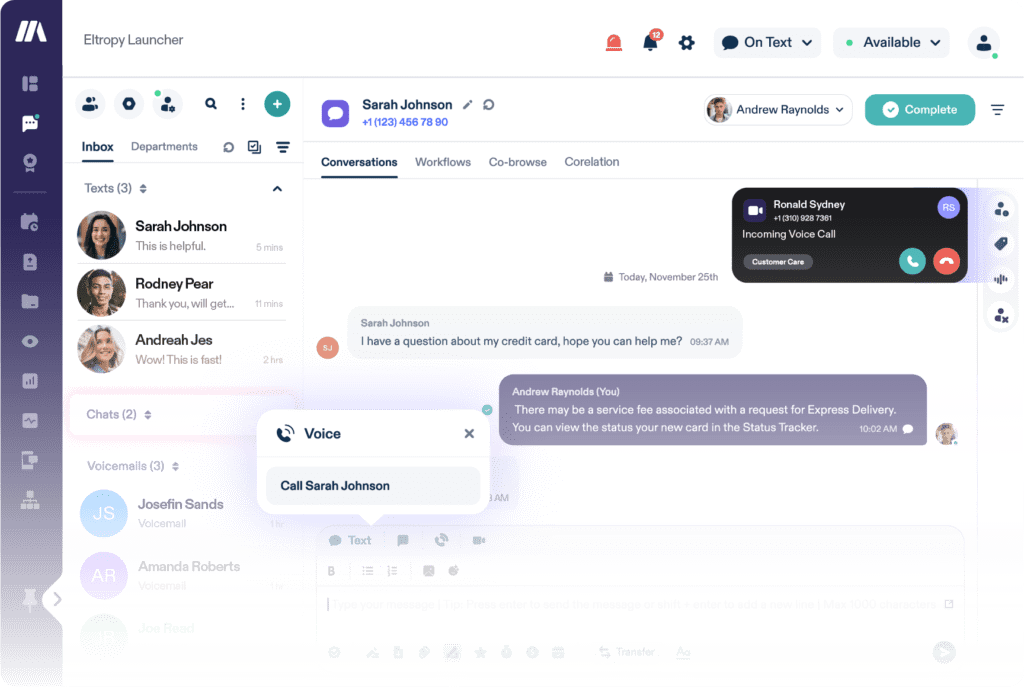
The platform focuses on member communication and contact center automation, using AI Chat and AI Voice agents to handle routine inquiries, loan questions, and transaction lookups. Eltopy also supports lending follow-ups, collections, and appointment scheduling. For complex requests, AI agents escalate conversations to employees with full interaction context and sentiment insights, reducing repeated questions and ensuring continuity of service.
Key features
- Agentic AI handles routine member inquiries, loan questions, and transaction lookups through AI Chat and AI Voice.
- Omnichannel communications unifying text, voice, video, and chat interactions in one platform.
- Human-in-the-loop support escalates complex conversations to employees with interaction history and sentiment insights.
- Lending and collections communications support loan follow-ups, document requests, payment reminders, and borrower engagement.
- Workflow automation and integrations connect member communications with core banking, lending, and other financial systems.
Pros
- Purpose-built for credit unions and community banks.
- Unified member communications across multiple channels.
- AI-powered self-service with human escalation.
- Strong support for lending and collections communications.
- Integration with existing banking and lending systems.
Cons
- Primarily focused on member communications and service operations.
- Complex integrations may require additional configuration.
- AI automation capabilities vary by channel and implementation.
Kore.ai
Kore.ai is an enterprise agentic AI platform that helps credit unions and banks automate member service, employee support, and banking operations. It combines prebuilt banking AI applications with tools for developing, deploying, and orchestrating custom AI agents.
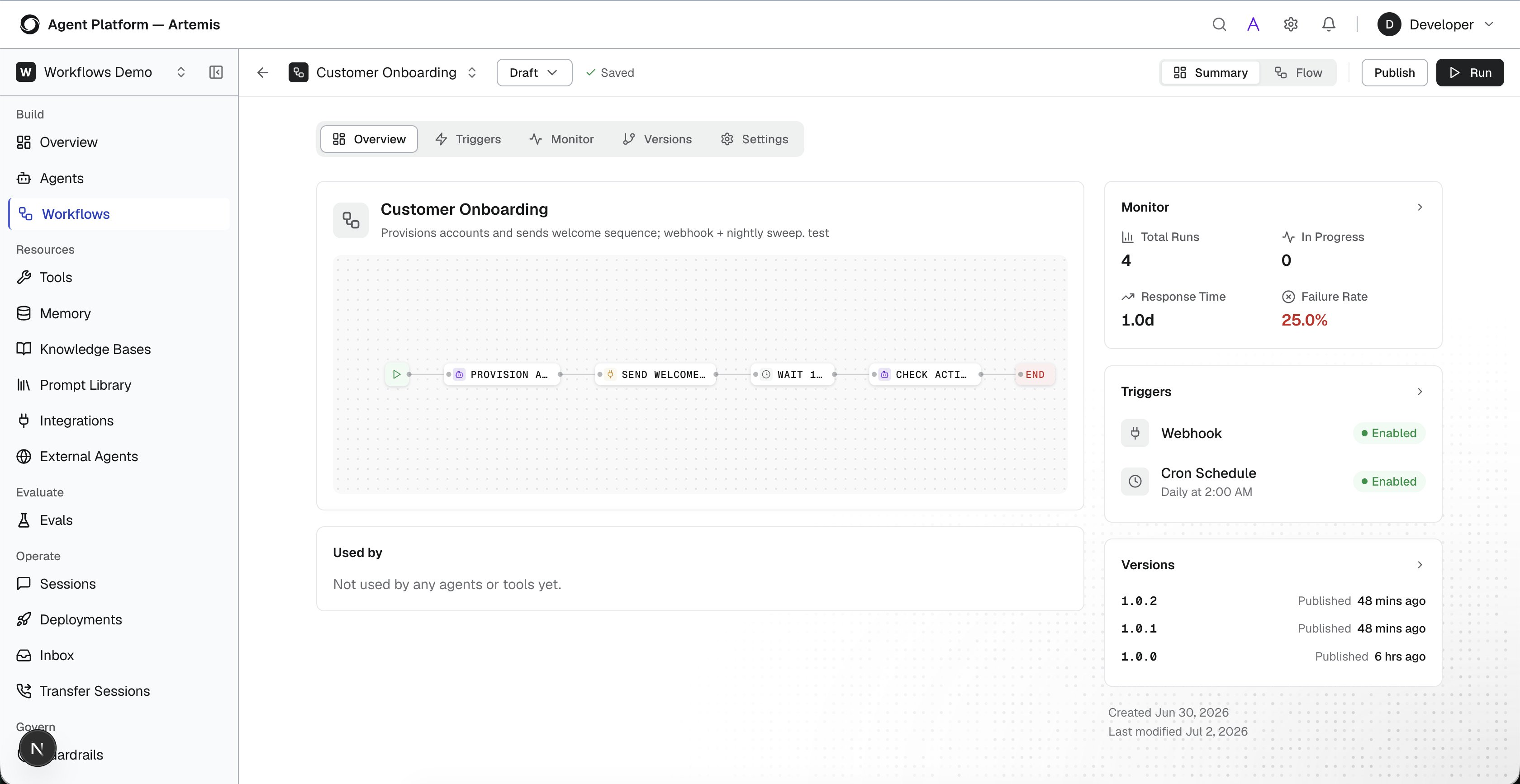
Its dedicated banking solution supports conversational self-service across voice and digital channels, covering account inquiries, card servicing, payments, and transaction disputes. Beyond member interactions, Kore.ai enables credit unions to automate multistep workflows such as member onboarding, loan application processing, fraud investigations, and account maintenance. AI agents can coordinate tasks across core banking, CRM, and lending systems, with human oversight for sensitive decisions.
Key features
- 250+ pre-built flows to support operations like balance inquiries, fund transfers, card management, and transaction disputes.
- Conversational AI automates member interactions across voice, chat, and digital banking channels.
- Agent Assist provides real-time knowledge retrieval, recommended actions, and service guidance.
- Built-in PCI compliance and configurable security guardrails.
- No-code capabilities to build, test, and deploy workflows with minimal reliance on technical specialists.
Pros
- Prebuilt banking AI applications and customizable agents.
- Automation across member service and operational workflows.
- Multi-agent orchestration for complex banking processes.
- Broad banking integrations and centralized AI governance.
Cons
- Complex custom agents may require technical expertise.
- Legacy banking integrations can increase implementation effort.
- Steeper learning curve for advanced workflows that require significant configuration and governance.
Zest AI
Zest AI is an AI-powered lending and credit risk management platform structured as a Credit Union Service Organization (CUSO). It helps credit unions automate underwriting, assess borrower risk, and make lending decisions using machine learning models.
The platform analyzes thousands of attributes from credit bureau data to assess creditworthiness beyond traditional scoring methods. Zest Protect adds fraud detection capabilities, while LuLu Lending Intelligence helps lending teams analyze portfolios, simulate scenarios, and assess performance.
Zest AI integrates with loan origination systems, including MeridianLink, allowing credit unions to incorporate AI underwriting into existing lending processes. The platform also provides model explainability and fair lending tools to support regulatory compliance and ongoing risk management.
Key features
- AI underwriting assesses borrower risk using machine learning models and credit bureau data.
- Automated loan decisioning processes eligible applications without manual underwriting.
- LuLu Lending Intelligence provides portfolio analysis, scenario simulations, and economic benchmarking.
- Zest Protect identifies potential application fraud using identity, income, and behavioral data.
- Fair lending controls support model explainability, validation, and regulatory review.
- LOS integrations connect AI risk assessments with existing loan origination workflows.
Pros
- Specialized AI underwriting for credit union lending.
- Potential to increase approvals or reduce credit risk.
- Automated decisions reduce manual underwriting workloads.
- Model explainability and fair lending controls.
- Integration with existing loan origination systems.
Cons
- Limited scope beyond lending and credit risk management.
- Model performance depends on data quality and ongoing validation.
- Implementation requires integration with existing lending systems.
How to Get Started with AI Agents in Your Credit Union
Credit unions don't need to overhaul their operations to start using AI agents. A more practical approach is to focus on a few processes where agents can deliver measurable results, then expand as the technology proves its value.
Below, Creatio’s CU experts shared a practical step-by-step guide on implementing AI agents across credit union workflows.
Step 1. Find Workflows Worth Automating
Look for tasks that take up significant staff time, involve repetitive steps, or frequently delay member requests. Review service volumes, processing times, and common bottlenecks to identify where AI agents could make the biggest difference. Loan document collection, account servicing, and onboarding follow-ups are good places to start.
Step 2. Give Agents Access to Reliable Member Data
AI agents are only as useful as the information they can access. Connect member data across core banking, CRM, lending, and servicing systems to establish a consistent Member 360 view. Pay particular attention to outdated records, duplicate information, and access permissions before allowing agents to act on that data.
Step 3. Launch One or Two Agents With Measurable Goals
Choose a limited number of use cases and establish what success looks like before deployment. For example, a lending agent might be measured by application completion rates and processing times, while a servicing agent could be evaluated on resolution rates and member satisfaction. Compare results against existing performance to determine whether the investment is paying off.
Step 4. Decide Where Employees Need to Step In
Not every action should be left to an AI agent. Define which requests agents can complete independently, which require approval, and what happens when an agent encounters an exception. Keep employees involved in consequential decisions, particularly those affecting credit eligibility, financial transactions, or potential fraud.
Step 5. Evaluate Platforms Against Your Existing Infrastructure
Prioritize AI platforms that work with your core banking system and other essential business applications without extensive customization. Assess security, auditability, agent management, deployment options, and the effort required to launch new workflows. Consider the ongoing cost of running and maintaining agents, not just initial implementation.
Step 6. Involve Employees From the Beginning
Bring frontline employees, lending teams, and operations staff into the implementation process. They know where workflows break down and which member interactions require personal attention. Train them to work with AI agents, handle escalations, and provide feedback as workflows evolve.
Step 7. Use Early Results to Guide Expansion
Track whether agents are reducing delays, improving service outcomes, and freeing employees for more valuable work. Address gaps before introducing additional agents. As adoption grows, connect agents across departments so they can coordinate related tasks rather than operating as separate tools.
Summary
AI agents can help credit unions improve member service, automate lending and back-office workflows, and support growth without proportionally increasing operating costs. The right solution depends on the institution's priorities, existing systems, and readiness to integrate AI into daily operations.
While specialized platforms address specific needs such as conversational banking or loan underwriting, Creatio Bank.AI provides a broader approach by combining AI agents, CRM, and workflow automation on a single platform. Credit unions can automate processes across the member lifecycle, customize agents with no-code tools, and scale AI adoption while maintaining human oversight.
Explore Creatio Bank.AI to see how AI agents can support your credit union's operations and growth.
