




































































Creatio vs HubSpot: Which Platform to Choose in 2026

Run customer workflows in the AI era. Try Creatio

Choosing between Creatio and HubSpot depends largely on what your organization needs beyond core CRM functionality. HubSpot has evolved from inbound marketing into a broader customer platform for marketing, sales, service, and content. Creatio combines CRM and workflow automation on a unified AI-native platform, where people and AI agents work together to automate customer-facing and industry workflows at scale.
In this article, we compare Creatio and HubSpot across their platform architecture, core capabilities, and AI to highlight the key differences and help you determine which platform better fits your business needs.
Key Takeaways:
- Creatio is best for mid-market and enterprise organizations with complex CRM and cross-functional automation needs, unifying human and AI agent workflows on a single AI-native platform.
- HubSpot is better suited to fast-growing teams seeking an easy-to-adopt CRM platform, with integrated marketing, sales, service, content, and data capabilities for managing customer-facing processes.
- The core difference between Creatio and HubSpot platforms is the scope of process orchestration: HubSpot centers automation on customer-facing processes, while Creatio extends it across complex, cross-functional operational and industry workflows.
- AI is integrated differently across the two platforms: HubSpot delivers Breeze AI capabilities based on subscription tiers and credit usage, whereas Creatio embeds AI agents directly into CRM and business workflows.
- HubSpot pricing varies across products, editions, seats, and AI consumption, while Creatio uses composable pricing and offers an Unlimited plan for broader enterprise adoption without traditional software constraints.
- Creatio offers greater customization flexibility, using visual no-code tools to build and adapt workflows, applications, and AI agents, while HubSpot provides a more standardized approach to CRM configuration.
- HubSpot can offer a faster path to deployment for standard CRM use cases, while Creatio is designed to support more complex implementations involving cross-functional workflows, custom applications, and broader process automation.
- Creatio provides more granular governance through configuration across roles, objects, records, and workflows, while HubSpot uses role- and permission-based controls centered on its CRM and customer platform.
Creatio vs. HubSpot: At a Glance
Although Creatio and HubSpot overlap across core CRM and automation capabilities, their differences become more important as businesses automate beyond standard customer workflows, address more complex requirements, and scale AI across teams.
The comparison below highlights the key criteria business leaders should consider when choosing between Creatio and HubSpot.
Evaluation criteria | Creatio | HubSpot |
| Value offering | AI-native CRM and workflow platform for people and AI agents | Agentic customer platform for marketing, sales, and service |
| Best for | Complex CRM and cross-functional automation, and governed agentic execution at scale | Easy-to-adopt CRM for marketing and sales activities |
| Platform architecture & Customization | AI-native no-code platform that enables business and IT teams to build and adapt apps and workflows | Configurable CRM with shared data, objects, properties, and pipelines |
| AI capabilities | Embedded AI tools and agents to execute complex business tasks | AI embedded across features (content, insights, routine tasks) to support user productivity |
| Workflow automation | End-to-end orchestration of full business processes with conditional logic, parallel execution, approvals and long-running workflows | Event-based workflows across marketing, sales and customer service |
| Implementation | Reduces development effort with coding agents and no-code visual tools, limiting reliance on specialized development resources. | Streamlined setup for standard CRM, with added effort for advanced requirements |
| Pricing | Core platform from $40 per user/month, CRM products from $15 per user/month; AI is included in each product by default. An Unlimited plan, with access to the full platform, all CRM products, and AI capabilities is available at custom pricing. | Starter plans from $20 per user/month, Professional – from $1,300/month for 6 seats and Enterprise at $4,700/month for 8 seats; additional seats and AI usage may add costs. |
What Is Creatio?
Creatio is an AI-native customer relationship management (CRM) and workflow automation platform that enables people and AI agents to manage customer-facing and operational processes in a single environment. It allows organizations to manage customer relationships, automate end-to-end workflows, and build custom applications and agents with AI coding agents and visual no-code tools.

Creatio is best suited to mid-market organizations and enterprises that need to extend automation beyond standard CRM processes. Alongside ready-to-use products for marketing, sales, and service, organizations can automate complex cross-functional workflows such as customer onboarding, case management, approvals, fulfillment, and compliance.
By natively combining visual no-code application development, CRM and workflow automation, and AI in a unified platform, Creatio enables business and IT teams to build and adapt applications, automate processes, and coordinate work between employees and AI agents without extensive custom development. According to Nucleus Research, this approach helps organizations to deploy workflows to accelerate application delivery by 73% and cut tech costs by 30%.
Creatio supports industry-specific workflows across more than 20 verticals, including banking, insurance, manufacturing, public sector, healthcare, and more. Its Unlimited Enterprise model allows organizations to scale users, AI agents, workflows, and applications without turning each expansion into a separate cost decision. This gives organizations more flexibility to introduce new use cases and expand automation across teams and processes as business needs change.
Today, Creatio automates tens of millions of workflows daily for thousands of customers across 100 countries, helping companies modernize customer workflows for the AI era.
Creatio’s core products include:
- Creatio Business Studio: An AI-native platform for building agents and applications using AI coding agents and no-code visual designers.
- Creatio AI Studio: An AI-native platform for managing the end-to-end AI agent lifecycle.
- Creatio AI CRM: AI CRM and workflow platform for marketing, sales, and service.
- Creatio Sales: An agentic sales platform for managing the end-to-end sales cycle.
- Creatio Marketing: An agentic marketing platform designed to accelerate the lead-to-revenue cycle.
- Creatio Service: An agentic service platform that helps organizations improve customer experiences and drive service excellence.
- Creatio Bank.AI: Banking AI CRM and workflow platform to grow your bank with no limits
What Is HubSpot?
HubSpot is an agentic customer platform that unifies marketing, sales, content, data, customer service and revenue tools. The platform is organized into specialized product suites, known as Hubs, that share a central Smart CRM to manage interactions throughout the entire customer journey.
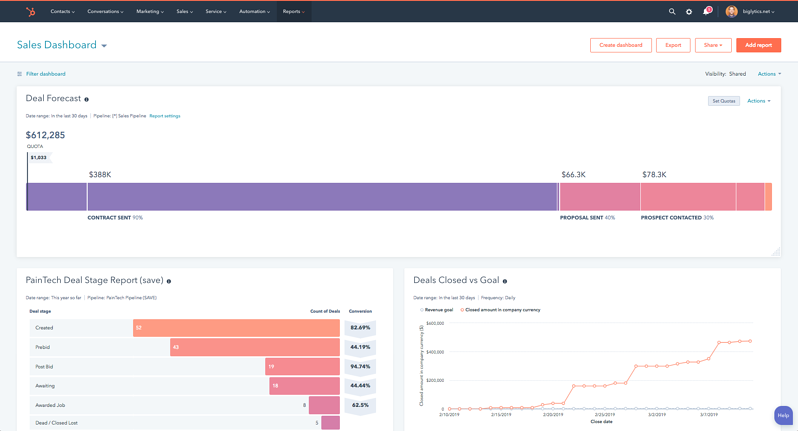
HubSpot is known for its ease of adoption and integrated approach to customer-facing processes. Companies can start with individual products and add capabilities as their needs grow, making it accessible to organizations that want to manage go-to-market processes without extensive technical complexity.
The platform also combines its CRM products with Breeze AI and an ecosystem of more than 2,000 integrations. Agent Hub provides a centralized environment for managing AI agents, while Agent Builder enables teams to create custom agents without coding.
HubSpot products include:
- Marketing Hub: Marketing automation software for lead generation, digital campaigns, and customer engagement.
- Sales Hub: Sales software for prospecting, pipeline management, sales automation, and forecasting.
- Service Hub: Customer service software for support, ticketing systems, knowledge bases, feedback, and retention.
- Content Hub: Content marketing software for creating and managing websites, landing pages, blogs, and other digital content.
- Data Hub: Data management software for connecting, cleaning, and activating customer data.
- Revenue Hub: CPQ, billing, and payments software for managing quote-to-revenue processes.
Main Capabilities of Creatio vs HubSpot
Creatio and HubSpot overlap across core CRM, AI, and automation capabilities, but the real difference lies in their depth of customization, process automation, scalability and costs. Below, we have compared how the two platforms compare across the capabilities that matter most.
Platform Architecture
HubSpot is built around Smart CRM, which provides the shared customer data foundation for its Marketing, Sales, Service, Content, Data, and Revenue Hubs. Companies can adopt these products individually or together while keeping customer data connected across the platform. This architecture is primarily designed to unify customer-facing functions around a single source of data and make the platform easy to adopt and expand.
Creatio is built as a unified AI CRM and workflow automation platform, natively connecting CRM products, no-code application development, complex process automation, and AI within one ecosystem. Compared with HubSpot’s CRM-centered model, Creatio provides greater flexibility to configure the platform itself, including custom applications, data models, and cross-functional workflows. This makes Creatio better suited to organizations that need CRM as part of a broader enterprise automation architecture, connecting customer-facing, operational, and industry workflows on a unified platform.
Process Automation
HubSpot relies on event-triggered, object-specific workflows with branching logic, built around CRM objects such as contacts, companies, deals, and tickets. Workflows can start from events, record criteria, schedules, or webhooks and support branching, delays, data updates, communications, and custom-coded actions. This allows teams to automate repetitive processes across marketing, sales, service, and data complex cross-functional flows (parallel execution, appr, but more complex logic may require custom code or add-on integrations.
Creatio provides a broader business process management and orchestration layer for structured and dynamic workflows. Its visual BPMN process and dynamic case designers allow teams to connect business rules, approvals, human tasks, AI agents, and external services into end-to-end processes. As a result, automation can cover not only simple CRM activities but also complex, enterprise-grade scenarios in which the steps, participants, and actions vary according to business context.
AI Features
HubSpot offers built-in generative and agentic AI through Breeze AI, primarily to automate GTM tasks and improve productivity across marketing, sales, and customer service. Its AI capabilities support content creation, prospecting, data enrichment, customer support, reporting, and other customer-facing activities.
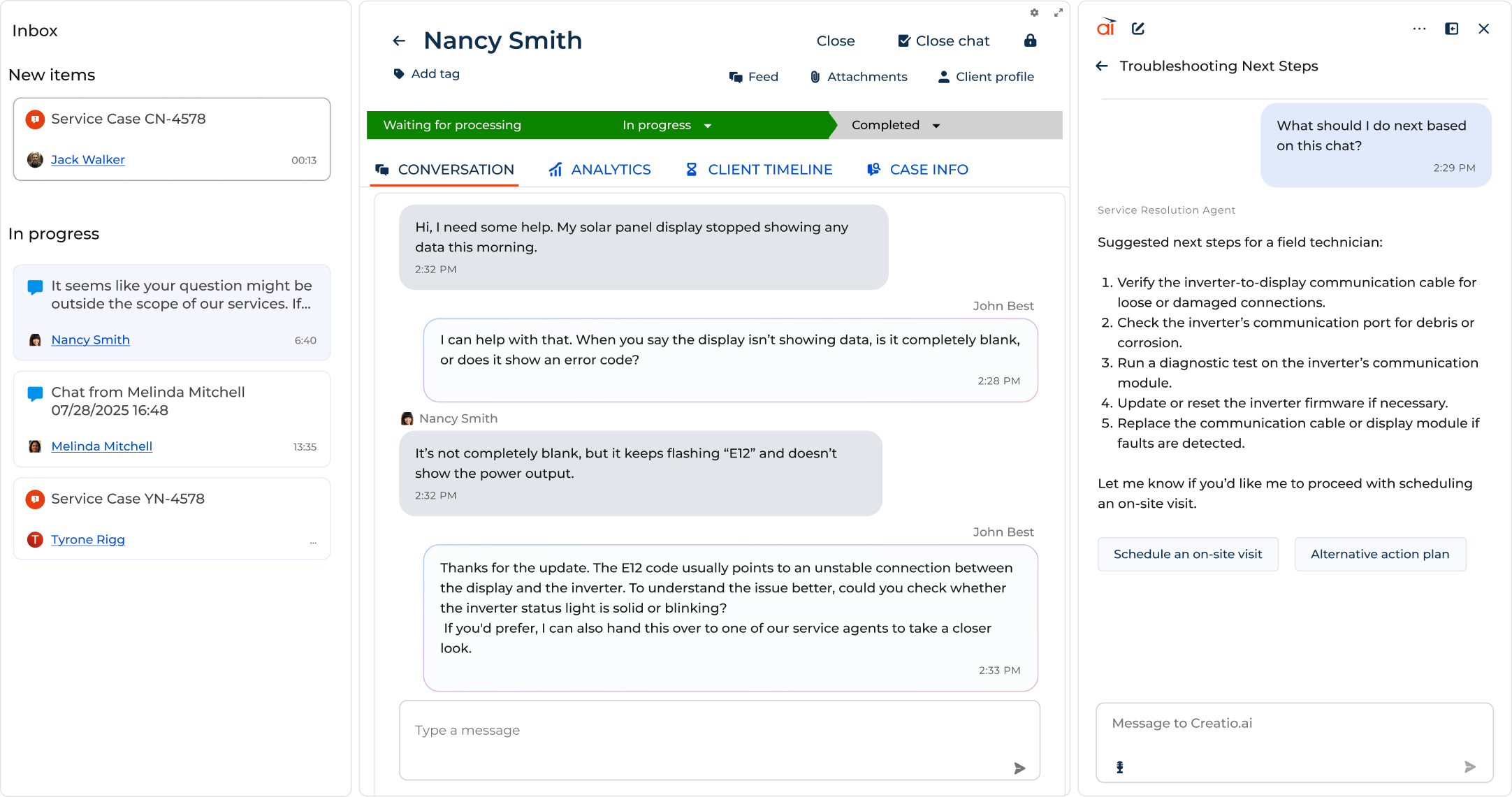
Creatio embeds predictive, generative, and agentic AI directly into its platform, supporting CRM and broader enterprise workflows. Sales teams can use AI for opportunity insights and forecasting, marketers for content creation, campaign optimization, and audience analysis, and service teams for case routing and resolution. Beyond CRM use cases, Creatio.ai can analyze complex data, support decisions, and automate steps within operational and industry workflows.
Creatio AI Agents vs. Breeze AI Agents
HubSpot offers four purpose-built Breeze Agents: Customer Agent, Prospecting Agent, Data Agent, and Content Agent. Teams can also create custom agents with Agent Builder, using natural-language instructions to define knowledge, tools, and actions, or deploy prebuilt agents from the HubSpot Marketplace. All agents are monitored, configured and managed through a centralized Agent Hub. However, agent availability varies by subscription tier, and usage is governed by HubSpot Credits. As organizations increase AI agents use cases, they may need additional credits or a higher-tier plan, making AI costs more dependent on usage at scale.

Creatio provides built-in AI agents across marketing, sales, and service, which organizations can customize for specific roles, processes, and industry requirements. With AI Studio, teams can also build agents from scratch, defining their roles, skills, tools, knowledge, permissions, and guardrails. Agents can connect to workflows, applications, APIs, and enterprise systems and coordinate work across multi-step processes. Unlike HubSpot’s tier- and credit-based model, Creatio makes AI agents available as a native part of its platform, with Creatio Unlimited Enterprise supporting unlimited AI agents, users, and workflows as adoption scales.
Reporting & Analytics
For teams that want ready-to-use visibility into customer and revenue performance, HubSpot offers a solid set of native CRM analytics tools and object-level reporting. Users can create dashboards and custom reports, analyze funnels and customer journeys, measure attribution, and track sales forecasts. For most standard CRM use cases, teams can get useful insights without building a separate reporting layer. However, some advanced capabilities, like customer journey, deal or revenue analytics, are available only in higher-tier plans.
Creatio comes with real-time analytics, configurable dashboards, and AI-driven insights built into the platform. Teams can use prebuilt dashboards or define metrics around custom objects, applications, and business processes, providing visibility into both CRM and broader operational performance.
Creatio’s built-in AI supports predictive scoring, forecasting, classification, recommendations, next-best actions, case routing, and conversion analysis. These insights can feed directly into workflows, for example, to prioritize leads, route cases, recommend offers, or trigger actions.
Governance & Access Control
HubSpot manages access through user and team permissions, with controls over CRM objects, records, tools, and assets — well suited to standard team structures. Enterprise plans add field-level view and edit restrictions, while record access can be limited by ownership, team, and pipeline stage.
Creatio supports granular access control at the system, object, record, and field level, using organizational and functional roles to govern what users can see and do. Permissions can also change dynamically as a process runs. For example, the platform can grant access for an approval and revoke it afterward. This makes governance part of process execution, particularly relevant for regulated industries such as banking, insurance, and the public sector.
Pricing and Total Cost of Ownership
HubSpot has a relatively accessible entry point, but pricing changes significantly as organizations move from Starter to Professional or Enterprise plans. Customer Platform Professional starts at $1,300 per month for six seats, while Enterprise starts at $4,700 per month for eight seats. Additional seats add to the subscription cost, AI features can consume HubSpot Credits, and some advanced automation, reporting, governance, and customization capabilities require higher-tier plans.
Creatio uses a more composable pricing model. Its core platform and CRM products are licensed separately, allowing organizations to select the products they need and add capabilities over time.
Organizations planning broader adoption can consider Creatio Unlimited Enterprise, which includes the full platform and CRM products with unlimited users, AI agents, workflows, applications, custom objects, and API calls. This reduces incremental licensing decisions as companies add teams, applications, and AI use cases.
The cost comparison therefore depends largely on scale. HubSpot can be cost-effective when requirements fit within a defined product tier and a relatively contained number of seats, while Creatio is designed for broader adoption of CRM and workflow automation across a large and growing user base.
G2 Scores: Creatio vs. HubSpot
Customer reviews provide a practical view of how each platform performs in day-to-day use. The G2 scores below compare Creatio and HubSpot across key CRM, workflow, usability, and support criteria reported by verified users.
G2 score highlights | Creatio | HubSpot |
| Ease of Setup | 8.4 | 8.3 |
| Ease of Admin | 8.6 | 8.6 |
| Quality of Support | 9.2 | 8.6 |
| Contact & Account Management | 9.0 | 8.7 |
| Leads Management | 9.1 | 8.7 |
| Customization | 8.8 | 8.6 |
| Workflow Capability | 9.0 | 8.3 |
| Ease of Use | 9.0 | 9.1 |
| Mobile User Support | 8.5 | 7.7 |
The G2 scores suggest that both platforms deliver a strong user experience, but their strengths differ. HubSpot has a slight edge in ease of use, reinforcing its easy adoption, while Creatio scores higher across most other categories, including workflow capability, customization, CRM management, and support. These results point to Creatio as a strong choice for more advanced CRM and workflow use cases.
Where Creatio Wins?
- Broader automation scope: Extends automation beyond CRM to complex cross-functional and industry workflows across teams, systems, and AI agents.
- Greater customization flexibility: Supports custom applications, data models, interfaces, and process logic with no-code tools and AI coding agents, reducing reliance on custom development.
- AI across end-to-end workflows: Embeds governed AI agents directly into CRM and operational processes, rather than limiting AI primarily to customer-facing use cases.
- Industry-specific workflows: Combines CRM with specialized workflows for 20+ industries, reducing the need for separate tools or extensive customization.
- Greater control for regulated environments: Provides granular access controls and cloud, private cloud, and on-premises deployment for security, compliance, and data residency requirements.
- More predictable enterprise scaling: Creatio Unlimited Enterprise removes limits on users, AI agents, workflows, applications, custom objects, and API calls.
Where HubSpot Wins?
- Ease of use: Provides an intuitive experience with less configuration required for common customer relationship processes.
- Faster adoption: Standard CRM functionality and prebuilt tools can shorten the path from implementation to day-to-day use when requirements fit HubSpot’s established model.
- Integrated go-to-market tools: Helps automate processes across marketing, sales, service, content, data, and revenue through a shared Smart CRM ecosystem.
- Straightforward expansion: Organizations can start with individual Hubs and add products as their requirements grow.
- Broad integration ecosystem: Provides more than 2,000 integrations to connect HubSpot with commonly used business applications.
Which Vendor Should You Choose: Creatio or HubSpot?
Choose HubSpot if fast deployment and ease of use matter most. HubSpot is a good fit for companies that:
- Focus primarily on marketing, lead generation, and CRM fundamentals.
- Need integrated, ready-to-use tools with limited configuration.
- Automate mainly established, team-specific workflows.
- Prioritize user adoption and ease of admin.
- Have limited requirements for complex cross-functional workflows or deep customization.
Choose Creatio when CRM is part of a broader automation strategy. Creatio is a good fit when:
- Processes cut across many teams, systems, and business functions.
- CRM data and workflows need to connect across the customer lifecycle.
- Business teams need to change processes without relying heavily on IT.
- Reducing manual coordination and administrative work is a priority.
- Processes and applications need to change frequently as the business evolves.
- Governance, scalability, and predictable costs become more important at scale.
According to a recent Nucleus Research study, Creatio customers cited ease of use, faster time-to-value, lower operational burden, and better alignment between data, workflows, and execution among the reasons for choosing Creatio over competing vendors. Customers reported 68% less application development time, up to 74% less sales administrative effort, 45% less manual data coordination, and 20–40% lower TCO.
Summary
HubSpot and Creatio both provide robust CRM, automation, and AI capabilities, but with different areas of focus. HubSpot is best suited for growing teams prioritizing ease of use and integrated marketing, sales, and customer service. Creatio is a stronger fit when CRM needs to connect with broader workflow automation and complex business processes.
As requirements expand across teams, the challenge often shifts from automating individual customer-facing activities to coordinating workflows, applications, and AI agents across the organization. Creatio’s AI-native software is designed to support this broader level of automation with no-code tools, modern AI, and CRM in one platform.
Request a guided demo to see how Creatio can support your CRM, automation, and AI strategy.
FAQ
Is Creatio better than HubSpot?
It depends on your requirements. Creatio is better suited to large enterprises with complex workflows, extensive customization, and cross-functional automation needs. HubSpot is a strong fit for organizations prioritizing ease of use, fast adoption, and integrated marketing, sales, and service automation.
Which is better for enterprise use, Creatio or HubSpot?
Creatio is better suited to large-scale enterprise deployments that require advanced workflow automation, governance, customization, and AI across multiple business functions. Creatio Unlimited also supports broader adoption by removing limits on users, AI agents, workflows, and applications.
How much does Creatio cost compared to HubSpot?
Creatio starts at $40 per user/month for its core AI-native platform, with CRM products starting at $15 per user/month each; for larger deployments, Creatio also offers an Unlimited plan with custom pricing. HubSpot uses tiered pricing, starting at $20 per seat/month for Starter, while Customer Platform Professional starts at $1,300/month for 6 seats and Enterprise at $4,700/month for 8 seats. Additional HubSpot seats and Breeze AI usage may increase the total cost.
Can Creatio replace HubSpot?
Yes. Creatio can replace HubSpot for mid-market and enterprise organizations that need customizable AI CRM alongside broader workflow automation, AI agents, and no-code app development. It can support marketing, sales, and service while also extending agentic automation to complex cross-functional and industry-specific processes.
What is the main difference between Creatio and HubSpot?
The main difference between Creatio and HubSpot is their approach to automation: Creatio is focused on deep agentic automation for complex CRM, cross-functional, and industry workflows, while HubSpot emphasizes ease of use and its unified automation for marketing, sales, and customer-facing processes.
How long does Creatio implementation take compared to HubSpot?
HubSpot can typically be deployed faster for standard CRM use cases due to its more out-of-the-box approach. Creatio implementation time depends on scope and complexity, but its no-code and AI capabilities can speed up deployment. According to Nucleus Research, Creatio implementations were 70% faster than legacy CRM systems.
