






































































A Guide to Agentic AI in Banking: Definition, Benefits and Use-Cases

Deploy Workflows 70% Faster with Creatio Agentic Platform

Over the past two decades, banking institutions have focused on digital transformation, investing in systems to streamline manual processes, improve customer experience, and better manage data. More recently, artificial intelligence (AI) has further enhanced these efforts by helping employees analyze information, generate insights, and make decisions.
Agentic AI marks the next step, enabling banks to move beyond automation and insights to executing processes end-to-end with minimal human involvement. In financial landscape, its adoption is accelerating: according to Creatio’s Global AI and No-Code Adoption Survey 2025, 80% of financial services leaders say AI agents are already a board-level topic or will be in 2026.
In this article, we explore agentic AI in banking, its benefits and challenges, and how to implement it efficiently to drive banking operations.
Key Takeaways:
- Agentic AI enables banks to execute multi-step processes with greater autonomy, moving from task-level automation to full workflow execution across departments.
- Agentic use cases span the entire banking value chain, including onboarding, lending, fraud control, customer service, and back-office operations.
- Key benefits of agentic banking are faster process execution, reduced manual effort, improved decision consistency, and the ability to scale operations without proportional headcount growth
- Most common challenges financial institutions face in agentic AI refer to regulatory compliance, data integration, internal expertise, and clearly defining ROI
- Agentic platforms like Creatio support adoption by combining CRM, workflow automation, and embedded AI to operationalize agent-driven processes across core banking operations
What Is Agentic AI in Banking?
Agentic AI in banking refers to autonomous, goal-driven artificial intelligence (AI) systems that can independently execute banking processes, make decisions, and coordinate actions across CRM, core banking platforms, and third-party services.
Unlike traditional AI models that focus on insights or predictions, agentic AI is designed to take action. At the core of these systems are AI agents — software entities that can understand objectives, plan next steps, and interact with multiple systems to complete tasks. They interpret goals (e.g., approve a loan, onboard a customer, resolve a service request), break them into tasks, and execute them end-to-end with minimal human intervention.
Key Capabilities of Agentic AI are:
- End-to-end process execution
- Goal-driven actions aligned with business objectives
- Cross-system workflow coordination
- Real-time adaptability to events and risks
- Built-in governance with human-in-the-loop control
Agentic AI vs. Traditional AI Systems: What’s the Difference?
Banks actively use technologies like RPA, machine learning, and generative AI to automate tasks and support decision-making. However, these systems typically operate within predefined workflows and are limited to specific functions.
Agentic AI extends the system capabilities beyond task-level automation, enabling independent decision-making and full execution of banking processes. In the table below, we have highlighted the key differentiators between traditional AI and agentic technologies.
| Capability | Traditional AI (RPA, ML, GenAI) | Agentic AI |
| Primary role | Automates tasks or provides insights | Executes banking processes end-to-end |
| Autonomy | Limited – requires human coordination | High – executes processes independently with oversight |
| Decision-making | Rule-based or predictive | Context-aware and goal-driven |
| Adaptability | Static – requires manual updates | Dynamic – continuously adapts to events and data points |
| System integration | Siloed or point-to-point | Orchestrates across CRM, core banking, and external systems |
| Examples in banking | Data entry, lead scoring, and follow-up email generation | Customer onboarding, lending, fraud identification and resolution |
How Agentic AI Works in Banking Systems
Agentic AI operates as a dynamic execution layer across banking systems, where AI agents manage processes by combining data points, decisioning, and action in real time. The logic of agentic AI follows a continuous, event-driven flow:
- Event detection: the system identifies a trigger, such as a submitted application, flagged transaction, customer request, or status change.
- Context Retrieval: the agent gathers relevant data from CRM, core banking, and external systems to build a real-time view of the customer, process, and risk context.
- Decision Logic: using business rules, policies, and AI models, the agent evaluates the situation and determines the next best action — proceed, request more information, initiate checks, or escalate.
- Action Execution: the agent performs tasks directly in connected systems, such as updating records, triggering KYC/AML checks, calling APIs, or advancing the workflow. After each action, the system updates the process state and reassesses conditions in real time.
- Exception Handling and Oversight
The agent performs tasks directly in connected systems, such as updating records, triggering KYC/AML checks, calling APIs, or advancing the workflow. After each action, the system updates the process state and reassesses conditions in real time. - Agent optimization
The system provides the ability to reassess conditions and adjust actions based on outcomes, new data, or events.
Here’s a great example of how agentic AI works in banking end-to-end — based on an AI-powered referral agent:
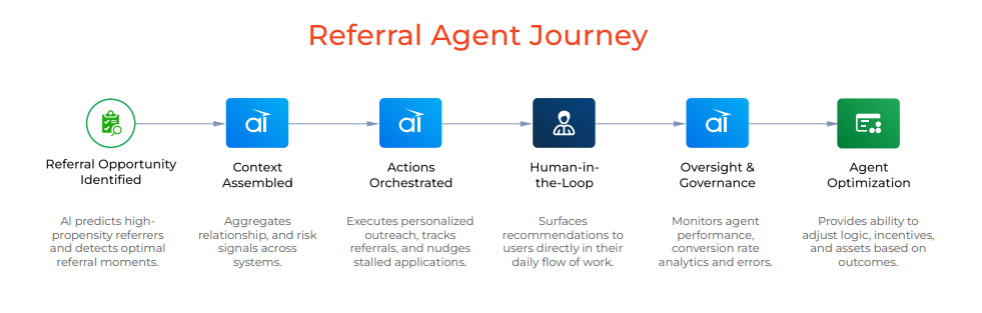
Example Journey of a Referral Agent - Creatio
10 Use Cases of Agentic AI in Banking
Agentic AI helps banks complete processes faster and handle more work without increasing operational complexity or headcount. Unlike traditional AI systems limited to specific functions, it operates across departments — taking on multi-step, repetitive tasks and enabling more consistent execution across the organization.
Below, we have uncovered some popular agentic AI use cases for financial services and banking.
Fraud Control and Investigation
Fraud control has traditionally relied on rules and manual checks. Agentic AI enables a more dynamic approach by monitoring transactions in real time, detecting evolving fraud patterns, and initiating investigation workflows automatically. For example, it can trigger alerts, block suspicious activity, and generate compliance reports.
With agentic AI, human involvement is needed mostly for exception handling and AI agent oversight. According to McKinsey, each practitioner can supervise 20 or more agent workers, driving significant productivity gains anywhere from 200% to 2,000%.
Customer Onboarding and KYC Automation
Customer onboarding directly impacts how quickly a customer starts using banking services and realizing value. Agentic AI helps accelerate this by managing the process end-to-end, guiding customers through steps, collecting and validating data, and performing KYC/AML checks without constant manual coordination.
While many banks already use AI to support KYC analysis, agentic AI can handle low- to medium-risk onboarding cases from start to finish, leaving only final approval or exceptions to human teams. It can also support ongoing KYC updates by pulling and reconciling data, flagging only meaningful changes, and reducing false positives.
Loan Processing and Credit Decisioning
In loan processing, agentic AI can autonomously pull applicant data from multiple sources, run credit checks, verify documents, and move the application through underwriting without manual handoffs. It can then submit cases for final human approval where required.
If additional information is needed or risk thresholds are exceeded, the AI agent flags the case for review; otherwise, it progresses the application automatically. This keeps applications moving and reduces bottlenecks in the approval process.
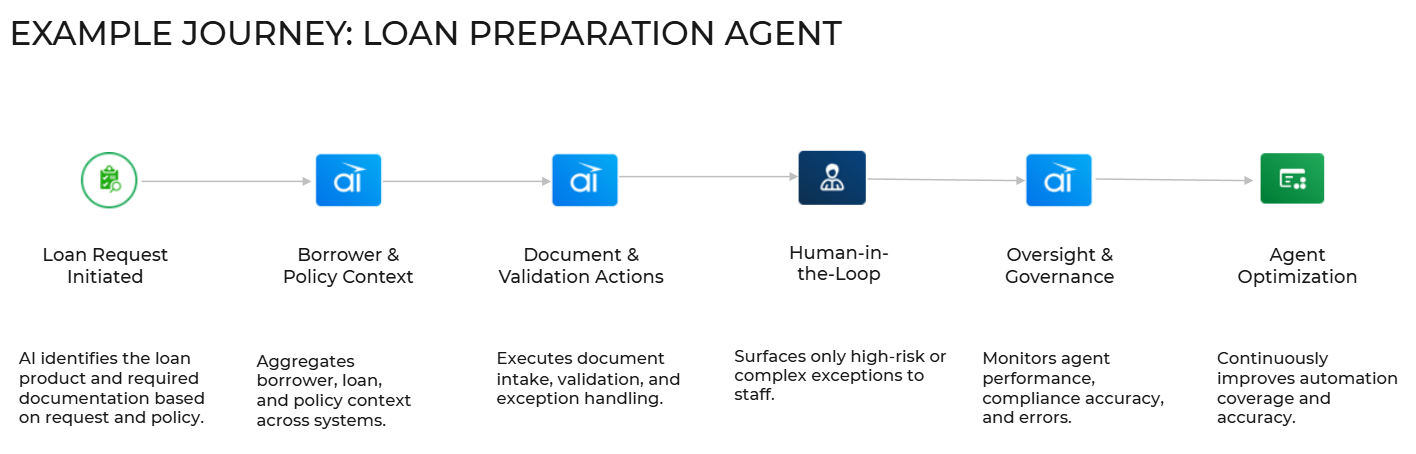
Example Journey of a Loan Preparation Agent - Creatio
Intelligent customer service
Agentic AI streamlines banking services by resolving routine requests, updating records, and escalating complex cases when needed. Rather than simply answering questions, it can autonomously handle high-volume queries such as balance checks, password resets, and transaction history inquiries. At the same time, it acts as a digital workforce for bankers — providing next-best-action insights and recommending relevant knowledge base content to improve service quality.
For example, Ent Credit Union used Creatio’s agentic platform to automate routing and recommendations across 340+ unique case types, reducing manual effort and improving accuracy. The organization also implemented AI-enhanced support for daily operations based on centralized structured and unstructured data, helping employees work faster and more efficiently.
Referral and Lead Management
Agentic AI helps identify and act on referral opportunities that are often missed when customer information is fragmented across teams, products or systems. It identifies when a referral should be triggered based on customer activity or context, then automatically routes it to the appropriate team with the necessary context, tracks progress and follows up if the process stalls.
Explore a real-world example of referral agent ROI in Creatio’s Agentic Banking Blueprint.
Account Opening and Product Fulfillment
Instead of waiting days for manual back-office verification, agentic AI can trigger a multi-step workflow as soon as an application is submitted. It extracts and validates data from documents, runs real-time KYC/AML checks, and verifies external sources such as credit bureaus. If information is missing or incorrect, it proactively engages the customer to resolve the issue before it delays the process.
Once the risk assessment is completed, the agent provisions the account in core banking systems, generates digital agreements, and notifies the customer that the product is ready for use.
Regulatory Compliance and Risk Management
AI agents can act as "virtual compliance officers", assisting human teams in monitoring transactions and customer activity against regulatory requirements. It detects anomalies, updates risk scores in real time, and initiates workflows such as AML investigations when needed.
Instead of only flagging issues, it can collect data from multiple systems, cross-check it against compliance rules, and prepare reports for review. This reduces manual effort and helps financial institutions keep up with evolving regulatory requirements without scaling compliance teams.
Document Processing Automation
Agentic AI automates document-heavy workflows by extracting, validating, and analyzing data from contracts, forms, and regulatory documents. Unlike traditional tools, agents don’t need a predefined map for every document; they use reasoning to find data in new or messy layouts (e.g., varying utility bills or handwritten notes). It can classify documents, flag inconsistencies, and route them through the appropriate review and approval steps.
Data Processing and Analysis
AI agents continuously scan massive, disparate datasets, such as transaction logs, market data or customer interactions to identify patterns and anomalies. When a significant pattern emerges, such as a sudden shift in a customer's spending behavior or a risk event, the agent doesn't just generate a report; it autonomously triggers specific actions —updating offers, routing insights to the right teams, or alerting the risk desk. This transforms banking data from a passive historical record into a proactive engine for action-driven execution.
Back-Office Workflow Orchestration
Agentic AI can support bankers in coordinating routine administrative and operational tasks that typically require manual follow-ups and handoffs. This includes activities such as meeting preparation, gathering relevant client or deal information, routing internal requests, and providing in-app assistance during daily work.
According to Creatio’s 2025 FinServ survey, administrative and operational workflows are among the top areas where agentic automation can reduce manual workload, improve accuracy, and streamline compliance-heavy processes.
Key Benefits of Agentic AI for the Banking Industry
Agentic AI is reshaping how banking processes are managed and executed, enabling banks to improve efficiency, drive revenue growth, and make sure scale operations more effectively. Core business benefits include:
- Faster time-to-value across core processes. By automating multi-step workflows such as onboarding, lending, and servicing, agentic AI removes delays between steps and eliminates manual handoffs. This reduces cycle times and enables faster delivery of banking services.
- Lower operating costs. End-to-end agentic automation in banking reduces reliance on manual work, minimizes errors, and lowers the cost per transaction or case. According to BCG, agentic AI systems could reduce banks’ costs by 30–40% by 2030.
- Increased revenue opportunities. By acting on customer data in real time, agentic AI enables timely follow-ups, improves conversion rates, and supports more effective cross-sell and upsell across the entire customer lifecycle.
- Higher employee productivity. With less time spent on coordination and routine execution, teams can handle greater scopes of repetitive tasks and focus on higher-value activities. McKinsey estimates that employees could shift from spending 80% of their time on execution tasks to focusing on customer interaction, decision-making, and innovation.
- Stronger risk and compliance outcomes. Processes are executed consistently based on predefined rules, with real-time monitoring and full audit trails. This reduces compliance gaps, human error, and exposure to operational risk.
- Scalable growth without proportional cost increase. Agentic AI enables banks to handle increasing volumes of customers, transactions, and processes without adding headcount, maintaining efficiency at scale. According to Creatio’s FinServ report, 87% of leaders expect AI agents to augment teams to drive productivity, create growth opportunities for current staff, or create new roles within the organization.
- Improved customer retention and lifetime value. Faster response times and more consistent, context-aware interactions driven by agentic AI allow financial institutions to improve customer experience and build stronger relationships.
- Greater operational control and accountability. Agentic AI gives banks full visibility into how processes are executed, enabling tighter control over operations, faster issue resolution, and stronger accountability across teams and systems.
Challenges of Implementing Agentic AI in Banking
While agentic AI offers significant potential, banks need to address several practical considerations to ensure successful adoption. These challenges are primarily related to regulation, data, and organizational readiness.
Regulatory, Security, and Legal Considerations
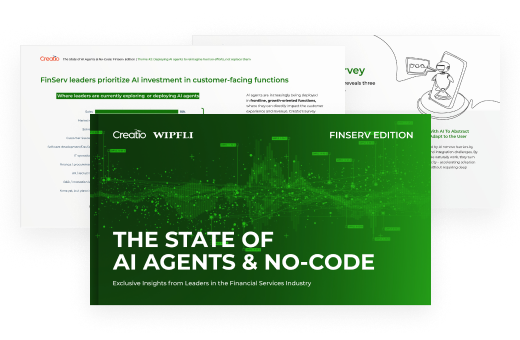
Banking operates under strict regulatory and risk management frameworks, including requirements such as KYC (Know Your Customer), AML (Anti-Money Laundering), GDPR, and other regional compliance standards. According to Creatio’s State of AI Agents and No-code: FinServ Edition, 52% of business and technology decision-makers cite regulatory, security, and legal concerns as a primary barrier to AI agents’ adoption.
Ensuring that agentic AI operates within defined policies — with full transparency, auditability, and human oversight — is essential for scaling agentic AI in a compliant and controlled way.
Data Quality and System Integration
Many banking institutions still rely on legacy systems and fragmented data environments. For agentic AI to work effectively, systems must be connected and data must be accessible and reliable.
AI Skills and Internal Expertise
Implementing agentic AI requires a combination of expertise in AI, workflow automation, and AI governance — capabilities that many banking institutions are still developing. Today, many organizations lack the in-house expertise needed to design, manage, and oversee AI-driven processes in a regulated banking environment.
Many teams require dedicated AI training and upskilling programs to build these capabilities, which can slow down adoption and delay time-to-value.
Defining ROI and Business Value
Unclear return on investment remains a key barrier to adoption, with every fifth finance leader citing it as a challenge when implementing AI agents. Quantifying the impact of agentic AI across complex, cross-functional processes can be difficult, particularly in early stages.
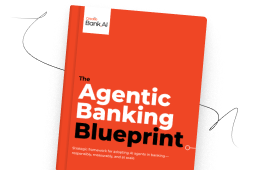
To address this, banks need a structured approach to adoption. Strategic frameworks such as Creatio’s Agentic Banking Blueprint provide a clear roadmap — from identifying high-impact use cases to scaling agentic AI across the organization — helping institutions link AI initiatives to measurable business outcomes.
— responsibly, measurably, and at scale.
How to Implement Agentic AI in Banking
The success of agentic AI in banking depends not just on the technology, but on how it is applied to real processes. Given the industry’s regulatory complexity and reliance on multiple systems, a structured, cross-functional approach is essential.
Step 1. Define priority use cases and select the right platform
Start by defining where agentic AI can deliver the most value, typically in areas with inefficiencies or high manual effort. Across banking operations, this often includes customer acquisition, onboarding, referrals, account servicing, dispute resolution, credit underwriting, fraud detection, and payments or transaction processing. These are core processes that directly impact customer relationships and operational efficiency.
Next, choose a platform that integrates with core banking systems, CRM, and key services such as KYC/AML, payments, and credit decisioning. It should support secure data handling, auditability, and compliance with financial regulations.
Step 2. Establish ownership and accountability for AI systems
At this stage, financial institutions need to designate clear stakeholders responsible for the deployment, performance, and supervision of banking AI agents. These roles ensure human oversight of agent execution, decision-making, and compliance with internal policies and regulatory requirements.sys
Clear ownership across business and risk management establishes accountability for AI system outcomes, performance, and exception handling.
Step 3. Establish the agentic AI lifecycle
At this stage, banking teams should define how agentic AI systems are designed, deployed, monitored, and continuously optimized. This includes setting decisioning rules, embedding compliance checks, and managing how agentic AI interacts with data, systems, and core workflows across banking processes.
Step 4. Embed change management and enablement
Prepare teams to work alongside agentic AI by introducing training programs, updating operating procedures, and gradually integrating these capabilities into daily banking operations. Encourage testing, feedback loops, and knowledge sharing to support adoption.
Step 5. Institutionalize governance and scale adoption
Standardize governance frameworks, audit processes, and risk controls to ensure consistent and compliant execution. This includes full visibility into AI systems’ actions, decision traceability, and oversight where required, enabling banks to scale agentic AI across products, channels, and business units.
How Creatio Supports Agentic AI in Banking
Creatio enables banks to design, execute, and continuously optimize banking operations by combining CRM, workflow automation, and AI in a single platform. Its composable architecture and no-code capabilities allow business users to build and adapt banking workflows without heavy IT involvement, supporting end-to-end processes across the customer lifecycle, from acquisition and onboarding to servicing and retention.
Unlike solutions that add AI as a separate layer, Creatio embeds agentic, generative, and predictive AI directly into its platform. This allows AI to operate within the bank’s data, workflows, and processes, improving execution and accelerating time to value.
In practice, this supports use cases such as automating customer acquisition and onboarding, coordinating loan processing, and managing service and retention workflows end-to-end.
Creatio Agentic CRM and Workflow Automation for Banking
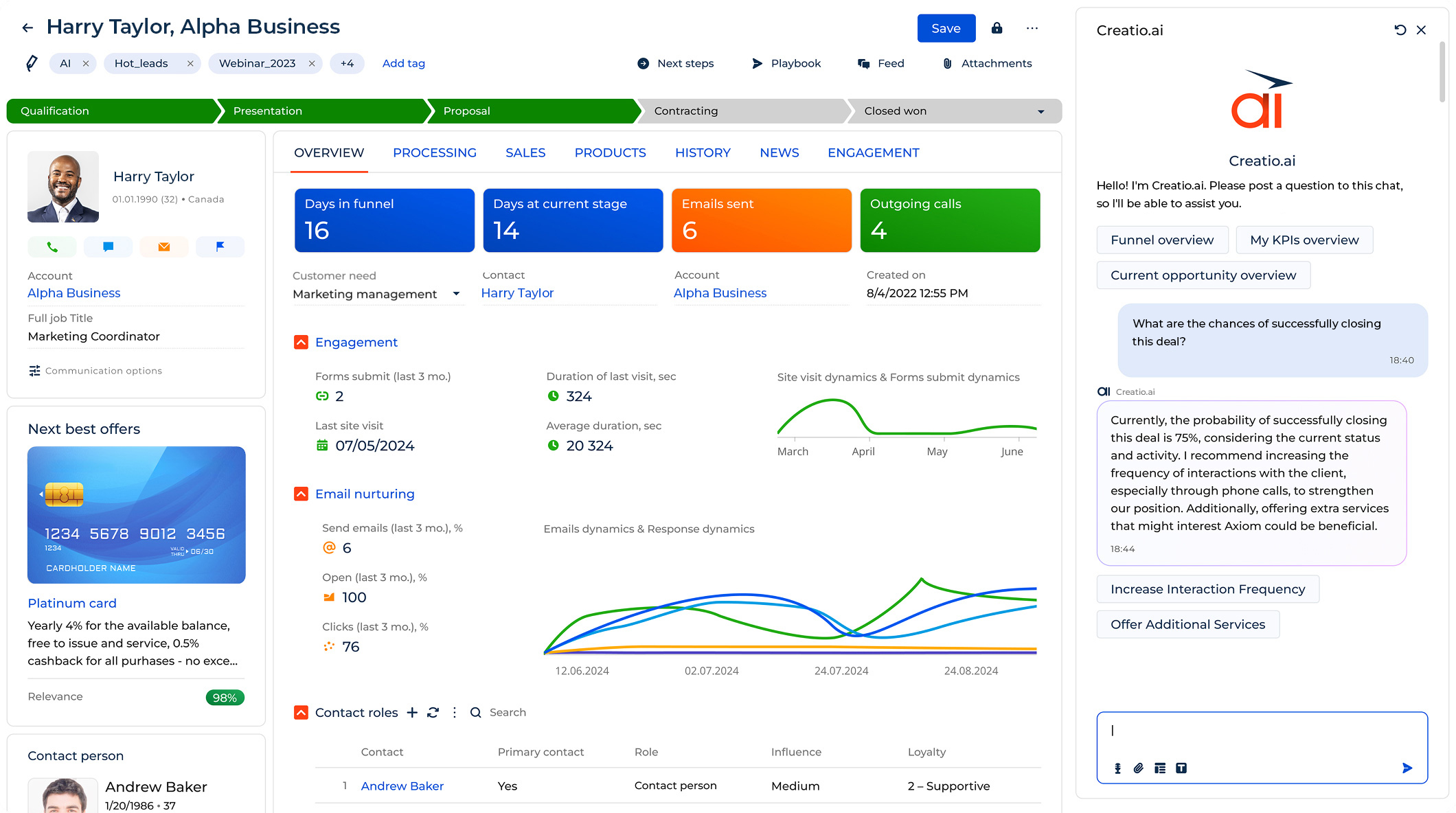
Creatio combines no-code development, agentic orchestration, and autonomous AI capabilities — all in one system. Banks can start with pre-built agents and extend or compose new ones without engineering effort.
These agents can operate independently, coordinate across workflows, and work directly within tools such as Teams, Outlook, and Zoom, enabling faster time to value, and lower total cost of ownership.
Creatio’s Pre-built Autonomous Agents for Financial Services
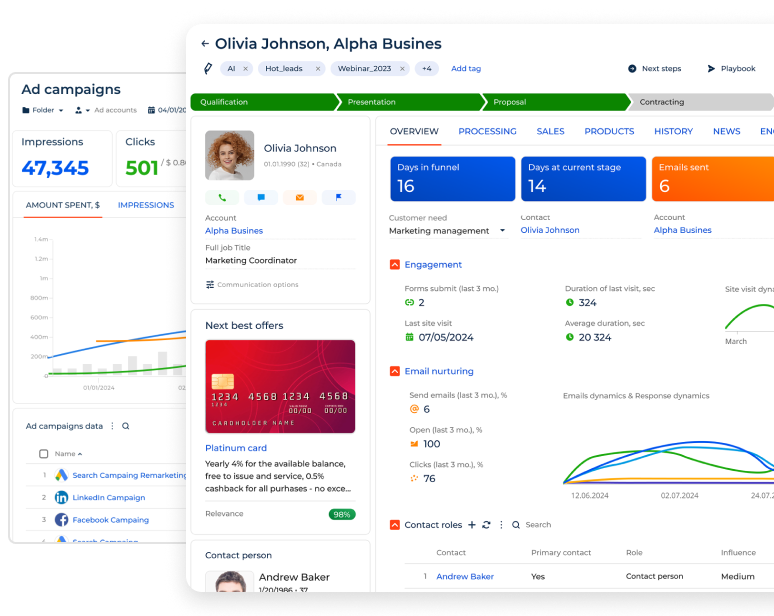
The platform provides various autonomous AI agents designed specifically for the financial services industry. These agents support both revenue growth and operational execution, helping banks acquire, grow, and retain customer relationships, as well as manage day-to-day processes with greater efficiency and full compliance.
Creatio’s autonomous agents for financial services include:
- Sales and growth agents: Referral Agent, Renewal Agent and Retention Agent.
- Service and experience agents: Customer Onboarding Agent, Loan Preparation Agent, and Loan Servicing Agent
Each agent can operate independently as a standalone component, integrated within existing system, or deployed together as a part of a connected multi-agent system.
Creatio’s Ready-to-Use CRM AI Agents
Creatio also includes AI agents embedded within its CRM products (Creatio Sales, Creatio Marketing, and Creatio Service) to support daily business activities, improve employee productivity, and generate insights.
- Sales agents: lead insights, opportunity management, meeting preparation, next-best actions, data enrichment
- Marketing agents: audience segmentation, campaign execution, email generation, performance optimization
- Service agents: case understanding, resolution guidance, knowledge creation, service performance support
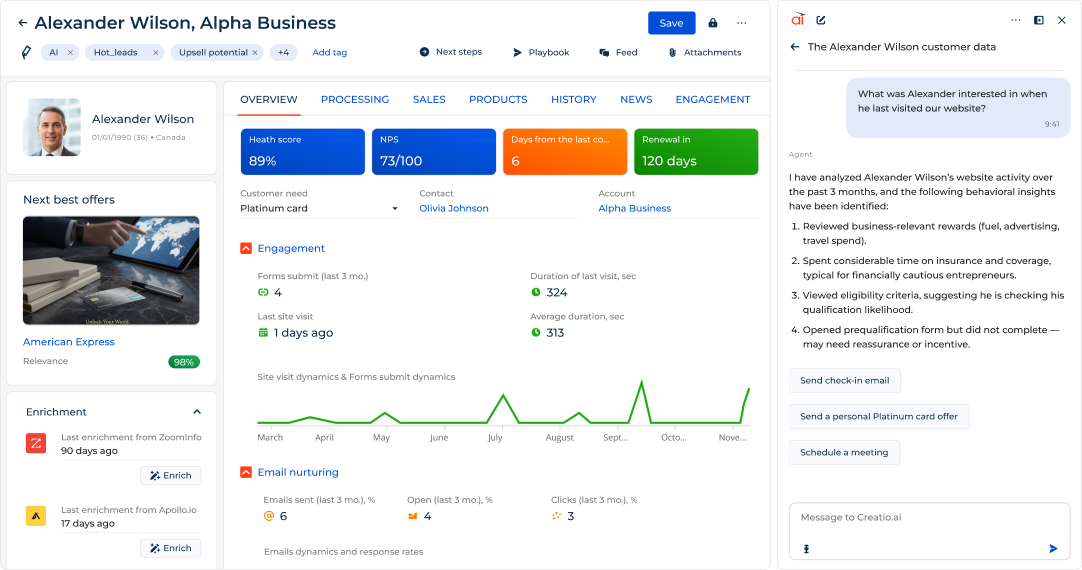
Example of Creatio’s CRM agent
Each agent can be customized by defining its role, instructions, skills, actions, and limitations to align with specific business needs. All agents and their capabilities are managed centrally through an AI command center, providing visibility, governance, and control.
Creatio also provides a No-Code Agent Builder that enables business users to create and adapt agentic systems by visually composing skills, workflows, and knowledge — without requiring technical expertise. This allows teams to deploy custom AI agents that operate independently or alongside employees within existing processes.

Summary
Agentic AI is rapidly becoming a key enabler of modern banking operations. It allows institutions to execute complex processes with greater speed, consistency, and control, helping scale operations without increasing costs or headcount. As adoption matures, its role across core banking workflows will continue to expand.
Creatio supports banks in building and optimizing agentic workflows that improve operational efficiency and customer engagement. Request a personalized demo to see how agentic AI can benefit your organization today.
