
































































Agentic AI in Marketing: Definition, Use Cases, and Benefits

Enhance Marketing Workflows with Creatio.ai

Marketing is entering a new phase — shifting from traditional automation to agentic AI. While most AI use cases in marketing today still rely on prompts and human input to execute tasks, the “agentic” model is rapidly evolving toward autonomous systems that can plan, execute, and optimize workflows independently.
The question is no longer whether agentic AI will be used; it’s when. And, according to Gartner, 60% of brands will use agentic AI to deliver streamlined one-to-one interactions by 2028, signaling a major shift in how marketing operates.
In this article, we explore what agentic AI in marketing is, how it differs from traditional AI and automation, its real business value, and the key steps to implement it and drive measurable marketing outcomes.
Key Takeaways
- Agentic AI is the "action layer" of the modern marketing stack, transforming data-driven insights into autonomous, goal-oriented workflows that execute and optimize marketing operations in real-time.
- The numerous benefits of agentic AI in marketing are greater autonomy in workflows, scalable hyper-personalization, improved customer journey, faster and more consistent campaign execution, higher alignment with business goals, and stronger marketing ROI.
- Some of the most popular use cases of agentic marketing are autonomous campaign orchestration, real-time lead management, dynamic customer journeys, and continuous campaign optimization.
- To successfully adopt agentic AI in marketing, organizations must address data quality, build trust in autonomous systems, and establish clear governance to ensure alignment with brand, strategy, and compliance requirements.
- To unlock real value from agentic marketing, teams need to focus on high-impact use cases, continuous experimentation, and redesigning how marketing workflows are planned, executed, and optimized.
- Creatio Marketing is a leading agentic marketing platform that helps teams accelerate the lead-to-revenue cycle with built-in AI, no-code capabilities, and advanced automation to orchestrate and optimize the entire customer journey.
What is Agentic AI in Marketing?
Agentic AI in marketing refers to autonomous, goal-driven AI systems that can plan, execute, and optimize complex, multi-step marketing workflows in real-time with minimal human intervention.
Agentic AI doesn’t just suggest actions — it executes them. Unlike traditional AI that requires constant prompting, agentic systems connect marketing insights to action, making decisions and operating across campaigns, journeys, and channels.
In marketing, agentic AI enables systems to continuously adapt by adjusting targeting, personalization, and execution in real time based on live data. Operating within defined governance frameworks, it helps organizations improve ROI, engagement, and customer retention at scale. At the same time, it enables more autonomous marketing workflows, shifting human roles away from manual execution toward strategic oversight and creative work.
Core pillars of agentic AI in marketing
- Goal-driven execution: Rather than following a rigid script, the AI is given a KPI (e.g., "Increase demo sign-ups by 15%") and determines the best sequence of actions to achieve it.
- Autonomous decision-making: Adjusts targeting, budget, and workflows in real time without constant human input.
- Cross-channel orchestration: Coordinates execution across CRM, social media, email, advertising and other marketing systems to create a unified customer journey.
- Dynamic real-time adaptation: Continuously learns from live performance results, automatically pivoting strategies if a campaign hits a bottleneck.
Agentic AI vs. GenAI, Predictive AI and Traditional Automation
To understand the value of agentic AI in marketing, it’s important to distinguish it from earlier generations of marketing technology. While workflow automation, generative AI, and predictive AI each address specific tasks like executing workflows, creating content, or analyzing data, agentic AI brings these capabilities together into a unified system that can independently plan and execute end-to-end marketing activities to achieve specific goals.
Below we have compared the key differences between agentic AI and
| Workflow Automation | Generative AI (GenAI) | Predictive AI | Agentic AI | |
| Primary function | Execute simple, predefined tasks | Create content | Analyze data and forecast outcomes | Plan and execute end-to-end workflows |
| How it works | Rule-based triggers and scripts | Prompt-based generation | Models trained on historical data | Goal-driven, autonomous decision-making |
| Human involvement | High - setup and monitoring | High - prompting and editing | Medium – interpretation | Low to medium - oversight and governance |
| Marketing use cases | Email sequences, lead routing | Copywriting, content generation | Lead scoring, churn prediction | Campaign orchestration, journey optimization, next-best actions |
Main Benefits of Agentic AI in Marketing
In marketing, agentic AI introduces a new, value-driven operating model. While AI agents handle repetitive, process-heavy tasks like campaign setup, data analysis, content generation, and optimization, marketers shift their focus to strategy, experimentation, and growth, guiding brand direction and driving higher-impact outcomes.
- Autonomous workflow execution – Routine marketing activities — such as campaign setup, audience segmentation, content generation, and optimization — are handled by AI marketing agents, reducing manual effort and operational overhead. For example, PwC reports up to a 40% reduction in content management workload with AI agents.
- Hyper-personalization at scale – Agentic systems analyze large volumes of behavioral and contextual data to tailor messages, offers, and journeys across micro-segments. Scalable personalization is a critical driver of marketing performance, with 71% of consumers expecting personalized interactions, according to McKinsey.
- Improved customer journey orchestration – Agentic AI dynamically adapts journeys across channels in real time, guiding customers toward conversion, retention, and expansion.
- Faster campaign execution – Time-intensive steps like briefing, research, and asset creation are compressed, enabling faster launches and more rapid iteration.
- Consistent cross-channel orchestration – Agentic AI coordinates marketing execution across CRM, email, advertising, web, and other platforms, ensuring for a unified customer experience.
- Scalable marketing operations – Organizations can execute more campaigns across more channels without increasing headcount.
- Stronger alignment with business outcomes – Agentic AI connects marketing activities directly to pipeline, revenue, and growth metrics, improving visibility and accountability.
- Higher marketing ROI — Agentic AI continuously optimizes campaigns in real time, improving targeting, timing, messaging, and spend allocation based on live performance data, ensuring you’ll maximize the value from every dollar spent.
8 Use Cases of Agentic AI in Marketing
Autonomous, cross-channel campaign orchestration
Agentic AI can monitor multiple marketing campaigns across channels and optimize them in real time: pause underperforming ad variations, reallocate budgets, and adjust bidding strategies to maximize ROI for every dollar spent.
For example, it can shift budget from low-performing social ads to high-converting search campaigns, trigger personalized email follow-ups based on user behavior, or adapt website messaging for specific segments, all with minimal human oversight. By coordinating execution across CRM, email, paid media, web, and social, it ensures consistent campaign messaging and timing across the entire journey.
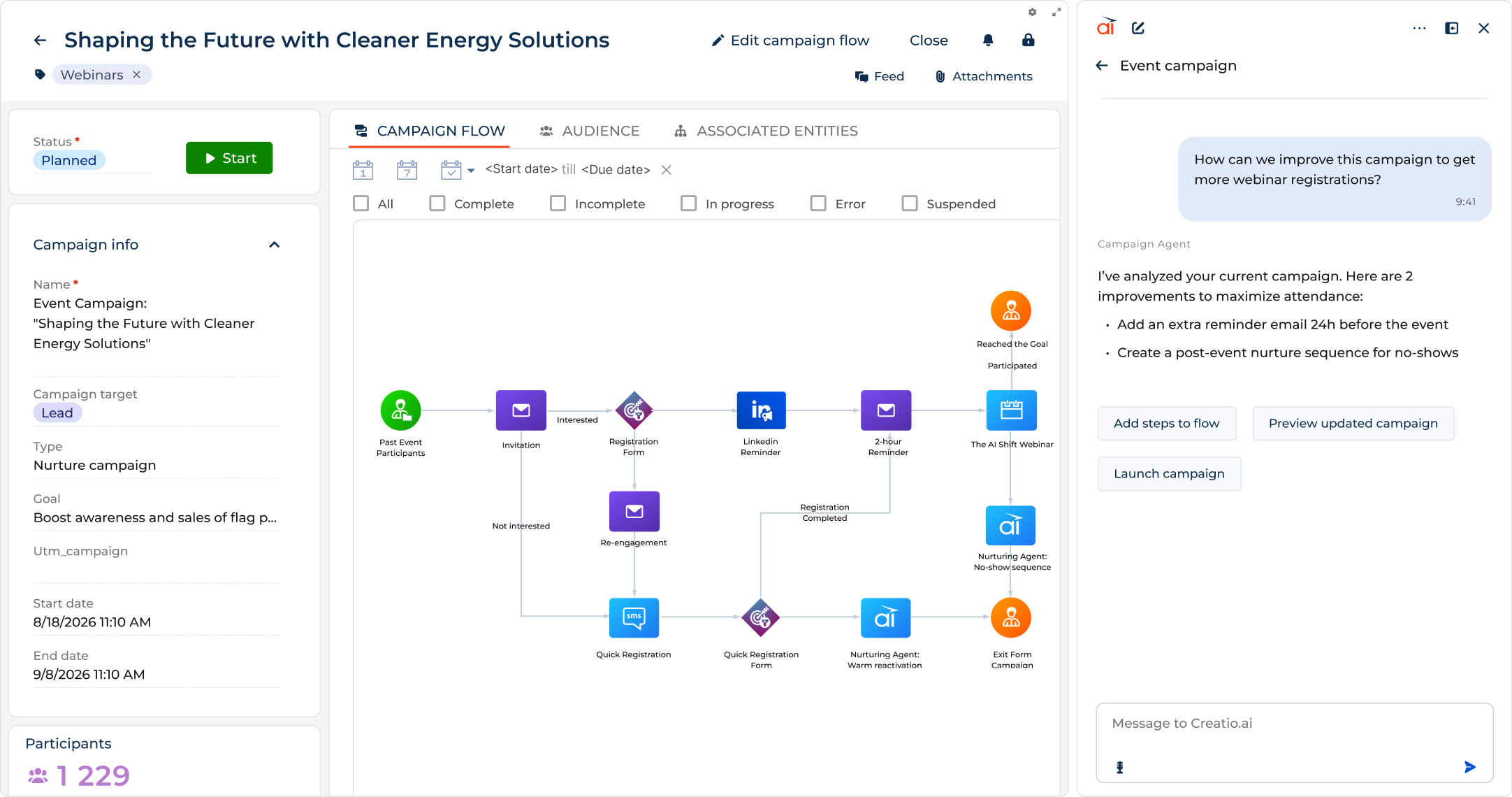
Agentic Campaign Orchestration – Creatio Marketing
Real-time lead qualification and routing
Agentic AI enables marketing teams to autonomously qualify and route leads based on behavior, engagement, and fit. It tracks signals from content interactions, campaign responses, and website activity to score leads and determine the next best action.
For instance, high-intent leads can be instantly routed to sales with full context, while early-stage prospects are automatically enrolled in personalized nurture journeys. Platforms like Creatio Marketing provide built-in CRM agents for lead scoring and distribution, helping human teams accelerate lead conversion and improve pipeline quality.
Dynamic customer journeys
Agentic AI continuously adapts customer journeys across channels by building and executing next-best actions based on real-time behavior, engagement, and context.
Using agentic AI, marketers can seamlessly move a high-value prospect from an email campaign to a relevant web page, adjust ad creatives and messaging based on user behavior, or trigger follow-up offers after product interaction, ensuring a seamless, relevant journey at every touchpoint.
Hyper-personalized content delivery
According to McKinsey, AI-driven personalization can enhance customer satisfaction by 20% and increase revenue by nearly 8%. Agentic AI builds on this by tailoring content for emails, ads, landing pages, and offers for target users or micro-segments, ensuring relevance for higher engagement.
For instance, it can adapt email content based on user behavior, personalize landing pages by industry or intent, adjust ad creatives in real time, or recommend relevant content and offers at the right moment to make each interaction is timely and relevant.
Always-on campaign optimization
Instead of periodic adjustments, agentic AI continuously learns from performance data to optimize targeting, messaging, and budget allocation in real time. This eliminates the need for manual updates and time-consuming A/B analysis, allowing marketers to focus on strategy, with the campaigns being continuously improved in the background.
AI-driven content production workflows
From briefs to final assets, agentic AI coordinates the entire content production engine: generating drafts, suggesting improvements to creative variations, and adapting formats across channels.
For example, it can turn a campaign brief into blog posts, email copy, and social media assets, then refine messaging based on user interaction data. This allows for launching campaigns faster, maintaining consistency, and optimizing creatives on the fly.
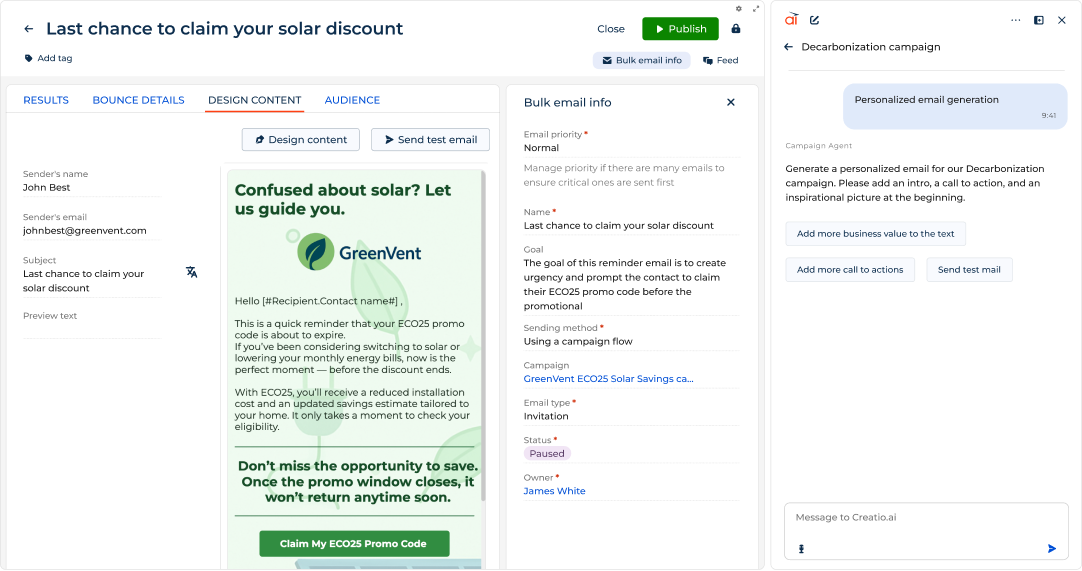
Personalized content development – Creatio Marketing
Predictive audience segmentation and targeting
Agentic AI identifies high-value segments in real time, refining audiences based on behavioral patterns and campaign performance.
For example, it can detect emerging segments with high conversion potential, dynamically update targeting criteria, or shift campaigns toward audiences showing specific engagement patterns to improve conversion flow.
Performance analytics and decision automation
Agentic AI automatically aggregates third-party data from sources such as Google Analytics, CRM, and advertising platforms to build and update marketing performance dashboards. It then analyzes campaign data, surfaces actionable insights, and autonomously recommends or executes optimization actions aligned with business goals, enabling faster, more informed decision-making.
Main Challenges of Agentic Marketing
While agentic AI brings significant benefits, its adoption also introduces new operational and strategic challenges that marketing teams must address:
- Data quality and real-time availability: Agentic AI relies on accurate, unified, and up-to-date data to make decisions. Poor data quality or fragmented systems can lead to incorrect targeting, ineffective personalization, and suboptimal campaign performance.
- Trust in autonomous systems: Moving from manual control to agentic marketing execution requires a shift in mindset. According to Fortune.com, many employees experience FOBO – fear of becoming obsolete, which became one of the top reasons for sabotaging AI-powered solutions. Business teams must trust AI agents to act on their behalf, which can be difficult without clear visibility into how decisions are made and validated.
- Governance and control boundaries: Without clearly defined rules, agentic AI systems may take actions that conflict with business goals or expectations. Organizations need to establish guardrails around what AI can and cannot execute, including approvals, thresholds, and escalation paths.
- Alignment with brand and strategy: Autonomous decisions must remain consistent with brand voice, messaging, and overall marketing strategy. Without proper oversight, AI-generated content or actions can dilute brand identity or create inconsistent customer experiences.
- Compliance and privacy risks: As agentic AI works across customer data and workflows, organizations must ensure compliance with regulations and internal policies of data protection. This requires transparency, auditability, and traceability of AI-driven decisions.
Though real, these challenges are not barriers. With the right strategy, tech stack, and AI governance, organizations can mitigate risks and unlock the full potential of agentic AI.
How to Implement Agentic AI in Marketing
Implementing agentic AI requires a strategic approach to redesigning marketing workflows, connecting data, and enabling autonomous execution. The steps below will help you build a bold strategy on adopting agentic AI across marketing and business workflows.
Step 1. Identify high-impact agentic use cases
Start by analyzing marketing workflows where speed, scale, and coordination have the greatest impact on performance. High-value starting points typically include campaign orchestration, lead lifecycle management, audience segmentation, content creation, and customer journey optimization.
Rather than automating isolated tasks, focus on multi-step processes where agentic AI can plan, execute, and optimize operations across the channels and drive measurable results.
Step 2. Connect your data, channels, and tools
Agentic AI is only as effective as the ecosystem it operates in. Ensure your CRM, marketing automation platform, advertising channels, and analytics tools are connected and accessible.
A unified data layer allows AI-powered agents to act on real-time performance data and historical insights, enabling smarter decisions and coordinated execution across all customer interactions.
Step 3. Design goal-driven marketing workflows
Define clear objectives — such as increasing conversions, improving engagement, accelerating pipeline, or optimizing retention — and design workflows where agentic AI can determine and execute the best actions to achieve them.
Set rules for segmentation, messaging, timing, lead management, and budget allocation, while allowing agents to adapt based on real-time data. At the same time, establish guardrails for brand voice, messaging, and approvals where needed to ensure consistency and control.
At the same time, establish clear boundaries for how AI operates, especially around brand voice, messaging, and customer experience. Define guidelines for content, approvals (where needed), and performance thresholds to ensure consistency and control.
Step 4. Redefine team roles around strategy and experimentation
As agentic AI takes over execution, marketing teams need to rethink how they operate. Instead of managing tasks manually, teams should focus on higher-value activities such as brand positioning, creative direction, experimentation, and performance analysis.
Foster a culture of continuous experimentation, where teams actively test agentic AI use cases, explore the potential of agentic marketing, and share new insights to drive marketing results.
Step 5. Establish guardrails for brand and performance
Define clear boundaries for how AI operates—especially around brand voice, messaging, and customer experience. Set guidelines for content, approvals (where needed), and campaign thresholds to ensure consistency and control.
At the same time, maintain visibility into AI-driven decisions and outcomes to track performance and refine strategies.
Step 6. Scale from campaigns to full-funnel orchestration
Once initial use cases prove value and your team is ready, expand agentic AI across the full marketing lifecycle, from audience discovery and campaign planning to lead management, customer engagement, and retention.
This allows for transforming the isolated agentic workflows to fully orchestrated, always-on agentic AI marketing systems that continuously adapt to customer behavior, data signals, and business goals.
Creatio’s Agentic AI Capabilities for Marketing
To operationalize agentic AI across marketing and the broader business, Creatio provides a unified platform designed to automate workflows and CRM with no-code tools and AI at its core. By embedding generative AI, predictive AI, and agentic AI capabilities directly into business processes, it enables business users to design, deploy, and continuously optimize agentic workflows — faster, with greater intelligence and full control.
Creatio Marketing is part of Creatio’s CRM suite, alongside Creatio Sales and Creatio Service, enabling seamless end-to-end automation across the entire customer lifecycle. The platform can be deployed as a unified CRM or as standalone solutions, and extended through 700+ third-party applications and integrations to fit complex business requirements and needs.
Within Creatio Marketing, AI agents operate across the full marketing lifecycle —streamlining execution, personalizing customer journeys, and optimizing performance in real time. These agents handle routine tasks, coordinate workflows, make decisions, and continuously adapt based on data to help marketers stay focused on strategic work.
Creatio Marketing is powered by the following AI Agents:
- Marketing Content Agent — Generates on-brand content for campaigns, newsletters, and landing pages
- Email Generation Agent — Creates and optimizes email copy based on audience behavior and campaign goals
- Campaign Agent — Plans, launches, and optimizes campaigns across channels
- Lead Scoring Agent — Evaluates and prioritizes leads in real time based on engagement and fit
- Lead Distribution Agent — Routes leads dynamically to the right teams and workflows
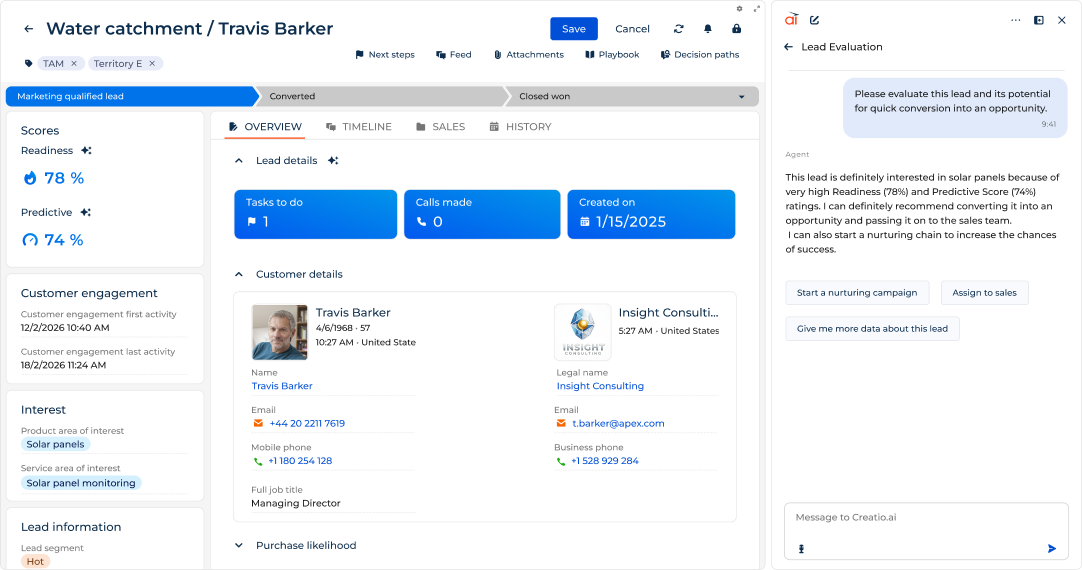
Lead Scoring Example – Creatio Marketing
Creatio’s embedded AI architecture ensures that all agents operate with full context on unified customer data, campaign history, and workflow logic to make data-driven decisions and optimize outcomes autonomously. With built-in conversational AI, marketers can interact with agents using natural language to launch campaigns, retrieve insights, or adjust workflows without navigating through interfaces.
Using the No-Code Agent Builder, teams can easily create and customize AI agents for specific marketing processes without technical expertise. This combination of agentic AI and no-code flexibility enables faster innovation, deeper personalization, and reduced reliance on IT.
To see how Creatio’s agentic AI can transform your marketing workflows, request a personalized demo and see the platform in action.
Future Trends in Agentic AI for Marketing
In the coming years, agentic AI will continue to reshape how marketing teams operate, engage customers, and drive growth. The following trends highlight where agentic marketing is headed next:
#1. Autonomous Campaign Orchestration
In marketing, agentic AI is evolving toward fully autonomous campaign orchestration, in which AI agents plan, execute, and optimize marketing initiatives end-to-end. With minimal involvement of human marketers, agentic AI systems will be able to:
- Build campaign strategies based on audience insights and business goals
- Generate and adapt content assets across channels
- Manage and optimize media buying and budget allocation
- Monitor performance and continuously adjust campaigns in real time
While strategic direction remains human-led, agentic AI will enable marketing teams to execute campaigns faster and with greater efficiency.
#2. Multi-Agent Systems
Today, many marketing teams already use AI agents to support specific tasks, such as creating ad creatives, segmenting audiences, or developing campaign strategies. The next step is the evolution toward multi-agent systems, where these specialized agents collaborate as a coordinated AI system to plan, execute, and continuously improve marketing efforts. Instead of managing separate tools or agents, marketers will rely on interconnected systems that operate with greater autonomy..
In practice, this means different agents working together to achieve complex goals, such as creating and optimizing blog content or running end-to-end marketing campaigns. By combining AI automation with domain-specific expertise, this trend will further improve the speed, quality, and coordination of marketing activities across the entire campaign lifecycle.
#3. Hyper-Personalized CX
Personalized customer experiences are not new, but agentic AI will take them to a new level. Agentic AI will enable marketers to tailor every interaction — ads, landing pages, offers, and emails — based on continuous analysis of customer behavior and contextual data. These systems will create and activate large volumes of micro-segments, dynamically testing and refining messaging across channels.
This will enable brands to deliver even more relevant, individualized experiences at scale, driving higher conversion rates, stronger customer loyalty, and increased lifetime value without added complexity.
#4. Business-to-Agent B2A Marketing
As AI agents begin to act on behalf of users — researching options, comparing vendors, and executing transactions — marketing will increasingly target AI systems, not just humans. These agents will prioritize structured, reliable data such as product specifications, pricing, availability, and integrations over traditional brand messaging.
If a brand cannot be surfaced by an agent, it may never enter the buyer’s decision process. The business priorities will be shifting from purely human-centric to agent-focused marketing. Marketers will need to optimize not only for humans, but also for “Agent Experience” (AX), ensuring their offerings are discoverable, interoperable, and actionable by AI systems.
Summary
Agentic AI is reshaping modern marketing by enabling autonomous, goal-driven workflows that can plan, perform, and optimize campaigns and customer journeys at massive scale. This allows teams to deliver highly personalized experiences, improve campaign performance, and shift focus from manual marketing execution to strategy and growth.
To support this shift, Creatio offers a powerful agentic marketing platform that enables teams to orchestrate campaigns, manage leads, and optimize performance across the entire customer lifecycle with greater speed, control, and scalability.
Request a personalized demo to see how agentic marketing can drive business growth today.
