






































































Multi-Agent Systems (MAS): Architecture, Examples, and Use Cases

Build smarter processes with a multi-agent system

Modern business processes become increasingly complex, with customer journeys, operational workflows, and real-time decisions now spanning multiple systems, data sources, and changing conditions - far beyond what a single decision-maker or AI agent can handle effectively. This complexity is driving a shift toward multi-agent systems, where specialized, autonomous agents work together, coordinate their actions, and adapt in real time, making them better equipped to manage these challenges.
In this article, we explain what multi-agent systems are, how they work, where they are used in practice, and how platforms like Creatio apply multi-agent principles to CRM and workflow automation.
Key takeaways:
- In multi-agent systems, multiple AI agents collaborate to execute tasks and achieve business goals.
- These systems operate by coordinating specialized agents that can perceive their environment, make decisions, communicate, take actions, and continually learn from the outcomes.
- Multi-agent systems enable scalability, resilience, parallel execution, and flexibility, which are critical for modern enterprise and industry applications.
- Single-agent systems are effective for simpler tasks, while multiple-agent systems enable the execution of complex workflows and large-scale tasks by enabling multi-agent collaboration.
- Creatio applies multi-agent system principles through specialized AI agents, unified CRM data, autonomous task execution, and human-in-the-loop governance.
What Is a Multi-Agent System?
A multi-agent system is a computational system composed of multiple autonomous agents that interact with one another within a shared environment to achieve individual or collective goals. In a multi-agent system (MAS), each autonomous AI agent is a goal-oriented, decision-making entity that performs tasks on behalf of users, with no or minimal human intervention.
Intelligent agents act independently, making their own decisions based on their objectives, knowledge, and decision logic, yet they are also deeply interconnected. They interact and influence one another’s behavior and the overall outcomes. Each agent has their specific role and capability to execute a set of tasks, but by working together, a multi-agent system can solve complex problems that would be difficult or impossible for a single AI agent to handle alone. This makes multi-agent systems particularly effective in complex and dynamic environments.
Core Components of a Multi-Agent System
The core components of a multi-agent system define how AI agents operate independently while interacting effectively within a shared environment. Together, these components enable coordination, adaptability, and teamwork.
1. AI agents
AI agents are the fundamental building blocks of a multi-agent system. These can include bots, software programs, robots, sensors, drones, and other similar devices. Each agent is capable of:
- Perceiving its environment, processing data, and recognizing patterns
- Making decisions based on its goals and available information
- Acting independently to pursue defined objectives
- Monitoring performance, learning, and adapting to increase efficiency
Agents can have different roles, capabilities, knowledge, or goals, which allow specialization and division of labor within the system.
2. Environment
The environment is the context in which AI agents exist, perceive, and act upon. It can be physical, such as robots in a warehouse, digital, such as software services, or a combination of both.
The environment can be shared, in which all agents observe and act within the same space, or distributed, where each agent has only partial visibility. This requires them to coordinate and exchange information to build a broader understanding of the environment in which they work.
3. Communication & interaction
Communication and interaction components define how agents exchange information and influence one another within a multi-agent system. These mechanisms enable agents to coordinate, align their goals, and solve complex problems together, despite agents operating independently of one another.
Agent communication involves:
- Message passing is the most direct form of interaction, where agents send and receive messages about their state, intentions, or tasks.
- Event-based coordination enables agents to react to changes in the environment or the whole system, rather than relying on direct messages.
- Negotiation and signaling support decision-making in situations with competing or overlapping goals.
Together, these interaction mechanisms enable multi-agent systems to strike a balance between autonomy and collaboration.
4. Coordination & control
Coordination and control define how AI agents work together and make decisions about tasks, goals, resource allocation, etc.
In cooperative settings, agents work toward shared or complementary goals, prioritizing collective outcomes over individual gain. In competitive settings, on the other hand, agents pursue their own objectives, often in opposition to those of others, requiring them to negotiate to reach a mutually beneficial agreement. Many real-world systems combine both cooperation and competition to streamline task execution and increase performance efficiency.
Coordination can be either centralized or decentralized. In centralized coordination, a single controller or coordinating agent has access to a knowledge base, assigns tasks, and manages interactions between different agents. While this approach facilitates agent communication and ensures a uniform source of information, it can limit the system’s resilience. If the "managing" agent fails, all other agents are unable to perform actions.
In contrast, decentralized coordination distributes decision-making across agents, enabling greater scalability, robustness, and adaptability, with system behavior emerging from local interactions rather than top-down control.
How Multi-Agent Systems Work
Multi-agent systems work by combining autonomous decision-making with continuous interaction among multiple agents that operate in a shared or distributed environment.
Here’s a step-by-step guide to how multi-agent systems work:
1. Perception
Each AI agent begins by perceiving its environment and collecting data. This can involve sensing environmental states, receiving messages, or observing events. Because visibility is often partial, agents typically maintain a local view of the system rather than a complete global state.
2. Decision-making
Based on its perceptions, internal knowledge, and goals, each agent independently evaluates possible actions and makes a decision to take action that will bring it closer to its goal. Decision-making can be rule-based, goal-driven, or learned through machine learning and reinforcement techniques.
Agents may:
- Select actions that maximize individual gains
- Plan sequences of actions to reach a goal
- Adapt strategies based on past outcomes or new information
3. Agent communication
Multiple AI agents communicate to share information, coordinate actions, and influence one another’s decisions.
Through communication, agents can:
- Exchange information or intentions
- Request or delegate tasks
- Negotiate responsibilities or the use of resources
4. Actions
Agents take autonomous actions based on their decisions and communications. Actions may affect the environment, other agents, or shared resources.
AI agents can:
- Execute plans and strategies
- Trigger events or responses from other agents
- Fulfill tasks and even entire workflows
In dynamic systems, actions must be taken quickly, which requires agents to respond in real-time to both expected and unexpected changes. More complex tasks or processes require more agents, who can divide the tasks between themselves according to their specialization and capabilities.
5. Feedback, learning, and adaptation
Multi-agent systems incorporate feedback loops that enable agents to learn from the outcomes of their actions and from one another. AI agents may refine their strategies or adjust goals based on success, failure, or changes in other agents’ behavior. This enables agents to continuously improve their performance, resulting in smarter, more adaptive, and effective systems over time.
Learn more about how autonomous AI agents work
Benefits and Challenges of Multi-Agent Systems
Multi-agent systems offer powerful advantages for solving complex problems, but they also introduce unique challenges. Understanding both is essential when adopting or building multi-agent systems.
Scalability
Multi-agent systems scale naturally by adding, removing, or adapting agents without having to redesign the entire system. Because the workload can be spread across agents, the system can effectively handle increasing complexity, data volume, or the number of tasks and processes.
Resilience
In a decentralized system, the absence of a single point of failure makes multi-agent systems more resilient. If one AI agent fails or behaves unexpectedly, other agents can continue operating and adapt their behavior to compensate for the loss.
Parallel execution
Agents operate independently and simultaneously, which means they can work on multiple tasks at the same time. This significantly improves productivity and responsiveness, especially in time-sensitive or complex processes.
Flexibility
Multi-agent systems are highly flexible and adaptable. Agents can change strategies, roles, or goals in response to new information or environmental changes. This enables the system to evolve if necessary, rather than adhering to rigid, predefined workflows.
Challenges of multi-agent systems
Coordination complexity
Whether in a centralized or decentralized system, as the number of agents grows, coordinating their actions becomes increasingly difficult. Managing dependencies, avoiding conflicts, and ensuring alignment with goals requires sophisticated coordination mechanisms and well-designed interaction protocols.
Monitoring and governance
In decentralized multi-agent systems, distributed control makes it difficult to monitor agent behavior and enforce policies consistently. This is why it’s crucial to have comprehensive AI governance and control frameworks to guarantee compliance, reliability, and ethical behavior across autonomous agents.
It’s up to humans to set rules and boundaries that agents must respect and ensure they comply with laws and regulations to avoid potential fines. The system should be easy to monitor and provide a human-in-the-loop framework to allow intervention in case AI agents stray from their course.
Debugging and explainability
Emergent behavior, while powerful, can be hard to predict or explain. Tracing errors, understanding system failures, or explaining outcomes is challenging when behavior results from many independent agents interacting with each other over time.
Security and control
Autonomous agents introduce new security risks, including malicious behavior, unintended actions, or exploitation of sensitive data. Maintaining control, enforcing permissions, and protecting the system from internal and external threats are critical challenges.
Multi-Agent Systems vs Single-Agent Systems
Aspect | Single-Agent Systems | Multi-Agent Systems |
| Scalability | Limited scalability; performance depends on a single agent’s capacity | Highly scalable; new agents can be added to distribute the increased workload |
| Fault tolerance | Low fault tolerance; failure of the agent can halt the system | High fault tolerance; the system continues functioning even if individual agents fail |
| Complexity | Best suited for simple or moderately complex tasks with clear objectives | Capable of handling highly complex, large-scale, and interdependent tasks |
| Decision-making | Centralized decision-making within one agent | Distributed decision-making across multiple autonomous agents or centralized with a single managing agent |
| Expertise | Have a single role with defined capabilities and expertise | Multiple agents have different roles and capabilities, which broaden the system’s expertise |
Types of Multi-Agent Systems
Multi-agent systems can be classified into several categories based on how agents interact, coordinate, and pursue goals. Each type is suited to different problems and system requirements.
Cooperative multi-agent systems
In cooperative multi-agent systems, agents work together toward shared or aligned goals. They coordinate actions, share information, and prioritize tasks, making them well-suited for tasks like resource optimization and workflow automation.
Competitive/adversarial multi-agent systems
Competitive or adversarial systems consist of agents with conflicting objectives. They compete to achieve individual goals and outperform other agents, which is beneficial in environments that require negotiation, optimization, or have limited resources.
Hierarchical multi-agent systems
Hierarchical multi-agent systems organize agents into layers of authority or roles, where higher-level agents guide or coordinate lower-level agents. This structure strikes a balance between centralized control and decentralized execution, enhancing control while maintaining some flexibility.
Decentralized or distributed systems
In distributed or decentralized systems, no individual agent has overall control. All agents operate independently based on local information and interactions, which enables high scalability, resilience, and adaptability, but also limits control.
These categories are not mutually exclusive, and many real-world AI systems combine elements from multiple types to meet complex process requirements.
Practical Use Cases of Multi-Agent Systems
Multi-agent systems are widely applied in industries where complex coordination, real-time decision-making, and adaptability are critical. Below are a few examples of practical use cases across various fields.
Banking, financial services, and insurance (BFSI)
In BFSI, multi-agent systems are used for many routine tasks, such as fraud detection, claim processing, customer service automation, and many more. Independent agents can monitor transactions, analyze risk signals, negotiate pricing, or manage customer interactions, improving speed, accuracy, and customer satisfaction.
- Fraud detection - multiple agents monitor transactions in real time, each focusing on different fraud signals such as behavior patterns, location anomalies, or transaction velocity. By sharing insights, agents can detect complex fraud schemes faster and with higher accuracy.
- Claim processing - in insurance, agents handle different stages of the claims lifecycle, including validation, damage assessment, policy checks, and payout approval. Parallel execution reduces processing time while improving consistency and accuracy.
- Customer service automation - customer-facing agents manage multiple inquiries and solve problems simultaneously, while backend agents retrieve data and analyze similar cases. This collaboration enables faster resolutions and more personalized customer experiences. More complex cases are routed to human customer service representatives, who receive full context and suggested resolutions prepared by AI agents.
Discover more use cases of AI agents for the financial industry - AI agents in finance
Transportation and logistics
Transportation systems leverage multi-agent frameworks for route optimization, cargo tracking, and fleet coordination. Each agent acts independently while coordinating with others to reduce congestion, optimize delivery times, and adapt to real-time conditions.
- Route optimization - routing agents continuously analyze traffic data and road conditions to suggest optimal routes.
- Cargo tracking – separate AI agents monitor the location and status of shipments, while others provide customers and logistics companies with real-time updates.
- Fleet coordination and truck assignments - in logistics and delivery operations, agents manage individual vehicles, drivers, or shipments. These agents coordinate schedules, capacity, and priorities to maximize fleet utilization.
Manufacturing
In manufacturing, multi-agent systems enable smart factories, where agents coordinate scheduling, maintenance, and resource allocation autonomously, allowing production systems to adapt quickly to disruptions, demand changes, or equipment failures.
- Production scheduling - several agents coordinate schedules of manufacturing machinery in real time based on capacity, priorities, and demand.
- Predictive maintenance - each agent is responsible for monitoring one piece of equipment and its sensor data to detect early signs of failure. Other agents analyze this data and provide maintenance recommendations to reduce downtime.
- Resource allocation - agents manage materials, machinery, energy, and labor across the production process. By dynamically reallocating resources, the system can respond effectively to supply chain disruptions, maintenance schedules, or shifting production requirements.
Healthcare and life sciences
Healthcare applications use AI systems for patient monitoring, clinical decision support, and hospital operations. Multi-agent frameworks help improve care coordination, reduce healthcare professionals’ workload, and respond to patient needs in real-time.
- Patient monitoring and disease prediction - agents continuously monitor patient data from medical devices and electronic health records. By detecting anomalies early, they enable timely interventions and improve patient care.
- Clinical decision support - decision-support agents analyze medical data, guidelines, and diagnostic images to assist clinicians in making informed treatment decisions.
- Hospital operations management - AI agents effectively coordinate scheduling, bed allocation, staffing, and equipment usage across multiple hospital departments.
Discover more examples of AI agents and how they can benefit different industries and functions.
How Creatio Applies Multi-Agent System Principles in CRM and Workflow Automation
Creatio applies multi-agent system principles to orchestrate complex CRM and workflow processes by embedding autonomous, role-based AI agents directly into its unified CRM and no-code platform. Rather than merely augmenting traditional automation with AI add-ons, Creatio’s agentic architecture enables independent agents to operate within shared CRM data, coordinate with one another, and autonomously perform tasks, while preserving human oversight and governance.
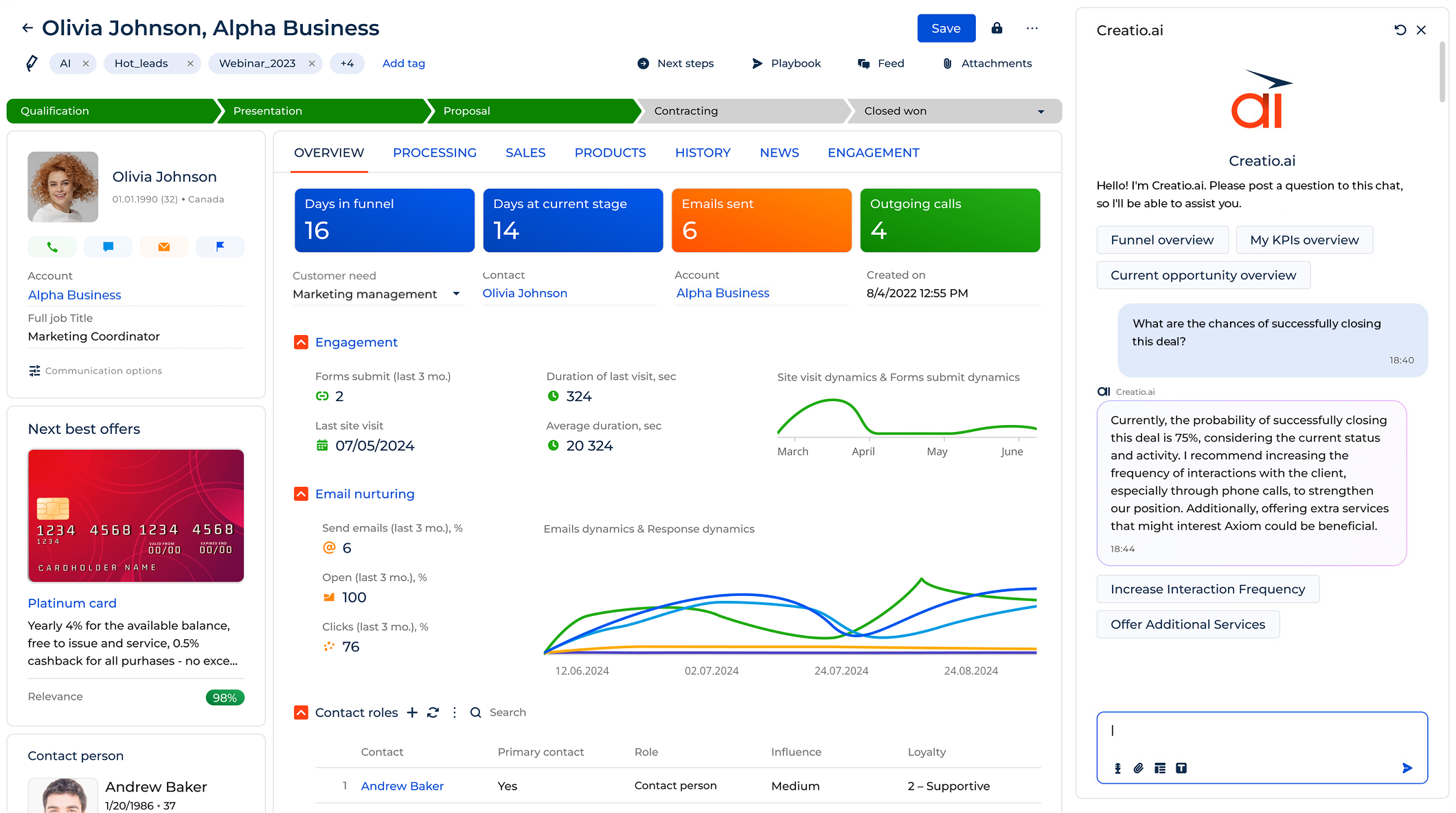
Creatio multi-agent principles include:
- Specialized AI agents for core CRM functions - Creatio embeds role-specific agents across sales, marketing, service, and other business functions. These agents are designed to automate common tasks, such as account research, content generation, quote preparation, case resolution, and dashboard automation, providing actionable insights, and supporting data-driven decision-making.
- Agents operate within unified CRM data and workflows - all agents work on the same CRM objects, relationships, and workflows, ensuring that actions taken by one agent are consistent with the broader operational context.
- Autonomous execution of routine tasks - agents can autonomously perform routine tasks, such as summarizing information, generating follow-up communications, updating CRM records, routing requests, and suggesting next-best actions, freeing human teams from repetitive work and enabling them to focus on high-value tasks.
- Human-in-the-loop control and governance - while agents can act independently, Creatio emphasizes the importance of human oversight. Agents prepare recommendations or actions that can be reviewed before execution, ensuring compliance with industry laws and business values.
- No-code configuration of workflows and agents - Creatio’s platform enables business users to design, deploy, and manage workflows and agents using no-code tools, eliminating the need for coding. Using visual designers, drag-and-drop builders, and natural language inputs, organizations can build workflows and custom AI agents tailored to their unique processes.
By integrating these multi-agent system principles at the core of its agentic CRM and workflow platform, Creatio enables organizations to scale intelligent operations, increase productivity, and drive business growth.

What to Look for When Implementing Multi-Agent Systems
When implementing a multi-agent-powered system, success depends not only on the capabilities of individual agents but also on the system's architecture, governance, and operational control. The checklist below highlights the key factors organizations should evaluate to ensure reliable, scalable, and trustworthy deployment.
Are you planning to implement a multi-agent system for your business? Consider these factors and use this checklist to make an informed decision:
- Clear agent responsibilities - ensure each agent has a well-defined role, scope, and objective. Clear responsibility reduces overlap and makes agent behavior easier to predict and manage.
- Centralized data context - agents should operate on a shared, consistent data foundation. A unified data context ensures that all agents make decisions based on the same information, improving accuracy, coordination, and relevance of outcomes.
- Orchestration and governance - effective multi-agent systems require orchestration layers that manage execution order, dependencies, and escalation paths. Governance mechanisms, such as approval rules, permissions, and policies, are crucial for maintaining control over autonomous behavior.
- Scalability - the system should allow for the addition, removal, or modification of agents without disrupting existing operations. Scalable architectures enable organizations to expand agent capabilities as processes, data volumes, or business needs evolve.
- Integration with existing systems - to ensure effective operations, agents must integrate seamlessly with all business applications and data sources used by an organization.
- Transparency and monitoring - organizations need visibility into agent actions, decisions, and outcomes. Monitoring, logging, and explainability features are critical for troubleshooting, compliance, performance optimization, and building trust in autonomous systems.
Evaluating these criteria helps ensure that multi-agent systems deliver real business value while remaining manageable, secure, and aligned with your organizational goals.
Read more practical tips on how to get started with AI agents.
Summary
Multi-agent-based systems are the future of effective business process automation. By distributing work across autonomous, specialized agents that can coordinate and operate simultaneously, organizations gain the scalability, resilience, and adaptability needed to manage increasingly complex processes. However, they need to be aware of the challenges that come with implementing these AI systems and consider key factors that influence successful implementation.
Creatio's multi-agent system helps organizations automate complex CRM and workflow processes using specialized AI agents that work together on a unified platform, delivering all the benefits while mitigating the associated challenges. Its no-code tools enable fast configuration and scaling of intelligent automation, while enterprise-grade security protocols ensure transparency, governance, and compliance.
Ready to increase productivity and efficiency with a multi-agent system? Request a tailored demo today and find out how Creatio can support your business goals.
