



































































Compliance Management Software: Full Guide and TOP 5 Solutions

Enhance Business Ops with Creatio’s Agentic CRM

Compliance today is still too often held together by spreadsheets and last-minute evidence gathering before an audit. As regulations grow more complex and change more frequently, manual compliance processes become slow, error-prone, and hard to scale. To modernize these processes, organizations can deploy compliance management software to help teams stay organized and audit-ready at all times with a fraction of the effort.
This article explores what compliance software is, how it works, the best available solutions, and how to choose the right one.
Key Takeaways
- Compliance software centralizes and automates compliance activities, including requirements, controls, risks, policies, evidence, and audits, in one system.
- AI-assisted compliance features help identify gaps, recommend actions, and improve efficiency through governed, human-in-the-loop processes.
- Choosing the right solution depends on supported frameworks, automation depth, integrations, scalability, pricing transparency, and vendor support.
- The best compliance management software includes Creatio, MetricStream, ServiceNow GRC, OneTrust, and Vanta as they offer strong capabilities for managing regulatory requirements, automating compliance workflows, supporting audits, and providing visibility across controls and risks.
What Is Compliance Management Software?
Compliance management software is a centralized digital solution that helps organizations automate compliance tasks, monitor changing regulations, and prove compliance with regulatory requirements and industry standards. It replaces manual paperwork with structured workflows, automated controls, and real-time visibility into compliance status.
Compliance solutions help organizations map compliance requirements to controls, manage policies and documentation, track regulatory compliance activities and deadlines, collect and store evidence, monitor compliance status, and support audits and certifications.
Who Needs Compliance Management?
Compliance software is used across multiple roles and functions, including risk and compliance professionals, legal and data protection teams, IT and security teams, internal audit teams, and executive leadership.
At the same time, compliance is a shared responsibility across the entire organization. Many controls depend on everyday actions taken by employees, such as following policies, completing approvals, handling data correctly, and reporting issues. The team's compliance is crucial to ensure organizations are equipped to protect operations, avoid disruptions, and secure business continuity.
Compliance Management Software vs GRC Software
Compliance management software is often confused with a GRC (Governance, Risk, and Compliance) system. While the two overlap, they serve different purposes and have different scopes.
The compliance program focuses primarily on execution: managing compliance requirements, tasks, evidence, audits, and reporting. GRC Software, on the other hand, has a broader, strategic view and focuses on risk identification, assessment, appetite, and enterprise-level reporting.
In short, regulatory compliance software answers: Are we compliant, and can we prove it?, while GRC software answers: What risks do we face, how do they relate to our strategy, and how should we govern them?
Aspect | Compliance Management Software | GRC Software |
| Primary focus | Automation of compliance tasks | Strategic governance and risk oversight |
| Main goal | Operationalize compliance and prove adherence to legal requirements | Understand, manage, and govern compliance risk management |
| Typical use | Day-to-day compliance operations | Strategic decision-making and risk oversight |
| Key capabilities | Mapping compliance requirements, control management, audits, reporting | Risk identification and assessment, risk appetite, governance frameworks, enterprise reporting |
| Primary users | Compliance officers, security teams, auditors, legal teams, process owners | Executive leadership, risk committees, board members, senior risk managers |
Many modern platforms combine elements of both, but organizations with complex regulatory environments often start with compliance management software solutions to establish control and visibility before expanding into full GRC capabilities.
Key Components of a Compliance Management System
A compliance management system brings together people, business processes, and technology with several core components to ensure compliance with regulatory standards.
Here’s a list of key compliance management systems’ components:
Policies and procedures
Policies and procedures in compliance software enable organizations to translate complicated regulatory requirements into clear rules, responsibilities, and tasks. They should be based on industry best practices and updated regularly. Well-defined policies ensure consistency and provide a foundation for effective controls and audits.
Controls and operational processes
Compliance software controls are the specific measures used to enforce policies and mitigate risks. These include technical, organizational, and procedural controls embedded in daily operations, such as multi-factor authentication to protect system access, approval workflows for financial transactions, and role-based access controls for sensitive data.
Monitoring, auditing, and reporting
These core components of compliance software help organizations ensure compliance controls are actually followed in everyday work. Monitoring involves regularly reviewing activities, systems, and evidence to spot compliance issues early. Audits are more structured reviews that test controls in detail and confirm they meet regulatory or internal requirements.
Reporting brings this information together in dashboards and reports, showing what is compliant, what is not, and where action is needed. This helps teams fix problems quickly and gives leadership a clear picture of the organization’s overall compliance status.
Documentation and recordkeeping
Documentation and recordkeeping provide evidence that compliance requirements have been met. This includes storing policies, risk assessments, records of how controls are performed, audit findings, and actions taken to fix issues.
Having this information organized and easily accessible within a single unified compliance software makes audits faster, helps respond to regulator or customer questions, and ensures responsibilities and decisions can be clearly traced.
Key Features of Compliance Management Software
The most effective compliance management solutions share a common set of capabilities designed to reduce manual effort, improve accuracy, and help organizations maintain continuous compliance across multiple frameworks and regulations.
Below are the key features typically found in modern compliance solutions:
Automated evidence collection
This feature removes the need to manually gather screenshots, files, or spreadsheet updates. Instead, the compliance software automatically pulls the required proof from connected systems, such as cloud platforms, identity tools, or HR systems, either on a scheduled or continuous basis. This helps keep evidence up to date, reduces human error, and saves teams time during audits and reviews.
Continuous regulation monitoring
Compliance management software continuously tracks framework requirements, looking for changes in regulations and assessing their impact on existing controls. When a new requirement appears or an existing one changes, teams are alerted early and can update processes before gaps turn into bigger issues.
Control and framework mapping
Regulatory compliance program maps multiple regulations, standards, and frameworks to a shared set of internal controls. Instead of managing each regulation separately, organizations define controls and reuse them across different requirements. This reduces duplicated work, makes updates easier when requirements change, and helps teams maintain consistent compliance across multiple frameworks.
Risk assessment and tracking
Many compliance platforms include built-in risk management capabilities that help identify, evaluate, and track compliance-related risks. These tools include structured risk scoring, ownership assignment, and mitigation planning.
Automated workflows
Workflows give teams a clear view of the compliance process by showing the current stage of work, required information, who is responsible, what has already been completed, and what still needs to be done. They also route tasks to the next responsible person, send reminders, and request reviews and approvals to ensure nothing is missed or delayed.
Integrations with cloud and security tools
Standard integrations include cloud infrastructure, IAM systems, security monitoring tools, HR platforms, and ticketing systems. These integrations enable automated compliance data collection, reduce manual effort, and help avoid errors.
AI-assisted compliance support
Modern compliance management platforms use AI agents to automate routine compliance tasks, such as reviewing evidence, flagging missing controls, answering compliance questions, or recommending next steps based on detected issues. Human experts remain in control through human-in-the-loop workflows, where AI suggestions are reviewed, approved, or adjusted before actions are finalized.
These capabilities are supported by AI governance features, including access controls, auditability, and transparency, making them safe to use even in highly regulated industries.
Benefits of Compliance Management Software
Compliance management software helps organizations shift from reactive, manual compliance efforts to a more structured, proactive approach. By centralizing processes and automating compliance activities, it reduces risks and increases productivity.
Here’s a list of key compliance solution benefits:
Reduced compliance risk
Compliance management software continuously monitors controls and regulatory requirements, helping organizations identify gaps and compliance issues early. It also ensures that companies stay up to date with the latest regulations by automatically scanning for updates and notifying the right personnel.
This way, compliance management tools reduce the risk of compliance violations, regulatory fines, and other legal sanctions that are not only costly but can also damage the company’s reputation. On the other hand, adherence to industry standards and regulations helps build brands' trust and customer confidence.
Improved operational efficiency
By implementing compliance programs, organizations can streamline processes and replace time-consuming manual tasks with automated workflows. The system can collect evidence, track deadlines, and compile reports, freeing employees to focus on higher-value work rather than administrative work.
Better audit readiness and faster audits
With controls, evidence, and documentation maintained in a single system, organizations are ready for audits at all times. Thanks to centralized software, audits become faster and less disruptive, as auditors can easily access all the required information without repeated requests or delays.
Enhanced visibility and accountability
Compliance status is clearly visible across multiple teams and security frameworks thanks to unified dashboards, workflows, and clear ownership assignments. This transparency improves accountability and helps leadership understand where risks and bottlenecks exist.
Streamlined regulatory updates
When regulations or internal policies change, compliance management software helps assess the impact, update controls, and communicate changes efficiently.
5 Best Compliance Management Software Solutions
1. Creatio
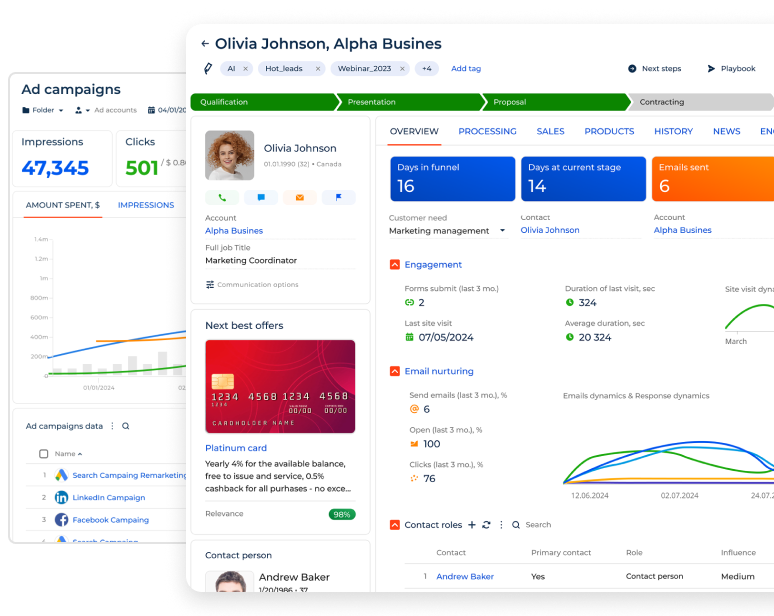
Creatio is an agentic CRM and workflows platform with no-code and AI at its core. The unified platform offers compliance workflows, audit trails, risk management, policy enforcement, and evidence collection within a single system. While Creatio is not a dedicated compliance management solution, it offers a wide range of compliance workflows and tools available through its extensive marketplace.
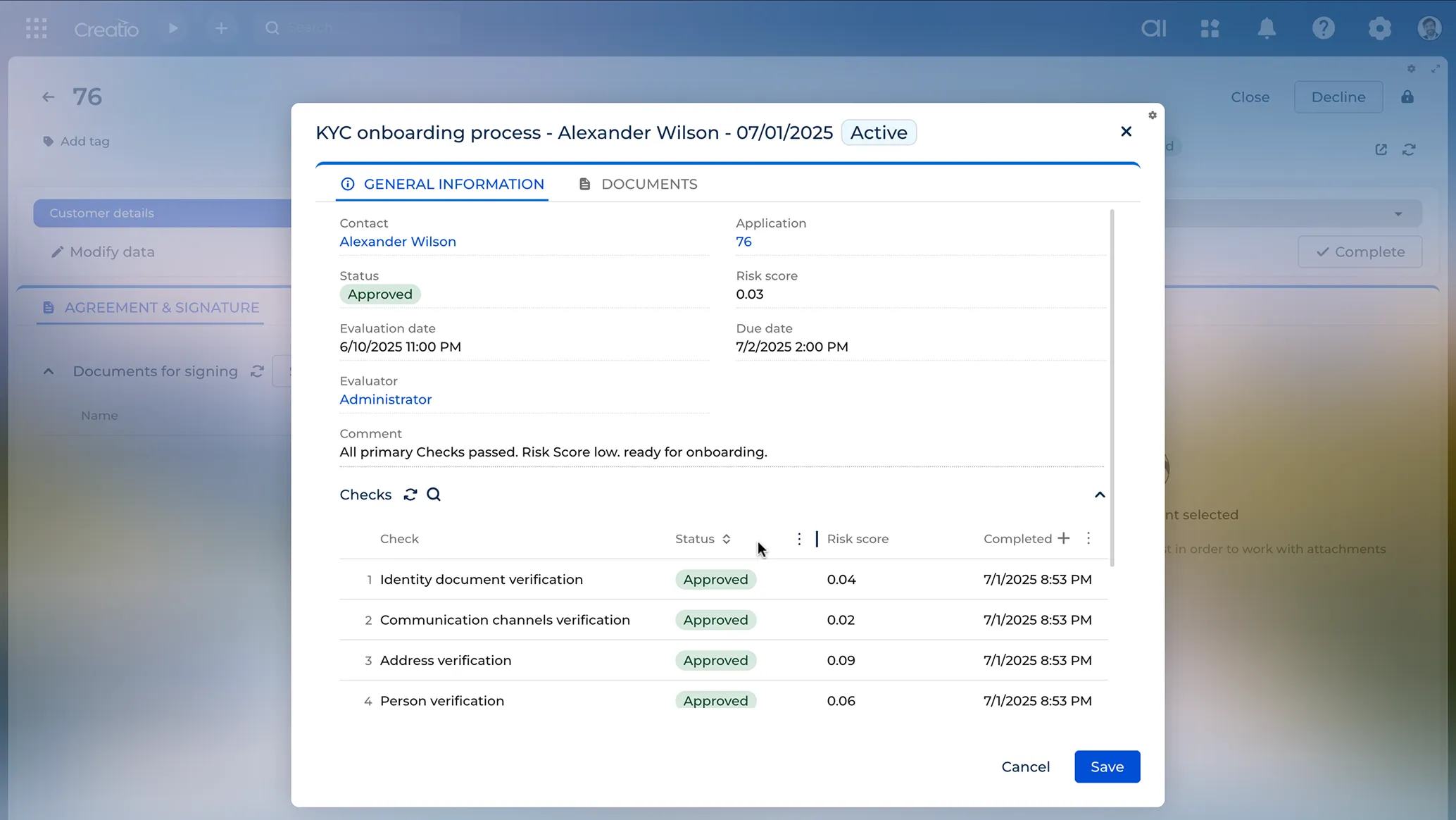
Instead of deploying a separate compliance management system, organizations can consolidate compliance alongside sales, marketing, and service processes on one platform, reducing complexity and improving operational alignment.
Organizations can either choose out-of-the-box compliance workflows to manage compliance, mitigate risk, and generate reports, or create custom ones for complex regulatory standards using no-code tools. Creatio also provides AI agents that assist with day-to-day compliance tasks, such as compiling and reviewing data, flagging gaps, recommending next actions, generating compliance reports, and answering compliance-related questions.
The Creatio platform also supports enterprise risk management by consolidating risk data in a single system, automating risk-related workflows, and leveraging AI models to predict risks and recommend next-best actions.
Creatio is ideal for organizations operating in highly regulated industries such as finance, the public sector, and healthcare. It provides industry-specific workflows that address regulatory requirements, such as HIPAA in healthcare and KYC in financial institutions. Combined with enterprise-grade security and governance standards, Creatio enables organizations to meet regulatory compliance obligations while protecting sensitive data and maintaining trust across their operations.
Key Features
- Out-of-the-box compliance workflows
- Configurable workflows built with no-code tools
- Best-in-class AI agents for compliance tasks
- Risk management, audit readiness, and regulatory tracking
- Centralized document and data management
- Real-time monitoring, customizable dashboards, and reporting
- Seamless integrations through API and marketplace
Pros
- Highly flexible and customizable to unique compliance processes
- Strong automation capabilities
- Easy to use, manage, and customize
- Great for teams with little to no internal developer resources
- Customizable dashboards and reporting
Cons
- Requires design and setup for unique compliance use cases
Pricing:
Pricing for Creatio products starts at $40 per user per month.
2. MetricStream
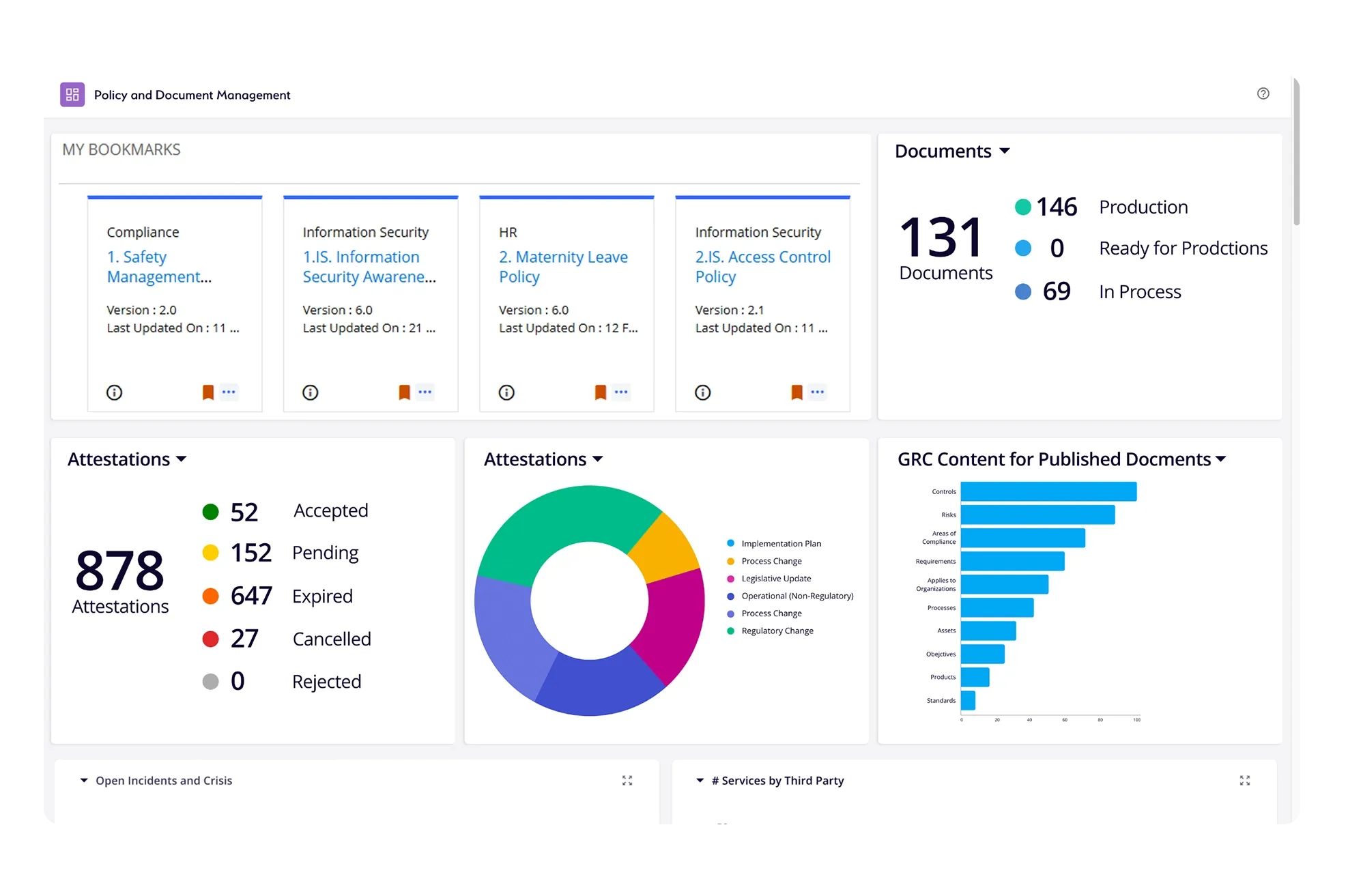
MetricStream is a low-code/no-code GRC cloud platform designed for risk, compliance, and audit management. The Regulatory Compliance Management products provide automated workflows, collaboration, and real-time reporting capabilities. MetricStream also offers an AI-first approach to ensure continuous compliance, helping organizations identify regulatory changes, assess their impact, and proactively address compliance risks.
Key Features
- Unified compliance, risk, and audit workflows
- Policy and regulatory compliance management
- Regulatory change management
- Case and incident management
- Vendor risk management
- Compliance advisory
Pros
- Broad GRC coverage
- Comprehensive reporting and analytics
- Strong integration capabilities
Cons
- Complex to implement, administer, and use
- Lagging performance, which slows down work
- Steeper learning curve and resource demands
- High costs of ownership
Pricing:
Pricing is only available upon request.
3. ServiceNow GRC
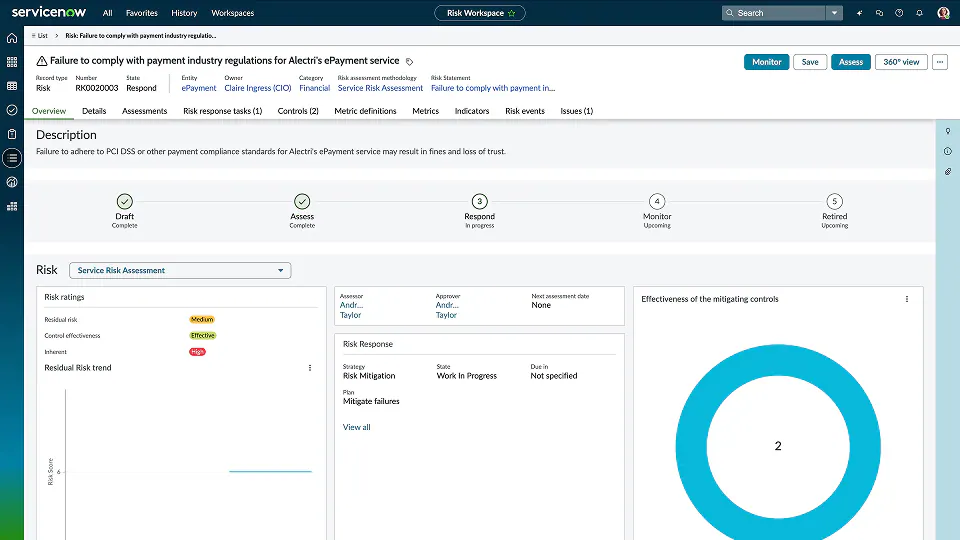
ServiceNow GRC provides a platform that unifies enterprise-wide governance, compliance, and risk. It provides policy and control management, risk assessment, audit workflows, and AI-powered insights for real-time visibility across the organization. With ServiceNow, organizations can improve compliance, streamline risk response processes, and enhance resilience.
Key Features
- Integrated compliance, policy, and risk management
- Audit and regulatory change management
- Real-time compliance monitoring and reporting
- Connectivity with ITSM and operations workflows
Pros
- Strong integration across enterprise processes
- Svalable for large organizations
- Real-time visibility into compliance status
Cons
- High costs of ownership
- Mainly focuses on risk management
- Requires dedicated ServiceNow developers for changes and customization
Pricing:
Pricing is only available upon request.
4. OneTrust
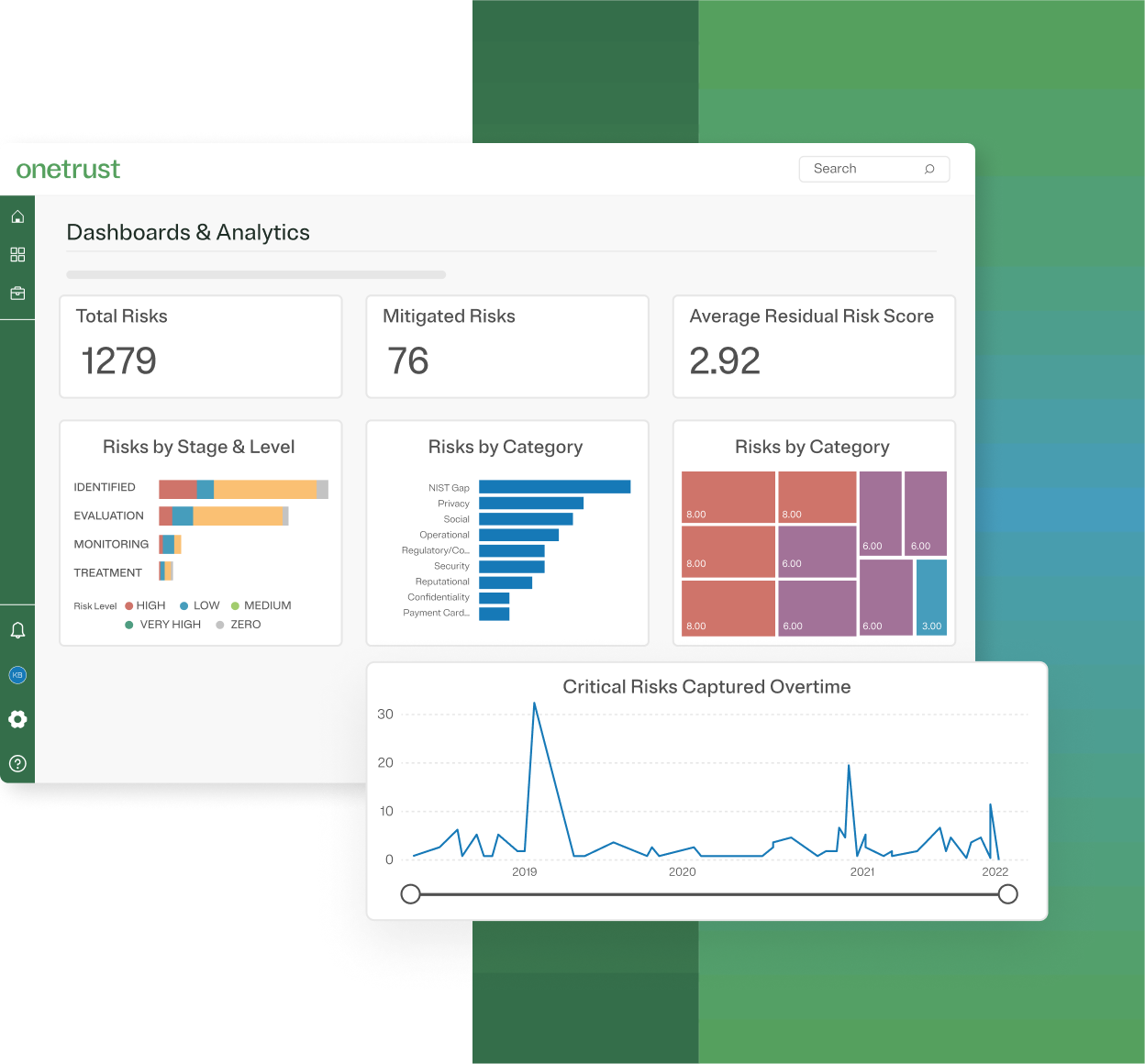
OneTrust is a privacy, security, and GRC platform that helps organizations automate compliance with data protection laws and manage risk and controls across environments. It supports over 50 compliance frameworks, including GDPR, SOC 2, CCPA, and HIPAA, with ready-to-use, standardized frameworks and a control library for evidence collection. OneTrust ensures audit-ready compliance, centralized compliance processes, and enterprise-wide visibility.
Key Features
- Regulatory mapping and control libraries
- 50+ ready-to-use compliance frameworks
- Policy and third-party risk management
- 500+ pre-built system connectors
- Automation and workflow capabilities
Pros
- Broad compliance and privacy coverage
- Centralized regulatory risk and compliance views
- Strong ecosystem for data protection use cases
Cons
- Complex configuration and deployment
- Resource-intensive implementation and maintenance
- Lack of AI-powered features
Pricing:
Pricing is only available upon request.
5. Vanta
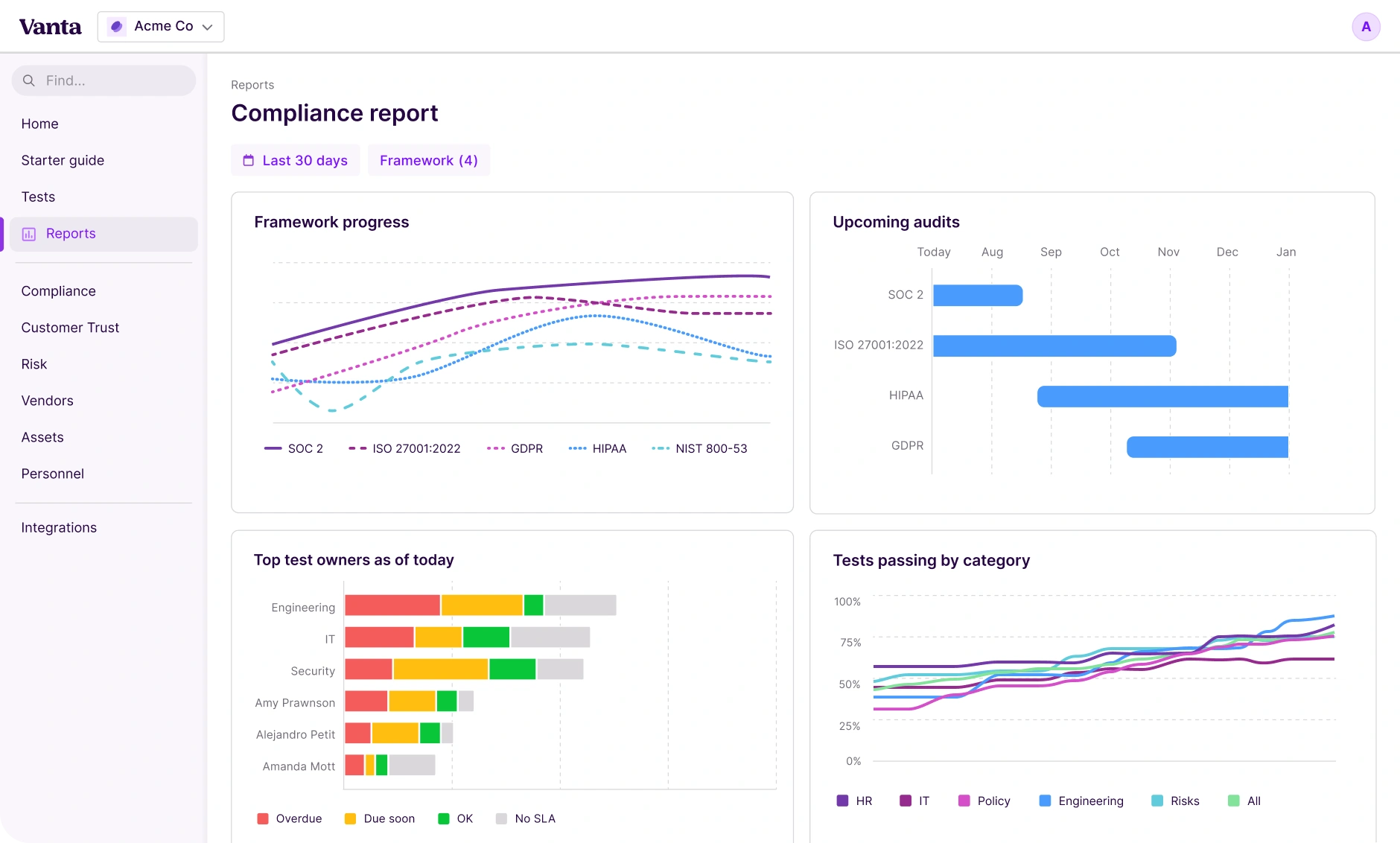
Vanta is a centralized compliance automation and trust management platform that automates and continuously monitors compliance posture in real-time. It’s well-suited for organizations pursuing certifications such as SOC 2, ISO 27001, and others by focusing on controls mapping and evidence automation, rather than broad GRC coverage. Vanta also offers AI agents that provide actionable insights and take action on behalf of users, further streamlining compliance automation.
Key Features
- Continuous compliance monitoring of controls across over 30 frameworks
- Pre-built document and policy templates
- Access and risk management
- AI-guided compliance workflows
Pros
- Very user-friendly and fast to implement
- Integrations with over 400 cloud tools
- Seamless compliance processes
Cons
- Less customizable for unique enterprise scenarios
- Issues with integrations with third-party tools
- Pricing lock-ins and inflexible contracts
Pricing:
Pricing is only available upon request.
How to Choose Compliance Management Software
Choosing the right compliance program depends on your regulatory requirements, organizational size, and the maturity of your compliance processes. When evaluating solutions, consider the following key factors:
- Supported frameworks and regulations - ensure the compliance software supports the regulations and standards relevant to your business and industry-specific requirements. Also, check how easily new frameworks can be added as your compliance scope grows.
- Automation depth - evaluate which parts of the compliance process are automated. Look for features like regulatory tracking, continuous monitoring, automated evidence collection, and alerts, rather than tools that rely heavily on manual updates.
- Integration ecosystem - the compliance management system should integrate with your existing systems, including cloud infrastructure, IAM, security tools, HR platforms, and ticketing systems through APIs or custom integrations.
- Audit and reporting capabilities - review how the platform supports internal and external audits. Check for auditor access, evidence organization, audit workflows, dashboards, visual analytics, and exportable reports for regulators or customers.
- Scalability and flexibility - consider whether the compliance software can scale with your organization as you add users, business units, regions, or compliance frameworks. Flexibility is especially important for organizations with evolving or complex compliance needs.
- Pricing transparency - make sure you fully understand how pricing is structured, including costs based on the number of users, frameworks, integrations, or organization size. Transparent pricing helps avoid unexpected costs and hidden fees.
- Support and onboarding - assess the quality of onboarding, documentation, training, and ongoing support. Personalized support from compliance software vendors can significantly reduce implementation time and help teams adopt the system quickly.
Summary
Compliance management software helps organizations manage, monitor, and demonstrate compliance with regulatory requirements, internal policies, and industry standards. It centralizes compliance activities, including control management, risk management, policy enforcement, audits, and reporting, into a single system.
Modern compliance management solution monitors regulatory changes, maps requirements to internal controls, integrates with cloud and security systems, and automatically collects evidence for audits. Many platforms also use AI-assisted compliance support to identify gaps, recommend actions, and improve efficiency through governed, human-in-the-loop workflows.
By moving compliance from manual tracking to automated, continuous processes, compliance management software enables organizations to stay compliant and resilient as regulatory expectations evolve.
