



































































What is B2B Sales Software? Best Tools for B2B Leaders in 2026

Score, Track, and Win With Creatio Sales CRM

In complex B2B environments, growth rarely comes from adding more leads. More often, it comes from managing existing opportunities with greater discipline. When deals enter the funnel but stall, slip, or close without clear visibility into why, scaling revenue becomes a serious business challenge.
B2B sales platforms bring structure to pipeline management and workflows by strengthening execution and improving sales productivity. This helps organizations convert more of their existing pipeline into revenue — not by working harder, but by executing smarter.
In this article, we’ll explore what B2B sales software is, its core capabilities, leading vendors in the market, and the best practices for choosing the right platform for your business needs.
Key Takeaways:
- B2B sales software is a specialized platform designed to manage complex business-to-business sales processes, starting from lead qualification to deal closure and further account growth. It aims to increase efficiency, boost revenue, and foster long-term customer relationships with business clients.
- This software is used by organizations that have complex, long sales cycles and growing companies scaling revenue operations across regions, divisions, or global markets.
- Core B2B sales software features focus on customer relationship management (CRM) and pipeline management, workflow automation, sales analytics and AI-driven insights that increase efficiency and boost win rates.
- The top platforms for B2B sales, such as Creatio Sales, HubSpot Sales Hub, Pipedrive, and others, help organizations manage pipelines end-to-end, shorten sales cycle, and increase revenue performance.
What is B2B Sales Software?
B2B sales software is a category of digital platforms that enable organizations manage and execute the process of selling products or services to other businesses. It supports complex sales environments that involve long buying cycles, multiple decision-makers, high-value contracts, and structured procurement processes, typically in mid-market and enterprise organizations. The main goal of such platforms is to help teams identify the right decision-makers, manage opportunities effectively, and drive predictable revenue growth.
B2B software supports the entire sales cycle, providing sales teams with the clarity and structure they need to perform at their best. Specifically, it helps B2B organizations to:
- Maintain a centralized view of accounts, contacts, and buying committees
- Manage opportunities and control pipeline progression
- Standardize sales workflows and approvals across teams
- Monitor pipeline health and forecast revenue accurately
- Use data-driven insights to prioritize deals, identify risks, and improve win rates
By reducing manual effort and improving visibility across the pipeline, B2B sales systems allow sales reps to focus on winning high-value deals and building meaningful, long-term customer relationships.
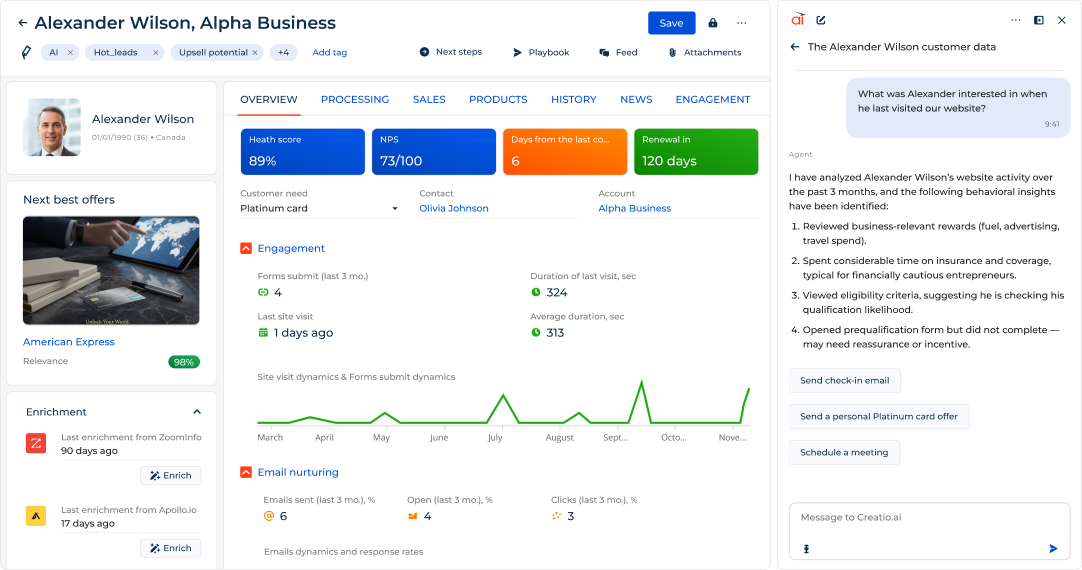
Example of B2B software for sales - Creatio Sales
Who Should Use B2B Sales Software?
In complex B2B sales, closing a deal rarely depends on one person. It requires coordination, visibility, and consistent execution across multiple roles. B2B sales software is built to support that reality — bringing structure to long sales cycles and aligning the teams responsible for driving revenue forward.
The primary users include:
- Sales Representatives and Account Executives – to manage pipelines, track stakeholder interactions, and close deals with greater structure and visibility.
- Sales Leaders (CROs, VPs of Sales) – to monitor pipeline health, improve forecast accuracy, and drive consistent revenue performance.
- Revenue Operations / Sales Operations – to standardize processes, maintain data integrity, and optimize reporting and automation.
Beyond sales, several other roles regularly use B2B sales tools to foster growth:
- Marketing Teams – to ensure qualified leads are smoothly routed to sales, align campaigns with sales performance, and measure marketing ROI.
- Customer Success / Account Management – to access full company data, track contract details, monitor renewals, and manage expansion opportunities.
- Finance Teams – to review deal terms, validate pricing, monitor revenue projections, and align forecasts with financial planning.
B2B software for sales connects multiple business teams within a unified platform, accelerating growth across the entire customer lifecycle.
Key Features to Look for in B2B Sales Software
Every B2B organization operates with its own sales model, structure, and priorities. However, certain platform capabilities consistently deliver value across industries, products, and market segments. Here are the features that define efficient B2B sales systems:
- Customer Relationship Management (CRM) Capabilities: Involves managing accounts, contacts, opportunities, and account hierarchies within a unified system. According to Nucleus Research, organizations that switched to Creatio CRM system report 17% reduction in manual data entry for sales teams.
- Opportunity & Pipeline Management: Tracks deal stages, revenue value, probabilities, and pipeline health while maintaining structured sales workflows.
- Sales Engagement Tools: For efficient outreach, follow-ups, multichannel communication tracking, and guided selling.
- Revenue Analytics & Forecasting: To get real-time visibility on pipeline performance, quota tracking, and reliable revenue projections.
- Sales Intelligence & Automation: Accelerates routine sales workflows with AI and autonomous agents, prioritizes high-impact deals, tracks opportunities, and provides next best actions recommendations for each B2B customer.
- CPQ & Deal Governance: Configures pricing, generates personalized sales quotes, manages discount approvals, and protects margins on complex B2B contracts.
- Collaboration & Cross-Team Alignment: One platform to connect sales with marketing, finance, service, and other business teams through shared data and coordinated workflows. In particular, Forrester highlights that nearly 65% of sales content is not utilized due to irrelevance,
- Seamless Integrations with Other Systems: Connects with the core business tools and platforms, such as ERP, marketing automation, customer service, and financial systems via APIs and native integrations.
- Enterprise-Grade Security & Compliance: Ensures role-based access, audit trails, data protection, and enterprise-grade governance.
Top 11 B2B Sales Software to Power Your Revenue in 2026
If you’re looking for the best B2B sales software, we’ve got you covered. Below is a detailed review of the top platforms that can strengthen your sales workflows and drive sustainable revenue growth.
B2B Sales Platform | Best for | Main Strength |
| Creatio Sales | Midsize to enterprise B2B sales teams that want to automate workflows and scale sales productivity | End-to-end sales workflow automation, powered by no-code customization and AI sales agents |
| Salesforce Sales Cloud | Large enterprises with complex global sales operations | Deep customization and extensive third-party ecosystem |
| HubSpot Sales Hub | Growing B2B teams focused on inbound sales and marketing alignment | Ease of use and strong integration with other HubSpot products |
| Pipedrive | Small to mid-sized teams seeking a simple CRM and pipeline visibility platform | Visual dashboards and easy-to-use deal tracking |
| Salesoft | Teams focused on outbound and multi-channel engagement | Unifies disconnected sales tools across the entire buyer-seller journey into one system |
| Zoho CRM | Sales experts looking for a cost-effective software with basic CRM functionality | Core CRM functionality with a broad range of integrations |
| Reply.io | Sales teams looking for AI-powered multichannel outreach and automated prospecting | Multichannel outreach and automated prospectingMultichannel sequences, AI SDR agents, and built-in email deliverability tools |
| Gong | Growing teams looking for AI-powered revenue intelligence capabilities | Revenue optimization and sales analytics |
| Monday CRM | Sales teams looking for a flexible workflow platform | Highly customizable pipeline and task management |
| Seismic | Revenue teams that prioritize sales enablement | Sales training, coaching and performance analytics |
| Apollo.io | Small to midsize B2B teams looking for sales engagement and automation | Prospecting, outreach and deal management automation |
1. Creatio Sales
Creatio Sales is a best-in-class B2B sales platform that empowers midsize to enterprise organizations orchestrate and automate the entire sales pipeline with no-code and AI. By natively combining sales CRM, workflow automation, and agentic AI capabilities within a single platform, Creatio is a go-to software for supporting complex, multi-stage sales processes.
A key advantage of Creatio Sales is that its embedded AI capabilities are included across all pricing tiers. This enables users to integrate sales intelligence in daily workflows and realize value immediately. For example, Creatio’s built-in AI agents for sales support tasks such as quote generation, upselling and cross-selling recommendations, and forecasting insights — helping reps reduce manual work, improve win rates, and close more deals without adding headcount.
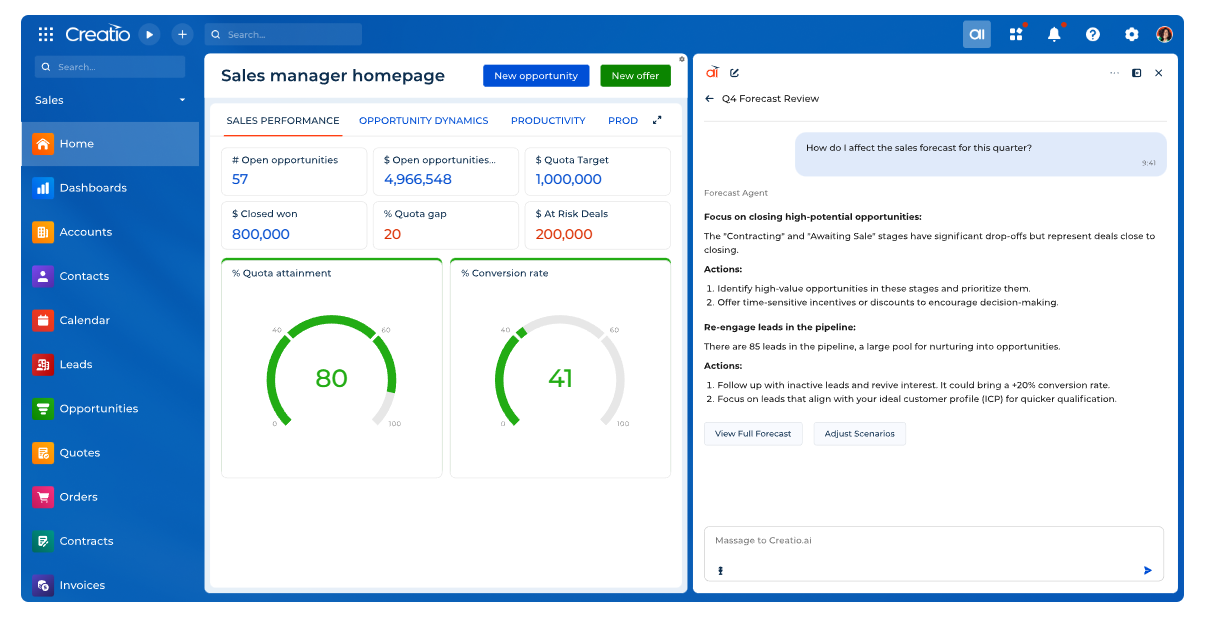
Unlike traditional sales platforms that require significant developer involvement, Creatio enables business users to adapt workflows, automation logic, and AI agents for sales through visual no-code tools and natural language instructions. This approach helps reduce total cost of ownership and accelerate time to value.
According to independent research by Nucleus Research, organizations that switched to Creatio reported a 61% reduction in lead response time and a 17% reduction in manual data entry for sales teams, which highlights measurable improvements in execution speed and operational efficiency.
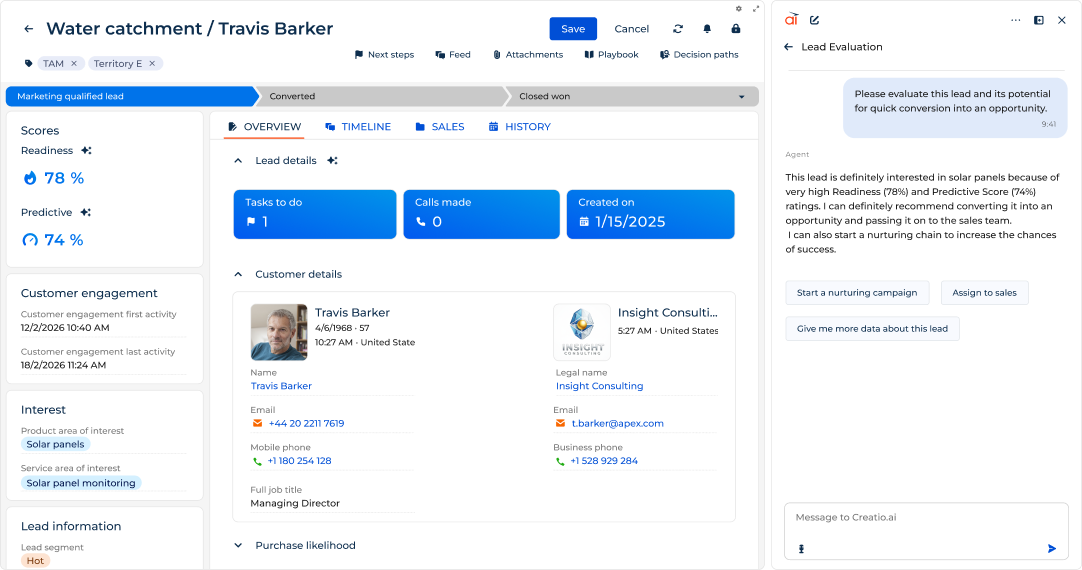
Creatio Sales can be deployed as a standalone solution or as part of Creatio’s broader CRM ecosystem, alongside Creatio Marketing and Creatio Service. This unified architecture helps organizations align sales, marketing, and service processes while maintaining shared data governance and operational consistency across departments.
Creatio has been recognized by leading industry analysts, including Gartner and Forrester. Creatio Sales was positioned as a Visionary in the 2025 Gartner® Magic Quadrant™ for Sales Force Automation Platforms, reflecting industry recognition of its forward-looking approach built for enterprise agility, scalability, and speed.
Key Features:
- Customer 360 view with centralized account, contact, opportunity, order, and contract management
- Powerful pipeline management capabilities to autonomously identify, qualify, and nurture new opportunities
- End-to-end sales automation, including guided selling, approvals, task routing, and sales forecasting
- Ready-to-use AI sales agents supporting core workflows for B2B sales, such as account research, opportunity prioritization, quote generation, meeting preparation, order management and CRM data updates
- AI-assisted no-code process design, enabling business users to configure workflows, applications, and AI agents without developer involvement
- Creatio.ai embedded into productivity tools such as Microsoft Outlook and Teams to provide AI-powered insights across every touchpoint
- Preconfigured industry solutions for 20+ sectors to accelerate implementation
Considerations:
- Advanced customization may require onboarding for teams new to no-code platforms.
Creatio Sales Pricing:
Creatio offers a composable pricing model that allows organizations to pay for the specific products and capabilities they require. Pricing for Creatio’s AI-native platform starts at $40 per user/month, while Creatio Sales, as well as Creatio Marketing and Creatio Service, can be added as standalone modules starting at $15 per user/month each. This enables B2B organizations to build a unified AI CRM system that meets their needs.

2. Salesforce Sales Cloud
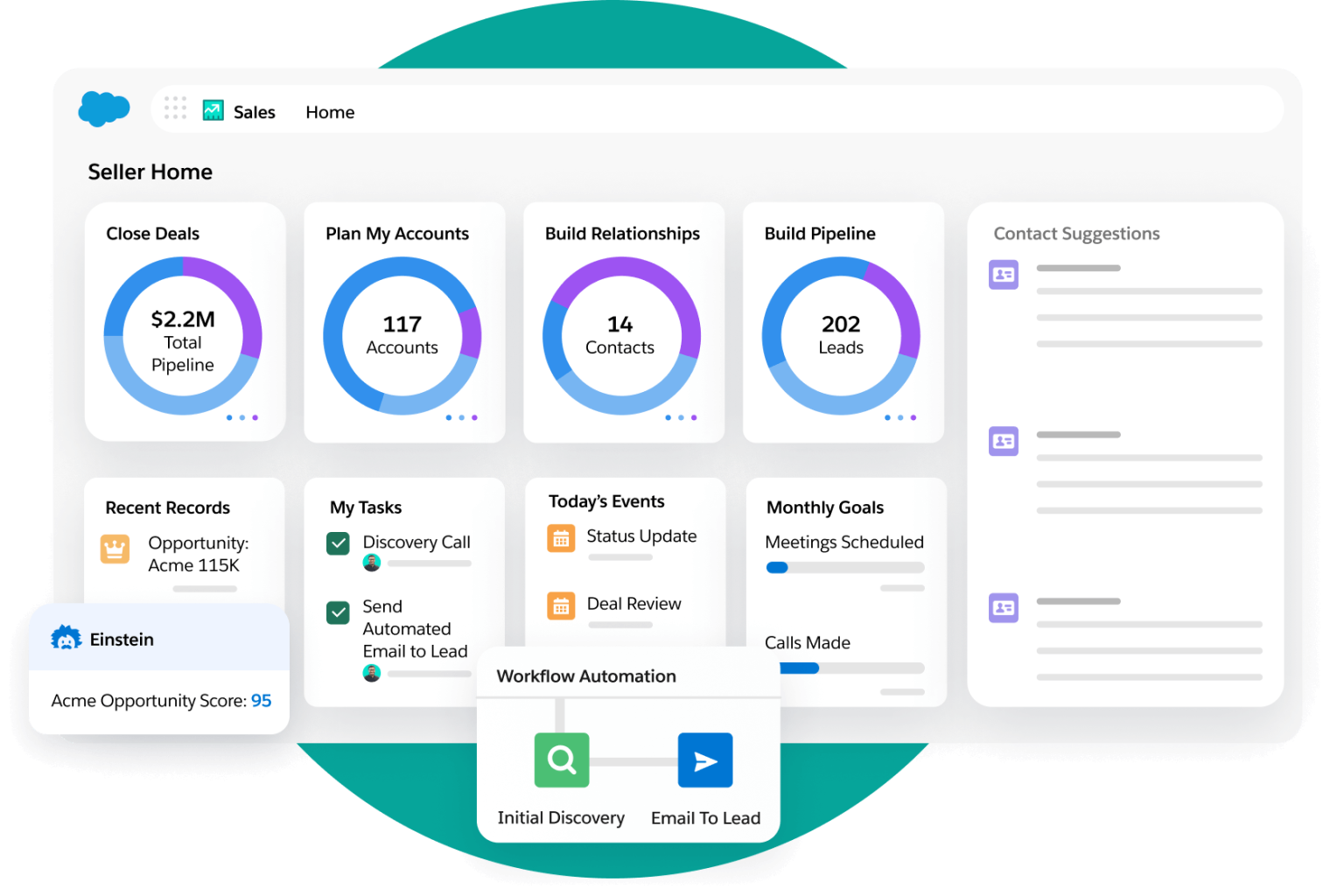
Salesforce Sales Cloud is a comprehensive sales platform designed to support complex B2B sales environments. It combines CRM system with pipeline management, forecasting, and workflow automation to help organizations coordinate multi-stage deals and structured sales workflows. Salesforce’s built-in AI capabilities (Einstein) provide predictive scoring, trend analysis, and recommendations to help teams prioritize opportunities and reduce manual work. Overall, Salesforce features a complete, unified environment where every stage of the deal is traceable and configurable.
Key Features:
- End-to-end deal management, from lead capture and qualification to opportunity tracking, quoting, approvals, and closing
- Customizable workflows, fields, approval processes, and pipeline stages
- Built-in AI (Einstein) for predictive scoring, recommendations, and trend insights
- 360-degree account and customer visibility within a centralized CRM
- Extensive third-party integrations to support a broader enterprise technology stack
Considerations:
- Higher entry cost for mid-sized teams, especially when advanced features and AI capabilities are required
- The platform’s depth and breadth can be overwhelming for smaller teams or businesses without enterprise-level requirements.
- Extensive customization options often come with a steep learning curve, particularly for non-technical users.
- Ongoing configuration and updates may require dedicated administrativeor developer support
Salesforce Sales Cloud Pricing:
Salesforce Sales Cloud offers multiple subscription tiers based on organizational size and feature requirements. Enterprise-level paid plans start from $175 to $550 per user per month, with higher tiers providing expanded customization, advanced automation, and AI-powered capabilities.
See also: Salesforce Alternatives & Competitors and Salesforce Marketing Cloud Alternatives & Competitors
3. HubSpot Sales Hub
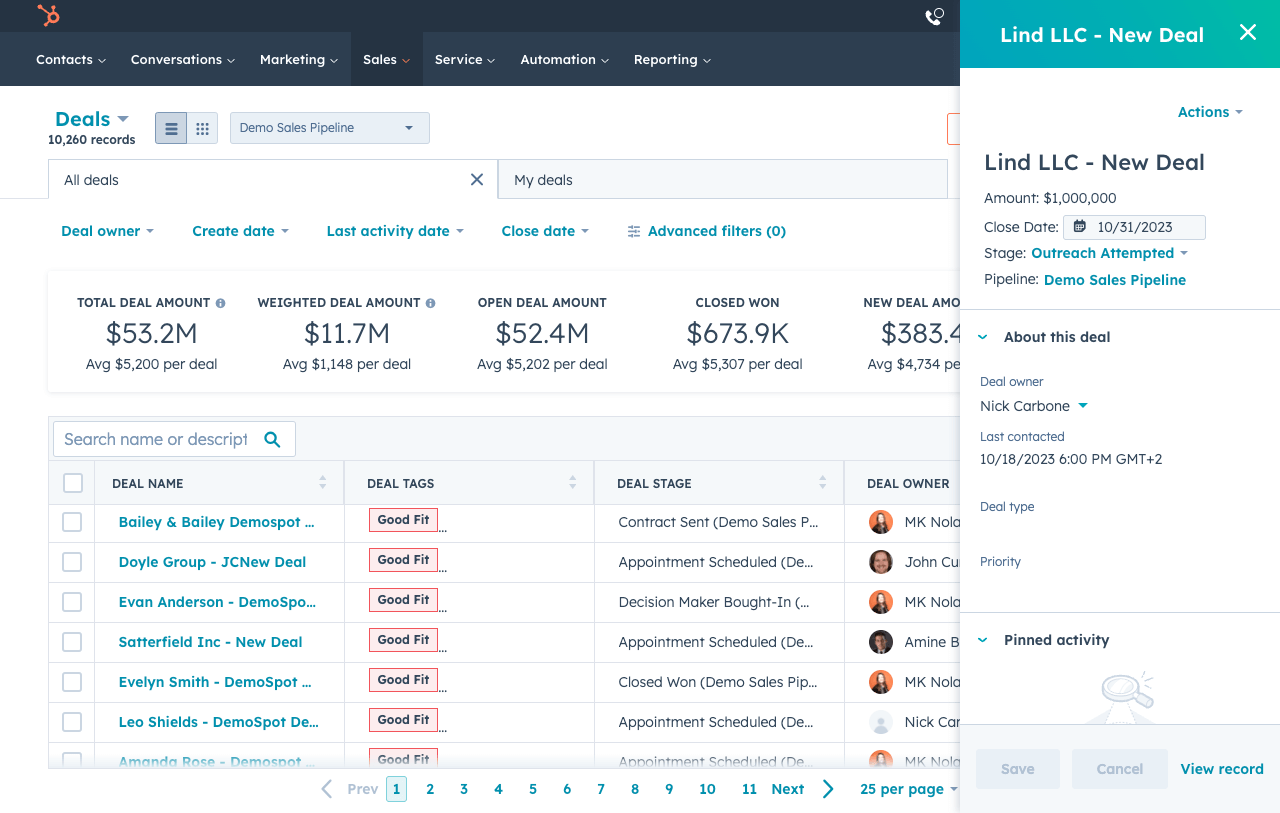
HubSpot Sales Hub is the sales-focused product of the broader HubSpot Smart CRM system. Its major advantage as a sales solution is the ease of use and its seamless, native integration with HubSpot’s Marketing, Service, Data, and other business products. It is best suited for sales teams from startups and growing B2B companies that are deeply interested in inbound sales and need a sales solution that effectively aligns their marketing and sales teams.
Key Features:
- Intuitive interface designed for quick adoption and minimal training
- Native integration with HubSpot product hubs with the shared CRM data
- AI-powered tools for email drafting, lead scoring, and conversation insights
- Built-in functionalities to automate follow-ups, task assignments, and lead routing
- Real-time pipeline tracking and performance dashboards
Considerations:
- May feel limited for organizations managing highly complex or multi-layered enterprise sales operations
- Customization options and data structures are less flexible compared to other enterprise-grade CRM systems
HubSpot Sales Hub Pricing:
Pricing for HubSpot Sales Hub scales based on features and team size. For midsize and enterprise companies, the plans start at $100 per user/month (Professional plan) and from $150 per user/month within the Enterprise plan.
See also: Top 10 HubSpot Alternatives & Competitors
4. Pipedrive
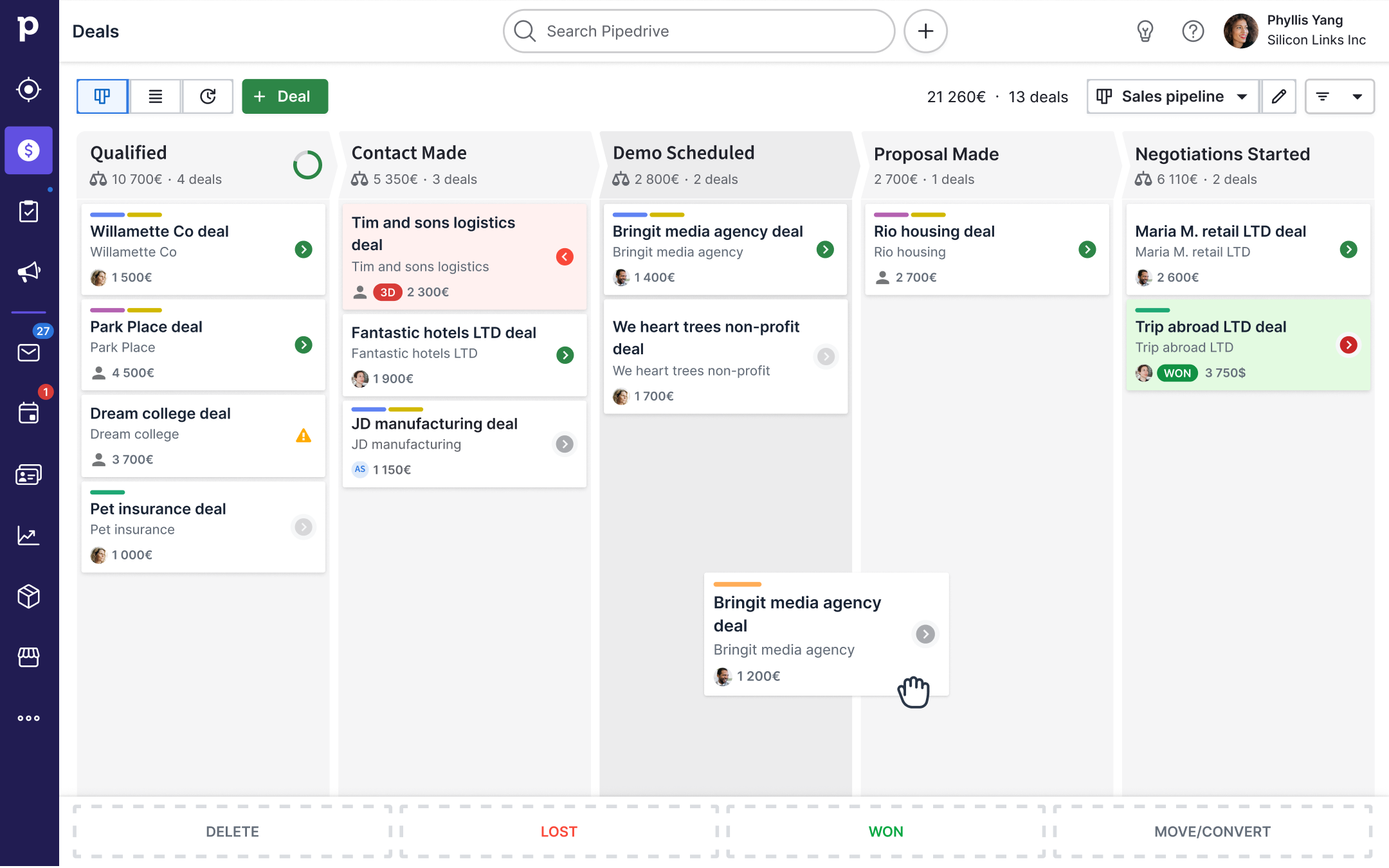
Pipedrive is a sales-focused CRM that provides robust pipeline visualization capabilities to help reps track and manage deals with clarity. The platform is known for its simplicity and usability, allowing sales reps to track deal stages, log activities, and prioritize next steps to win more deals. Pipedrive is focused on delivering a streamlined experience for lead management and revenue forecasting. It is commonly adopted by small and mid-sized B2B companies looking for a fast-to-deploy, easy-to-manage CRM.
Key Features:
- Drag-and-drop pipeline view to help sales reps effectively track the deals across every stage
- Lead capture tools, including web forms, chatbots, and a centralized lead inbox to ensure a steady flow of potential customers into the pipeline
- Customizable pipelines and data fields to power up sales processes
- Email syncing, activity tracking, and contact management
- Integrations with third-party sales and productivity tools
Considerations:
- Not designed for complex enterprise sales workflows
- Limited native marketing functionality; may require external tools and integration for marketing campaigns
- Analytics and forecasting capabilities are pretty basic, might not fit for B2B enterprise needs
- Scalability limitations for very large teams
Pipedrive Pricing:
Pipedrive’s paid plans typically start at approximately $14 per user per month for the Lite tier, increasing to around $39 (Growth), $59 (Premium), and $79 (Ultimate) per user per month. For B2B companies, higher tiers are recommended to unlock advanced automation, reporting, and support features.
5. Salesloft
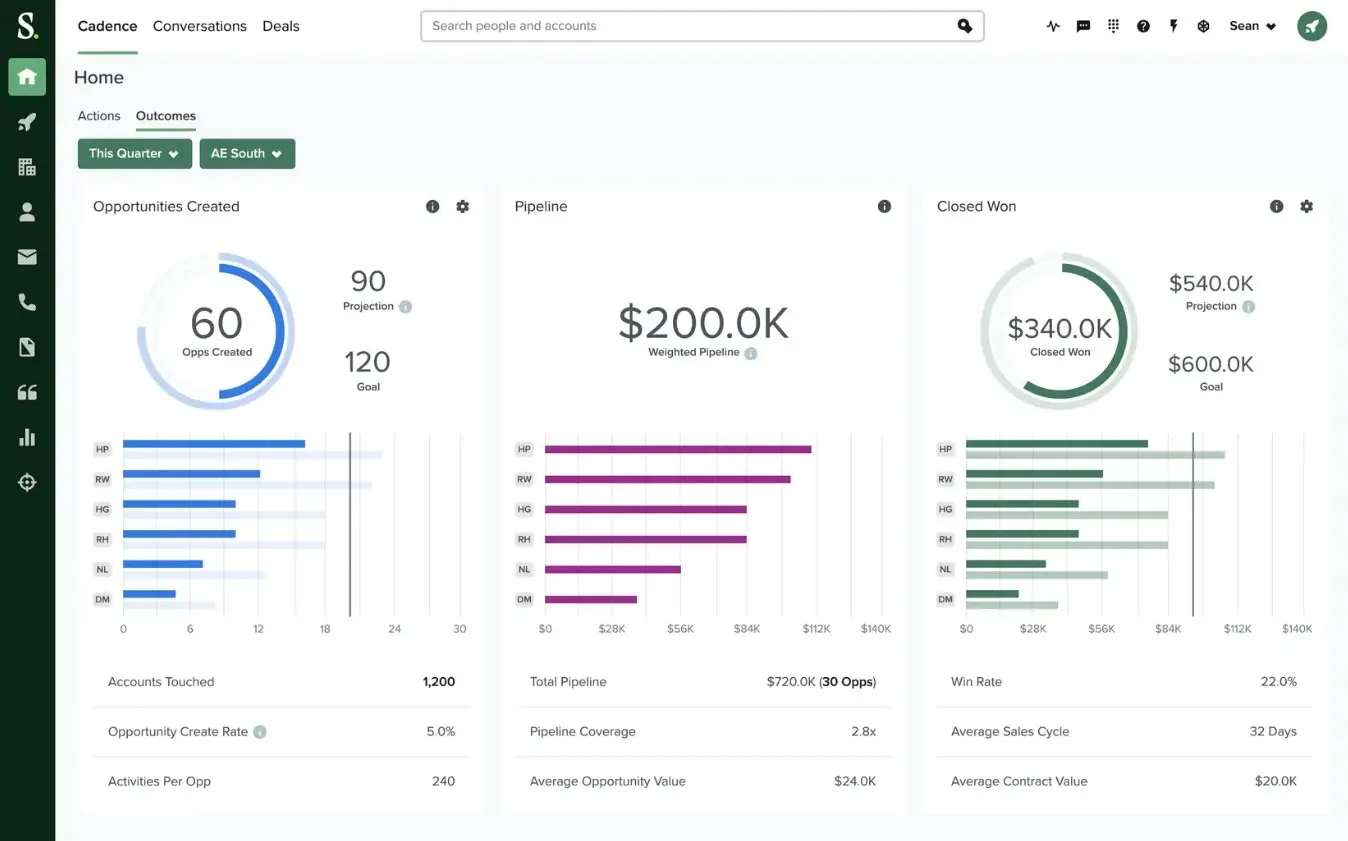
Salesloft is a sales engagement and revenue orchestration platform designed to help business teams manage outbound outreach and improve execution across the sales funnel. It works alongside existing CRM and sales tools to structure multi-channel engagement, automate manual tasks, and provide visibility into rep activity and deal progress. Its AI-powered insights and conversation intelligence tools empower teams to timely spot high-value opportunities and refine outreach strategies to improve win rates. Salesloft is commonly adopted by growing and enterprise sales organizations focused on scaling outbound performance and buyer engagement to drive revenue growth.
Key Features:
- Multi-channel cadence automation across email, phone, and social outreach
- Native integrations with CRM and other sales systems
- Engagement tracking tools to manage pipeline and deal activity
- Conversation intelligence, including call recording, transcription, and analysis
- Performance dashboards tracking rep activity and engagement metrics
Considerations:
- Not a full CRM; requires integration with a separate platform for comprehensive account and pipeline management
- The initial setup and ongoing optimization may require dedicated RevOps support or technical expertise
- Feature depth can increase overall sales tech stack complexity
Salesloft Pricing:
Salesloft’s pricing is not publicly disclosed and is available only upon request.
6. Zoho CRM
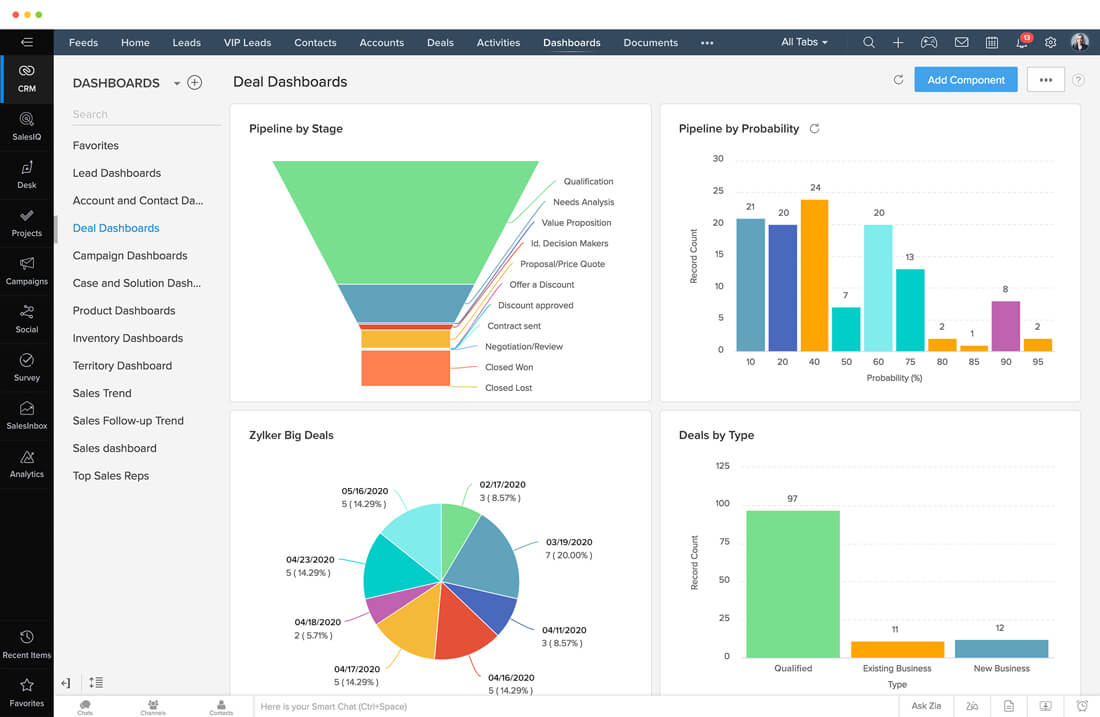
Zoho is a popular customer relationship management software that allows B2B teams capture leads, manage contacts, and close deals more efficiently. The platform provides a broad range of lead management and sales tools, yet is easy to configure, which makes it a go-to solution for small and mid-sized businesses. Its intuitive interface, visual pipeline, and AI automation capabilities make it possible for teams to save time and focus on closing deals rather than carrying out repetitive admin tasks. The platform also allows sales managers to customize the existing sales tech stack to match the unique processes of their team or industry.
Key Features:
- Multi-channel lead capture and centralized contact management
- AI assistant (Zia) providing lead scoring, predictive insights, trend analysis, and data quality recommendations
- Customizable workflows, dashboards, modules, and fields
- Integration with Zoho applications and external business systems
- Mobile application for on-the-go deal and activity management
Considerations:
- May require an initial setup and user training, especially if you are setting up complex workflows or migrating from another system
- Advanced customization can introduce complexity for smaller teams
Zoho CRM pricing:
Zoho’s paid plans typically start at approximately $20 per user per month (Standard tier) offering standard set of sales tools. Large B2B teams might require Professional ($35 per user/month), Enterprise ($50), or Ultimate ($65) to access advanced automation, analytics and AI capabilities.
See also: Top 10 Zoho CRM Alternatives and Competitors
7. Reply.io
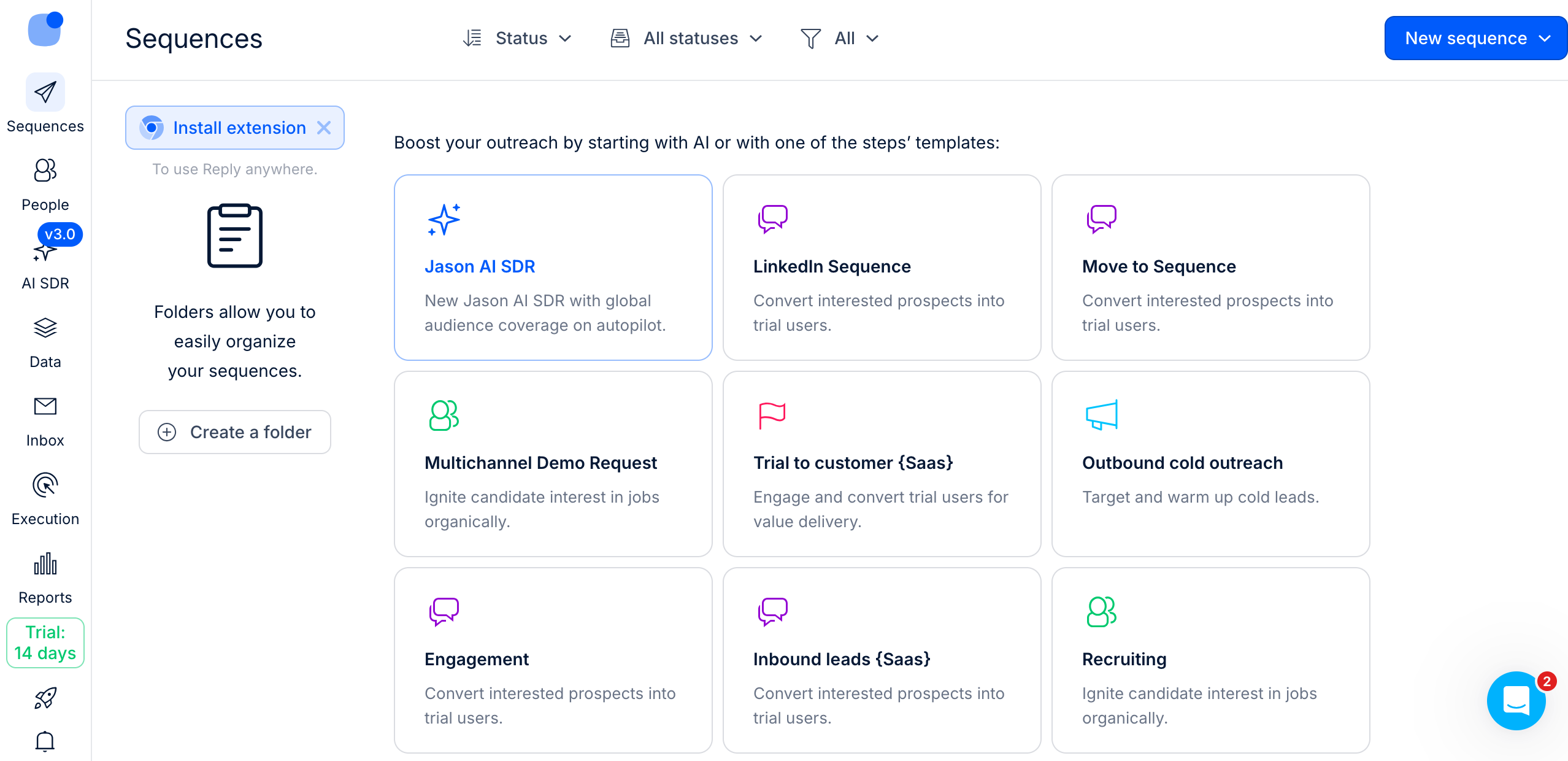
Reply.io helps sales teams book more meetings with less effort using AI-powered, multichannel outreach. You get live B2B data, multichannel sequences, AI personalization, solid email infrastructure, and analytics all under one roof. It's one of the best LinkedIn outreach tools for teams that want email, LinkedIn, calls, and SMS running from a single place - without juggling multiple apps.
Key Features:
- AI SDR Agent that learns your product, finds ideal prospects, personalizes messages, engages across channels, and books meetings
- 1B+ verified B2B contacts built right into the platform, so no need for extra tools
- Multichannel sequences with email, LinkedIn, SMS, WhatsApp, calls, and more — all automated, all in one place
- Email Deliverability Suite with inbox warm-up, SPF/DKIM/DMARC checks, and custom tracking domains
Considerations:
- The interface can feel overwhelming for new users since there are so many features packed in
- The per-seat pricing model compounds quickly for growing teams — adding your 6th SDR costs the same as your 1st
- If you only need basic cold email, simpler and cheaper tools may be a better fit
- Automated messaging can feel impersonal or off-brand without careful oversight
Reply.io Pricing:
Reply.io offers a free plan with an AI sequence generator and 200 data credits. Paid plans start at $49/user/month for email automation, stepping up to $89/user/month for full multichannel automation including LinkedIn, calls, and SMS. AI SDR plans start at $800/month for teams that want hands-off, automated prospecting and outreach.
8. Gong
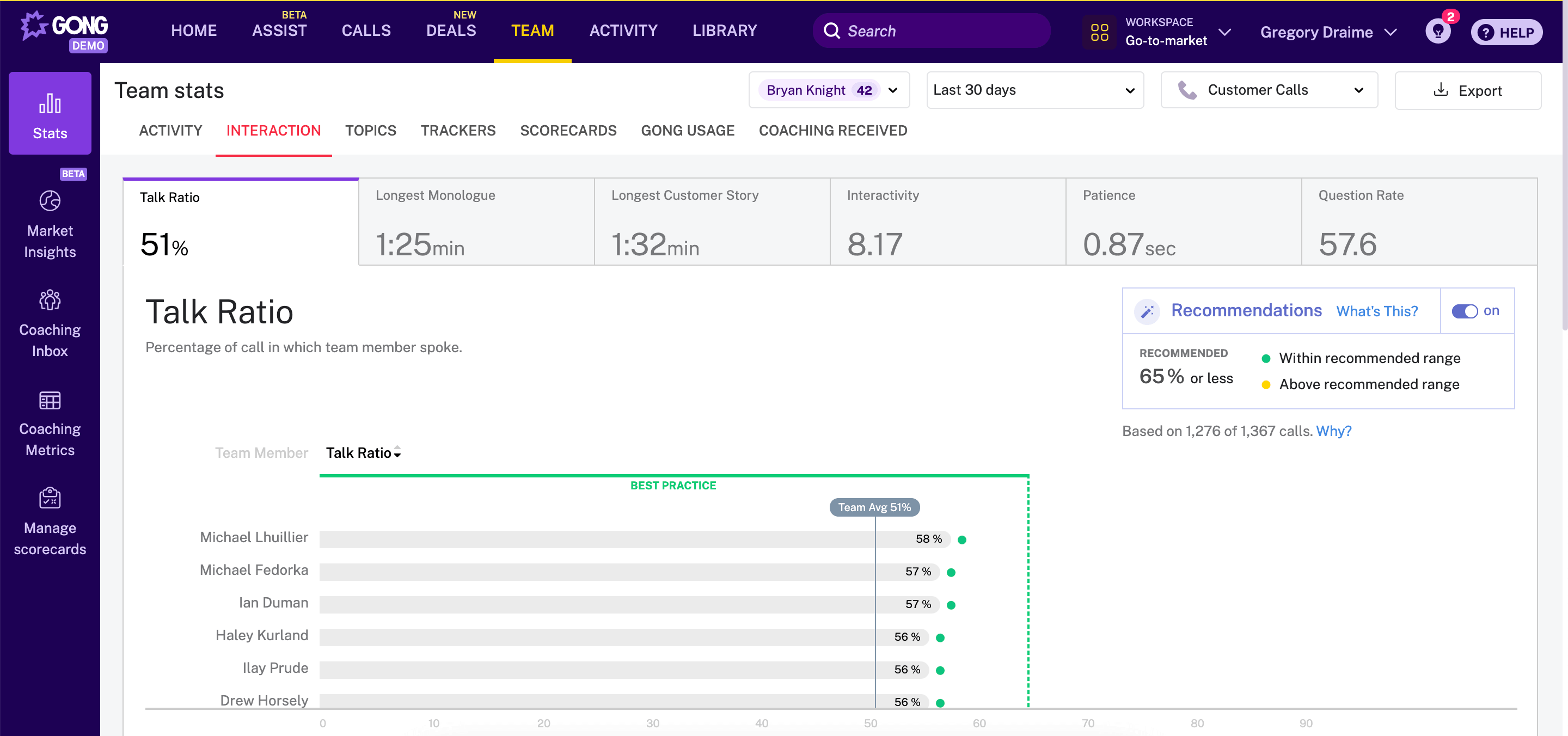
Gong is a revenue intelligence platform designed to help sales professionals improve performance through conversation and deal analytics. Its built-in sales intelligence tools capture and analyze sales calls, meetings, and emails to surface real-time insights about buyer behavior, deal risk, and rep effectiveness. Unlike the platforms focused on managing sales pipelines, Gong provides visibility into what is happening inside deals, helping sales leaders forecast more accurately and refine execution. It is particularly useful for identifying risk signals, coaching opportunities, and win/loss patterns.
Key Features:
- AI-powered sales-conversation recording and transcription
- Conversation and deal-risk analytics
- Coaching tools that allow managers to train reps based on real sales conversations
- Pipeline and forecasting visibility based on engagement signals
- Performance analytics across reps, teams, and sales workflows
Considerations:
- Better fits as a sales enablement tool, and does not replace a CRM or full sales execution platform
- Primarily provides post-call analysis, and not real-time guidance during conversations
- Implementation requires integration with CRM, calendar, and communication tools, which may involve technical setup and take several weeks to adopt
Gong Pricing:
Gong’s pricing is available upon request. Its pricing model typically depends on team size and feature requirements.
9. Monday CRM
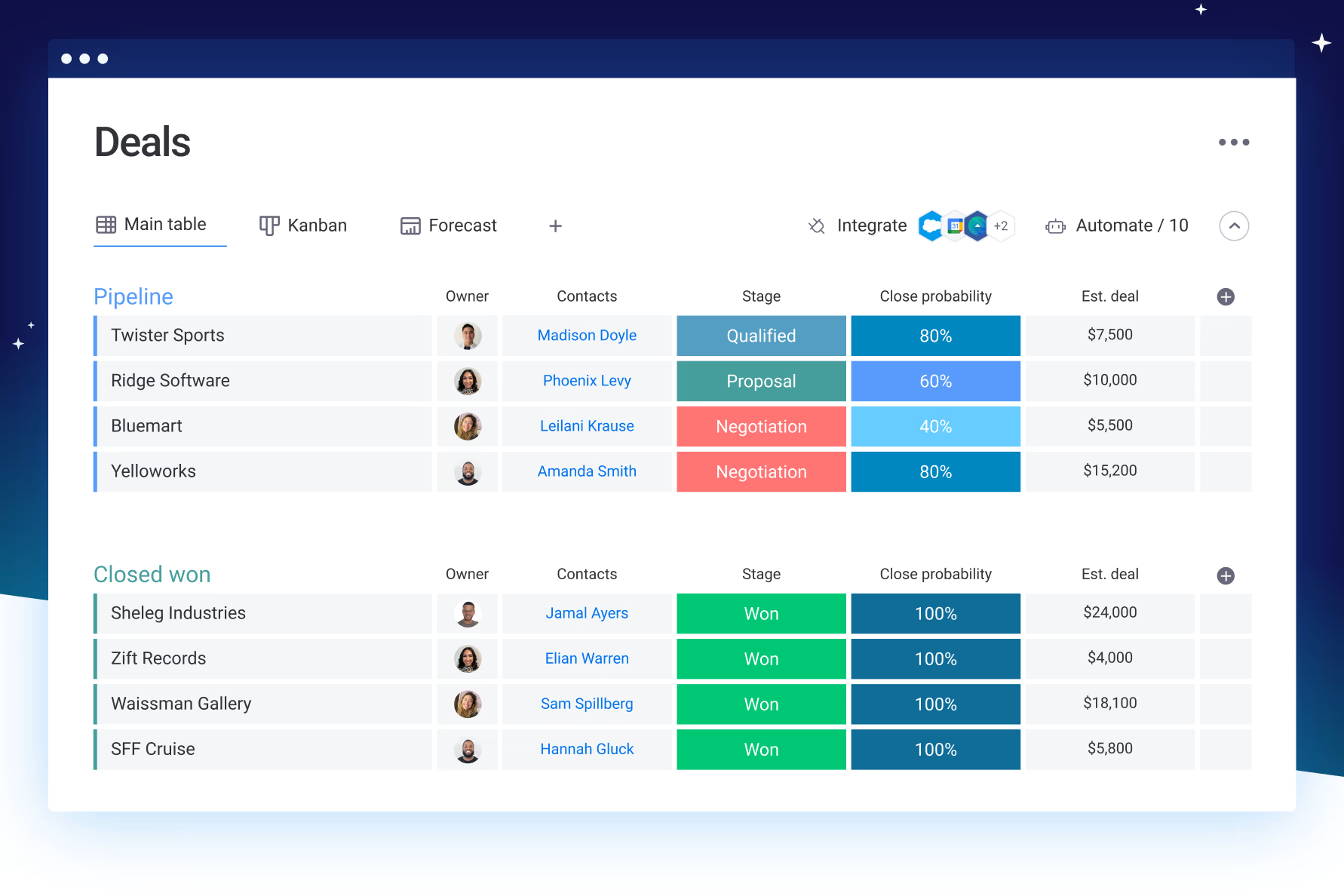
Monday CRM is a flexible, cloud-based sales management platform built on Monday.com’s broader work operating system. It enables B2B teams to effectively manage leads, contacts, deals, and pipelines within a customizable workspace. The platform provides multiple automation tools, but its key feature is the ability to configure workflows, boards, and processes to match the needs of sales and marketing teams. Monday CRM is commonly adopted by growing B2B companies seeking flexibility, ease of setup, and adaptable workflow design without the heavy technical complexity.
Key Features:
- Customizable pipelines, boards, and data structures to match specific sales processes
- Workflow automation for repetitive tasks such as lead routing, status updates, notifications, and data management
- Two-way email integration, activity logging, and AI-powered email drafting (available in selected plans)
- Real-time dashboards consolidating pipeline health, deal values, and team performance
- Mobile access for managing deals and activities on the go
Considerations:
- Setting up the pipelines, automation, and workflows can present a learning curve for non-technical users
- Advanced features like sales forecasting are locked under high-tier plans, which could limit the ROI (Return on Investment ) for growing teams
Monday CRM Pricing:
Monday CRM offers tiered per-user pricing, with the basic plans starting at $9 per user per month. Pro plans, often used by growing teams, start at around $19 per user per month, and Enterprise pricing is available upon request.
10. Seismic
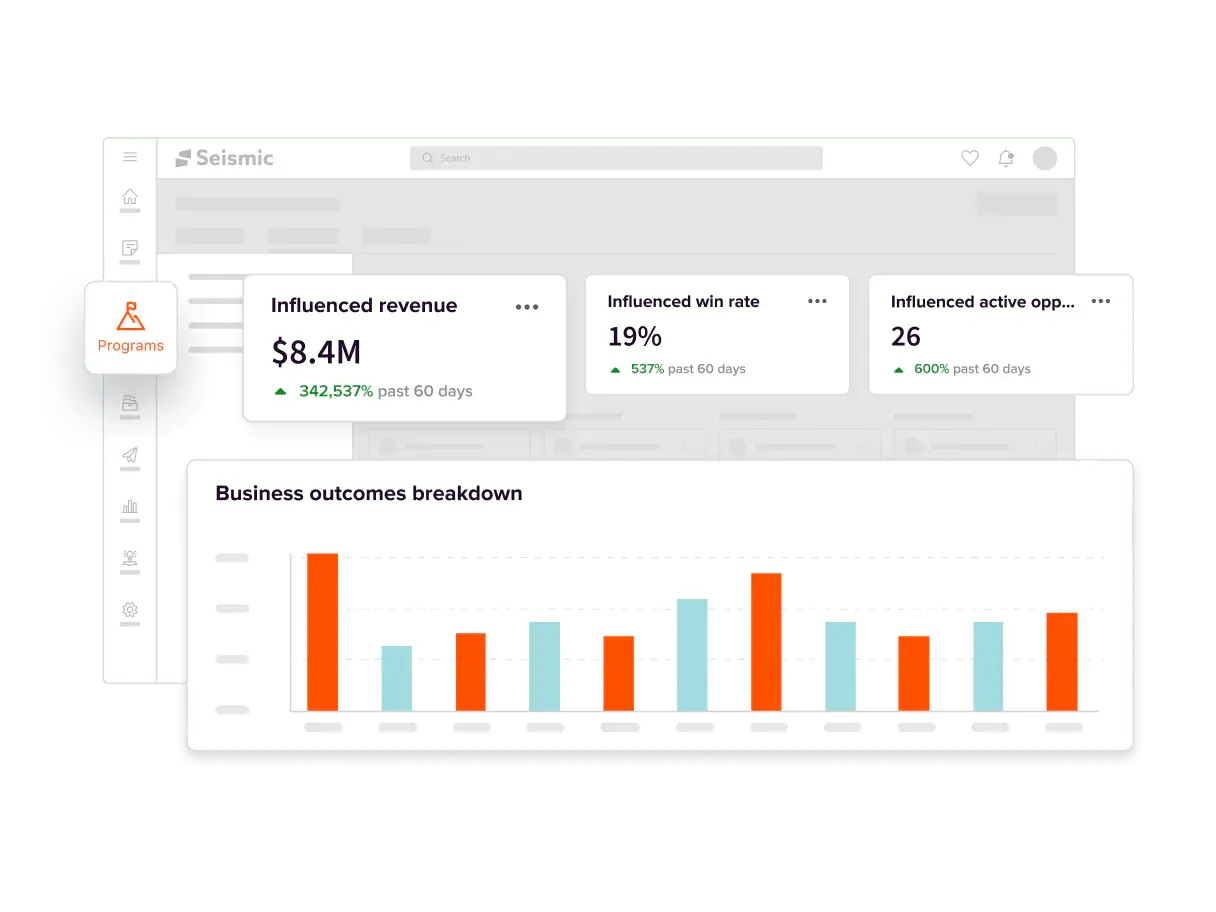
Seismic is a sales enablement platform designed to help sales and customer-facing teams deliver the right content at the right stage of the buyer journey. Rather than functioning as a CRM, Seismic focuses on content management, training, and performance analytics to improve how sales reps engage prospects. Seismic integrates with existing CRM and B2B sales tools to support deal cycles with the relevant content, coaching, and engagement options. It is commonly adopted by mid-market and enterprise organizations that want to improve alignment between sales, marketing, and enablement teams.
Key Features:
- AI-powered content recommendations through Seismic Aura, suggesting relevant materials based on deal stage, persona, or industry
- Content management and governance tools to centralize sales collateral
- Scalable onboarding and ongoing training with role-based learning paths
- Integration with CRM and sales platforms to embed enablement into daily workflows
- Reporting dashboards tracking content usage, buyer engagement, and training effectiveness
Considerations:
- Not a unified sales platform, but rather a solid amplification solution for such
- Requires structured content management and internal discipline to realize full value
- May require dedicated enablement or operations support for optimal implementation
- Not designed to manage contacts, pipelines, or CRM data
Seismic Pricing:
Seismic’s pricing is not publicly disclosed and is available only upon request.
11. Apollo.io
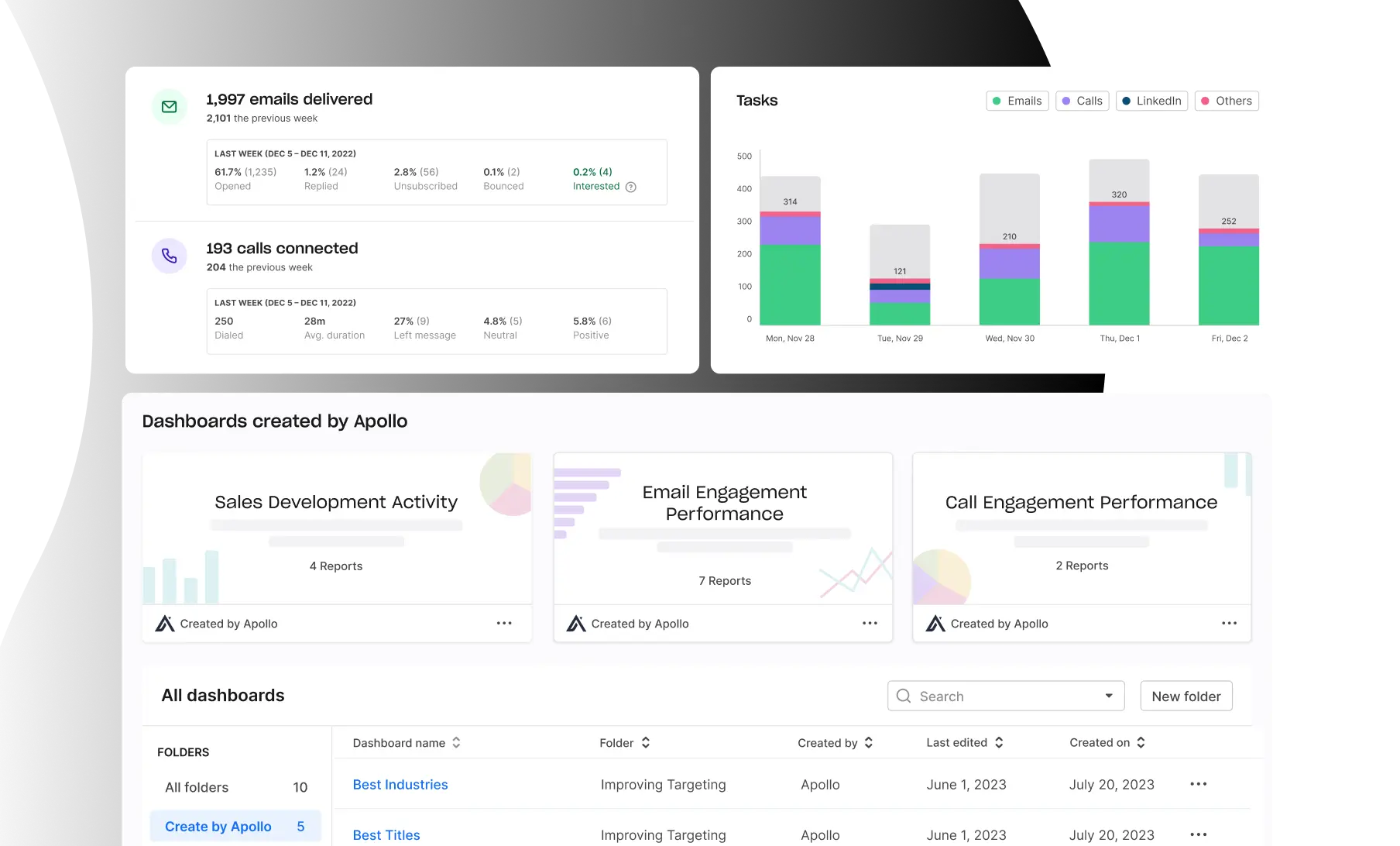
Apollo.io is a unified B2B sales engagement and lead generation platform that helps sales teams to identify potential buyers and run outbound campaigns from a single platform. It combines a large B2B contact database with outreach automation tools, allowing sales reps to source leads, enrich data, and engage prospects without switching between multiple systems. The platform focuses heavily on outbound sales workflows and pipeline generation rather than full-cycle CRM management.
Key Features:
- Access to a large B2B contact and company database for prospect discovery
- Advanced filtering by industry, company size, seniority, geography, and job title
- Automated multi-channel outreach campaigns for email, sales calls, and sequences
- Built-in dialing, calls logging, and call transcription tools
Considerations:
- Not designed to replace an end-to-end customer relationship management system to support sales pipelines or long-term account tracking
- May require onboarding time for teams new to outbound automation
- Less suitable for organizations primarily focused on inbound or relationship-driven sales models
Apollo Pricing:
Apollo.io pricing is based on the yearly credits that provide access to emails, phone numbers, and enriched data. The Professional plans start at $99 per user/month, with the limits of 4,000 credits per user for one year. The additional credits can be purchased as needed, starting at $25 per 1,000.
AI in B2B Sales: What to Expect in the Future?
The future of B2B sales is moving toward an era of autonomous, conversational, and human-in-the-loop workflows. To understand where the industry is headed, here are five key statistics that define the upcoming landscape:
1. Focus on AI-powered Sales Workflows
According to Gartner, by 2027, 95% of sellers’ research workflows will begin with AI. This marks a fundamental shift from manual data gathering to "agentic" systems that independently analyze data and surface insights before a seller even begins their work.
2. AI Agents Will Become a Strategic Business Priority
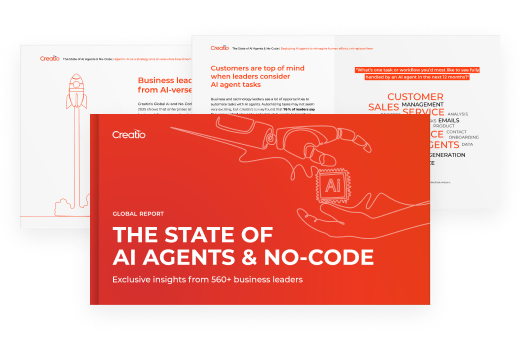
According to Creatio’s recent report “The State of AI Agents and No-Code”, 86% of C-level decision-makers believe AI agents will be vital to their strategic goals within the next two to three years. This top-down pressure is driving organizations to move from simply being "AI-versed" to becoming "AI-first".
3. AI as a Core Efficiency Driver in Sales
According to McKinsey research, AI sales tools can increase leads by more than 50%, reduce costs by up to 60%, and cut call time by up to 70%, resulting in significantly higher sales productivity and profitability. It’s no surprise that decision makers are already taking this into notice, with 67% already deploying AI agents, with sales (14%), marketing (13%), and service (12%) teams leading the way.
4. Conversational AI Advancing Sales Execution
Gartner also predicts that by 2028, 60% of B2B sales tasks will be executed through conversational interfaces. Instead of navigating complex traditional software, sellers will interact with their tools using natural language—text and voice—to manage their pipelines.
5. Human-Centered Selling Will Remain Critical
Despite the technological surge, the human element remains paramount in the upcoming years. By 2030, 75% of B2B buyers will prefer sales experiences that prioritize human interaction over AI. At the same time, AI will support execution and data analysis — but relationship-building, trust, and strategic guidance will remain human-driven.
Learn more about the proven tactics and use cases of AI in Sales.
How to Choose the Right B2B Platform for Sales
The right B2B software for sales is the one that can strengthen pipeline management, improve sales productivity, and adapt to the complex, evolving sales needs of your B2B organization.
Here are the key steps that can help in the decision process:
Step 1: Assess Your Sales Model
B2B sales environments can differ significantly: from fast transactional deals to long, complex enterprise cycles that take months to close. Before exploring the vendors, clearly define how your sales team sells, including stages, stakeholders, and approvals, and ensure the platform supports that structure end-to-end. Otherwise, it will create more friction instead of improving performance.
Step 2: Evaluate Scalability and Customization
As organizations evolve with new products, regions, teams, and more complex deal structures, you need to ensure that the B2B platform can scale as well. Choose the software that can seamlessly operate with the increasing pipeline volume, additional users, expanded reporting needs, and more advanced workflows over time.
At the same time, make sure that your B2B sales system allows for adapting processes, dashboards, and automation logic without heavy development or long IT cycles. For example, Creatio’s agentic sales platform allows adapting any business process without code, using natural language and visual no-code tools. This allows for reduced implementation timelines by 70% and cuts technology costs by 37%, according to Nucleus Research.Top of FormBottom of Form
Step 3: Consider Automation and AI Capabilities
B2B sales software should reduce manual effort and streamline execution across the entire sales cycle. Prioritize platforms that automate routine sales workflows with minimal human involvement, such as lead routing, follow-ups, approvals, quote generation, and data updates.
Beyond automation features, assess advanced capabilities such as autonomous AI agents that prioritize high-value opportunities, update CRM records, score leads, recommend next best actions, and forecast revenue. This will allow sales teams to focus on building stronger customer relationships and winning deals.
Step 4: Prioritize Reporting, Analytics, and Intelligence
The right platform should provide structured pipeline reporting, enforce deal qualification criteria, and deliver reliable forecast rollups by team, region, and product. AI-driven analytics can assist teams in surfacing gaps in pipeline coverage, flagging stalled or high-risk deals for the reps, and improving forecasting for sales leaders.
Step 5: Understand Platform’s Cost vs Value
Price alone is not the metric; revenue impact is. The selected platform should not only fit your budget and operational needs, but also drive measurable improvements in revenue growth and execution efficiency. This is what separates a real business investment from a recurring software expense.
Summary
B2B sales software is essential for organizations managing complex sales and revenue operations. By bringing structure to managing pipelines, workflows, and forecasting, it provides clear visibility into deal progression, reduces manual effort, and enables teams to focus on high-value opportunities and customer engagement that drive real business growth.
Creatio Sales is built for B2B organizations that need automation, adaptability, and sales enablement within a single platform. As an agentic no-code sales platform, it helps teams automate core processes, embed intelligence into daily workflows, and manage the full sales lifecycle — from prospecting to renewal — while adapting easily to evolving business needs.
Request a personalized demo of Creatio Sales to see how agentic automation can accelerate your revenue growth.
