



































































Sales CRM: A Comprehensive Guide & Best Sales CRM Software [Without the Hype]

Score, Track, and Win With Creatio Sales CRM

All your business decisions ultimately tie back to one metric: revenue. And with sales being a core driver of that revenue, it can’t afford gaps, guesswork, or inefficiency. Teams need structure, visibility, and a reliable way to manage every interaction that shapes a deal.
As selling becomes faster and more personalized, reps need a system that can unify customer data, streamline workflows, and automate routine tasks to keep deals moving. That’s where a sales CRM comes in, giving teams a shared environment to manage their pipeline end-to-end and maintain steady momentum.
In this guide, you’ll learn what a sales CRM is, how it strengthens sales performance, and what to look for in the right platform. You’ll also find an overview of leading sales CRM solutions to help you identify the solution that best aligns with your goals — without unnecessary hype or complexity.
Key Takeaways:
- A sales CRM is a system that helps sales teams manage customer relationships, track deals, and execute sales processes consistently across the entire sales cycle.
- The key benefits of CRM for sales include improved pipeline visibility, reduced manual work through automation, better decision-making, and more predictable revenue outcomes.
- Core sales CRM functionality is focused on centralizing customer data and streamlining processes. The key capabilities include contact and lead management, pipeline management, workflow automation, omnichannel communication, reporting, and built-in AI capabilities.
- Leading sales CRM platforms include Creatio Sales, Microsoft Dynamics 365, Salesforce CRM, HubSpot, and Zoho CRM.
What is CRM in Sales?
In sales, CRM (Customer Relationship Management) is the software used to manage all interactions with current and potential customers by organizing sales data, tracking pipeline activity, planning next steps, and streamlining day-to-day tasks to improve sales efficiency and close more deals. A strong sales CRM is not “just another tool”, it serves as the operational backbone that helps teams nurture leads, manage opportunities, and build consistent relationships throughout the entire sales pipeline.
Customer relationship management software for sales typically supports processes like:
- Organizing complex lead and customer data in a single system
- Automating outreach, follow-ups, and cross-team handoffs
- Highlighting promising opportunities and recommend next-best actions in real-time
- Maintaining clear pipeline stages for tracking deal progress across regions and teams
- Streamlining approval steps for pricing, proposals, and contract reviews
- Supporting consistent forecasting with AI-assisted insights and trend analysis
- …and many more
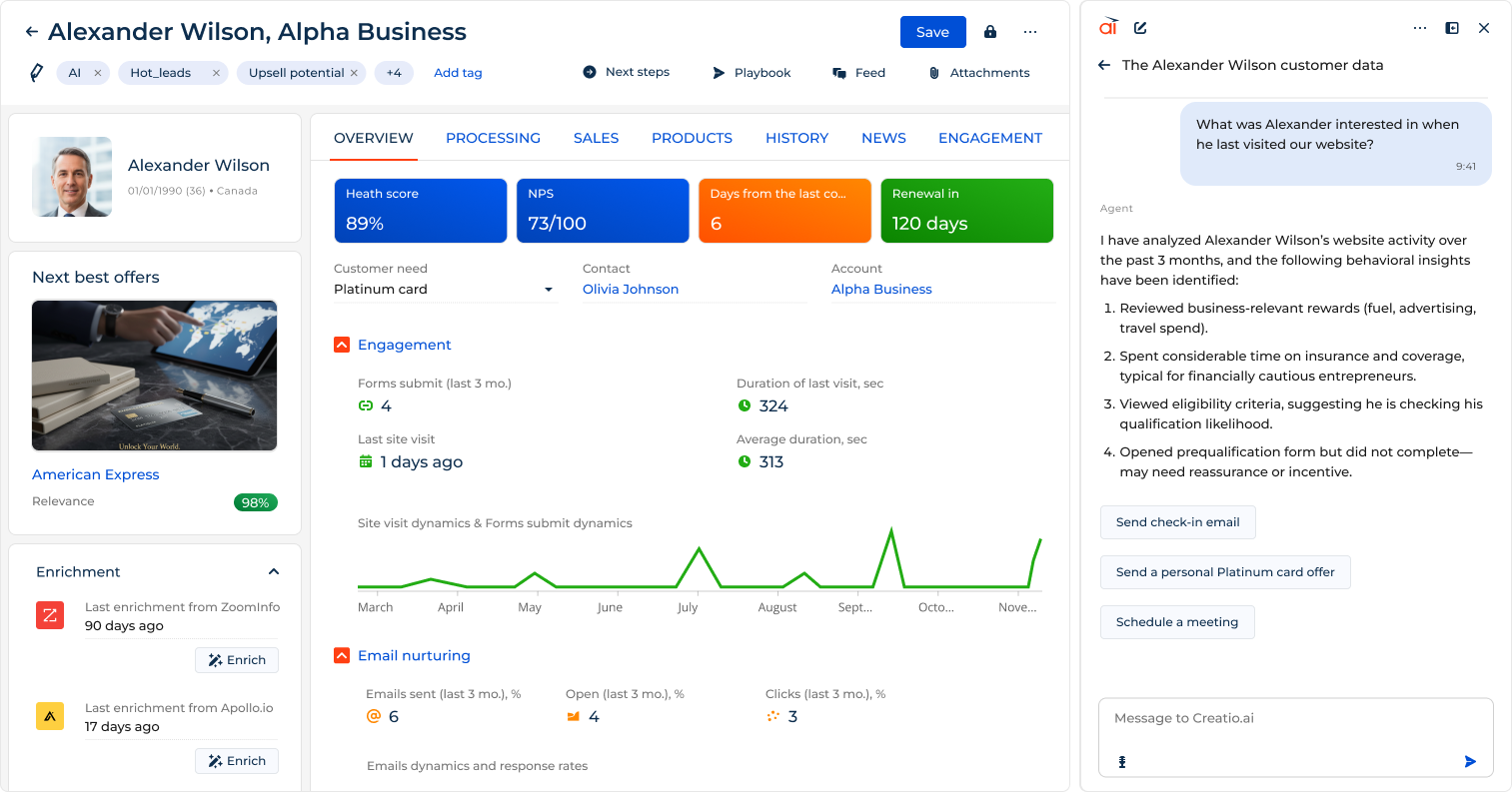
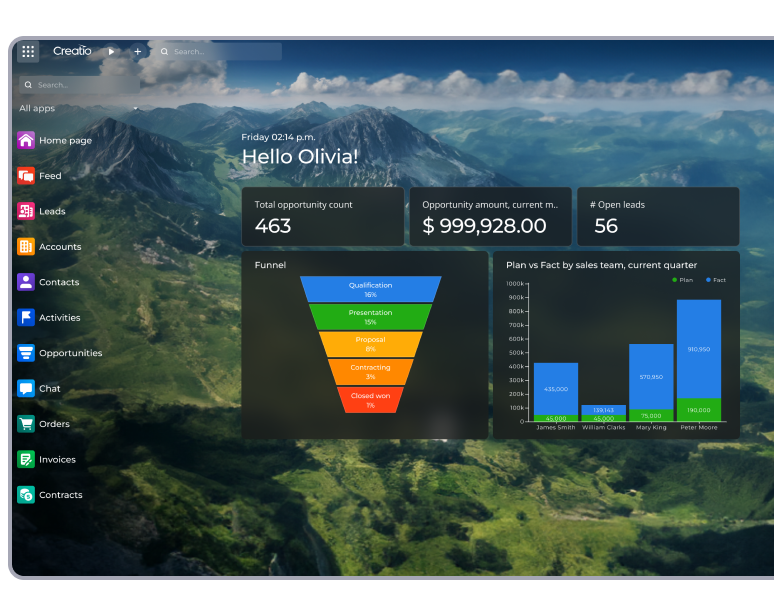
Customer Relationship Software for Sales: Example
Most Essential Features of Sales CRM Software
To maximize sales success, CRM software should combine core sales functionality, automation, collaboration, and centralized customer data to support consistent execution across the entire sales pipeline.
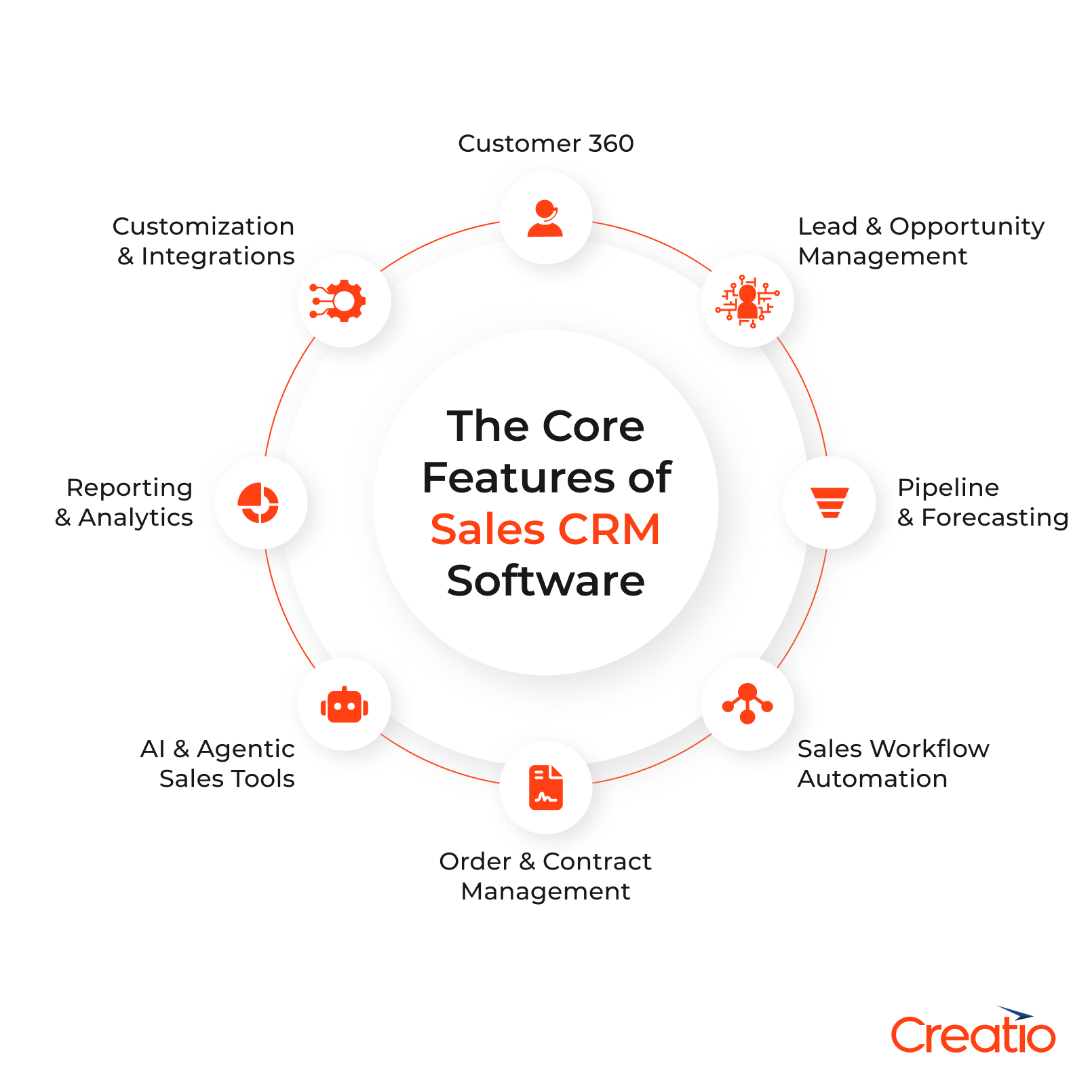
- Customer 360: A unified view of every lead, contact, and account—centralizing history, interactions, and key details so reps can quickly assess pipeline status, prepare for conversations, and share updates across teams.
- Lead & Opportunity Management: Organizes leads, standardizes qualification, and tracks opportunities through every stage of the sales cycle. Helps reps prioritize key deals and supports leaders with consistent pipeline visibility.
- Order & Contract Management: Manages quotes, pricing details, proposals, and contract steps in one place. Streamlines document updates, approvals, and stakeholder alignment during negotiations.
- Pipeline Visibility & Management: Provides clear views of each deal’s stage, status, and movement. Helps teams identify bottlenecks, stay focused on active opportunities, and maintain consistent sales execution across regions.
- Sales Forecasting: Estimates future revenue using pipeline data and historical trends. Predictive AI can highlight risks and surface early indicators to support more informed planning.
- Activity & Task Management: Logs calls, emails, and meetings and schedules follow-ups directly within the CRM. Keeps outreach consistent and clarifies what needs attention at every stage.
- Sales Workflow Automation: Automates repetitive steps such as lead routing, reminders, approvals, and record updates to improve efficiency and keep sales processes running smoothly.
- Reporting & Analytics: Dashboards and reports that consolidate performance metrics, pipeline insights, and team activity to support data-driven decisions.
- AI & Agentic Tools for Sales Teams: AI-driven guidance that assists with prioritization, insights, recommendations, and data enrichment to support day-to-day execution.
- Collaboration Tools: Shared notes, files, and communication threads that help sales, marketing, operations, and service teams stay aligned on every customer and deal.
- Integrations & Mobile Access: Connectivity with marketing systems, ERP, CPQ, support tools, and email — plus mobile access for teams working in the field or remotely.
- Customization & No-Code Flexibility: Allows business teams to configure sales processes, fields, and automations without complex development.
Unlocking New Sales Opportunities with AI Sales CRM
AI is becoming a foundational capability in CRM technology, and sales teams are rapidly adopting it to streamline work and improve execution. According to Creatio’s global survey report, nearly 46% of leaders are exploring or deploying AI for CRM processes.
In sales, AI tools and digital agents introduce new levels of automation, intelligence, and personalization by helping teams focus more on selling and less on administrative tasks. Here are the key pillars of how AI supports modern sales operations:
- Automation: Captures data from calls and emails, schedules follow-ups, generates proposals, and handles routine administrative work.
- Predictive Analytics: Analyzes patterns to support forecasting, surface high-potential leads, and identify early signals about customer needs.
- Intelligent Assistance: Provides context-aware suggestions for next steps, talking points, and personalized content to help reps navigate conversations more effectively.
- Data-Driven Insights: Delivers dashboards and analytical views that help teams make informed decisions, prioritize workloads, and allocate resources.
- Enhanced Personalization: Tailors communication and engagement strategies based on customer behavior, preferences, and historical interactions.

Example: Forecasting quota growth with Creatio.ai
Key Benefits of Sales CRM
What makes a CRM so important for sales teams? Below are five core benefits of CRM tools that make it essential for driving consistent sales performance across the organization.:
#1. All Data — In One Place
A sales CRM consolidates every interaction, document, and customer detail into a single system, that is functional and fully secure. For the teams managing long, multi-stakeholder cycles, this eliminates information gaps and ensures that account executives, SDRs, customer success, and leadership operate with the same context.
#2. Smarter Decision-Making
A sales CRM gives reps the clarity to focus on the right actions, mainly by identifying warm accounts, spotting cross-sell opportunities, and understanding which deals need attention now. Leaders benefit from the same visibility, gaining a clear view of pipeline stages, deal progress, performance trends, and sales forecasting insights that help guide planning and resource allocation.
#3. Increased Revenue & Retention
A structured CRM strengthens engagement throughout long, complex sales cycles by organizing outreach, follow-ups, and key customer details — the elements that make every interaction more relevant and personalized. It also supports stronger post-sale relationships by giving teams clear visibility into renewal timelines and expansion opportunities, helping maintain more stable, long-term revenue.
#4. Improved Sales Productivity
Sales managers can work far more efficiently when administrative tasks and sales processes are organized, simplified, and more automated. A sales CRM provides a single place to manage activities, track progress, and maintain account information, helping teams focus on the things that matter most. This is particularly important for large or distributed teams, as it supports more structured, consistent, and predictable workflows.
According to Nucleus Research, organizations that implemented Creatio CRM reported a 61% reduction in lead response time and a 17% reduction in manual data entry for sales teams.
#5. Enhanced Collaboration
The success of any organization always rely on coordinated efforts across sales, marketing, operations, finance, and customer success. A modern CRM gives all teams shared visibility into accounts and deals, making collaboration smoother and reducing communication gaps. With a single source of truth, business teams can align on priorities, stay updated on account changes, and manage complex deals with greater consistency.
5 Best Sales CRM to Consider for 2026
Sales CRM Vendor | Best for | Pricing | Rating |
| Creatio Sales | Midsize to large organizations looking for a highly customizable sales CRM with advanced sales force automation and built-in AI capabilities. | Starts from $40 per user/month | G2: 4.5 Capterra: 4.7 |
| Zoho CRM | Growing sales teams that need a flexible CRM with built-in AI intelligence and broad integration opportunities. | Starts from $20 per user/month | G2: 4.1 Capterra: 4.3 |
| Salesforce Sales Cloud | Large and enterprise sales organizations that need a customizable sales platform with built-in analytics and AI. | Starts from $25 per user/month | G2: 4.4 Capterra: 4.4 |
| HubSpot Sales Hub | Small to mid-sized teams and growing organizations looking for a standard sales CRM with straightforward, assistive AI capabilities. | Starts from $100 per user/month | G2: 4.4 Capterra: 4.5 |
| Microsoft Dynamics 365 Sales | Mid-sized to large organizations that need an enterprise-grade sales CRM with tight integration with Microsoft’s ecosystem. | Starts from $65 per user/month | G2: 4.4 Capterra: 3.8 |
1. Creatio Sales
Creatio Sales is a modern sales CRM platform designed to help teams automate and orchestrate the entire sales cycle, with AI and no-code capabilities at its core. It combines AI-enhanced sales functionality with composable process design, enabling organizations to adapt and scale sales workflows that improve execution and rep productivity.
Creatio Sales can be deployed as a standalone solution or as part of a unified CRM platform alongside Creatio Marketing and Creatio Service. This gives organizations the flexibility to align their sales with marketing and service processes while keeping customer data, workflows, and execution connected and always up-to-date across teams.
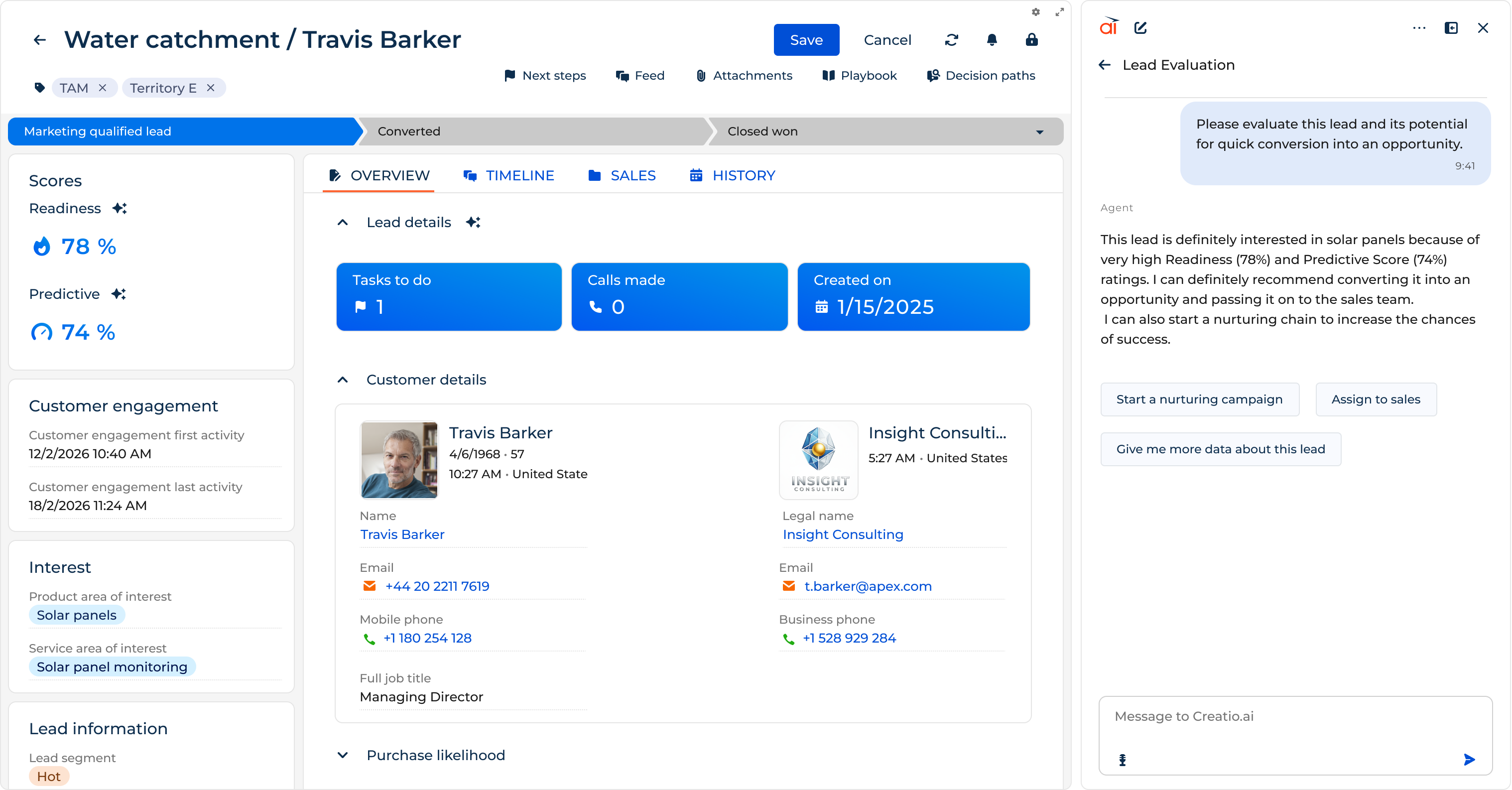
With a comprehensive Customer 360 view and advanced sales automation, Creatio Sales helps reps identify high-value accounts, prioritize opportunities, and move deals forward more efficiently. AI-powered forecasting and analytics provide deeper visibility into pipeline health, performance trends, and customer behavior, supporting more informed sales planning and execution. Agentic AI capabilities are embedded directly into daily tools like MS Outlook and Teams, enabling reps to access context-aware insights without switching applications.
Creatio’s built-in AI sales agents support teams throughout the sales cycle — from initial outreach to deal closure — helping to reduce manual tasks and make every customer connection more relevant and personalized. Moreover, the role-based agents can be configured or extended using natural language to match specific sales processes and requirements.
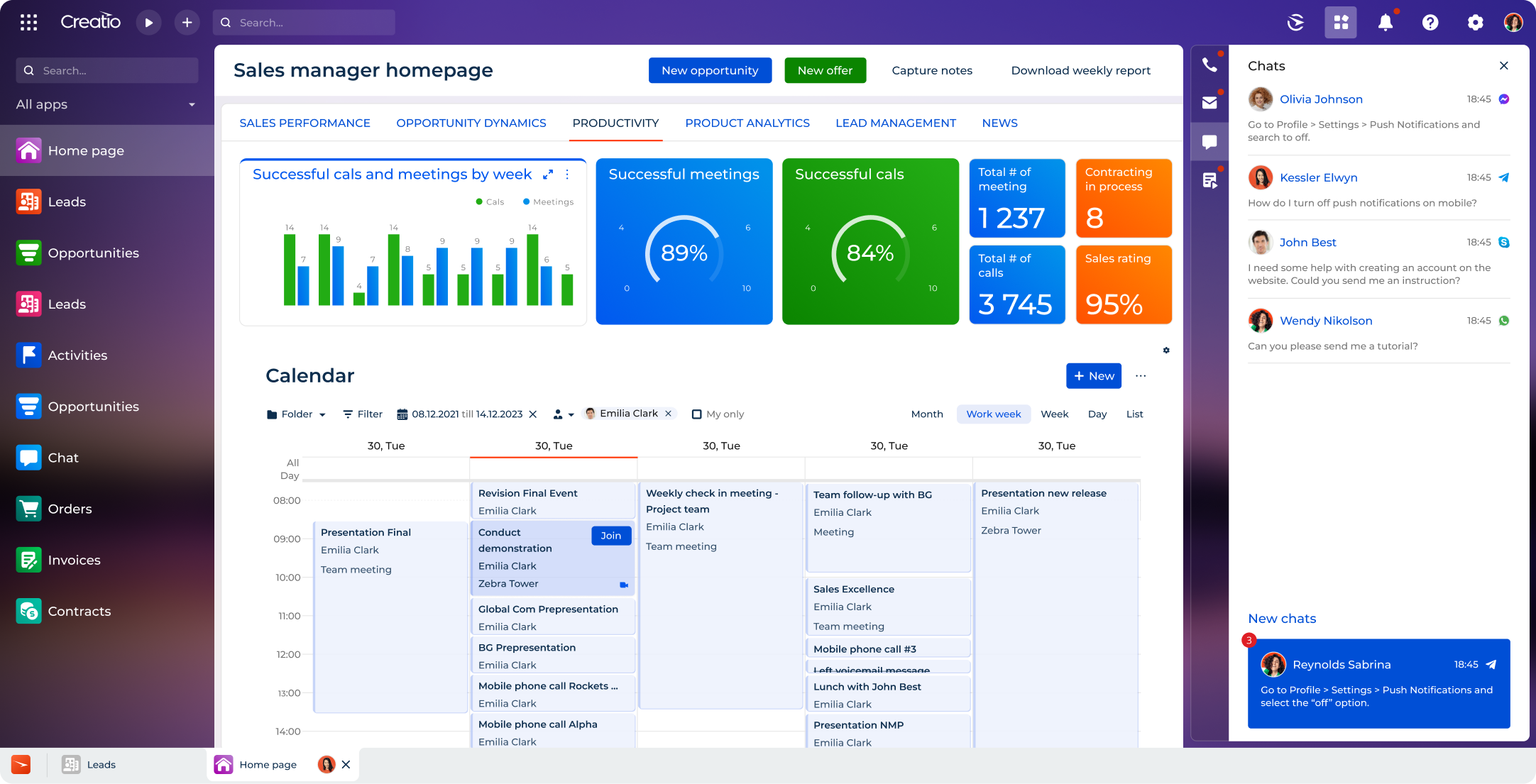
Creatio’s excellence has been recognized by analysts and customers alike. Most notably, Creatio Sales was positioned as a Visionary in the Gartner® Magic Quadrant™ for Sales Force Automation Platforms, reflecting recognition of its AI-native, no-code alternative to traditional CRM platforms.
Standout Features:
- Ready-to-use applications for sales, such as Customer 360, lead and opportunity management, order and contract management, sales productivity, guided selling, and sales forecasting
- Built-in, customizable AI sales agents supporting account research, quote generation, forecasting, territory management, meeting preparation, and more
- Modern conversational workspace designed to improve multitasking and rep productivity
- AI-assisted no-code tools that enable sales professionals to create, configure, and deploy workflows, applications, and agents without development
- Preconfigured solutions for 20+ industries
- Mobile application to enhance productivity for field and remote sales teams
Pros:
- Generative, predictive and agentic AI capabilities embedded directly into the platform’s core
- Seamless integration with Creatio Marketing and Creatio Service
- No-code customization enables teams to tailor workflows without IT dependency
- Flexible, composable pricing that allows organizations to pay only for what they use
Cons:
- May present a slight learning curve for users unfamiliar with no-code platforms
Pricing:
Creatio offers a flexible pricing model that allows organizations to pay only for the products and capabilities they need. Pricing for the core agentic platform starts at $40 per month, with Creatio Sales, Creatio Marketing and Creatio Service added as standalone modules at $15 per user per month each. This allows organizations to build an AI-native CRM solution tailored to their specific business needs.
Enterprises scaling AI across teams and workflows, Creatio also offers the Unlimited plan. This plan includes access to the full platform, all CRM products, and AI capabilities — with no limits on users, AI agents, workflows, applications, and scale.
2. Zoho CRM
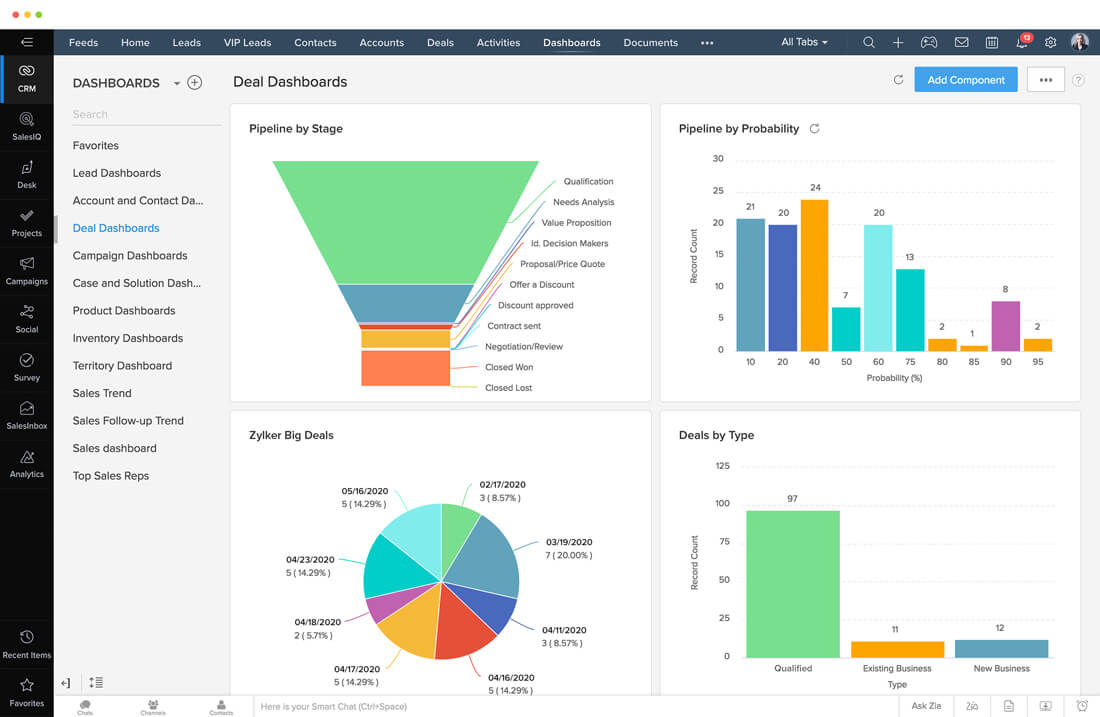
Zoho CRM is a sales-focused platform designed to help small to mid-sized businesses centralize customer data and streamline sales activities. It combines core CRM capabilities with sales automation, analytics, email marketing, and inventory-related tools within a single workspace. AI-powered assistance is delivered through Zoho’s digital assistant, Zia, which supports routine sales tasks such as lead scoring, forecasting, and customer insights rather than autonomous, agent-driven execution. Zoho CRM is widely recognized for its accessibility and balance between functionality and affordability.
Standout Features:
- Zia AI assistant for lead scoring, anomaly detection, and sales predictions
- AI-based deal insights highlighting trends, risks, and performance changes
- Workflow automation for lead routing, follow-ups, and task assignment
- Sales forecasting tools based on historical and pipeline data
- Email and activity intelligence for tracking engagement and response patterns
Pros:
- Broad integration across Zoho’s business applications
- Built-in AI available across multiple pricing tiers
- Competitive pricing compared to enterprise-focused CRM platforms
Cons:
- Customization capabilities may be limited for complex enterprise sales models
- Advanced analytics and automation are restricted to higher-tier plans
- AI capabilities are assistive rather than fully agentic or autonomous
Pricing:
Zoho CRM is offered in multiple editions, typically ranging from $20 to $65 per user per month, depending on the plan and billing model. Professional sales teams often choose the Enterprise ($50 per user/month) or Ultimate plans ($60 per user/month), which include advanced automation, analytics, and AI-powered features.
See also: Top 10 Zoho CRM Alternatives and Competitors
3. Salesforce Sales Cloud
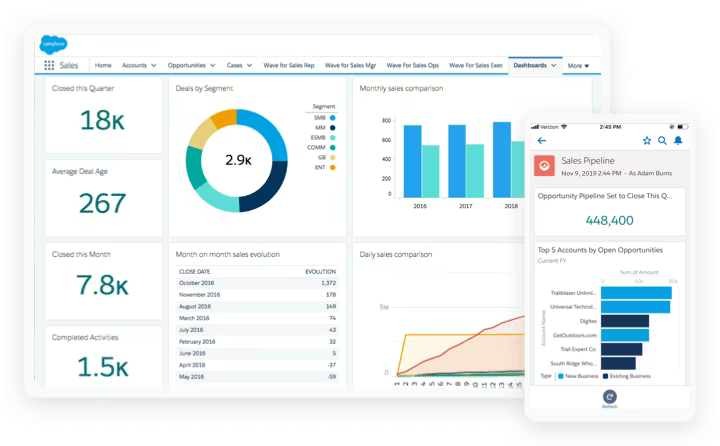
Salesforce Sales Cloud is a CRM designed to support complex sales operations, large pipelines, and multi-region teams. It enables organizations to manage leads, contacts, accounts, and opportunities within a single configurable interface. The platform includes sales engagement and conversation intelligence, lead and opportunity management, productivity tools, workflow automation, and a broad ecosystem of integrations. Advanced AI capabilities are available through higher-tier editions and add-ons, supporting analytics, forecasting, and sales insights. Overall, the platform is best suited for organizations that require extensive integrations and scalability across global sales teams.
Standout Features:
- Built-in AI for lead scoring and deal prioritization, opportunity insights and predictive forecasting
- Advanced pipeline and forecast management with configurable rollups
- Sales analytics and dashboards for performance and trend analysis
- Extensive automation tools using Salesforce Flow
- Sales engagement and conversation intelligence to fish more insights from your sales calls
Pros:
- Strong AI-driven analytics, forecasting, and sales insights
- Highly customizable to fit complex and industry-specific sales processes
- Scales well for large, global, and multi-entity sales organizations
- Extensive ecosystem of third-party integrations and partners
Cons:
- Higher implementation and long-term ownership costs compared to many sales CRM platforms
- Advanced AI and automation capabilities are limited to higher-tier editions
- Onboarding and deep customization often require external consulting or specialized expertise
- The platform’s complexity can result in a steeper learning curve for users
Pricing:
Salesforce Sales Cloud is available in several editions, with pricing ranging from $25 to $550 per user per month. Sales teams typically opt for Professional ($175), Enterprise ($330), Unlimited ($350) or Agentforce 1 Sales ($550), which support AI tools and more extensive customization.
See also: Salesforce Alternatives & Competitors and Salesforce Marketing Cloud Alternatives & Competitors
4. HubSpot Sales Hub
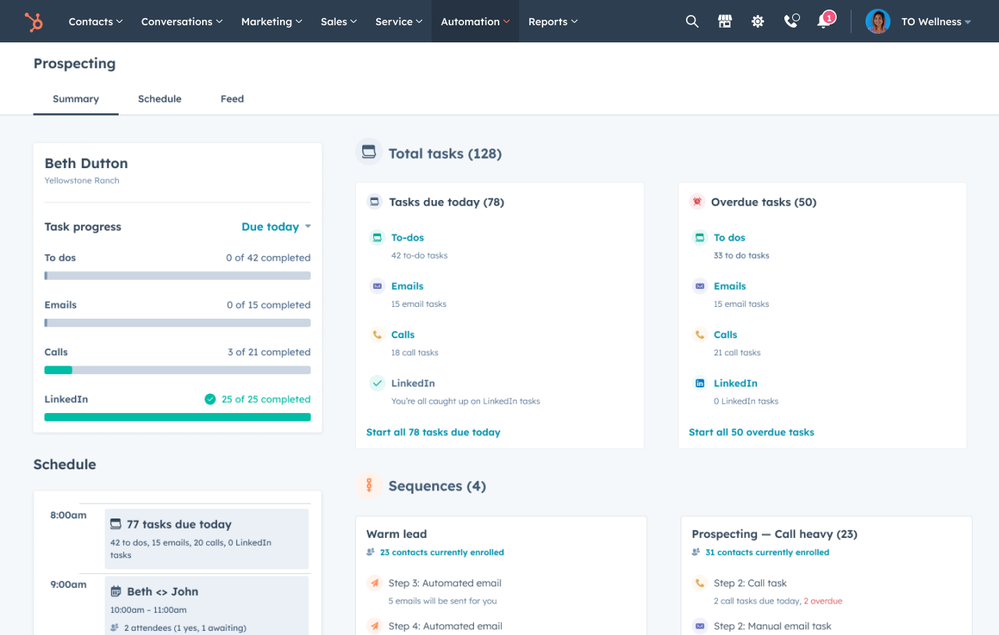
HubSpot Sales Hub is a CRM designed to help teams manage deals, automate outreach, and coordinate sales workflows within HubSpot’s Smart CRM platform. It unifies prospecting, engagement, and deal management into a single interface, making it especially effective for organizations already using HubSpot’s service or marketing tools. The platform’s built-in AI capabilities support reps in daily sales activities like content generation, insights, and automation rather than autonomous or fully agentic workflows. With an intuitive interface and seamless product connectivity, HubSpot Sales Hub is easy to adopt and enables consistent collaboration across teams.
Standout Features:
- AI meeting assistant for call recording, transcription, and conversation insights
- Breeze Prospecting Agent to support account research and prospect prioritization
- Email insights and AI-assisted content for outreach and follow-ups
- Pipeline visualization and deal tracking for day-to-day sales execution
- Sales analytics and dashboards for performance monitoring
- Forecasting tools based on pipeline and historical data
Pros:
- Strong integration with HubSpot’s marketing, service, and operations tools
- Easy to adopt with a user-friendly interface and guided workflows
- Centralizes prospecting, engagement, and deal management in one platform
- Supports collaboration across teams and business units
Cons:
- AI capabilities are primarily assistive, not fully agentic or autonomous
- Advanced AI, forecasting, and customization features are limited to higher-tier plans
- Customization depth may be limited for complex or non-standard sales processes
- For Professional and Enterprise plans, a one-time onboarding fee of $1,500 is required
Pricing:
HubSpot Sales Hub offers a free plan with basic CRM features, along with paid tiers for more advanced functionality. The best fit for sales teams are Professional plan, priced at $100 per user/month, or Enterprise plan at $150 per user/month.
See also: Top 10 HubSpot Alternatives & Competitors
5. Microsoft Dynamics 365 Sales
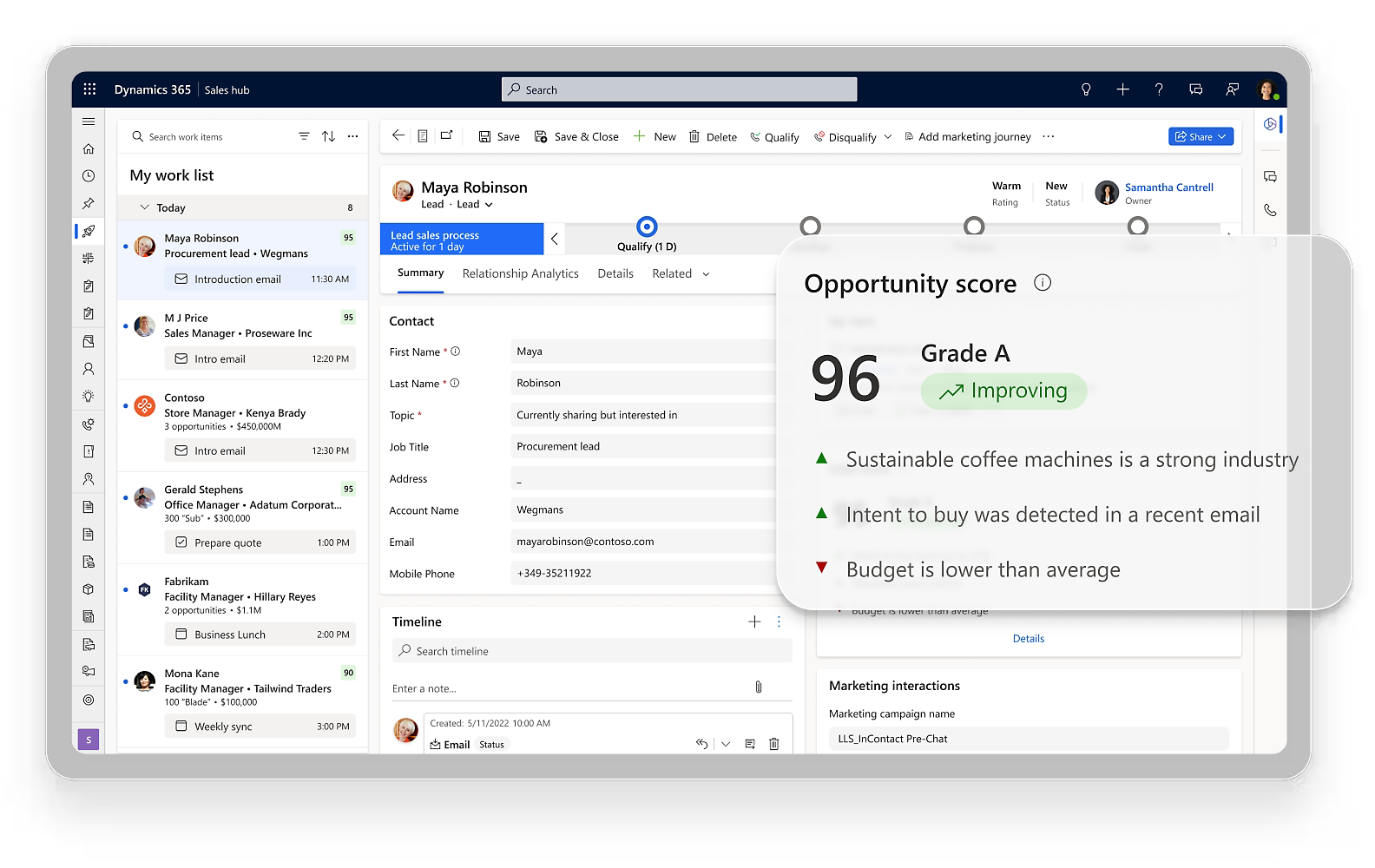
Microsoft Dynamics 365 Sales is a solution built to support complex sales processes, long deal cycles, and large sales teams. It combines core CRM tools for sales with data-driven AI insights through Microsoft Copilot, embedding intelligence directly into pipeline management, forecasting, and daily rep workflows. As a result, the reps can prepare for engagements, take the best actions and analyze performance to further improve customer interactions. The platform is particularly effective for businesses already using Microsoft products, helping teams to naturally extend sales workflows across tools like Outlook, Teams, and Excel.
Standout Features:
- Autonomous lead research and qualification
- AI-based scoring models and prioritized work lists for opportunity qualification
- Microsoft Copilot to assist with reviewing open sales tasks, new assignments, and pipeline updates
- AI-generated opportunity summaries and meeting preparation notes to check customer status, relevant news, and past meeting notes
- Automated sales guidance to update teams on failure points in the sales sequence
Pros:
- Seamless integration with Microsoft 365, Teams, and Power Platform
- Strong AI-driven forecasting, analytics, and sales insights
- Scales easily for large, distributed, or multi-region sales teams
- Flexible customization through low-code and enterprise tools
Cons:
- Higher complexity compared to SMB-focused sales CRMs
- Adoption often requires structured onboarding
- Advanced AI automations and insights are tied to Enterprise and Premium editions
- Customization and automation may require Power Platform expertise
Pricing:
Microsoft Dynamics 365 Sales is available in three editions: Professional plan ($65 per user/month), Enterprise plan ($105 per user/month), and Premium plan ($150 per user/month).
How to Use Sales CRM Software: Real-World Cases from Leading Companies
Sales CRM software is widely used to support day-to-day sales execution — from early prospecting to deal closure and post-sale follow-up. In practice, teams rely on CRM systems to structure workflows, guide actions, and capture outcomes at every stage of the sales cycle.
Here’s how organizations put these capabilities into practice:
Prospecting & Qualification
At the earliest stage of the sales cycle, sales CRM software helps teams identify the right accounts faster and personalize outreach with far less manual work. The most common ways it supports sales reps include:
- Scoring leads automatically based on engagement, firmographics, and behavior
- Using AI agents to automate account research, identify decision-makers, and enrich profiles
- Generating personalized email sequences for outreach, supported by accurate contact data from email finder tools
- Flagging warm accounts and suggesting next-best actions
- Recommending priority segments for targeted prospecting
Use Case: Purplebricks Unlocks Record Lead Performance with AI CRM
Purplebricks has transformed its lead management and outbound prospecting by replacing legacy systems with Creatio’s agentic CRM. In just six months, the company saw a 35% increase in lead volume and a 50% improvement in lead conversions through intelligent automation and faster, more targeted engagement. By categorizing and routing thousands of daily inquiries from sites like Rightmove and Zoopla, the sales teams gained real-time funnel visibility and uncovered multi-step opportunities from single customer.
Lead & Contact Management
Sales teams use CRM software to bring structure, visibility, and consistency to how leads are captured, managed, and progressed into active opportunities. Common use cases include:
- Tracking every call, email, meeting, and touchpoint in a unified timeline
- Automatically assigning leads to the right rep based on region, expertise, or workload
- Segmenting accounts by industry, size, priority, or buying stage
- Using AI agents to monitor deal engagement and alert reps when activity drops
- Guiding opportunity progression with stage-based workflows and next-step prompts
Use Case: Americar Accelerates Customer Journey with No-code Agentic CRM
Americar unified fragmented processes on Creatio’s agentic platform, enabling instant lead capture, AI-driven prompts, and guided opportunity workflows. Sales managers now respond within one to two minutes, supported by real-time stock and pricing data that keep offers accurate. The result is faster responses, fully aligned sales process, and a complete 360° view of the customer journey.
Omnichannel Communication
Sales CRM enables teams to manage buyer conversations across channels while preserving context and continuity. In practice, sales teams use it to:
- Manage email, calls, chat, web inquiries, and messaging from a single interface
- Maintain a unified interaction history across sales and service touchpoints
- Use AI-powered chatbots to handle routine inquiries and qualify inbound requests
- Automate sales responses, including follow-ups, proposals, and quote delivery
- Coordinate demos and meetings with built-in scheduling and reminders
Use Case: Astana Motors Delivers Flawless Service Execution Using a Dedicated No-Code Platform
Astana Motors modernized CRM processes across its dealership network using Creatio’s no-code platform. With a centralized omnichannel contact center, AI-powered chatbots, and a single customer interaction window, teams now manage customer communications seamlessly across channels. The company also streamlined digital document management, reducing contract approval time from 2–3 months to just 2–3 days, significantly accelerating service execution and operational efficiency.
Sales Pipeline Management & Forecasting
Sales CRM software helps teams maintain visibility into deal progress, anticipate risks, and plan revenue with greater confidence. In practice, sales reps and leaders use it to:
- Providing real-time visibility into deal stages, progress, and bottlenecks
- Scoring opportunities based on momentum, engagement, and stage progression
- Using predictive analytics to improve forecast accuracy
- Highlighting stalled or at-risk deals that require attention
- Generating regular pipeline summaries for reps and leadership
Use Case: Howdens Boosts Sales Conversion with No-Code Sales CRM
Howdens improved pipeline visibility and sales execution by adopting Creatio’s no-code sales CRM across its depot network. Within six months, the company increased its sales conversion rate from 32% to 38% (+18.75%) and captured over 1,200 new qualified leads that were previously difficult to track. Better pipeline oversight helped teams manage higher lead volumes without losing opportunities during peak periods.
Closing Execution & Sales Outcomes
Sales CRM systems enable teams to close deals with control and consistency, while capturing the insights needed to improve future execution. This includes completing final steps, standardizing close processes, and turning closed deals into actionable performance insight. Some common examples are:
- Managing contract workflows, approvals, and document routing in a structured process
- Tracking close-readiness tasks, such as signatures, reviews, and stakeholder sign-off
- Identifying upsell and cross-sell opportunities based on customer history and engagement
- Standardizing deal close documentation for repeatable execution
- Capturing results and performance signals for coaching and process optimization
Use Case: BSN Sports Drives Proactive, Data-Driven Sales with All-in-One CRM
BSN Sports shifted from a reactive, inbound-led sales model to a more structured and proactive approach using Creatio CRM. Customizable shared dashboards and full pipeline visibility improved prioritization, enabled targeted coaching, and strengthened collaboration across teams. The company reported a 50–60% increase in sales book size per sales rep over five years, with continued growth expected as digital capabilities expand.
How to Choose a CRM Software for Sales
The right CRM should match how your teams sell today — and scale as your revenue operations grow. Here are the main criteria for evaluating sales CRMs before you make a purchase decision.
Step 1: Define Your Sales Goals and Processes
Start by mapping how your sales organization operates today and where improvement is needed. Identify bottlenecks in prospecting, deal progression, forecasting, or handoffs, and involve sales reps and managers to surface daily challenges and must-have capabilities.
Step 2: Validate Core Sales Functionality
A dedicated sales CRM system should support your entire sales cycle without compromise. Prioritize platforms that feature lead and opportunity management, pipeline visibility, help track sales activities, and are suitable for quoting and contract workflows, as these are the non-negotiables to ensure sales success.
Step 3: Assess AI and Sales Automation Capabilities
AI is no longer optional in CRM systems, especially for revenue teams. Evaluate the built-in AI capabilities and how they help streamline processes, improve decision-making and increase customer retention. For example, agentic CRM platforms, such as Creatio Sales, embed AI agents directly into sales workflows — automating account research, quote generation, meeting preparation, forecasting, and territory management — so teams can manage core business processes within a single system.
Step 4: Ensure Compatibility with Your Sales Ecosystem
A CRM system should fit naturally into your existing sales stack, including email and calendars, business phone systems, sales engagement tools, CPQ or ERP systems, marketing platforms, and customer support software. Strong integrations prevent CRM data silos, reduce manual work, and ensure seamless information flow across sales managers and external teams.
Step 5: Plan for Scale, Adoption, and Long-Term Value
Once you shortlist CRM vendors, evaluate their long-term viability beyond feature sets. Assess ease of use and onboarding, no-code customization options, scalability across teams or regions, total cost of ownership, and the strength of the vendor’s partner and support ecosystem. Modern CRM platforms can translate these factors into measurable business value — for example, Nucleus Research found that organizations migrating from Salesforce and Microsoft to Creatio CRM reported a 37% reduction in technology costs and up to a 70% reduction in implementation timelines, highlighting the impact of flexibility and faster time to value.
Summary
A CRM plays a fundamental role in helping reps execute consistently across the entire sales cycle. By bringing structure to workflows and sales data, it gives teams clear pipeline visibility, reduces manual effort, and helps reps focus on closing more deals, which drive revenue and stronger customer relationships.
Creatio Sales is built for organizations that value automation and flexibility without complexity. As a unified, no-code CRM powered by agentic AI, it enables sales teams to automate core processes, guide day-to-day execution, and manage the full sales lifecycle from prospecting to close, while adapting easily to evolving sales models and growth needs.
