





































































Agentic AI in Sales Guide: Definition, Use-Cases, and Benefits

Deploy Workflows 70% Faster with Creatio Agentic Platform

Until recently, digital sales transformation powered by artificial intelligence focused on improving efficiency, helping teams analyze data, generate content, and prioritize leads. However, efficiency alone doesn’t solve the core challenge of sales departments: consistent execution at scale. This is where a new era of AI capabilities emerges: agentic AI for sales.
Instead of assisting with individual tasks, agentic artificial intelligence in sales is designed to take action - executing workflows, following up with leads, and moving deals forward autonomously. It represents a fundamental shift from AI as a support tool to AI as an active participant in sales execution. This shift is happening faster than many organizations expected, with 67% of enterprises already considering AI agents a crucial part of their digital transformation, according to BCG research.
Key Takeaways
- Agentic AI in sales goes beyond assistive AI by acting autonomously - planning, deciding, and executing multi-step actions across sales operations to achieve defined goals.
- Benefits include higher conversion rates, shorter sales cycles, increased productivity, improved decision-making, and autonomous lead management.
- Agentic AI can operate across the entire sales lifecycle, from autonomous prospecting and outreach orchestration to deal progression, lead nurturing, predictive forecasting, cross-sell/upsell execution, and CRM data updates.
- Successful adoption depends on overcoming key barriers, including data quality and integration, trust and transparency, alignment with sales processes, and governance and compliance.
- Implementation should start from defining clear use cases, ensuring a strong data foundation, choosing a scalable platform, integrating agents into existing systems, and rolling out gradually through pilots and measurable outcomes.
- Creatio agentic AI for sales stands out as one of the best solutions on the market by enabling organizations to deploy, manage, and scale AI agents easily within a unified, AI-native environment.
What is Agentic AI in Sales
Agentic AI in sales refers to an AI system that goes beyond passive automation by acting autonomously to achieve sales goals, rather than simply assisting humans with insights or content. At its core are AI sales agents, intelligent entities that can plan, decide, and execute multi-step actions across the sales operations with minimal human intervention.
Unlike traditional AI assistants, which require human input to act, AI agents can operate proactively and independently, continuously taking action to move deals forward, engage prospects, and manage workflows throughout the entire sales lifecycle.
Benefits of Agentic AI in Sales
Agentic AI creates impact not just by automating routine tasks, but by taking ownership of execution gaps that typically slow down or break the sales process. Its value comes from acting continuously, not occasionally.
- Higher conversion rates - most deals are lost in the “in-between moments”- late follow-ups, generic outreach, or missed signals. Sales AI agents eliminate these gaps by persistently executing tailored actions at every stage: adjusting messaging based on engagement, triggering follow-ups at optimal times, and re-engaging leads when intent resurfaces. This consistency, not just personalization, drives higher conversion.
- Shorter sales cycles - sales cycles often stall due to human bottlenecks: waiting to send the next email, manually updating CRM data, or preparing materials. Agentic AI removes this friction by progressing deals in real time - automatically updating data, nudging stakeholders, surfacing objections, and initiating next steps without delay.
- Increased productivity - agentic sales AI takes over repetitive tasks, including data entry, prospecting, and scheduling, allowing sales teams to focus on high-value work, such as relationship building, negotiating, and closing deals.
- Autonomous lead management - traditional lead management is reactive and time-consuming. AI sales agents make it continuous and dynamic, with leads qualified, nurtured, and prioritized in real time based on behavior.
- Improved decision making - rather than relying on static dashboards and flawed analysis, agentic AI in sales enables more informed decision-making based on real-time data. Additionally, it doesn’t just highlight risks or opportunities; it acts on them. For example, instead of flagging a stalled deal, it can initiate recovery sequences, involve the right stakeholders, or adjust engagement strategy, turning insight into immediate action.
Independent Research - Discover how Creatio agentic CRM enables 70% faster implementation, 37% lower total cost of ownership, and 61% faster lead response compared to legacy platforms.
10 Agentic AI Use Cases in Sales
To understand the real impact of agentic AI in sales, it’s useful to look at where execution, not just assistance, changes how the work gets done. Sales AI agents operate autonomously across the entire sales lifecycle, from prospecting and lead management to deal execution and expansion.
Always-on prospecting and lead research
Agentic sales AI can independently identify target accounts, research prospects, gather relevant data, and prepare outreach content without requiring a rep to manually initiate each step. Instead of just surfacing data, it continuously works in the background to build and refine prospect lists based on defined goals, ideal customer profiles, and live signals.
According to Forbes, businesses that implemented AI sales tools into their processes automated up to 90% of prospecting tasks.
Personalized outreach orchestration
Sales AI agents can manage outreach as an end-to-end process rather than a one-off task. They can initiate contact with high-value prospects, follow up consistently, leverage generative sales AI to personalize messaging, and continue execution across channels until the prospect responds, converts, or is deprioritized. This makes outreach more persistent, coordinated, and outcome-driven.
Autonomous lead qualification & routing
Agentic AI evaluates inbound leads the moment they enter the funnel - analyzing behavior, customer data, and previous interactions - and makes qualification and scoring decisions in real time. Instead of routing rules or manual triage, AI agents dynamically assign leads to the right rep, segment, or nurture path, ensuring immediate and accurate follow-up.
According to a Harvard Business Review study, sales organizations that use AI-driven lead prioritization can increase conversion rates by up to 50%.
Continuous follow-up management
Follow-ups are one of the most common failure points in sales. Agentic AI continuously monitors interactions across channels and leverages natural language understanding to provide context-aware follow-ups at the right moment. It ensures that no conversation stalls due to delay, oversight, or competing priorities.
Sales coaching
In an agentic model, AI does more than analyze sales calls or suggest improvements after the fact. Instead, agentic AI in sales can detect performance gaps, identify patterns across rep behavior, and proactively trigger coaching actions, such as recommending talk points, surfacing objections to prepare for, or prompting sales leaders when intervention is needed.
Deal progression orchestration
Within active opportunities, agentic AI identifies what needs to happen next and executes it. Whether it’s sending relevant content, prompting stakeholder involvement, or scheduling the next interaction, AI sales agents keep deals moving forward by managing execution at each stage of the pipeline.
Dynamic lead nurturing & reactivation
Agentic AI replaces static nurture campaigns with action that adapts to lead engagement. It continuously adjusts messaging and timing based on lead behavior, and can autonomously re-engage dormant leads when new signals appear, keeping the pipeline alive and responsive.
Cross-sell & upsell execution based on live signals
Sales agentic AI monitors customer data, such as product usage, lifecycle stage, and buying patterns, to identify cross-selling and up-selling opportunities as they emerge. In many organizations, this data is scattered across systems and departments, making these opportunities easy to miss.
However, even when identified, execution often stalls due to competing priorities or manual follow-ups. Agentic AI closes this gap by not only surfacing opportunities but also acting on them - triggering targeted outreach, coordinating follow-ups, or alerting reps at the right moment - ensuring cross-sell and up-sell opportunities are consistently captured and progressed.
Predictive sales forecasting
Traditional forecasting tools generate projections based on static inputs and historical data. AI sales forecasting goes further by continuously monitoring deal movement, engagement signals, pipeline changes, market trends, and execution risks to dynamically update forecasts.
More importantly, it doesn’t just surface insights, but acts on them. Agentic AI systems can adjust sales strategies in real time, shifting focus to higher-converting segments, refining outreach approaches, or reallocating effort based on emerging trends.
Autonomous CRM data capture & hygiene
Rather than expecting reps to manually handle CRM updates, agentic AI tools do it automatically. It logs activities, updates deal stages, enriches records with external data, and ensures consistency, keeping CRM data accurate and error-free without manual work.
Challenges in Implementing Agentic AI Systems in Sales
While agentic AI in sales introduces a fundamentally new level of automation and autonomy, realizing its full value requires overcoming several challenges.
Poor data quality and complex integration
In many sales organizations, data is fragmented across systems, inconsistent, or incomplete, making it difficult for AI agents to act reliably. Because agentic systems don’t just analyze data but act on it, poor data quality can lead to incorrect outreach, misrouted leads, or flawed prioritization. Additionally, integrating multiple systems into a unified environment is often complex but essential for enabling effective end-to-end execution.
Lack of trust, transparency, or explainability
For sales teams to rely on agentic AI, they need to understand and trust its actions. Unlike traditional tools that provide recommendations, agentic systems make decisions and execute workflows, sometimes without direct human input.
This raises important questions: Why did the agent prioritize this lead? Why did it trigger this outreach? Without clear visibility into decision-making and logic, adoption can stall. Building trust requires explainable actions, visibility into reasoning, and the ability to audit and override agent behavior when needed.
Alignment with sales processes and human collaboration
Every sales team has its own processes, motions, and nuances in how representatives engage with prospects and customers, and sales AI agents need to adapt to them. The challenge is ensuring that agentic AI acts as a true collaborator, handling execution while aligning with rep ownership, handoffs, and decisions.
Governance, security, and compliance
Because agentic AI can take action across systems, it introduces new governance and risk considerations. Organizations need clear controls over what agents are allowed to do, under what conditions, and with what level of autonomy.
This is especially important in regulated industries or regions with strict data privacy requirements. Ensuring compliance with policies (e.g., GDPR), maintaining data security, introducing a human-in-the-loop approach, and defining guardrails for agent behavior are essential to safely scale agentic sales AI.
How to Implement Agentic AI in Sales
Implementing agentic AI in sales is not just about deploying new technology; it requires rethinking how execution occurs across the sales operations. The goal is to introduce autonomy in a controlled, measurable way that aligns with business outcomes and existing workflows.
Here’s a step-by-step guide on how to do it effectively:
Define clear objectives and use cases
Start by identifying where agentic AI can create the most impact. Focus on execution gaps - areas where deals stall, follow-ups are inconsistent, or opportunities are missed. Prioritize specific use cases, such as outbound prospecting or lead management, and set clear objectives, like increasing conversion rates, reducing response times, etc.
Build the data foundation early
AI agents depend on accurate, connected, and real-time data. This means you need to ensure your CRM, communication tools, and data sources are properly integrated and maintained. This step often involves consolidating data sources, cleaning data from errors or duplicates, and establishing reliable data flows across systems.
Choose a scalable agentic AI platform
When adopting agentic AI tools, the key decision is not just which agent to deploy, but which platform can support agentic execution across the business. Many vendors offer single-purpose agents that can solve specific problems, which can be an attractive option when you’re just starting with AI sales tools. However, when you’re ready to expand into new use cases, you will find it creates unwanted fragmentation, requiring additional tools, integrations, and vendors to implement new agents.
Instead, organizations should prioritize platforms that provide a comprehensive agentic ecosystem across different business functions. This allows businesses to scale AI agents seamlessly, without constantly stitching together new solutions.
Implement and integrate agentic workflows
Most vendors provide prebuilt AI agents and workflows, but successful implementation depends on how well they are integrated into your systems and sales operations.
Key priorities include:
- Ensuring data flow across systems (CRM, email, communication platforms, marketing automation tools, etc.)
- Embedding agents into existing workflows (outreach, lead management, nurturing flows, etc.)
- Aligning AI agent actions with your sales processes
The goal is not to introduce a new layer of tools, but to make agentic AI a native part of how sales execution happens.
Pilot, measure, and scale
Start implementation with a controlled rollout - pilot sales agentic AI in a specific team, segment, or use case. Make sure you track KPIs, such as conversion rates, response times, pipeline velocity, or rep productivity, and use these insights to refine agent behavior, adjust workflows, and build sales team confidence. After that, you can scale gradually across additional use cases and teams, but remember to ensure that governance and performance keep pace with the expansion.
Creatio Agentic Capabilities for Sales
Creatio delivers agentic AI in sales capabilities as part of a unified, AI-native CRM and workflow automation platform, designed to embed intelligence directly into sales execution rather than layer it on top. This allows organizations to move beyond fragmented automation and isolated tools toward a model where AI agents actively drive outcomes across the entire sales lifecycle.
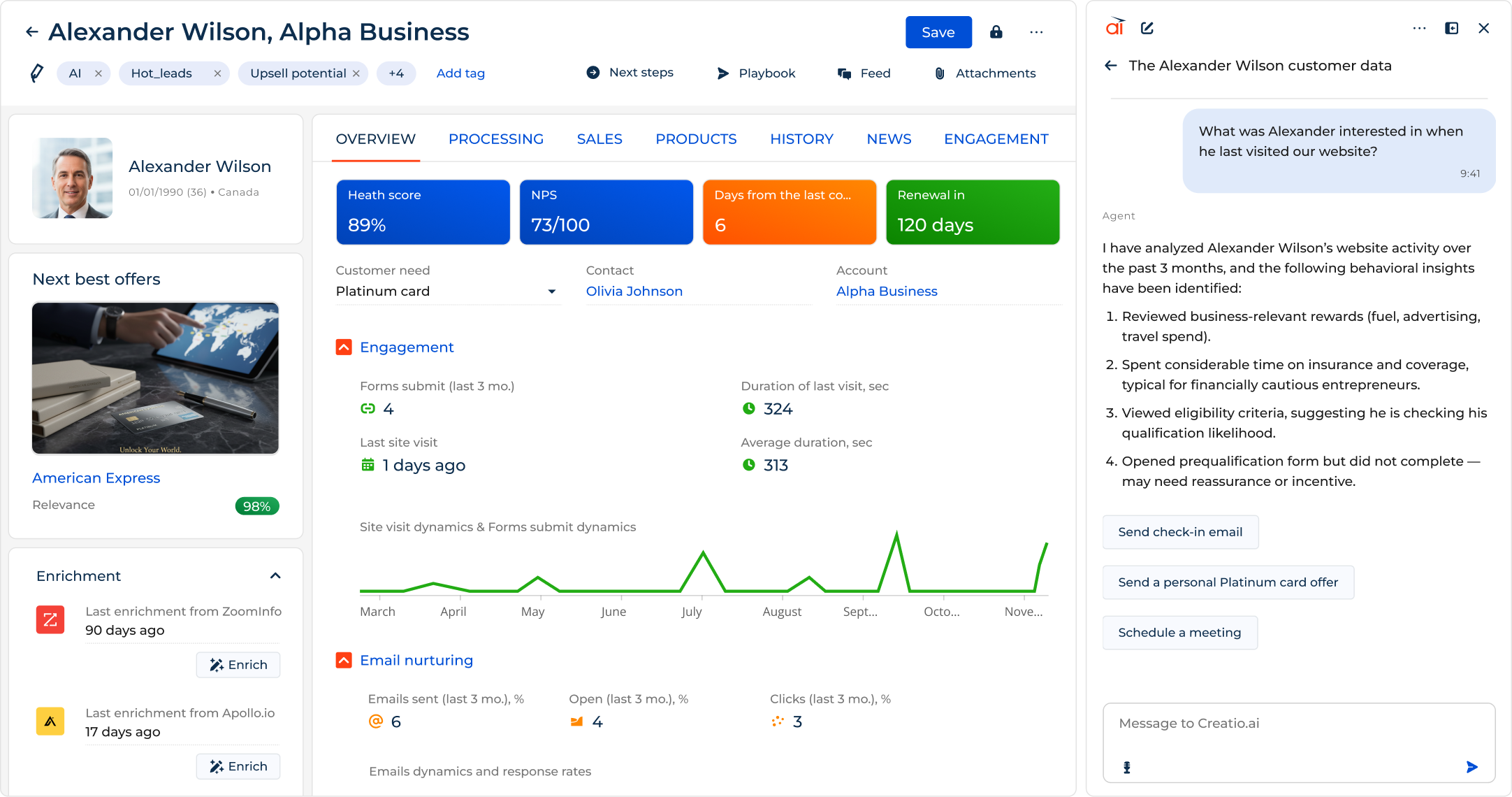
At the core of Creatio’s approach is the idea of end-to-end execution. Instead of supporting individual tasks, like drafting emails or scoring leads, AI agents operate within workflows to continuously move opportunities forward. They can assist with prospect research, initiate and manage outreach, support quote generation, maintain CRM data, and help advance deals by triggering next-best actions at the right time. This shifts sales from a rep-driven sequence of tasks to a system where execution is continuous, coordinated, and less dependent on manual follow-through. By working directly within CRM and communication tools such as Microsoft Teams and Outlook, they eliminate the disconnect between insight and action.

What differentiates Creatio is its end-to-end platform approach. Instead of relying on multiple solutions, organizations can deploy AI agents across different business functions within a single environment, enabling agentic AI to operate consistently throughout the entire customer lifecycle. This not only reduces integration complexity but also ensures that data, context, and actions remain aligned.
Creatio also enables rapid deployment and scalability through its no-code capabilities. Business users and sales leaders can configure custom agents and adapt agent behavior without heavy development, making it easier to launch new use cases, refine workflows, and scale agentic AI across teams and regions.
By combining agentic, generative, and predictive AI in a unified architecture, Creatio provides a complete execution layer for modern sales organizations, helping teams reduce manual work, maintain momentum across the pipeline, and operate with greater speed and accuracy.

Summary
Agentic AI marks a shift from AI that supports repetitive tasks to intelligent systems that execute them autonomously, addressing the core challenge of consistent execution at scale. It automates use cases across sales processes, from prospecting to deal management and expansion, while improving conversion, speed, and productivity.
Choosing the right platform is critical. Organizations need solutions that go beyond isolated agents and support scalable, end-to-end execution. This is where platforms like Creatio agentic CRM stand out, delivering agentic AI within a unified, AI-native environment that enables businesses to deploy, manage, and scale AI agents seamlessly.
