



































































Enterprise AI Agents: A Complete Guide for Business Leaders

Accelerate Lead Response Time by 61% With Creatio

Enterprise AI agents are the next stage of enterprise Artificial Intelligence adoption. While many organizations have successfully deployed generative AI to create content, answer questions, and accelerate knowledge work, those capabilities alone rarely deliver measurable business outcomes.
Real enterprise value comes when AI can securely access business data, interact with enterprise systems, execute complex workflows, and complete tasks within established governance and compliance frameworks. This shift reflects a broader change in how organizations approach AI. After years of experimentation with standalone copilots and chat interfaces, business leaders are increasingly focused on operational impact.
In this guide, you'll learn what enterprise AI agents are, how they work, the business use cases delivering value today, the benefits and governance considerations organizations should understand, and the key criteria for selecting the best enterprise AI agent platform.
Key Takeaways
- Enterprise AI agents are AI-powered systems that combine reasoning with enterprise data, applications, workflows, and governed actions to execute work and achieve business objectives.
- AI agents for enterprises go beyond generative AI by moving from generating answers or content to planning, executing, and orchestrating multi-step business processes across enterprise systems.
- The benefits of enterprise agents include faster execution and continuous operations, higher employee productivity, better decision-making, scalable operational capacity, reduced costs, and improved customer experiences.
- Enterprise-ready AI agents require security, governance, and control. Organizations need strong data privacy, access controls, observability, human-in-the-loop capabilities, and lifecycle management to deploy agents safely at scale.
- Agentic AI platforms provide the foundation for connecting agents with business data, systems, and workflows while enabling organizations to build, integrate, orchestrate, monitor, and govern a growing ecosystem of AI agents.
- Creatio provides an enterprise-ready foundation for agentic automation, bringing AI agents, no-code workflows, enterprise data, integrations, security, and governance into a unified environment.
What Are Enterprise AI Agents?
Enterprise AI agents are intelligent systems powered by large language models (LLMs), machine learning (ML), and natural language processing that can understand business objectives, reason through multi-step tasks, access enterprise data and applications, and take governed actions to complete workflows autonomously or in collaboration with people, while maintaining full compliance with security and industry standards.
AI agents for enterprises are designed to achieve business outcomes by combining intelligence with enterprise systems, business rules, and human oversight. For example, if the objective is to increase revenue, an enterprise AI agent can identify high-intent prospects, enrich CRM records, recommend the next best action for each opportunity, generate personalized outreach, schedule follow-up tasks, and update the sales pipeline automatically, helping sales teams close deals faster rather than simply producing sales copy.
What makes an AI agent “enterprise-ready”?
Not every AI agent is built for enterprise needs and requirements. While many AI agents can answer questions, generate content, or automate simple tasks, enterprise environments demand far more. They require AI systems that operate securely, reliably, and at scale while adhering to organizational and security policies.
An enterprise AI agent is designed not just to assist users, but to participate in business operations. To do so effectively, it must combine advanced reasoning with access to core systems, high-quality data, business applications, governance controls, and the ability to take actions within defined boundaries.



The following capabilities distinguish enterprise-ready AI agents from general-purpose AI assistants:
Secure access to enterprise data
Enterprise AI agents must work with trusted business information rather than relying solely on publicly available knowledge. They should securely retrieve relevant data from the business’s owned CRM, ERP, HR, finance, customer service, and other enterprise software while respecting role-based permissions and data access policies.
Action, not just conversation
The true value of an enterprise AI agent lies in its ability to execute work, not simply recommend it. Beyond answering questions or generating content, enterprise agents can create records, update systems, trigger workflows, route approvals, send notifications, or orchestrate processes across multiple applications to achieve a business objective.
Workflow orchestration across systems
Business processes rarely exist within a single application. AI agents integrate seamlessly and coordinate work across existing enterprise systems, selecting the appropriate tools and maintaining context throughout a multi-step workflow. This enables end-to-end process automation rather than isolated task execution.
Governance, security, and compliance
Enterprise AI must operate within organizational guardrails. Enterprise-ready agents enforce security policies, protect sensitive data, maintain audit trails, support human intervention where required, and comply with regulatory and industry requirements.
Reliability and human oversight
Business-critical decisions often require transparency and accountability. Intelligent agents for enterprise should provide explainable reasoning, escalation paths for exceptions, and opportunities for human review before executing high-impact actions.
Scalability and continuous improvement
Enterprise AI agents must perform consistently across thousands of users, departments, and business scenarios. They should be configurable, reusable, and improved through continuous monitoring, feedback, and evolving business rules, allowing organizations to refine agent behavior and scale AI adoption without sacrificing control.
How Enterprise AI Agents Work
At a high level, AI agents for enterprise follow a simple pattern: they understand a business objective, gather the information they need, determine the best course of action, execute complex tasks across existing systems and continuously adapt based on new inputs and outcomes.
A typical enterprise AI agent workflow includes the following steps:
1. Understand the business objective
Every workflow begins with a goal rather than a prompt. An enterprise AI agent interprets the business's needs, identifies the desired outcome, and determines the tasks required to achieve it.
2. Retrieve enterprise context
To make informed decisions, the agent gathers relevant information from enterprise systems or industry-specific applications. Instead of relying only on its training data, it works with real-time business data to achieve the best results.
3. Reason and plan
The agent analyzes the available information, breaks complex objectives into manageable steps, and determines the most effective sequence of actions. It can decide which tools to use, whether additional information is needed, and when human approval should be requested.
4. Execute actions across business systems
Unlike traditional AI assistants that stop after generating a response, enterprise AI agents can interact with enterprise applications through APIs, workflows, and business logic. They can update records, trigger processes, generate documents, assign tasks, send notifications, or coordinate work across multiple systems to complete an end-to-end process.
5. Operate within enterprise governance
Enterprise AI agents enforce role-based permissions, comply with security and regulatory requirements, maintain audit trails, and escalate decisions that require human review. Governance is embedded throughout the workflow rather than applied as a final checkpoint.
6. Learn and improve
Enterprise AI agents continuously improve through monitoring, feedback, and evolving business rules. Organizations can optimize workflows, refine decision logic, and expand agent capabilities over time while maintaining consistency and control.
Key Use Cases of Enterprise AI Agents
AI agents for enterprise can deliver value across virtually every business function and industry. While specific implementations vary, their core strength remains the same: automate complex processes, support employees, and increase operational efficiency.
Sales
Enterprise AI agents help sales teams spend less time on administrative work and more time building customer relationships. They can enrich and score leads using external and internal data, route opportunities to the right representatives, research prospects before meetings, recommend the next best action based on deal context, update CRM records automatically, prepare quotes, and identify pipeline risks before they impact revenue. The result is a more efficient sales process, improved forecast accuracy, and faster deal cycles.
Marketing
Marketing teams use enterprise AI agents to deliver more personalized campaigns while reducing manual effort. Agents can research target accounts, segment audiences, coordinate lead-nurture journeys, adapt content for different channels and customer personas, summarize campaign performance, and recommend optimization opportunities based on real-time data. This enables marketers to scale personalization, improve campaign effectiveness, and accelerate time to market.
Customer Service
Enterprise AI agents help organizations resolve customer issues faster while improving service quality. They can classify and prioritize incoming cases, retrieve relevant knowledge articles and customer history, draft personalized responses, detect sentiment and urgency, recommend resolutions, and escalate complex issues to the appropriate specialist when human intervention is required. By automating routine work and supporting service agents with contextual insights, organizations can reduce response times, improve first-contact resolution, and increase customer satisfaction.
Financial Services
Banks, credit unions, and other financial institutions use AI agents for enterprises to automate complex, highly regulated processes while delivering faster and more personalized customer experiences. AI agents can support customer onboarding and Know Your Customer (KYC) verification, assist with loan and mortgage origination, detect potential fraud, guide service representatives through compliance requirements, automate document processing, and recommend the next best action during customer interactions.
Manufacturing
Manufacturers use enterprise AI agents to improve production efficiency, supply chain visibility, and operational resilience. Agents can monitor production workflows, analyze equipment and inventory data, coordinate maintenance requests, identify supply chain disruptions, assist with quality control documentation, and recommend actions to minimize downtime. By connecting operational data with enterprise systems, manufacturers can optimize resource utilization, reduce costs, and improve production performance.
Insurance
Enterprise AI agents enable insurers to automate policy administration and accelerate claims processing while maintaining regulatory compliance. They can collect and validate policyholder information, analyze claims documentation, detect inconsistencies or potential fraud, coordinate approvals, retrieve relevant policy details, and guide agents through complex underwriting or claims workflows. These capabilities help insurers reduce processing times, improve decision consistency, and deliver better customer experiences.
Healthcare
Healthcare organizations use AI agents for enterprise to reduce administrative burden while supporting clinical and operational workflows. Agents can assist with patient intake, appointment coordination, medical documentation, insurance verification, and information retrieval from electronic health records. By automating routine tasks while operating within strict privacy and compliance requirements, healthcare providers can improve efficiency and allow clinicians to spend more time on patient care.
Public Sector
Government agencies use enterprise AI agents to modernize citizen services and improve operational efficiency. Agents can guide citizens through digital services, process applications and supporting documents, retrieve information from multiple government systems, coordinate case management, route approvals, and assist public employees with policy and regulatory guidance. By automating repetitive administrative work while maintaining transparency, security, and accountability, public sector organizations can improve service delivery, reduce processing times, and make better use of limited resources, accelerating project delivery by up to 88%.
How Creatio Delivers AI Agents for the Enterprises
Enterprises need more than powerful language models or collections of specialized agents for AI tools to deliver meaningful business outcomes. They need a platform that connects AI with business processes, data, enterprise governance, and orchestration. That's where an agentic AI platform becomes essential.
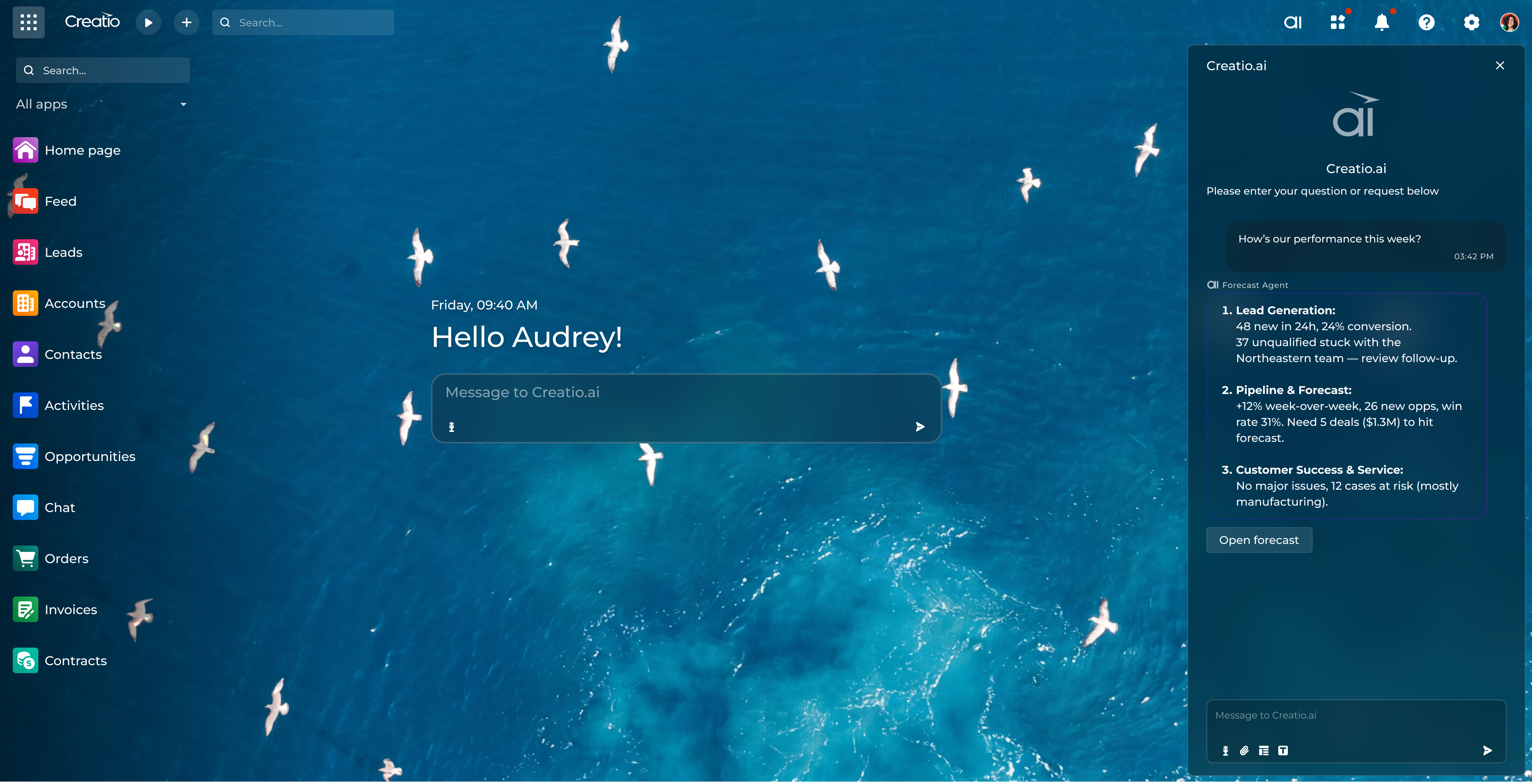
Creatio provides a unified agentic AI platform where AI agents operate on shared business data, coordinated workflows, and governed business logic. A central orchestration layer ensures agents work toward the same business objectives, share context through enterprise applications, and execute multi-agent workflows rather than relying on ad hoc interactions between autonomous agents. This allows organizations to scale AI confidently without introducing operational complexity.
Creatio Enterprise AI Agents
Creatio delivers purpose-built AI agents that support core business functions while remaining connected on a single platform:
- Sales AI Agents help teams qualify leads and enrich records, prepare for customer meetings, recommend next-best actions, automate CRM updates, generate quotes, and forecast future sales
- Marketing AI Agents assist with audience segmentation, personalized content generation, lead scoring and distribution, campaign execution, and performance analysis to help marketers deliver more relevant customer experiences
- Customer Service AI Agents streamline case management by classifying requests, retrieving knowledge, drafting responses, recommending resolutions, and routing complex issues to the right specialists
For financial institutions, Creatio’s Bank.AI offers a collection of autonomous AI agents that operate directly within existing enterprise systems, workflows, and productivity tools.
These include revenue-focused agents that help generate new business, increase referrals, drive renewals, and proactively strengthen customer relationships, and operational excellence agents that streamline complex financial processes, including onboarding, loan origination, servicing, and account management. AI agents autonomously orchestrate end-to-end workflows, collect and validate required data and documentation, support compliance requirements, manage approvals, and automate servicing actions. An independent study found that the Creatio agentic platform helps financial institutions deploy workflows 70% faster while cutting tech costs by 30%.
— responsibly, measurably, and at scale.
Creatio AI-Native Platform
Creatio’s AI-native platform provides the foundation enterprises need to build, deploy, manage, and scale AI agents across the enterprise while maintaining security and control.

Creatio AI Studio is an AI-native platform for managing the end-to-end enterprise agent lifecycle, bringing together the capabilities organizations need to build, run, and govern enterprise AI agents. Teams can rapidly develop and deploy agents using natural language prompts and visual designers, while Coding Agent SDKs provide a more advanced option for complex agentic tasks. AI Studio also connects agents with enterprise systems, data, knowledge, and workflows through MCP, APIs, and webhooks.
Importantly for enterprise deployments, AI Studio provides built-in observability and enterprise-grade security and governance through Creatio’s best-in-class responsible AI practices. Organizations can monitor agent activity and execution history, apply governance rules and data-access controls, introduce approvals and human-in-the-loop checkpoints, and maintain visibility into agent decisions and actions. This enables enterprises to scale intelligent automation while keeping AI operations governed and secured.

Creatio AI Twin brings agent creation directly to employees, enabling business users to build personal agents without technical skills. A user describes what they want an agent to do in natural language, works with AI Twin to refine the requirements, tests the resulting agent conversationally, and can then move it from sandbox to production using Creatio's built-in governance framework.
Because AI Twin natively understands Creatio objects, data, and workflows, it can build agents powered by AI Studio's capabilities in the background. At the same time, AI Twin inherits the same role-based access as the employee it acts for, follows existing Creatio roles and business rules, and maintains an audit trail of its decisions. This combination gives employees significantly more freedom to solve everyday business problems with AI capabilities without waiting on IT resources.
As organizations expand AI adoption, licensing complexity can quickly become a barrier. Creatio addresses this challenge through its Unlimited Enterprise model, allowing organizations to scale AI agents, users, workflows, or scale without the traditional constraints associated with per-user licensing. This gives enterprises the flexibility to freely extend AI solutions to new teams, processes, and use cases.
Rather than deploying disconnected AI assistants across the organization, enterprises can build a coordinated, intelligent multi-agent systems that share business context, operate on unified workflows, and are governed from a single platform.
What Are the Key Benefits of Enterprise AI Agents?
When deployed on a unified enterprise platform, AI agents deliver value far beyond task automation. By combining reasoning, enterprise data, workflow orchestration, and governed execution, they help organizations improve efficiency, increase agility, and scale operations.
The key benefits of AI agents for enterprise include:
- Faster execution and continuous operations. Enterprise AI agents can orchestrate routine and multi-step processes in seconds instead of hours, while operating around the clock. They reduce process bottlenecks, accelerate response times, and ensure work continues even outside business hours.
- Higher employee productivity. By automating repetitive administrative tasks, retrieving information, updating business systems, and coordinating workflows, AI agents free employees to focus on strategic work, customer relationships, and complex decision-making instead of administrative processes.
- Enhanced decision-making. Enterprise AI agents analyze data from multiple business systems, surface relevant insights, recommend next-best actions, and provide contextual information that helps employees make faster, more informed decisions.
- Scalable operational capacity. Unlike traditional staffing models, AI agents enable organizations to handle growing workloads without proportionally increasing headcount. Businesses can support more customers, process more transactions, and execute more workflows while maintaining consistent service quality.
- Reduced operational costs. Automating repetitive processes reduces manual effort, minimizes human error, shortens processing times, and lowers the cost of delivering business services across departments.
- Improved customer and employee experiences. AI agents provide faster responses, personalized interactions, and consistent support while eliminating delays caused by manual handoffs. Employees also benefit from immediate access to information and intelligent assistance throughout their daily work.
- Greater process consistency and compliance. AI agents for enterprise execute workflows according to predefined rules, governance policies, and regulatory requirements. This improves consistency, reduces compliance risks, and creates complete audit trails for business-critical activities.
- Faster innovation and business agility. Organizations can rapidly introduce new AI-powered workflows, adapt existing processes, and respond to changing market conditions without rebuilding entire systems. This allows enterprises to continuously optimize operations as business needs evolve.
Ultimately, the greatest benefit of AI agents for enterprise is their ability to transform AI from a productivity tool into an operational capability. Instead of helping employees complete individual tasks faster, enterprise AI agents help organizations execute entire processes more efficiently, consistently, and at scale.
Risks and Challenges of Enterprise AI Agents
While enterprise AI agents offer significant opportunities, organizations must also address the operational, technical, and organizational challenges that come with deploying AI at scale. Successfully adopting enterprise AI requires balancing innovation with governance, security, and responsible oversight.
Key challenges include:
- Data privacy and access control. Enterprise AI agents often need access to sensitive customer, employee, financial, or operational data. Organizations must ensure agents enforce role-based permissions and comply with data privacy regulations to prevent unauthorized access or leakage.
- Security threats. As AI agents interact with enterprise applications and execute business actions, they become part of the organization's attack surface. Businesses need safeguards against threats such as prompt injection, unauthorized access, malicious attacks, and other emerging AI security risks.
- Governance and compliance. AI agents should operate within clearly defined business policies, regulatory requirements, and ethical guidelines. Organizations need mechanisms to define guardrails, enforce approval policies, maintain audit trails, and demonstrate compliance with industry regulations.
- Limited observability and accountability. Without centralized monitoring, it can be difficult to understand why an AI agent made a particular decision, what actions it performed, or whether it followed organizational policies. Enterprises need visibility into agent activity, execution history, performance, and outcomes to build trust and support continuous improvement.
- Integration complexity. AI agents for enterprise are only as effective as the systems they can access. Integrating with legacy applications, multiple data sources, and disconnected business processes can be one of the most significant implementation challenges, particularly in large organizations with complex technology environments.
- Reliability and accuracy. AI agents may produce incorrect recommendations, misinterpret business context, or fail when confronted with incomplete or conflicting information. Human oversight, validation mechanisms, and clearly defined escalation paths remain essential, particularly for high-impact business decisions.
- Workforce adoption and change management. Successfully introducing AI agents requires more than deploying new technology. Employees need to understand how AI fits into their daily work, when to rely on automated decisions, and when human judgment is required. Clear communication, and training help build trust and encourage adoption across the organization.
- Scalability and operational control. As organizations deploy more AI agents across departments, managing them individually becomes increasingly difficult. Without centralized orchestration, standardized governance, and shared business context, enterprises risk creating disconnected AI silos that are difficult to monitor, maintain, and scale.
These challenges highlight why enterprise AI success depends not only on the capabilities of individual agents but also on the platform that manages them. Organizations need an enterprise-grade foundation that provides secure integrations, centralized governance, observability, and coordinated orchestration, ensuring AI agents work together as part of a controlled business ecosystem rather than as isolated automations.
How to Choose an AI Agent Platform for Enterprises
The success of enterprise AI depends as much on the platform as it does on the AI models themselves. While many vendors offer AI agents, enterprise organizations need a platform that can securely integrate AI into business operations, scale across departments, and maintain governance over every action an agent takes.
Use the following checklist when evaluating an enterprise AI agent platform:
1. Workflow orchestration and enterprise integrations
AI agents should do more than generate responses, they should execute end-to-end processes. Look for a platform that integrates with CRM, ERP, customer service, and other enterprise software while supporting business rules, approvals, SLAs, event triggers, exception handling, and cross-system workflow orchestration.
2. Enterprise-grade security and governance
Enterprise AI must operate within clearly defined guardrails. Evaluate whether the platform provides access management, role-based permissions, data security, audit trails, policy enforcement, and centralized governance to ensure AI agents act compliantly.
3. Human-in-the-loop controls
Not every business decision should be fully autonomous. Choose a platform that allows organizations to introduce human review at critical decision points through approval workflows, escalation paths, exception handling, manual overrides, and seamless collaboration between AI agents and employees.
4. Observability and lifecycle management
Organizations need complete visibility into how AI agents operate. A strong enterprise platform should provide tools for monitoring agent activity, inspecting decisions and executed actions, measuring performance, maintaining auditability, managing versions, and safely updating, suspending, or rolling back agents when necessary.
5. No-code usability and developer extensibility
Enterprise AI should empower both business and IT teams. The ideal platform enables business users to build and modify AI-powered workflows using no-code tools while giving developers the APIs, SDKs, custom components, and governance controls needed to support complex enterprise requirements.
6. Think beyond individual AI agents
Perhaps the most important question is not "How capable is this AI agent?" but "Can this platform coordinate multi-agent systems the enterprise needs?"
As organizations deploy AI across multiple departments, the challenge quickly shifts from agent development to orchestrating how they work together. Without a shared process architecture, unified business data, and centralized governance, even highly capable agents can create disconnected automations that reinforce existing silos.
The most successful enterprises are therefore investing in agentic AI systems rather than standalone AI solutions.
An agentic platform provides the orchestration, enterprise context, governance, and lifecycle management needed to ensure multiple agents contribute to a coordinated business outcome and not just isolated tasks.
Summary
Enterprise AI agents represent the shift from AI capabilities that generates answers and content to AI that can execute work and achieve business outcomes. By combining AI agent reasoning with enterprise data, applications, workflows, and governed actions, they can automate and orchestrate complex processes across sales, marketing, customer service, financial services, manufacturing, insurance, healthcare, and the public sector.
The value of enterprise-ready agents goes beyond individual productivity gains. They can accelerate execution, improve decision-making, expand operational capacity, and reduce costs while working continuously at scale. Realizing that value, however, requires an enterprise-ready foundation with robust security, integrations, governance, observability, and human-in-the-loop controls. For business leaders, the goal is not simply to deploy more AI agents, but to create a connected and governed multi-agent systems that turns AI intelligence into measurable business results.
