




































































Creatio vs Salesforce: A Comprehensive Platform Comparison for 2026

Switch Fast. Scale Smart. Go Creatio

When evaluating CRM platforms, organizations can choose from long-established enterprise ecosystems or newer AI-native platforms designed for faster, AI-driven innovation at scale. Salesforce and Creatio represent two distinct approaches within that market.
Salesforce is a long-established vendor offering a broad ecosystem of products and applications to support enterprise workflows. Creatio is an AI-native platform designed to reduce the constraints of traditional software and scale execution freely across people, AI agents, workflows, and applications.
This article provides an in-depth Creatio vs. Salesforce comparison, covering their key strengths, architecture, implementation approach, and AI capabilities to help you assess which platform best fits your business needs in the AI era.
Key Takeaways:
- Creatio is best for midsize and large enterprise organizations seeking an AI-native CRM and workflow platform that supports faster, yet enterprise-grade innovation, with most of technical complexity handled via AI and no-code.
- Salesforce is a stronger fit for large enterprises and growing businesses with highly formalized, multi-department workflows and extensive technical resources for deep platform customization and maintenance.
- Creatio implementations can typically be completed in 6–16 weeks, compared with six months or more for complex Salesforce deployments.
- Creatio natively embeds AI capabilities across its core platform and CRM products, while advanced Salesforce AI functionality may require higher-tier subscriptions, additional products, or consumption-based services.
- According to Nucleus Research, Creatio can deliver 37% lower total cost of ownership and 70% faster implementation compared to Salesforce, as measured from the customers switching from Salesforce to Creatio.
- Compared with code-heavy alternatives, Creatio can help teams customize workflows up to 80% faster, helping organizations respond to changing business needs with greater speed and flexibility.
Creatio vs. Salesforce: At a Glance
Feature capabilities remain important, but they are only one part of the decision. Organizations should also consider how each platform fits their existing technology infrastructure, the resources required to implement and maintain it, and how quickly it can support priority CRM, workflow, and AI use cases.
The comparison below covers the core criteria business leaders typically evaluate when comparing Creatio and Salesforce.
Evaluation criteria | Creatio | Salesforce |
| Value offering | Unified AI CRM and workflow platform where people and AI agents work together — with no limits on users, agents, workflows, or scale | AI CRM that helps companies become agentic enterprises by unifying people, AI agents, data, and Customer 360 |
| Best for | Mid-market and large enterprise organizations seeking to reduce platform complexity, accelerate innovation, and scale governed AI across customer and operational workflows | Organizations with a mature Salesforce estate, established Salesforce technical resources, and a strong need to preserve that ecosystem |
| Core architecture & Customization | One AI-native platform that combines modern AI stack, and no-code visual designers to help business and IT teams build and adapt applications and processes faster | Highly configurable platform. Complex implementations and customizations often rely on Apex development and specialized Salesforce administration skills |
| AI capabilities | AI-driven tools and AI agents are natively embedded into the platform. AI Studio for end-to-end agent orchestration and AI governance | Span across Einstein AI, Agentforce platform and Einstein 1 Studio. Advanced functionality may require separate products, add-ons, or consumption-based services |
| Workflow automation | Build and update end-to-end workflows visually in one platform, with no-code tools and embedded AI agents. | Build workflows with Salesforce Flow and related tools; more complex requirements may need Apex code and specialized Salesforce expertise. |
| Industries coverage | Industry workflows for 20+ verticals, including banking, credit unions, insurance, manufacturing, and the public sector | Nearly 16 dedicated industry clouds for financial services, healthcare, retail, and other sectors |
| Deployment options | Cloud and on-premises deployment options | Only cloud-based deployment |
| Implementation | Enables business and IT teams to configure applications and workflows using coding agents and no-code visual tools, reducing reliance on specialized development resources | Typically requires Salesforce administrators, developers, consultants, and integration partners to implement and configure |
| Pricing model | Core platform starts at $40 per user/month, with each CRM product available from $15 per user/month. AI capabilities are included into each product by default. An Unlimited plan with access to the full platform, all CRM products, and AI capabilities is available with custom pricing. | CRM pricing starts at $25 per user/month for Starter Suite or $100 per user/month for Pro Suite. Advanced cloud products that include Agentforce capabilities range from $175 to $550 per user/month. Additional costs may apply for products, add-ons, support plans, and consumption-based AI or data services. |
What Is Creatio?
Creatio is an AI-native customer relationship management (CRM) and workflow automation platform. It enables organizations to manage and automate customer-facing and operational workflows, as well as build custom AI-powered applications, workflows, and agents with AI coding agents and no-code visual tools.
Creatio is best suited to mid-sized businesses and large organizations looking to automate complex, end-to-end CRM and industry workflows using an AI-native engine and advanced no-code designers, without extensive coding skills. It provides a unified platform to orchestrate human-led and agentic workflows, use agent assistants to augment human work, and deploy autonomous agents to manage complex business processes end to end.
With its Unlimited Enterprise model, Creatio helps organizations remove the structural limitations of traditional enterprise software and scale execution freely across people, AI agents, workflows, and applications.
Creatio supports AI-powered vertical workflows across more than 20 industries, helping growing companies and global organizations accelerate revenue, streamline operations, and improve customer experiences in financial services, manufacturing, public services and beyond.
With a global team and a large ecosystem of partners, Creatio serves thousands of customers in over 100 countries and automates tens of millions of workflows daily.
Creatio’s core products include:
- Creatio Business Studio: An AI-native platform for building agents and applications using AI coding agents and no-code visual designers.
- Creatio AI Studio: An AI-native platform for managing the end-to-end AI agent lifecycle.
- Creatio AI CRM: AI CRM and workflow platform for marketing, sales, and service.
- Creatio Sales: An agentic sales platform for managing the end-to-end sales cycle.
- Creatio Marketing: An agentic marketing platform designed to accelerate the lead-to-revenue cycle.
- Creatio Service: An agentic service platform that helps organizations improve customer experiences and drive service excellence.
- Creatio Bank.AI: Banking AI CRM and workflow platform to grow your bank with no limits

What Is Salesforce?
Salesforce is a cloud-based CRM platform that connects people, AI agents, applications, and customer data. It helps businesses manage customer relationships, support sales and customer service, organize data, and coordinate work across teams. As a central hub, it enables sales, marketing, and service teams to view customer histories, automate routine tasks, make informed decisions, and execute work more efficiently.
Salesforce is a popular choice for enterprises with complex business processes that need a highly customizable, scalable, and deeply integrated CRM platform to unify sales, service, marketing, and data across departments.
The platform is known for its extensive portfolio of “cloud” products, large marketplace of apps and integrations, and global community of administrators, developers, partners, and users.
Salesforce’s core products include:
- Sales Cloud: An agentic CRM solution that helps revenue teams manage and scale their sales efforts.
- Service Cloud: A CRM platform for customer service and support, centralizing interactions across channels like phone, chat, and social media.
- Marketing Cloud: A unified digital platform that uses AI and a single customer view to automate and personalize marketing.
- Commerce Cloud: A suite of cloud-based tools to build, manage, and scale their sales channels for B2B and B2C businesses.

Key Differences of Creatio vs Salesforce
Like other enterprise platforms, Creatio and Salesforce share many capabilities, including robust CRM, workflow automation, and advanced AI. The main differences lie in how they approach customization, automation, AI adoption, and scalability. Below, we compare the key areas organizations should consider when choosing between the two.
Customization and Development
Salesforce provides built-in drag-and-drop tools, page layout adjustments, and Salesforce Flow for basic configuration. However, more complex or highly specialized requirements may require developer-led customization using Apex, Visualforce, and Lightning Web Components (LWC). This can increase reliance on internal technical teams or external consultants, while custom code requires ongoing testing and maintenance as business requirements, integrations, and platform releases evolve. For organizations seeking to reduce development dependency, this complexity can be a key reason to consider Creatio.

Salesforce’s configuration process
While legacy CRMs typically require in-depth technical expertise, Creatio offers a different approach. Its advanced no-code designers enable business users to build applications, workflows, AI agents, interfaces, and data models using visual tools, without extensive IT involvement. Powered by coding agents (like Claude Code, Codex or GitHub Copilot) and a modern AI stack, Creatio’s AI-native platform helps teams build business apps up to 10× faster and quickly adapt user experiences and processes as requirements change. According to Nucleus Research, organizations moving from Salesforce and Microsoft Dynamics to Creatio can achieve up to a 70% reduction in implementation timelines.
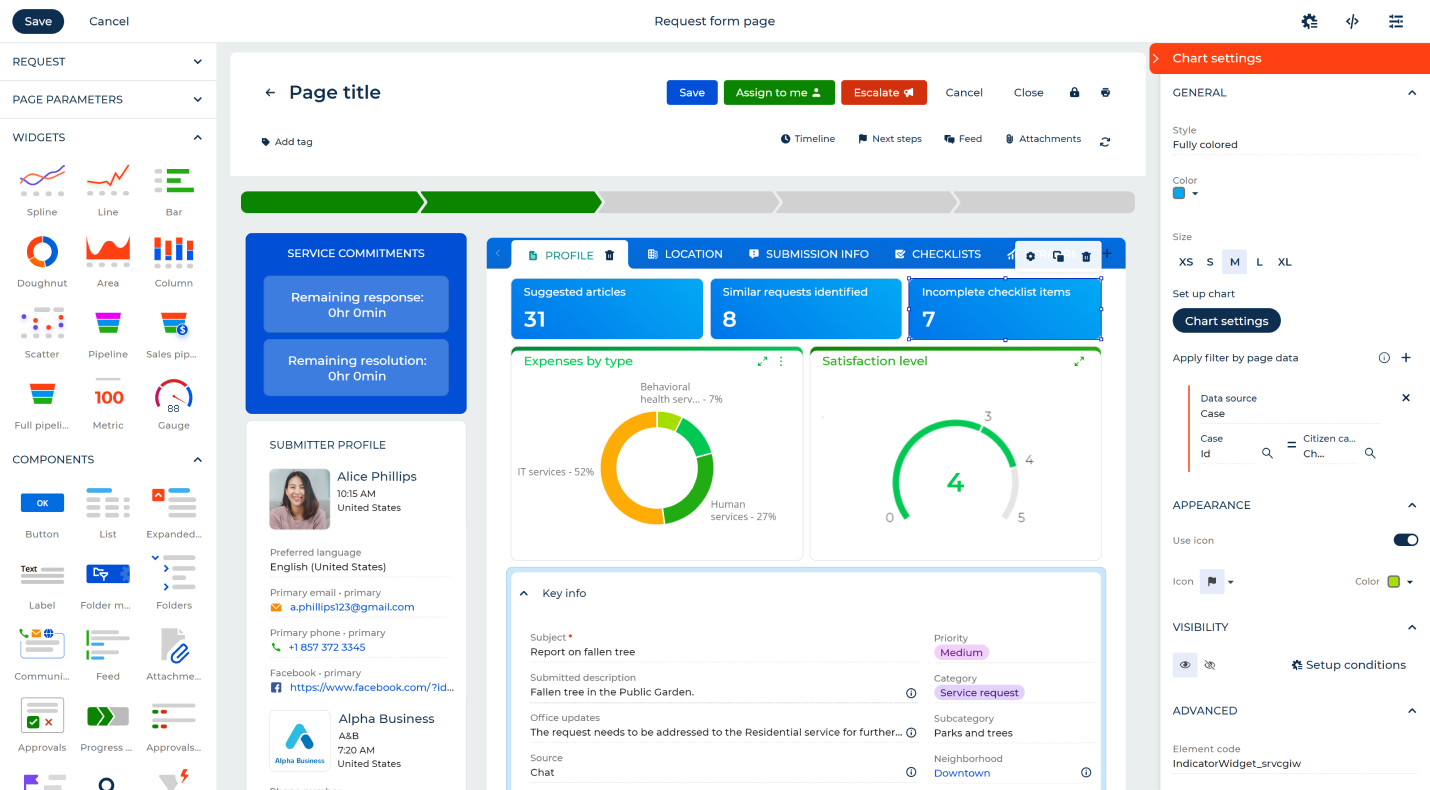
Creatio’s configuration process
Workflow Automation
Salesforce automates workflows through Salesforce Flow, approval processes, and Apex (for custom business logic to system events). While it supports a wide range of automation scenarios, the complex, cross-functional processes may require advanced configuration, custom coding, or deep integrations.
Creatio provides a unified AI-native environment for automating end-to-end customer and operational workflows across people and AI agents. Business users can design processes visually, adapt business rules as needs change, and build AI agents to automate complex workflows end-to-end.
One Creatio customer reported that processes which previously took 5-10 days can now be completed in minutes or hours. The company also reported a 40% reduction in process inefficiency across key workflows.
With Creatio, organizations can consolidate human execution, AI-driven automation, and agentic automation in a single workflow environment.
Usability, User Experience, and Adoption
Although Salesforce offers a mature, feature-rich interface, its broad product portfolio and extensive customization options can create a steeper learning curve for new users. Organizations often need administrators, training, and external support to help teams navigate the platform and use its capabilities effectively after adoption. User feedback also commonly points to the need to customize the interface and the lack of consistency across different parts of the platform.

Salesforce’s reporting dashboard for sales
Creatio is designed to provide a consistent, role-based user experience across CRM, workflows, and AI capabilities. It enables business users to tailor pages, dashboards, data views, and workflows using visual no-code tools and natural-language prompts. This can reduce training and technical-support needs, making it easier to turn changing business requirements into usable applications and processes without disrupting day-to-day operations.

Creatio Sales dashboard
AI Capabilities
Both Creatio and Salesforce offer predictive, generative, and agentic AI capabilities. The key difference is how organizations build, govern, and scale AI use cases across CRM and operational workflows.
Creatio embeds AI directly into its CRM and workflow platform, allowing AI tools and agents to work with customer data, business rules, and live processes in context. Business teams can use one AI-native platform to build and run AI agents and AI-driven workflows that generate insights, recommend next steps, and execute complex processes across sales, marketing, service, and operations.
With Creatio Business Studio, teams can build applications using no-code visual tools and connect popular AI coding agents through SDKs. AI Studio supports the full enterprise-agent lifecycle — from design and testing to deployment, monitoring, and governance. AI Twin further simplifies agent creation: users describe a goal in natural language, and it assembles the required agents, workflows, and skills in a governed environment.
This approach helps organizations move AI initiatives from experimentation into everyday processes without separating AI from the data and workflows it is intended to improve. For example, a public-sector organization reported a 41% productivity improvement after using Creatio for AI-driven document validation and automated governance workflows. (Source: 2026 Nucleus Research benefit case study for public sector)

Creatio AI Studio: Agent Metrics
Salesforce delivers AI through several products, including Einstein, Agentforce, and Einstein 1 Studio. Einstein supports predictive and generative AI use cases, Agentforce enables autonomous agents, and Einstein 1 Studio provides tools to build custom AI experiences. This can be a strong approach for organizations already invested in the Salesforce ecosystem; however, they should assess how the required products, data foundation, implementation resources, and consumption-based services affect the overall cost and complexity of scaling AI.

Salesforce Einstein
Industry CRM Capabilities
Salesforce offers a range of industry-specific CRM capabilities through its dedicated “cloud” products, including financial services, healthcare, manufacturing, retail and public sector. These pre-built solutions help enterprises embed compliance, access specialized data models and functionality. At the same time, industry deployments can require multiple products, complex third party integrations, and additional technical resources to tailor the platform to specific business requirements.
As for Creatio, it offers an AI-powered CRM platform tailored for more than 20 industries, including financial services, manufacturing, pharma, public sector, and more. Organizations use Creatio’s industry-ready workflows, data models, and process templates as a starting point, then adapt processes, interfaces, and automation to their specific needs using AI coding agents and visual no-code tools. This enables teams to build, implement, and customize industry-specific AI solutions without being limited by rigid, preconfigured workflows.
The platform is also composable, allowing organizations to consolidate fragmented technology environments over time. For example, one financial institution replaced seven legacy systems with a Creatio’s unified, agentic no-code platform (Source: Nucleus Research benefit case study for financial services)
Integration Ecosystem and Extensibility
Both Creatio and Salesforce offer integration ecosystems, marketplaces, APIs, and partner networks to connect CRM platform with other business systems.
Creatio enables organizations to connect its AI CRM and workflow platform with external systems through native connectors, web services, and modular packages that help synchronize data and automate operations across the technology stack. Salesforce offers AppExchange, APIs, and MuleSoft for enterprise integration scenarios, including ERP, marketing automation, and e-commerce platforms. However, in complex environments, Salesforce integrations may require more specialized development and integration resources to configure and maintain.
Pricing and Total Cost of Ownership
Creatio and Salesforce take different approaches to pricing, particularly when organizations plan to scale adoption across teams, workflows, and AI use cases. Creatio offers composable pricing for its core platform and CRM products, as well as an Unlimited Enterprise model designed for enterprise-wide deployment.
Under Creatio’s Unlimited model, organizations receive the full Creatio platform and CRM products with no limits on users, AI agents, workflows, applications, custom objects, or API calls. This allows organizations to seamlessly expand use of the platform across users, workflows, applications, and AI agents without per-user or per-usage limits.
Salesforce pricing is primarily product- and user-based, with costs varying by cloud, edition, AI products and AI usage. Its total cost can also include implementation, customization, integrations, developer or admin resources, consulting, maintenance, and training.
When comparing the total cost of ownership for both vendors, organizations should look beyond initial license prices and also assess their expected scale, technical requirements, and AI adoption plans. For enterprises planning to expand users, workflows, applications, and AI agents broadly, Creatio’s Unlimited model can offer a more predictable alternative to Salesforce’s product-, seat-, and usage-based approach.
Creatio AI Studio vs. Salesforce Agentforce
AI agents are becoming a strategic enterprise priority rather than a standalone innovation project, and according to Creatio’s State of AI Agents and No-Code report, 86% of executives said AI agents already entered boardroom conversations.
In terms of the vendors’ agentic capabilities, both Creatio AI Studio and Agentforce provide tools to build, deploy, and manage AI agents. The difference lies in how each vendor brings together agent development, business workflows, integrations, governance, and pricing.
Creatio AI Studio is an AI-native platform for managing the end-to-end enterprise agent lifecycle, and is integrated directly into the core Business Studio platform. Salesforce Agentforce is a dedicated platform for building and operating autonomous agents within Salesforce’s broader CRM ecosystem. Below we’ve outlined a couple of criteria to help you evaluate each vendor’s strengths.
AI Agent Development and Customization
Creatio AI Studio enables teams to configure, test, and deploy AI agents using natural-language prompts and no-code visual designers. Business users can customize Creatio’s built-in CRM AI agents for marketing, sales, and service, or create agents for their own roles and industry-specific use cases without writing code. For the most complex agentic tasks, developers can use Creatio coding-agent SDKs and extend AI Studio with their favorite coding agents.
Creatio also offers AI Twin, Creatio’s native builder agent for creating, modifying, deploying, and operating AI agents inside Creatio. With a native knowledge of Creatio data objects and workflows, it can assemble AI agents, skills, and agentic workflows based on a high-level description from a user, giving employees a faster starting point for testing and refining an agentic solution, as well as automatically handling governance and security within Creatio’s governance framework.
Salesforce Agentforce provides Agentforce Builder for creating, customizing, testing, and monitoring agents. Teams can define agents, subagents, actions, instructions, variables, and routing, then use prompt templates, APIs and tools like Salesforce Flow and Apex to connect agents with business logic and external systems.
Compared with Agentforce’s admin- and developer-led approach, Creatio makes agent development more accessible to business users through natural-language prompts, no-code tools, and AI Twin.
Connecting Agents to Business Work
Creatio connects AI agents directly to CRM data, applications, and business processes within the same AI-native platform. It offers AI-driven tools that automate routine tasks and support decision-making, AI agents that assist employees with work such as data entry and lead scoring, and autonomous agents that execute defined, multi-step processes in complex industry workflows, including financial services and manufacturing.
Like Creatio AI Studio, Salesforce Agentforce connects AI agents to daily business operations through CRM data, enterprise APIs, and workflows. Its agents can execute multi-step tasks across sales, service, and marketing while operating within defined business guardrails.
AI Governance and Enterprise Lifecycle Management
As organizations scale AI adoption, they need clear controls over what agents can access, how they act, and when human review is required.
Creatio AI Studio centralizes agent design, testing, deployment, monitoring, and governance. Organizations can monitor agent activity, execution history, triggers, and outcomes; set data-access permissions and execution constraints; and enforce policies, approvals, audit trails, and human-in-the-loop checkpoints for sensitive actions.
Creatio AI agents operate within defined role contexts and inherit the permissions of the associated user or configured service role. This applies existing access, workflow, and approval controls to AI-enabled processes. Creatio’s AI Trust Framework supports transparency, traceability, data protection, and risk-based controls, and is designed to align with evolving AI governance and data-protection requirements, including EU AI Act principles.
Salesforce provides governance and observability through Agentforce tools, enabling teams to test agents before deployment, monitor performance and consumption, analyze interactions, and refine agent logic over time. Centralized monitoring and optimization for deployed agents is provided through a separate Agentforce Observability tool.
To summarize, both platforms provide robust enterprise AI governance capabilities. Creatio emphasizes applying governance controls within AI-enabled workflows, while Salesforce places a stronger emphasis on observability and optimization of deployed agents.
AI Pricing
The platforms also differ in how they price AI and agentic capabilities.
Creatio AI Studio is integrated directly into the Creatio platform and available across its all products; Creatio Business & AI Studio pricing starts at $40 per user/month. Organizations can also purchase additional AI Packages to scale their AI adoption, which may be easier to evaluate for teams that want to build and scale agents alongside CRM and workflow automation on one platform.
Salesforce Agentforce comes as a separate add-on, building on the relevant Salesforce products and licenses already used by the organization. It offers several pricing approaches: $2 per conversation and Flex Credits priced at $500 per 100,000 credits (according to Salesforce, a standard agent action uses on average 20 Flex Credits, or $0.10). It also provides add-ons for industry solutions, ranging from $125 through $550 per user/month.
To summarize, Creatio AI Studio is best suited to organizations prioritizing unified agentic workflows, broader business-user participation, and more predictable scaling. Agentforce is a natural fit for extending an established Salesforce environment. However, the choice is not always either-or: Creatio can replace, consolidate, or coexist with Salesforce based on the organization’s architecture and AI roadmap.
Final Verdict: Creatio AI Studio vs. Agentforce
Overall, the main differences between two AI platforms come down to who can build agents, how they are governed, and how AI usage is priced. Creatio AI Studio makes agent development accessible to both business and IT teams, provides centralized governance, supports multiple AI models, and uses a unified AI Credit model that covers all AI consumption across any model and any provider. Agentforce is designed primarily for organizations with established Salesforce expertise and adds usage-based AI costs to existing licenses. While it extends an existing Salesforce environment, Creatio provides a more unified path to scaling agentic AI across the enterprise.
G2 Scores: Creatio vs. Salesforce
Customer feedback is an essential part of the evaluation process, offering a practical view of how each platform performs after implementation. The G2 scores below compare Creatio and Salesforce across key criteria reported by verified users.
G2 score highlights | Creatio | Salesforce |
| Ease of Setup | 8.4 | 7.8 |
| Ease of Admin | 8.6 | 7.9 |
| Avg ROI | 11 months | 15 months |
| Quality of Support | 9.2 | 8.0 |
| Contact & Account Management | 9.0 | 8.8 |
| Leads Management | 9.1 | 8.5 |
| Customization | 8.8 | 8.5 |
| Workflow Capability | 9.0 | 8.5 |
| Ease of Use | 9.0 | 8.1 |
| Mobile User Support | 8.5 | 7.7 |
Compared with Salesforce, Creatio scores higher for ease of setup, ease of administration, workflow capability, customization, and quality of support. It enables organizations to configure and evolve CRM processes with less technical complexity — one of Creatio’s key differentiators. Salesforce remains strong in its ecosystem, advanced customization options, and partner network.
Where Creatio Wins?
- Faster implementation and faster ROI: Creatio’s AI-native engine, coding agents and no-code visual tools help teams reduce delivery cycles and reliance on dedicated technical resources.
- Higher-rated sales force automation and pipeline management: With Creatio, sales teams can adapt processes, automate approvals, and manage complex customer journeys without relying heavily on developers or CRM administrators
- More agile marketing workflows with no-code automation: Helps marketing teams launch and modify campaigns faster without lengthy development cycles, supporting advanced automation of campaign workflows and lead management.
- Higher customer satisfaction with service and case management: Enables teams to quickly configure service operations and automate repetitive tasks without extensive technical effort.
- Easier customization with no-code tools: Allows organizations to easily modify workflows, automate processes, and build custom applications without deep IT involvement.
- Lower complexity for business: Requires less training and less dependency on specialized administrators to manage automation, reporting, and configuration changes.
Where Salesforce Wins?
- Large ecosystem and AppExchange marketplace: Provides a broad selection of third-party applications, integrations, and implementation partners.
- Established Salesforce technical talent: Offers a large global network of certified developers, consultants, and specialized agencies.
- Deep customization for Salesforce-centric enterprises: Supports complex configuration and automation through Salesforce tools such as Flow and Apex code.
- Continuity for existing Salesforce customers: Can be the natural choice for organizations already invested in Salesforce clouds, data models, and development practices.
Why Companies Switch from Salesforce to Creatio
Back in 1999, Salesforce transformed the CRM market by replacing many legacy on-premises systems with a cloud-based delivery model. Today, a similar shift is underway as organizations reevaluate and replace legacy software products in favor of AI-native platforms like Creatio.
Organizations typically consider moving from Salesforce to Creatio to reduce total cost of ownership (TCO), accelerate implementation, and give business teams more freedom to adapt workflows without relying heavily on developers. According to independent Nucleus Research, organizations that switched to Creatio from legacy systems, like Salesforce and Microsoft, achieve up to 70% faster implementation and a 37% reduction in total cost of ownership.

The case studies below demonstrate why organizations assess Creatio as a Salesforce alternative: they need a platform that can support complex CRM and workflow automation while ensuring scalable implementation, customization, and AI adoption.
Avidia Bank: Scaling innovation with Creatio’s Agentic CRM
Avidia Bank, a community bank with approximately $3 billion in assets, replaced its legacy CRM with Creatio to unify commercial lending, HR, and customer service. In six months, the bank achieved what its previous CRM initiative had not delivered in six years, creating a stronger foundation for workflow automation and AI-enabled operations.
Today, 86% of Avidia’s workforce uses Creatio. The platform provides a single source of truth across business lines and supports experiences tailored to how relationship managers work.

Building on its automated workflows, Avidia is now advancing AI-enabled decision support with Creatio. The bank is developing an AI banking agent that surfaces key customer information like recent deposits, balances, open opportunities, and recent interactions – in a single view to help relationship managers prepare faster and make better-informed decisions.
Learn more about the success story of Avidia Bank.
Howdens: 6x faster deployment speed
Howdens, the UK’s leading specialist kitchen supplier, faced an 18-month, multi-million-dollar Salesforce rollout. Instead, the company chose Creatio and deployed the platform across its first 20 pilot depots in just 12 weeks.

Within six months, Howdens captured more than 1,200 qualified leads and increased its sales conversion rate by 18.75%, from 32% to 38%.
Learn more about Howdens’ experience with Creatio.
Everwise Credit Union: An agentic CRM for enhanced customer relationships
Everwise Credit Union, Indiana’s largest credit union, carefully evaluated the market, including Salesforce and Microsoft — both of which they had experience implementing. The decision to choose Creatio's AI-powered CRM came down to something beyond product capabilities: the quality of the relationship.

Using a Scrum and Agile approach, Everwise validated requirements across all 27 departments before full implementation. Creatio’s no-code architecture enabled business users to configure workflows and agentic automation themselves, which was essential for the enterprise-wide rollout.
Discover success story of Everwise Credit Union.
Which Vendor Should You Choose: Creatio or Salesforce?
Choose Creatio if your priority is to improve operational performance, accelerate AI adoption, and scale CRM and industry workflows on a unified AI-native platform. It is particularly well suited to organizations facing:
- Fragmented customer and operational processes across multiple systems
- AI pilots that need to rapidly become governed, executable workflows
- Industry-specific requirements for agentic automation
- Slow delivery cycles caused by heavy reliance on developers or external consultants
- Rising costs as users, workflows, applications, API usage, and AI adoption expand
You can choose Salesforce if your organization prioritizes its broad CRM ecosystem, extensive marketplace, and deep customization supported by established Salesforce expertise. For existing Salesforce customers, however, the decision is not necessarily an either-or choice. Creatio supports three modernization paths:
- Replace: Move the front office to Creatio to unify CRM, workflows, and AI on one platform.
- Consolidate: Retain Salesforce where it provides the most value while moving other processes and capabilities to Creatio.
- Coexist: Keep Salesforce as the system of record and deploy Creatio alongside it as an AI-native workflow and orchestration layer.
The right approach depends on your existing architecture, transformation priorities, technical resources, and long-term AI strategy. Creatio can support a complete platform transformation or help simplify and extend an established Salesforce environment.
Summary
Creatio and Salesforce are both established platforms for managing customer relationships and supporting enterprise transformation. Each offers strengths that can deliver meaningful business value.
Having compared Creatio vs. Salesforce, we see Creatio as a stronger and more flexible option for organizations seeking an AI-native CRM and workflow platform that brings embedded AI capabilities, no-code visual designers, and agentic automation together in one environment. It helps midsize to large companies connect customer and operational workflows, reduce reliance on custom development, and scale AI-driven tools, AI agents, and autonomous agents with enterprise-grade governance.
Request a guided demo to see how Creatio help your accelerate AI adoption, and scale innovation with confidence.
FAQ
Is Creatio better than Salesforce?
Neither platform is universally “better,” as the right choice depends on your needs. Creatio is a strong alternative to Salesforce for organizations seeking an AI-native CRM and workflow automation platform to build agents and applications without extensive development, while Salesforce suits businesses that need a broad integration ecosystem and developer-led customization.
How much does Creatio cost compared to Salesforce?
Creatio is significantly more affordable than Salesforce due to its lower total cost of ownership, faster implementation, and embedded AI capabilities. Creatio Business & AI Studio starts at $40 per user/month, with CRM products at $15 per user/month each. Salesforce CRM pricing starts at $25 per user/month for its Starter Suite, while AI capabilities, locked Salesforce Einstein and Agentforce, may be billed separately.
Can Creatio replace Salesforce?
Yes. Creatio can replace Salesforce for many midsize and enterprise organizations seeking embedded AI, flexible customization, faster deployment, lower total cost of ownership, and unified CRM and workflow automation capabilities.
What is the main difference between Creatio and Salesforce?
The key difference between Creatio and Salesforce is their core approach: Creatio enables businesses orchestrate and run human-led and agentic workflows within its unified AI CRM and workflow platform, while Salesforce is a massive ecosystem powerhouse relying on extensive custom development and third-party intergations.
How long does Creatio implementation take compared to Salesforce?
Creatio implementation is generally faster than Salesforce, with enterprise setups typically documented at 4-12 weeks (or up to 70% faster overall, according to Nucleus Research), whereas Salesforce deployments range broadly from a few weeks to over a year depending on project scope and complexity.
