


































































Best AI Agents in 2026: Top Platforms and How to Choose

Automate End-to-End Workflows with Creatio AI Agents

In 2026, AI agents are becoming a core layer of modern business operations, with 67% of enterprises already considering AI agents as a crucial part of their digital transformation. While early AI tools focused on content generation and basic automation, today’s leading solutions go further, shifting from generative AI to agentic AI that can make decisions, take actions, and execute complex workflows autonomously.
The best AI agents go beyond simple assistance. They analyze data, coordinate tasks across systems, and continuously optimize outcomes, becoming an active part of business operations. In the age of AI, businesses need these capabilities to scale efficiently, reduce manual work, and stay competitive.
Key Takeaways
- All-in-one enterprise platforms (e.g., Creatio, Agentforce, Kore.ai) provide end-to-end automation across business processes and enterprise-grade security, governance, and compliance
- Customer and employee experience agents (e.g., Moveworks, Cognigy, HubSpot) focus on service, support, and conversational use cases
- Simple workflow automation tools with AI (e.g., Zapier AI) extend traditional automation with lightweight agent capabilities but lack full autonomy
- AI agent builders (e.g., Creatio, Relevance AI) enable the creation of specialized agents, often centered around data and specific tasks
- Multi-agent frameworks (e.g., CrewAI, AutoGen) are designed for orchestrating collaboration between multiple agents, primarily for developers
- Developer frameworks (e.g., LangChain, LangGraph) provide the building blocks for custom agent systems but require significant engineering effort and is primarily used by technical teams
- When choosing the best AI agents, organizations should focus on data integration, security, ease of use, scalability, ease of integration with existing tech stack, and the depth of reasoning capabilities
What Are AI Agents?
AI agents are autonomous or semi-autonomous systems powered by artificial intelligence that can understand context, reason, make decisions, and take actions to accomplish multi-step tasks with minimal human intervention.
Unlike traditional automation, they can dynamically adapt to changing inputs and conditions rather than following fixed rules. By combining data analysis, decision-making, and execution, AI agents can operate as active participants in business processes, not just passive tools.
Key Features of the Best AI Agents
The capabilities of AI agents can vary widely, but the best tools share a common set of features that enable them to operate reliably, scale across use cases, and deliver real value.
Below are the key characteristics that define leading AI agents today:
- Autonomy - the best AI agents can operate with minimal human intervention, independently planning and executing specific tasks toward a defined goal
- Multi-step reasoning - AI agent tools use advanced LLM models to analyze context, break down problems into manageable tasks, and make informed decisions rather than following fixed rules
- Tool integration - top AI agents connect to different tools, APIs, and systems, enabling them to perform actions across tools
- Memory - they retain and use past interactions and data to maintain context, learn, and improve their performance over time
- Security/Governance - strong safeguards ensure agents operate within defined boundaries, protecting data, enforcing policies, and maintaining accountability.
Best AI Agent Platforms in 2026
The AI agent platform landscape in 2026 includes a mix of enterprise-grade solutions, automation platforms, and developer frameworks. While many vendors offer strong capabilities in specific areas, only a few top AI agent platforms for business provide a unified approach to building, deploying, and governing AI agents at scale.
Here is the best AI agent platforms comparison:
| Platform | Best for | Pricing | Customer rating (G2) |
| Creatio AI Agents | End-to-end enterprise AI agent platform for full customer lifecycle and workflow automation | Starting at $40/user/month + AI Actions | 4.8 |
| Agentforce (Salesforce) | Salesforce-centric organizations focused on CRM automation | Starting at $550/user/month + Flex Credits | 4.3 |
| Moveworks | Internal enterprise support (IT, HR) automation | On request | 4.6 |
| Kore.ai | Conversational AI for customer and employee interactions | On request | 4.6 |
| Cognigy | Contact center and customer service automation | On request | 4.6 |
| Relevance AI | Data-driven AI agents for startups and mid-market teams | Starting at $19/user/month + actions | 4.3 |
| CrewAI | Developers experimenting with AI agents | Free plan + custom enterprise pricing | N/A |
| LangChain / LangGraph | Developers building custom AI agent frameworks | Free plan + paid plan starting at $39/user/month + usage fees | 4.4 |
| Zapier AI | Simple cross-app automation with lightweight AI | Starting at $69.99/user/month | 4.5 |
| HubSpot | AI-assisted automation inside HubSpot CRM software | Starting at $90/user/month + Credits | 4.4 |
1. Creatio AI Agents
Best for: End-to-end enterprise AI agent platform for full customer lifecycle and workflow automation
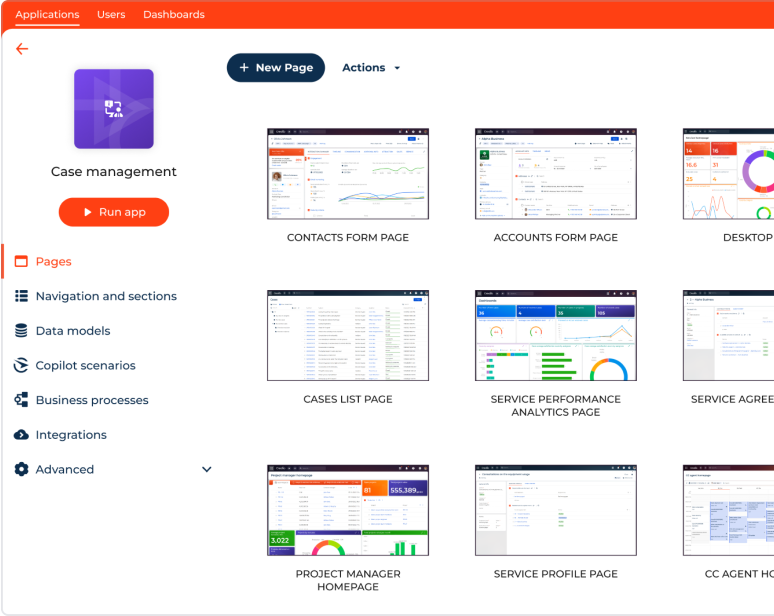
Creatio is an AI agent platform that offers the best-in-class agents built on an agentic platform that combines human-led and fully agentic execution, aligned with how modern organizations operate and scale in the AI era. It enables organizations to design, deploy, and manage agents within a single environment that combines AI, workflow automation, and data.
Creatio AI agents are intelligent entities that understand desired outcomes and find the best path to achieve business goals. They are built to support core business functions, including sales, marketing, customer service, and industry-specific processes. Creatio provides a fully integrated layer that enables multiple agents to operate natively within CRM and enterprise systems, automating complex, cross-functional workflows.
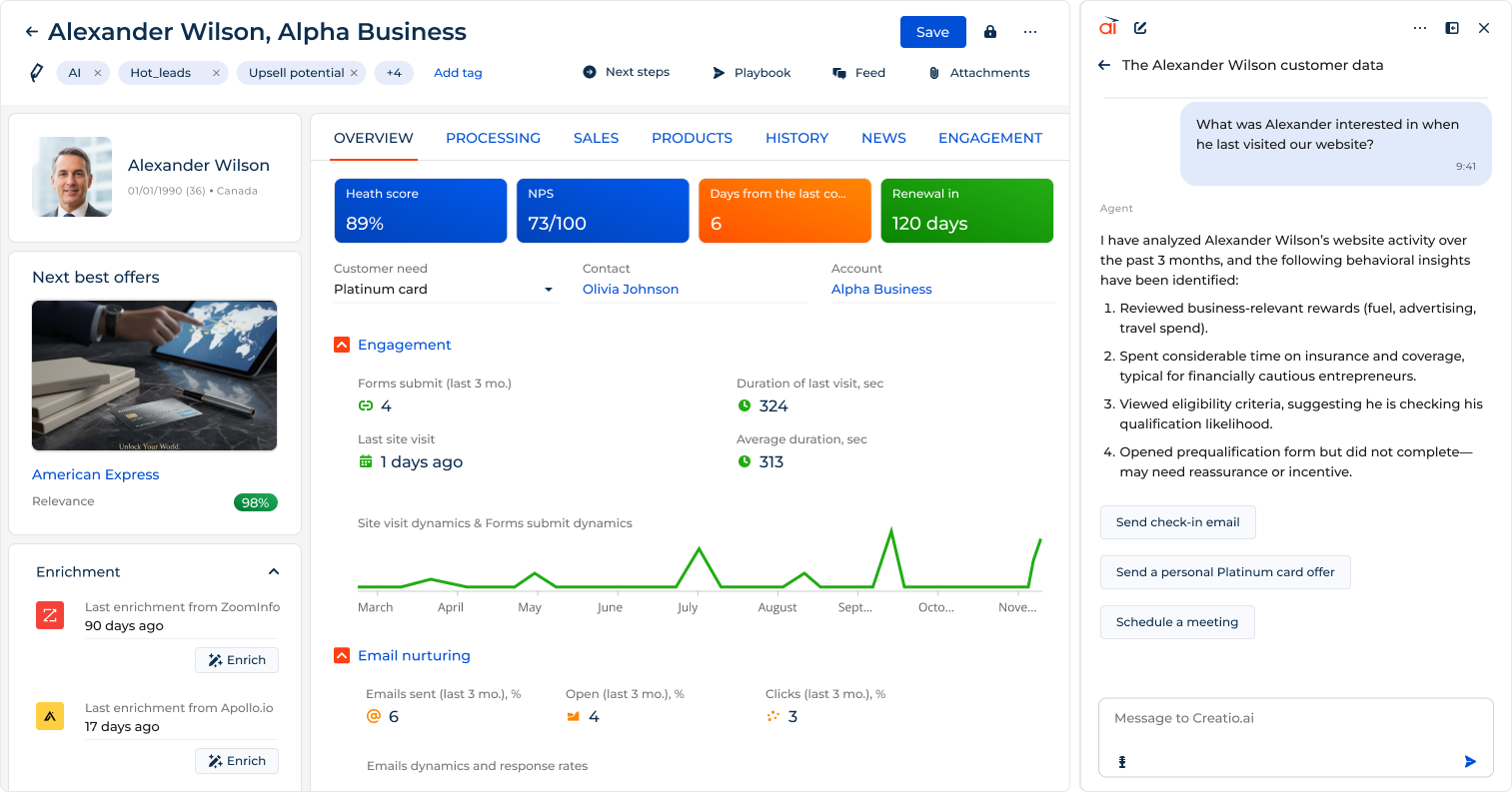
At the core of the platform are CRM AI agents tailored to specific business responsibilities. These agents continuously analyze context, recommend next steps, and take action to complete complex tasks. In addition, Creatio supports AI-assisted no-code development, enabling users to design, build, and optimize business processes and applications faster. By embedding AI directly into everyday tools such as CRM, Outlook, Teams, and other enterprise platforms, Creatio ensures that insights and automation are delivered where users already work, without disrupting existing processes.
Creatio CRM agents include:
- Sales Agents - automate lead scoring, personalize outreach, and accelerate sales cycles by helping sales team prepare for meetings, generating forecasts, and recommending next-best actions. They also enrich account data, update the CRM, automate quoting, and streamline territory management and order fulfillment.
- Marketing Agents - scale content creation and campaign execution by segmenting audiences, orchestrating omnichannel campaigns, personalizing messaging, and continuously optimizing performance. They also streamline lead scoring and distribution, ensuring faster conversion.
- Service Agents - improve resolution speed and accuracy by creating, prioritizing, and summarizing cases, extracting insights, recommending actions, and streamlining communication across channels.
The platform also supports vertical AI agents for industry-specific use cases. For financial institutions, Creatio provides autonomous banking agents that operate with a high level of autonomy, streamlining complex workflows, reducing operational costs, and enhancing customer experiences. Importantly, Creatio banking agents can be deployed independently of the Creatio platform, allowing organizations to run them within existing systems and environments without requiring a full platform adoption, an approach that remains unique on the market.
Autonomous agents for banking include:
- Revenue-Generation Agents - referral, renewal, and retention agents help banks and credit unions generate new business and retain existing customers.
- Operational Excellence Agents - customer onboarding, loan preparation, and loan servicing agents, significantly decrease operational costs and improve customer experience
— responsibly, measurably, and at scale.
A key differentiator is Creatio’s no-code Agent Builder, which allows business users with no technical skills, not just developers, to create and customize their own AI agents. Users can describe new agents in natural language to the coding agent, use a visual workflow builder, define agent skills, and connect data sources without writing code, significantly accelerating deployment and adoption.
As a unified platform, Creatio enables enterprise companies to seamlessly scale by adding agents, workflows, and use cases as needed, while maintaining enterprise-grade security, compliance, and transparency through human oversight and policy enforcement, enabling businesses to adopt AI with confidence.
Key features
- AI-assisted no-code development
- AI Agent Builder for business users and IT
- Agentic execution across business processes
- Pre-built CRM AI agents for sales, service, and marketing teams
- Autonomous agents for banks and credit unions
- Embedded AI directly in productivity tools
- AI Command Center for monitoring and managing agents
- Enterprise-grade governance, security, and compliance controls
Pros
- True end-to-end AI agent platform
- Multi-agent collaboration across business processes
- Enables both business and IT to build agents
- AI-powered no-code approach significantly reduces time to deployment
- Strong governance and enterprise readiness
- A rich marketplace of third-party applications
- Highly flexible and customizable for different industries
- Unified environment eliminates the need for multiple disconnected tools
Cons
- Maybe more than needed for small, single-use cases
Rating
G2: 4.8/5
Pricing
Creatio pricing starts at $40 per user per month, with AI Actions packages starting at $416 per month for 25.000 Actions. All pre-built CRM agents and AI features are included in the core product, with no additional licenses required.
2. Agentforce
Best for: Salesforce-centric organizations focused on CRM automation
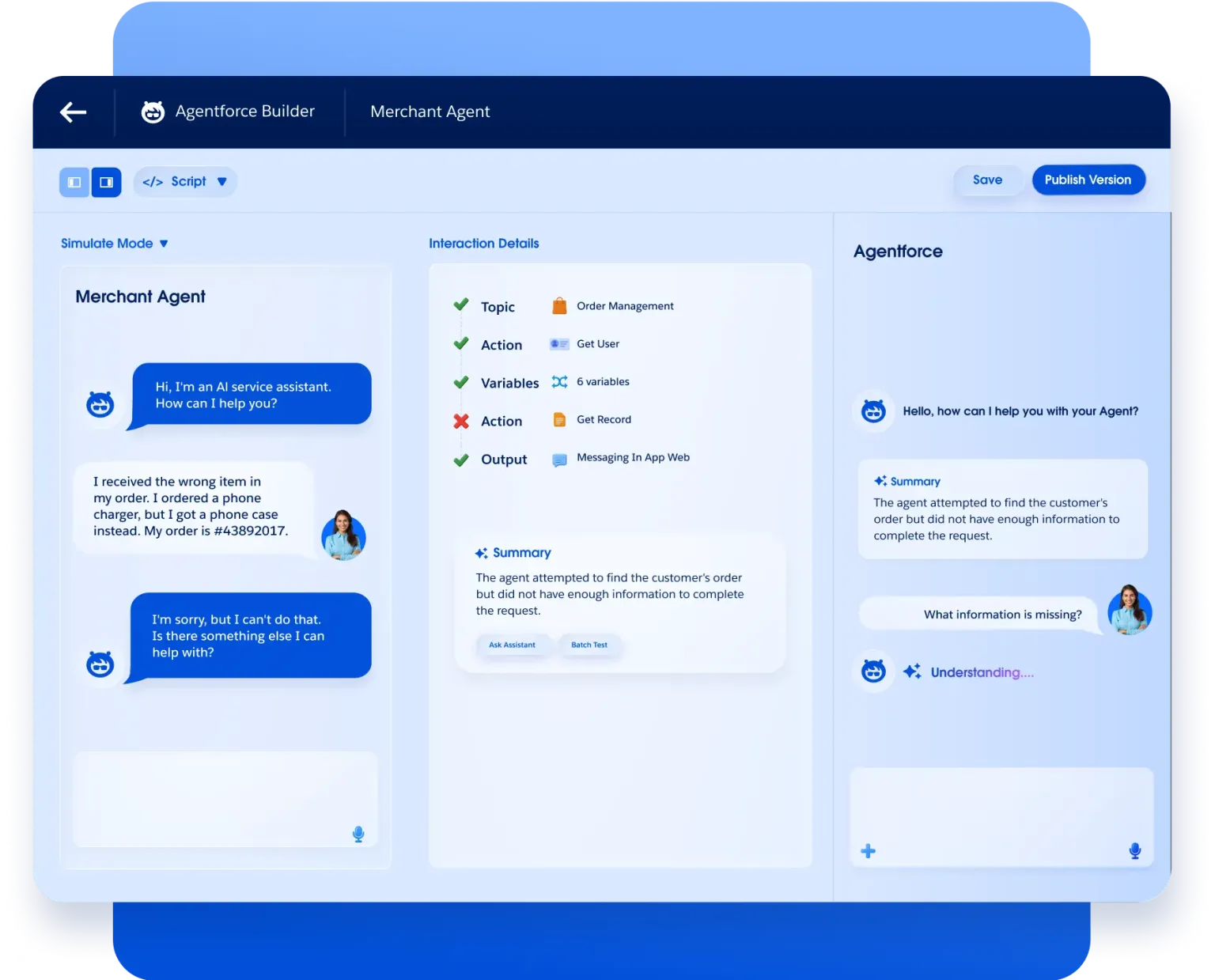
Agentforce is an agentic platform by Salesforce that’s designed to build, deploy, and manage AI agents. It focuses on automating sales, service, and customer engagement processes across applications, conversations, and workflows. Agentforce enables enterprise teams to leverage pre-built agents and customize new ones with pro-code and low-code tools. While powerful within Salesforce, it is primarily designed for organizations already invested in that ecosystem.
Key features
- Pre-built CRM-focused agents
- Agentforce Builder combines drafting, testing, and deployment in a single workspace
- Agent Script controls AI agents with deterministic workflows and LLM reasoning
- Agentforce Voice enables AI-powered voice capabilities across web and mobile
- Intelligent Context extracts information from unstructured sources
- Agentforce Guardrails enable control over agent behavior
- Enterprise compliance and data security features
Pros
- Good solution for existing Salesforce customers
- Deep Salesforce data integration
- Mature enterprise infrastructure and security
Cons
- Heavily tied to the Salesforce ecosystem
- Significant learning curve
- Limited flexibility outside CRM use cases
- Requires technical skills and coding experience to create new agents
- High cost and pricing complexity
Rating
G2: 4.3/5
Pricing
Pricing for the Salesforce platform, including full Agentforce capabilities, starts at $550 per user per month. An additional 100k Flex Credits can be purchased for $500.
See also: Salesforce Alternatives & Competitors
3. Moveworks
Best for: Internal enterprise support (IT, HR) automation
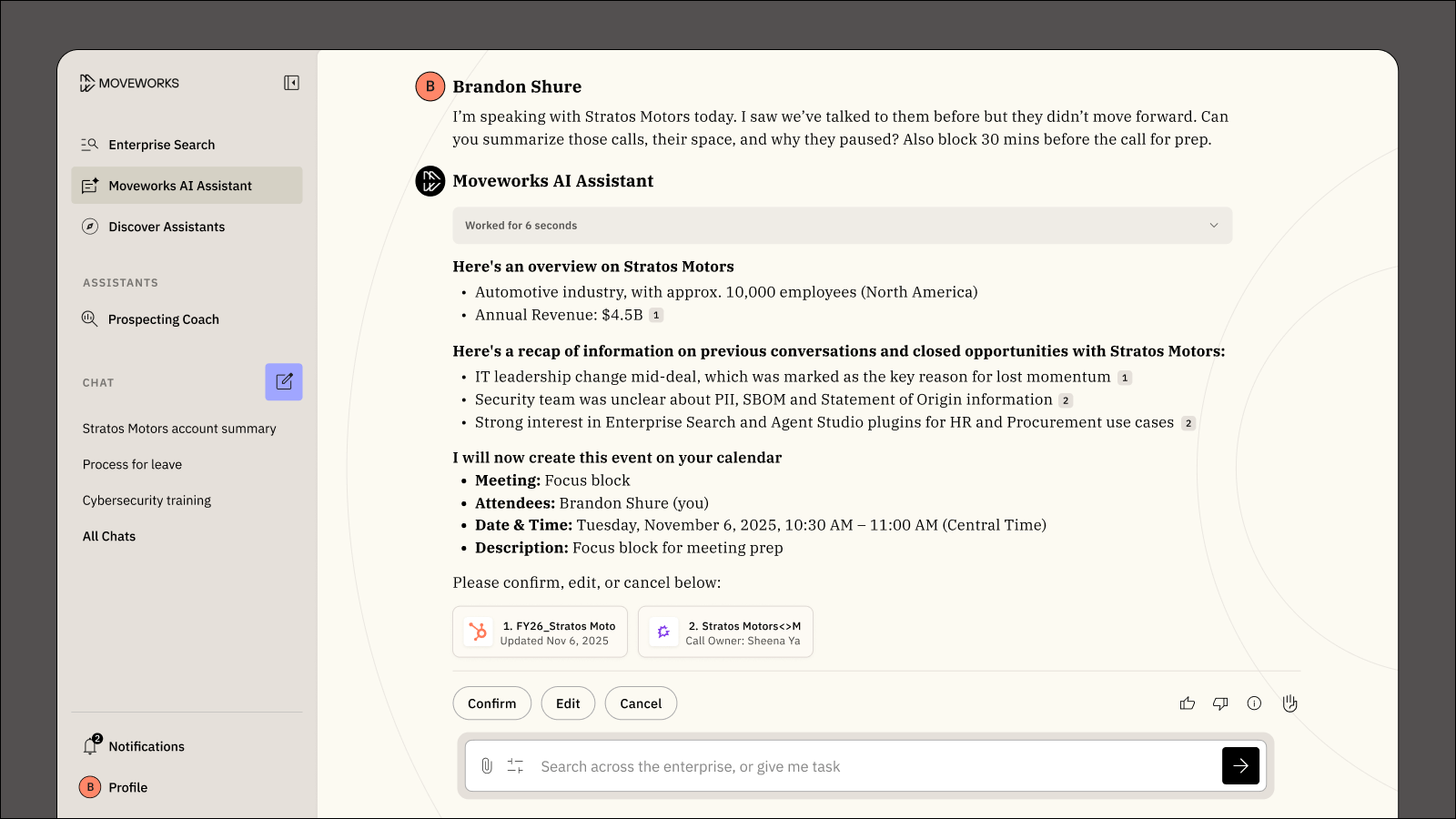
Moveworks is an AI Assistant platform that automates internal enterprise operations using AI agents, particularly in IT and HR support. Its platform is designed to resolve employee requests and support tickets with rich search functionality and automated workflows. However, its scope is largely limited to support internal use cases rather than agentic business process automation.
Key features
- Pre-trained agents for employee support
- Reasoning Engine for enterprise-wide automation
- AI Agent Marketplace provides a library of ready-to-use AI agents
- Enterprise Search delivers context-aware answers
- Agent Studio for building and customizing agents
Pros
- Effective for specific internal use cases
- Real-time analytics for AI deployment
- Trust, security, and data privacy for AI governance
Cons
- Narrow focus (IT/HR)
- Lack of autonomous agentic capabilities
- Lack of no-code tools; requires developing skills to create new agents
Rating
G2: 4.6/5
Pricing
Custom pricing is available upon request.
4. Kore.ai
Best for: Conversational AI agents for customer and employee interactions
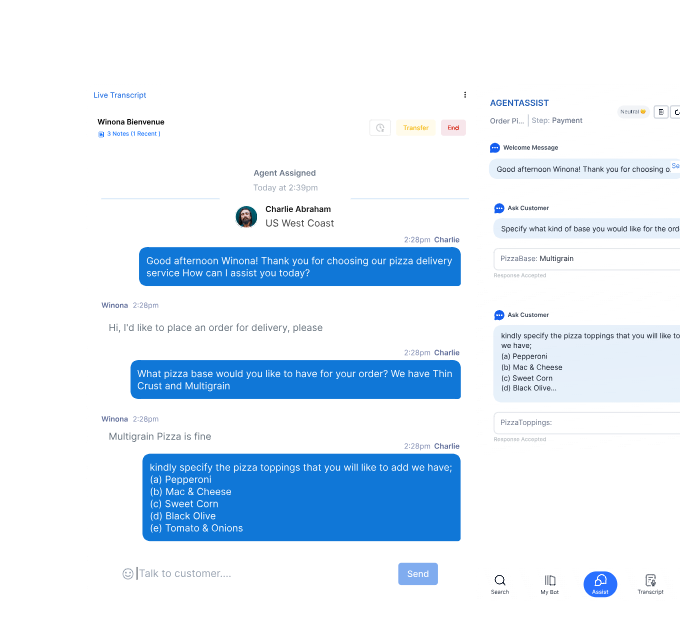
Kore.ai offers a unified AI platform designed to build, orchestrate, and optimize AI agents and agentic workflows across systems, use cases, and teams. It provides a wide range of tools and pre-built solutions, particularly for chat and voice automation. Kore.ai also provides industry-specific agents for retail, healthcare, and banking. However, its approach can feel fragmented when applied to broader workflow-driven automation, compared to other solutions.
Key features
- Omnichannel conversational agents
- Multi-agent orchestration capabilities for complex tasks
- Real-time observability to monitor, analyze, and optimize agent behavior
- Enterprise-grade governance and compliance tools
Pros
- Wide range of pre-built solutions
- No-code tools for non-technical users
- Consistent omnichannel experience
Cons
- Complex platform with steep learning curve
- Less unified approach to workflows and automation
- Lack of autonomous capabilities
Rating
G2: 4.6/5
Pricing
Custom pricing is available upon request.
5. Cognigy
Best for: AI-powered customer service chatbots for enterprise contact centers
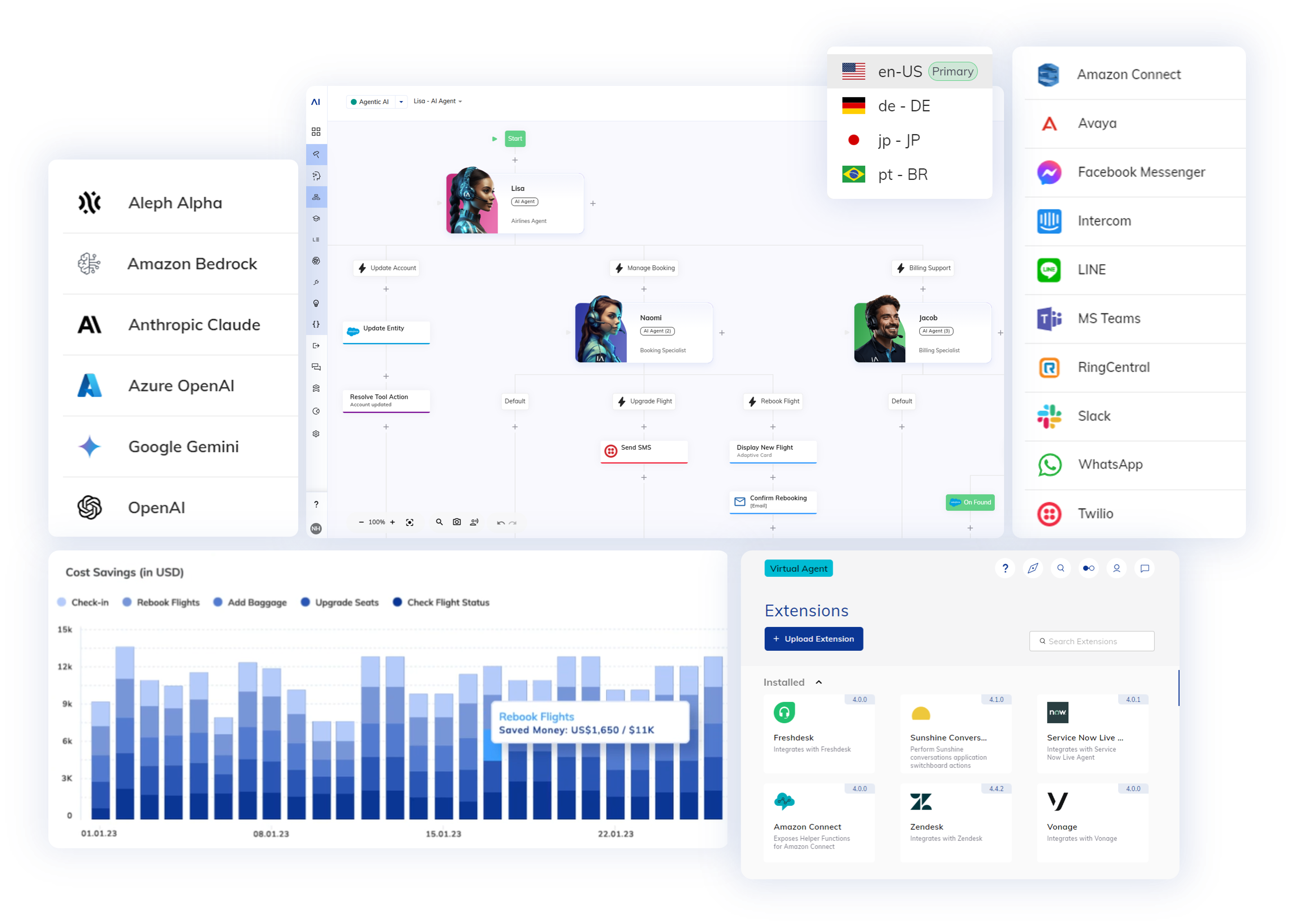
Cognigy specializes in AI-driven customer service automation for enterprise contact centers. It enables organizations to deploy voice and chat agents powered by conversational and generative AI across multiple channels, providing round-the-clock customer support. While strong in CX, it is not designed as a general-purpose AI agent platform.
Key features
- AI agents for voice and chat automation answer questions around the clock
- Intelligent routing with context for complex cases
- Omnichannel support across over 30 channels, including Webchat, WhatsApp, Facebook Messenger, and more
- Agent Copilot supports service agents with tools and knowledge
- Enterprise integrations with over 100 systems
Pros
- Great solution for contact center use cases
- Good voice capabilities
- Fluent in 100+ languages
- 360° insights into AI agents' performance
Cons
- Primarily limited to CX scenarios
- Not a general-purpose agent platform
Rating
G2: 4.6/5
Pricing
Custom pricing is available upon request.
6. Relevance AI
Best for: Data-driven AI agents for startups and mid-market teams
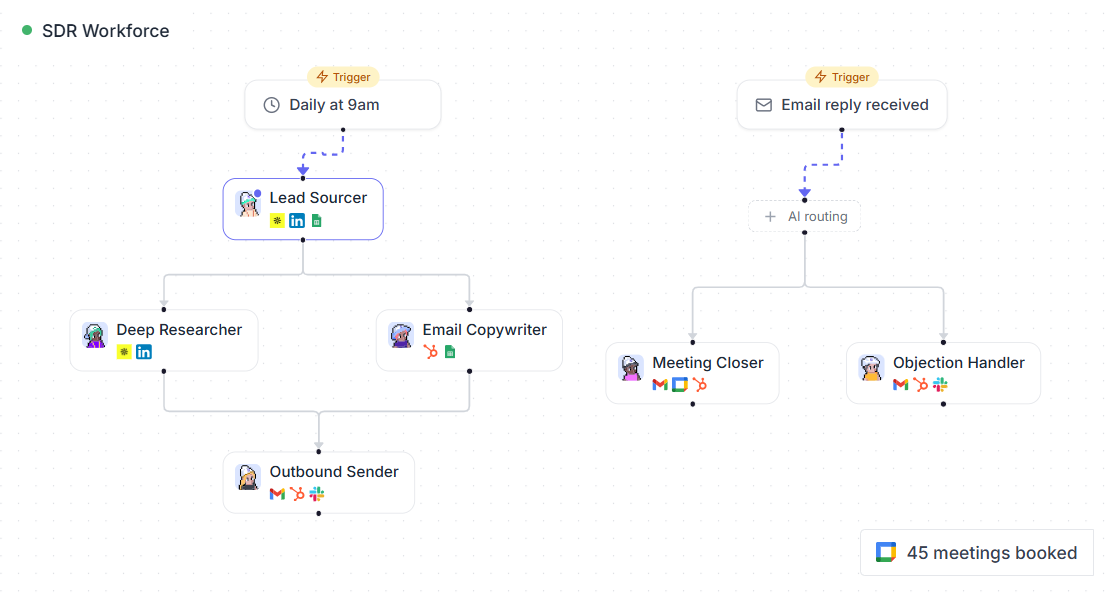
Relevance is an AI platform designed to build AI agents for knowledge work and operational tasks. It focuses on enabling GTM teams to create specialized agents and combine them into multi-agent teams capable of executing more complex workflows. Relevance offers a no-code AI agent builder and access to Claude Code & Codex to enable non-technical users, but doesn’t offer any industry-specific agents.
Key features
- No-code AI agent builder and Claude Code & Codex plugins
- SuperGTM offers AI teammates that support employees in their daily tasks
- AI workforces are multi-agent teams that can run autonomously
- API integrations with over 1000 applications
- A library of pre-built agents, including a BDR Agent, Research Agent, Inbound Qualification Agent, and Customer Support Agent
Pros
- Flexible and quick to prototype with no-code tools
- A rich library of ready-to-use agents
- Good for data-heavy use cases
Cons
- Lack of a unified platform for broad business process automation
- Governance and scalability are still evolving
- Lack of industry-specific agents
- Costs can rise quickly, especially for enterprise users
Rating
G2: 4.3/5
Pricing
Pricing for Relevance AI starts at $19/month with 30k actions/year.
7. CrewAI
Best for: Developers experimenting with AI agents
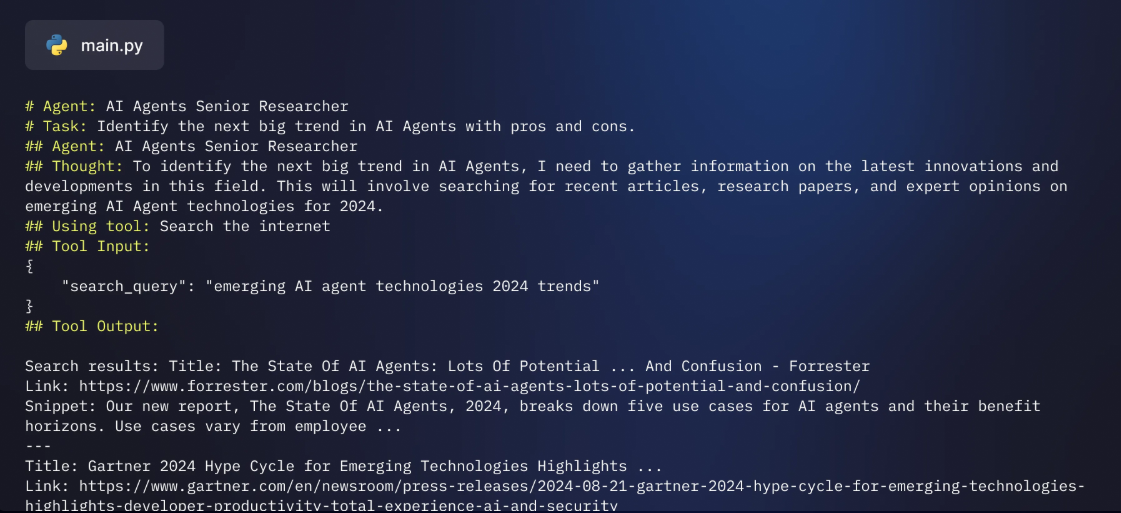
CrewAI is an open-source development space for building multi-agent systems in which agents collaborate in structured roles. It is primarily used by developers experimenting with agent orchestration and task delegation. It is not a complete platform and requires additional infrastructure for production use.
Key features
- Role-based multi-agent collaboration
- Integration with over 100 open-source tools
- Agentic RAG offers multiple knowledge sources (files, websites, and vector databases)
- Memory management system (short-term, long-term)
- Python-based framework
Pros
- Flexible for experimentation with AI agents
- Integrates with business applications via native integrations and custom API calls
- Real-time monitoring with operational insights
- Supports multiple LLMs, including OpenAI, Anthropic, Gemini, and Hugging Face
Cons
- Requires engineering expertise
- No built-in enterprise capabilities or pre-built agents
- Requires significant effort to develop and implement agents
- Not a complete platform
- Lacks enterprise-grade security and governance
- Not suitable for regulated industries
Rating
N/A
Pricing
CrewAI offers a free plan for up to 50 AI workflow executions/month, and a custom enterprise paid plan with access to an infrastructure, training, and 50 hours of development/month.
8. LangChain / LangGraph
Best for: Developers building custom AI agent frameworks
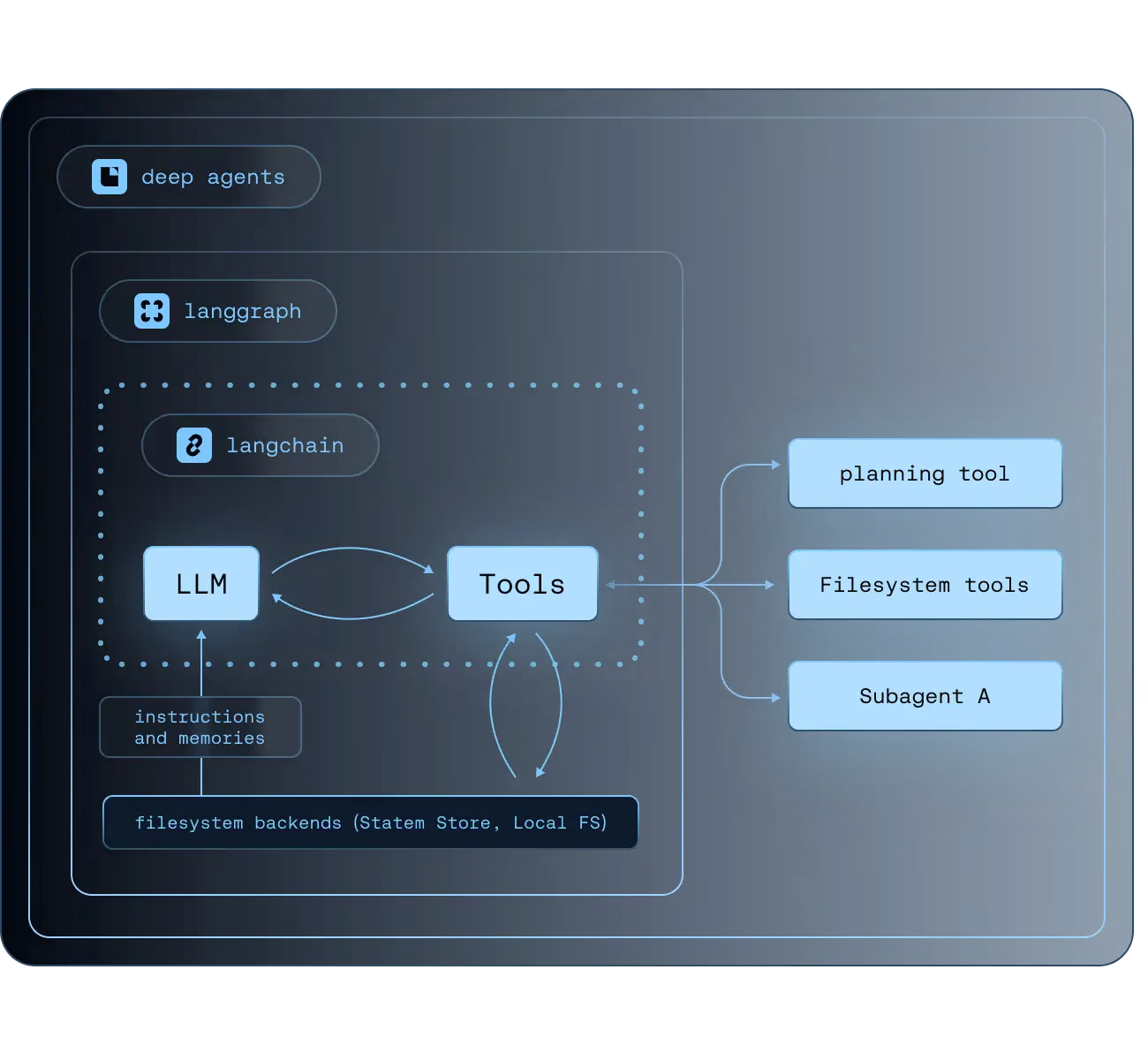
LangChain and LangGraph are popular development frameworks for building AI agents and orchestrating complex workflows. They provide developers and technical teams with tools for integrating AI models, managing memory, and controlling execution flows. However, they require significant engineering effort and time, and do not offer a unified out-of-the-box platform.
Key features
- Tool and API integrations
- Pre-built agent architecture and integrations (LangChain)
- Diverse control flows on one framework (LangGraph)
- Native token-by-token streaming shows agent reasoning and actions in real time.
- Built-in memory stores conversation histories and maintains context over time
Pros
- Highly flexible for developers
- Moderation, quality controls, and human-in-the-loop checks
- Strong community and ecosystem
- Over 1000 integrations with models, tools, and databases
- LangChain Academy Course
Cons
- Requires significant engineering resources
- Fragmented tooling
- No out-of-the-box enterprise solution
- Lack of enterprise-grade security and compliance
Rating
G2: 4.4/5
Pricing
LangChain and LangGraph are available for free to solo designers. Paid plans for teams start at $39 per user per month, plus additional usage-based pricing fees.
9. Zapier AI
Best for: Cross-app automation with lightweight AI
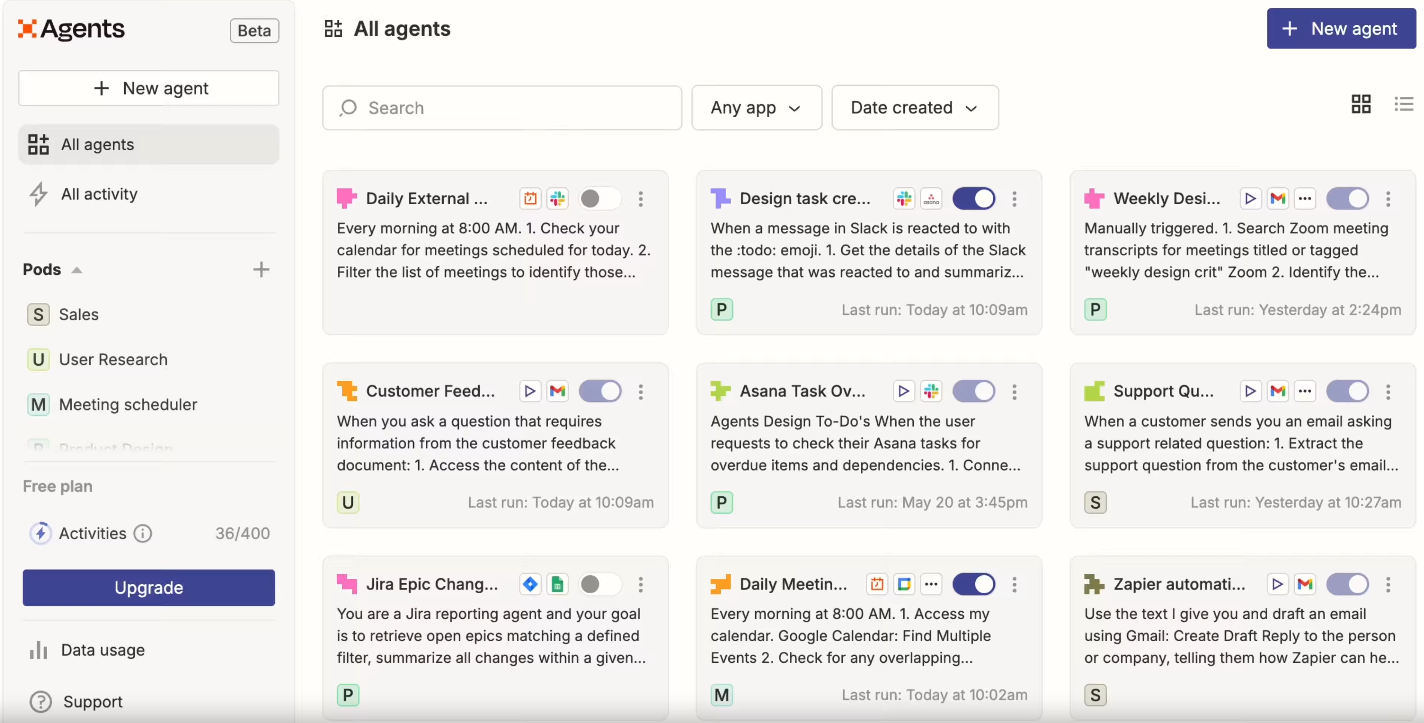
Zapier AI extends a well-known automation platform with AI-powered workflows and lightweight agent capabilities. It allows users to connect with multiple apps and automate repetitive tasks using natural language and pre-built integrations. Zapier is best suited for automation across applications rather than complex agent orchestration, and as a result, it falls short of full AI agent platform capabilities.
Key features
- AI-powered workflow builder and automation
- Trigger-based automation
- Pre-built and customized AI agents for task execution
- AI Agent builder supported by an AI assistant Zapier Copilot
- No-code interface for non-technical teams
- AI guardrails for data security
Pros
- Easy to use and quick to deploy with a user-friendly visual interface
- Large integration ecosystem with thousands of third-party apps
- Connects with multiple LLM solutions
- Strong for simple tasks and cross-app automation
Cons
- Limited autonomy and reasoning capabilities
- Task-based pricing becomes expensive at scale
- AI agents are treated as add-ons, not native components
- Not designed for complex, multi-agent orchestration
Rating
G2: 4.5/5
Pricing
Pricing for Zapier starts at $69.99 per month for the core platform, including access to AI agents. AI-powered chatbots are priced separately, with plans starting at $20 per month for up to five chatbots.
10. HubSpot
Best for: AI-assisted automation inside HubSpot CRM software
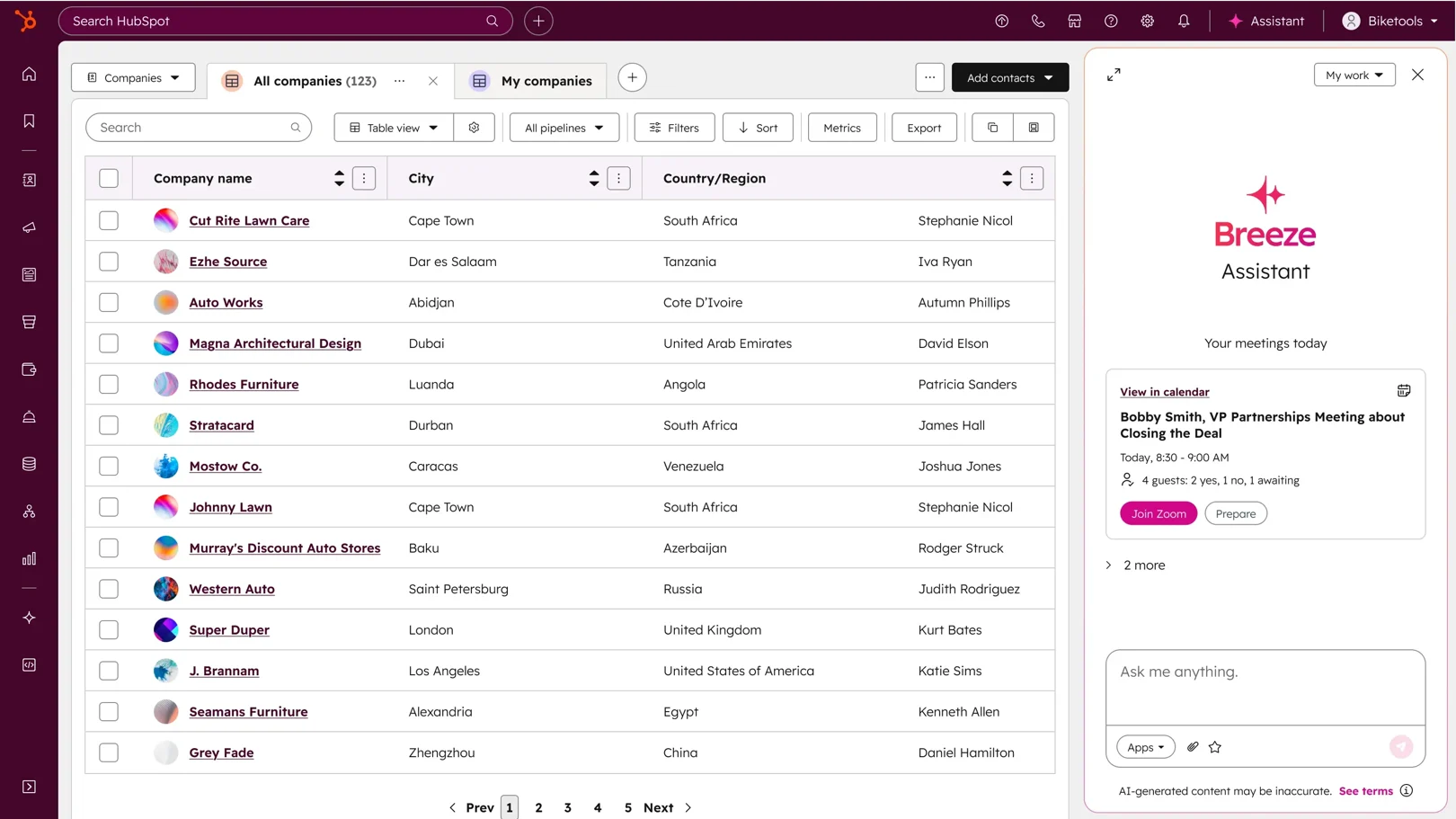
HubSpot offers AI agents as part of its broader CRM platform under the “Breeze” AI suite. These agents are embedded across marketing, sales, and customer service workflows, helping automate content creation, lead management, and customer interactions. HubSpot offers a marketplace of ready-to-use agents but does not provide the capability to create new agents or customize existing ones.
Key features
- Built-in AI agents for sales, support, and marketing
- AI content generation and email automation
- CRM-native data analysis and lead scoring
- Customer service and chatbot automation
- AI-powered workflow automation across HubSpot hubs
Pros
- Deep integration with CRM data and workflows
- Strong marketing and sales automation capabilities
- Easy to adopt for existing HubSpot users
Cons
- No capabilities to create custom agents
- Lack of autonomous capabilities
- Price can quickly increase, especially for larger organizations
- Not a fully extensible agent platform
Rating
G2: 4.4/5
Pricing
Pricing for HubSpot with AI agents varies by product. Sales and Service Hubs start at $90 per user per month, and Marketing Hub starts at $800 per month with 3,000 Credits each. More credits can be purchased separately. Additionally, HubSpot charges a one-time $1,500 onboarding fee.
See also: Top 10 HubSpot Alternatives & Competitors
How to Choose the Best AI Agent Platform
Choosing the best AI agent platform requires aligning it with your available resources (both technical and operational) and your long-term scalability and transformation goals. While many tools offer similar features on the surface, the real differences emerge in how effectively they support growth, integration, and real-world execution.
Before making a final decision, consider the following aspects:
- Data integration - look for platforms that seamlessly connect with your existing tech stack (CRM, ERP, databases) to ensure agents can access and act on real business data
- Security - enterprise-grade security, governance, and compliance are critical, especially when agents handle sensitive data or execute actions across systems
- Ease of use - consider who will build and manage agents. No-code platforms enable business users to move faster, while developer-heavy tools require technical expertise and longer implementation cycles
- Scalability - the platform should support growth, from a few use cases to enterprise-wide deployment, without requiring major rework or additional tools
- Reasoning capability - evaluate how well agents can understand context, make decisions, and handle multi-step workflows, not just execute simple tasks
Quick decision guide
To simplify the selection process, you can use the following quick decision guide based on your organization’s needs and capabilities:
- Enterprise organization looking to scale AI across departments?
→ Choose a unified, enterprise-ready platform (e.g., Creatio, Agentforce) - Looking for industry-specific use cases (e.g., banking, manufacturing)?
→ Choose industry-specific AI agents with built-in compliance and domain workflows (e.g., Creatio, Kore.ai) - Need AI mainly for customer support or internal service automation?
→ Look at specialized CX/EX platforms (e.g., Moveworks, Cognigy) - Non-technical team looking to power automation with AI?
→ Use no-code / workflow automation tools (e.g., Creatio, Zapier AI, Relevance AI) - Experimenting with AI agents with engineering resources?
→ Choose developer frameworks (e.g., LangChain, AutoGen, CrewAI)
Summary
AI agent tools are redefining how work gets done, shifting businesses from manual processes and static automation to intelligent, autonomous execution. However, not all platforms are created equal. The real value lies in solutions that combine strong reasoning, seamless integration with existing tools, scalability, and enterprise-grade governance.
As organizations move deeper into the AI era, the focus should be on platforms that can support long-term growth, not just isolated use cases. A unified approach in which AI automation tools, workflows, and data work together will be key to driving meaningful business outcomes. Ultimately, the best AI agent platform is the one that not only meets today’s needs but also enables organizations to scale, adapt, and operate effectively in an increasingly AI-driven world.
