




































































CRM Automation Guide: Benefits, Use Cases & Best Tools in 2026

Boost Productivity & Business Ops. Try Creatio CRM

Customer relationship management (CRM) systems are meant to help teams manage customer relationships, but too often they create extra work - manual data entry, record updates, and follow-ups that consume valuable time. CRM automation eliminates this manual effort by automatically updating records, triggering actions, and keeping workflows moving in the background. Due to recent advancements in Artificial Intelligence, many modern CRM systems also include AI-powered tools. With AI-enhanced automation, teams can spend less time on administrative tasks and more time engaging customers, making CRM a true productivity driver in 2026.
In this guide, we explore the key benefits of CRM automation, examine real-world use cases across industries, and compare the best CRM automation tools available in.
Key Takeaways
- CRM automation is a process of automating repetitive, manual tasks across customer service, sales, and marketing teams.
- AI has significantly amplified the impact of CRM automation, transforming it into a powerful productivity enhancer by reducing manual work, supporting informed decision-making, and enabling the autonomous execution of complex tasks.
- Automating routine activities, such as contact management, record updates, follow-ups, and handoffs, enables teams to focus on high-value work that drives revenue and enhances customer satisfaction.
- Industry-specific use cases—from finance and manufacturing to the public sector, CRM automation platforms adapt to unique workflows and compliance needs.
- The best customer relationship management software includes Creatio, Salesforce, and HubSpot due to their comprehensive features powered by AI.
What is CRM Automation?
Customer relationship management (CRM) automation is a process of automating repetitive tasks that every sales, marketing, and service team has to perform to effectively manage customer relationships. The automation software can take care of daily tasks like updating customer information, sending follow-up emails, or scheduling appointments. Modern CRM solutions offer AI-powered tools, such as AI agents, assistants, and copilots, to further enhance automation capabilities. AI tools can autonomously manage workflows, surface insights, and recommend or execute next steps across departments, significantly improving productivity.
With CRM automation, employees don't have to focus on time-consuming administrative tasks anymore. Instead, they can dedicate their time to what truly matters - building strong relationships with current and prospective customers.
Why Does Your Business Need CRM Automation in 2026?
In 2026, customer expectations, competitive pressure, and the volume of data businesses must manage will continue to grow. In that dynamic reality, manual processes and disconnected tools are simply no longer sufficient. While CRM automation helps organizations significantly improve efficiency, the implementation of AI has transformed it into an even more powerful tool for productivity enhancement.
With AI-powered CRM automation tools, businesses can:
- Automate repetitive tasks, such as follow-ups, meeting scheduling, and updating deal stages to reduce manual work.
- Automatically capture and update data from online forms, ads, emails, meetings, and other sources.
- Automatically update data between different systems and tools without manual effort.
- Enrich customer data with AI agents that autonomously search third-party sources.
- Streamline end-to-end workflows and business processes
- Improve the efficiency of customer-facing teams with AI recommendations, summaries, and next-best-action guidance
- Ensure consistent, omnichannel communication
- Deliver personalized and timely customer interactions based on real-time behavior, intent, and predictive insights
- Support informed decision-making with forecasting and real-time data insights
Benefits of CRM Automation
The benefits of automating customer relationship management do not end with freeing up employees' time. With CRM automation, all customer-facing teams can increase their productivity and achieve better results.
Here are the key benefits of CRM automation for your customer service, sales, and marketing teams:
Increased productivity
Sales team
With CRM automation, sales reps don't have to waste time manually going through all the prospects' data, updating the sales pipeline, and sending reminders. Instead, they can focus on nurturing high-potential leads and close deals more efficiently, while CRM sales automation handles those repetitive tasks. AI-powered CRM tools further enhance sales performance by automatically prioritizing leads, predicting deal outcomes, recommending next-best actions based on real-time insights, and generating sales reports.
CRM software ensures that all leads are captured and handed off to the most fitting sales representative. It also helps automate lead scoring and follow-up tasks that are triggered depending on customer behavior to make sure no opportunity is missed. This helps sales teams streamline sales processes, engage with prospects at the right time, and maximize their efforts.
Thanks to CRM automation, sales representatives can be more productive, close more deals, and achieve or even exceed their sales quota.
Marketing team
Part of the marketing job is to assess the lead’s readiness to convert before they are handed off to sales reps to make sure they don’t waste time on prospects far from ready to buy. This is a tedious task when done manually, but with CRM marketing automation, the entire process is streamlined and more efficient. CRM and marketing automation software takes care of lead scoring thanks to pre-defined rules so marketing specialists can focus on attracting more prospects. The process can be enhanced with the help of marketing AI agents that autonomously adapt evaluated aspects and their weights to predict conversion likelihood even more accurately, without manual reprogramming.
CRM automation helps marketing teams automate every aspect of campaign management, helping it run smoothly. This includes scheduling ads, sending personalized email campaigns triggered by form submissions, automatically posting on social media platforms, and many more. Marketing automation tools also help segment the targeted audience and make lead nurturing campaigns more successful.
Marketing AI agents can also support the creation of campaign materials by generating first drafts of emails, social media posts, visuals, and other content, further enhancing marketing efforts.
With CRM software, specialists can focus on the creative part of the job, making sure their marketing campaigns are engaging and tailored to their audience preferences, while CRM and AI handle tedious marketing tasks.
Customer service team
With CRM automation, customer service teams can increase their productivity and help more clients. Customer service automation tools take care of routine tasks like ticket routing, status updates, and follow-up communications, allowing customer support reps to fully focus on resolving clients' issues.
AI-powered chatbots and assistants can further improve customer service efforts by handling routine inquiries and automatically routing more complex cases to the right person with the full context of past engagement. With access to a complete and automatically updated history of customer interactions, customer service agents can provide more personalized support, and take care of problems more efficiently.
AI agents for customer service can also recommend the best response based on previously resolved cases or suggest a knowledge-based article to further educate customers. This not only speeds up response times but also shortens time-to-resolution and improves resolution accuracy, increasing client satisfaction.
Improved Customer Experience
Sales team
Nowadays, customers expect tailored offers rather than generic pamphlets that have nothing to do with their unique case. However, preparing everything manually is challenging, even for small businesses, let alone industry giants with thousands of prospects.
CRM automation helps sales representatives personalize communication with potential clients, improving their experience with the business. Automated CRM tools streamline lead management by tracking each prospect through the entire sales cycle, enabling sales agents to engage with them at the right time and with the most relevant message. Sales AI agents can even prepare and send tailored messages automatically when triggered by preconfigured events.
How is that possible? CRM automation software updates lead data in real-time and triggers tasks like follow-up emails, sending demos, or check-in phone calls to help sales representatives engage with the prospects more efficiently.
Marketing team
The biggest advantage of CRM software automation for marketing professionals is that it helps them effortlessly engage with the audience on a more personalized level. Marketing automation tools can segment the audience, analyze their data, and provide a guide on how to deliver tailored content and communication to satisfy their needs.
AI-powered CRM automation tools can also generate personalized content drafts, allowing marketing professionals to automatically send targeted emails, offers, or recommendations that resonate with each individual. This ensures that every campaign feels relevant and timely, improving the overall customer experience.
Customer service team
Customer service automation helps customer service teams to respond quickly to clients that need support. Thanks to updated information about customer's history, preferences, and previous interactions, they can take care of their problems more efficiently, even if they are not the ones who helped them in the past. This way, customers don't have to repeat themselves even if they used different channels to contact your business.
Enhanced collaboration
Sales team
CRM automation fosters better collaboration among sales team members by providing a centralized platform for sharing customer information. Sales representatives can view customer histories, upcoming tasks, and recent interactions, allowing them to collaborate on closing deals or managing key accounts. AI agents can also automatically notify team members about completed or delayed tasks, helping streamline sales processes. Automated updates and real-time notifications ensure that everyone is aligned, reducing the chances of miscommunication or missed opportunities.
Marketing team
For marketing professionals, CRM automation integrates seamlessly with sales and service functions, ensuring that all departments are working from the same set of customer data. AI-powered CRM automation enhances this alignment by continuously analyzing lead behavior and customer engagement signals to determine when prospects are ready to move to the next stage. Automated workflows support intelligent handoffs between marketing, sales, and customer service, ensuring leads are transferred at the right moment with full context, including history and intent data.
Automated workflows help marketers align their campaigns with the sales pipeline, targeting the right leads at the right time. This collaboration allows marketing to adjust their strategies based on real-time insights from sales and customer service.
Customer service team
CRM automation improves collaboration between customer service and other departments by giving service reps access to a customer's entire journey. Whether it's a recent marketing offer or an open sales opportunity, service agents can provide more informed assistance. Within support teams, CRM automation also enables seamless collaboration by allowing cases to be easily handed off between representatives when specialized expertise is required or when a team member is unavailable.
Automated case assignment and handoff workflows ensure that every request is routed to the most appropriate support rep with full context. This visibility ensures that the entire team is working together to provide a seamless customer experience, leading to quicker issue resolution and a more cohesive interaction with the business.
Improved business outcomes
Sales team
By automating repetitive, manual tasks, CRM allows sales reps to focus entirely on high-value activities such as building relationships, negotiating, and closing deals, increasing sales and revenue. AI-powered CRM automation further streamlines sales processes by handling more complex tasks, including lead prioritization, sales pipeline management, and follow-up recommendations based on real-time CRM data.
Data-driven insights delivered by the CRM on customer behavior and preferences help sales representatives prepare tailored pitches and offers. With AI analyzing historical data, sales reps gain predictive insights into deal likelihood, optimal pricing, and the best timing for outreach. This results in higher conversion rates, larger deal sizes, and sustained revenue growth.
Marketing team
With automated CRM tools, marketers can create and deploy more targeted and effective campaigns. When marketing automation tools handle tedious tasks like audience segmentation, content distribution, and performance tracking, they can concentrate on creating multiple creative campaigns, increasing the possibility of success. AI-powered capabilities further enhance campaign performance by analyzing customer behavior, predicting engagement, and dynamically optimizing targeting, timing, and content.
Marketing automation software also helps perform A/B tests and improve the overall effectiveness of marketing campaigns. With AI identifying winning variations and reallocating resources to top-performing campaigns in real time, marketers can maximize return on investment (ROI).
Customer service team
For the customer service team, CRM automation is an important ally in keeping the clients satisfied and reducing churn. With faster and more personalized support that helps address customer issues more efficiently, support teams can ensure their clients feel taken care of and are less likely to leave for competition.
Satisfied customers are also more likely to stay loyal to the same business and spread the word about the company. Positive word-of-mouth can attract new clients and help businesses grow.
Key CRM Automation Features
The benefits of customer relationship management come from robust automation features that help businesses become more productive, improve customer relationships, and enhance business outcomes.
These are the key automation features that determine CRM capabilities:
- Contact management - centralizes and manages customer data in a single, automatically updated database, ensuring all contact records are up-to-date. AI tools help keep data clean and surface relevant insights for every team.
- Workflow automation - automates repetitive processes such as data entry, task assignments, follow-ups, approvals, and notifications. Intelligent workflow automation ensures that actions are triggered at the right time based on predefined rules, customer behavior, or pipeline changes.
- Lead management - automatically captures leads from multiple channels, creates records, scores leads, and routes them to the most appropriate sales representative.
- Campaign management - helps plan, execute, and monitor marketing campaigns with automated audience segmentation, email workflows, and content delivery. AI autonomously optimizes targeting, timing, and messaging to improve customer engagement and ROI.
- Case management - streamlines case management with automated ticket creation, routing, escalation, and status updates.
- AI agents, copilots, and assistants - support teams by summarizing activities, recommending next steps, generating lead-generation content, and autonomously executing routine tasks across sales, marketing, and support.
- Analytics and reporting - automatically creates dashboards and reports on sales, marketing, and service performance. AI-powered analytics surface trends, predict outcomes, and support data-driven decision-making, eliminating manual data analysis.
- CRM integration with third-party applications - ensures seamless data flow between different systems, including email boxes, calendars, marketing automation platforms, project management tools, accounting software, and other business tools. Eliminates the need for manual updates between systems.
Adapting CRM Automation Tools to Fit Industry Needs
CRM automation solutions can be tailored to fit the specific demands of different industries, offering industry-specific workflows, and helping businesses thrive.
Below you'll find a few CRM automation examples for specific industries:
Finance industry
Banks, credit unions, and mortgage companies can streamline their lending management processes from loan originating to servicing and recovery.
With customer 360 data and automated loan verification workflows, loan officers can provide personalized loan terms for each client, and quickly collect approvals from the middle office. AI agents for finance automatically analyze financial data, detect risk patterns, and surface relevant insights, enabling faster, more informed decision-making while reducing manual effort. This way, finance businesses can provide quick and efficient customer service, ensuring high customer satisfaction. Automated workflows can also be customized to include all unique loan processing policies.

Raiffeisen Bank Albania Case Study
Raiffeisen Bank Albania was looking for a new solution to help them automate and streamline their complex and dynamic business lending processes. Their previous system was outdated, lacked flexibility in terms of process automation, and had limited CRM integration capabilities with other interfaces.
The company needed a tool that would streamline the loan management process and ensure transparency while making the best use of information flows and data input. With configuration-driven models provided by Creatio, they could swiftly automate the corporate lending process with a default application processing workflow designed for customer loans. The automated workflow provided preconfigured tasks and hints that ensured the simplicity of customer-facing operations, guiding users through every stage of the loan management process. This helped Raiffeisen Bank Albania reduce processing time and simplify the processing process for both employees and customers.
Public Sector
Government agencies, municipalities, and public service organizations can use CRM automation to streamline service management and delivery.
With a centralized citizen 360 view and automated workflows, public sector employees can manage requests, applications, permits, and benefits more efficiently. AI-powered tools can automatically classify incoming requests, prioritize them, extract key information from forms and documents, and route cases to the appropriate department or specialist based on urgency, topic, or eligibility. With AI-powered CRM system, organizations in the public sector can deliver faster, more transparent, and more consistent services while maintaining compliance, accountability, and data security.
City of Boston Case Study
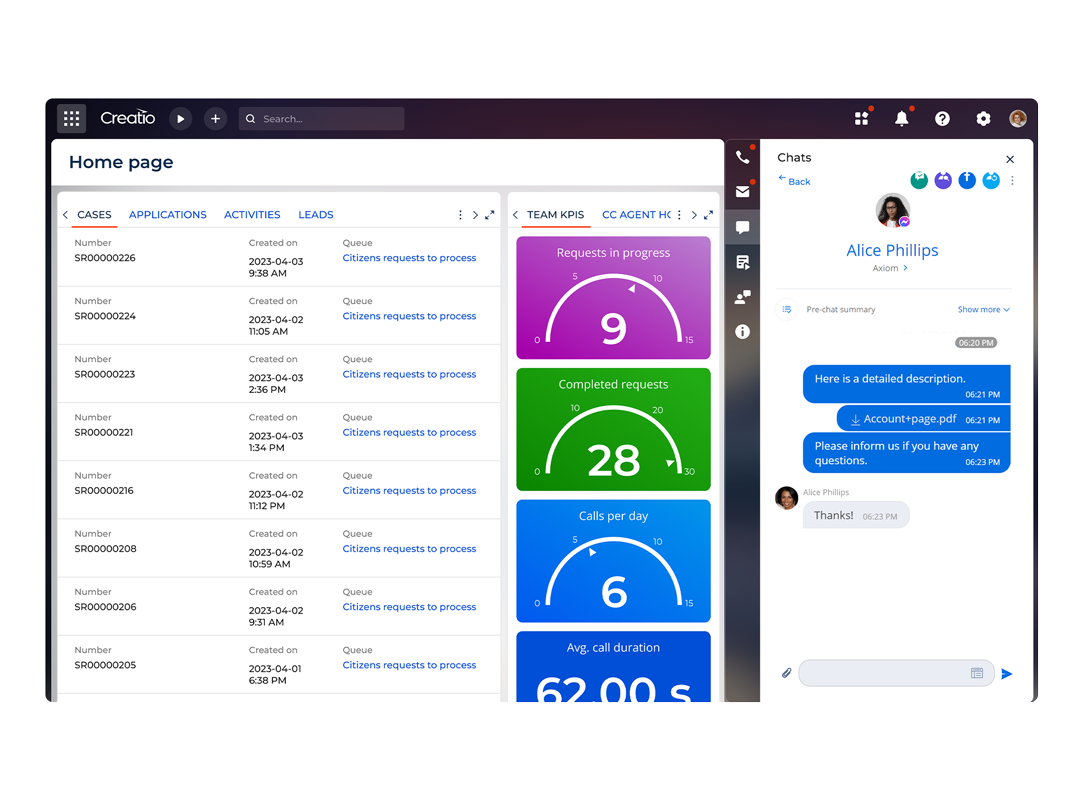
The City of Boston sought to replace its outdated 311 citizen service system with a more agile, scalable solution to manage diverse service requests. Boston chose Creatio’s AI-powered, no-code CRM system to consolidate and simplify more than 180 distinct service request types. This enabled faster request intake, intelligent routing, and clearer workflows, improving both the employee experience and citizen interactions. The implementation unified dozens of city departments under a single system, enhancing cross-departmental coordination and boosting service delivery speed and accuracy.
Manufacturing
Manufacturing companies can use CRM automation software to improve their order processing, distribution workflows, and supply chain management. Thanks to that they can promptly fulfill their orders, ensure that all product input is properly timed and tracked, and minimize production downtime via automated delivery processes. AI-powered capabilities further enhance these workflows by autonomously analyzing demand patterns, production schedules, and inventory levels in real time.
To avoid delays, track goods and fleet en route, and keep the inventory and delivery data synchronized, manufacturing companies can automate shipment scheduling. CRM can also automate product data sharing and synchronization between multiple divisions and avoid over-/understocking in warehouses.

Blueprint automation case study
Blueprint automation sales representatives used to store data in Excel spreadsheets and enter data manually which took more working hours than the actual selling process. The lack of centralized customer data was their main obstacle in achieving effective customer interactions and building strong relationships. To streamline customer communication, automate all the stages of the customer's journey, and reduce human error, BPA decided to implement Creatio CRM.
The adoption of the Creatio resulted in up to 75% reduction in the time spent on day-to-day activities. The platform became a digital hub for BPA marketing and sales teams with all customer data and every interaction automatically logged into the system. Thanks to that sales representatives no longer have to enter data manually and can focus on highly valuable tasks like participating in industry trade shows and building relationships with customers.
Find out how CRM automation can enhance operations in other industries including retail, pharma, high tech, and telecom.
Top 3 Best CRM Automation Vendors
1. Creatio CRM
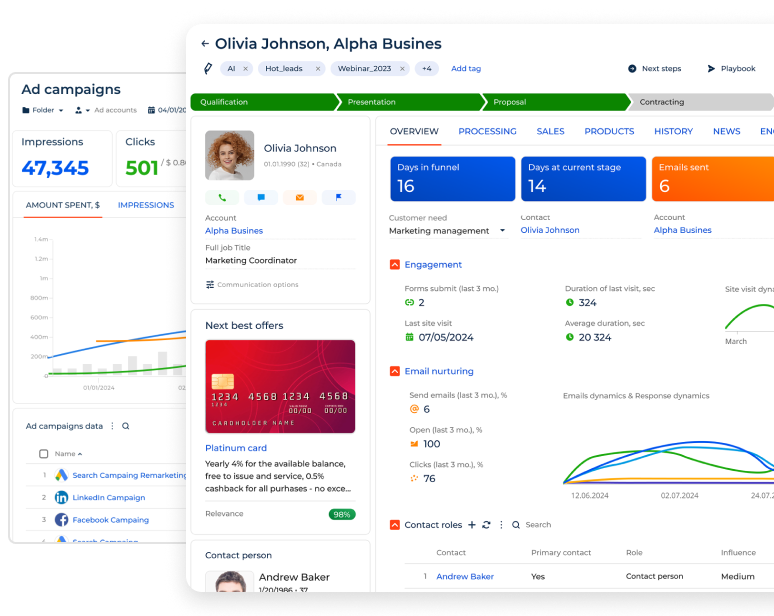
Creatio stands out as a leading CRM automation platform for organizations that need intelligent process automation, maximum flexibility, and AI-powered solutions. Built on a no-code architecture, Creatio’s AI CRM enables businesses to design, automate, and optimize sales, marketing, service, and industry-specific workflows from a single platform.
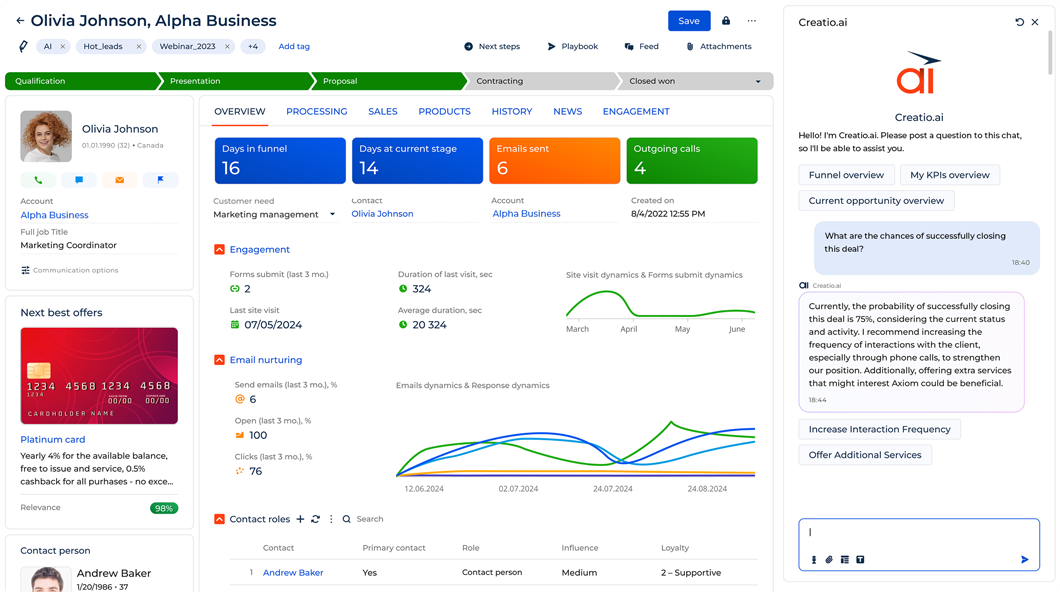
Creatio’s embedded AI agents autonomously execute tasks across the entire customer lifecycle, support intelligent decision-making with data-driven insights, and automate handoffs, real-time notifications, and data entry. Unlike many competitors, Creatio enables business users, not just IT teams, to create and adapt processes to changing business needs.
Pros
- True no-code platform for end-to-end CRM and workflow automation
- Powerful AI agents embedded into the core of the platform and available at no additional cost
- High flexibility and customization without coding
- Unified platform for sales, marketing, and customer service
- Well-suited for complex, industry-specific use cases in over 20 verticals
- Powerful analytics and reporting capabilities
- Rich marketplace with over 700 third-party applications and connectors
Cons
Extensive customization options may pose an initial learning curve
2. Salesforce
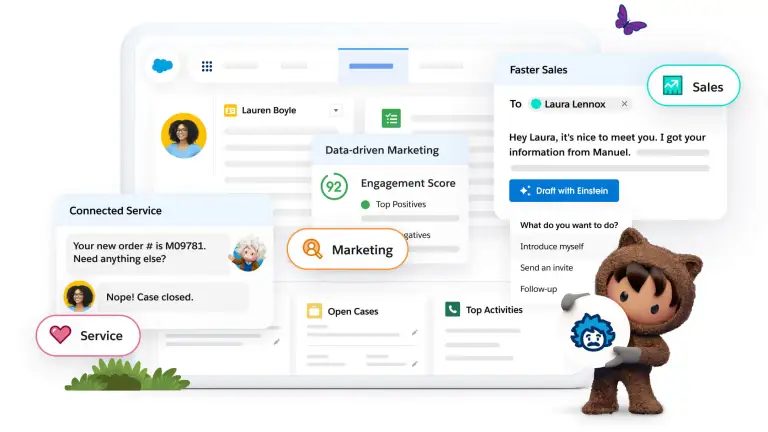
Salesforce is an enterprise CRM software with automation, analytics, and integration capabilities. Salesforce’s AI features include lead scoring, predictive insights, forecasting, and recommendations across sales and customer service functions. However, achieving advanced automation often requires significant configuration, custom development, and reliance on external consultants, which can lead to increased costs and complexity over time.
Pros
- Mature, enterprise-grade CRM platform
- Large app marketplace and partner ecosystem
- Strong analytics and reporting capabilities
- Scales well for large organizations
Cons
- Complex setup, customization, and automation often require developers’ support
- Steep learning curve and unintuitive interface
- Very high total cost of ownership
- AI capabilities are only available in the highest tiers and are not embedded into the core of the platform
See also: Salesforce Alternatives & Competitors
3. HubSpot
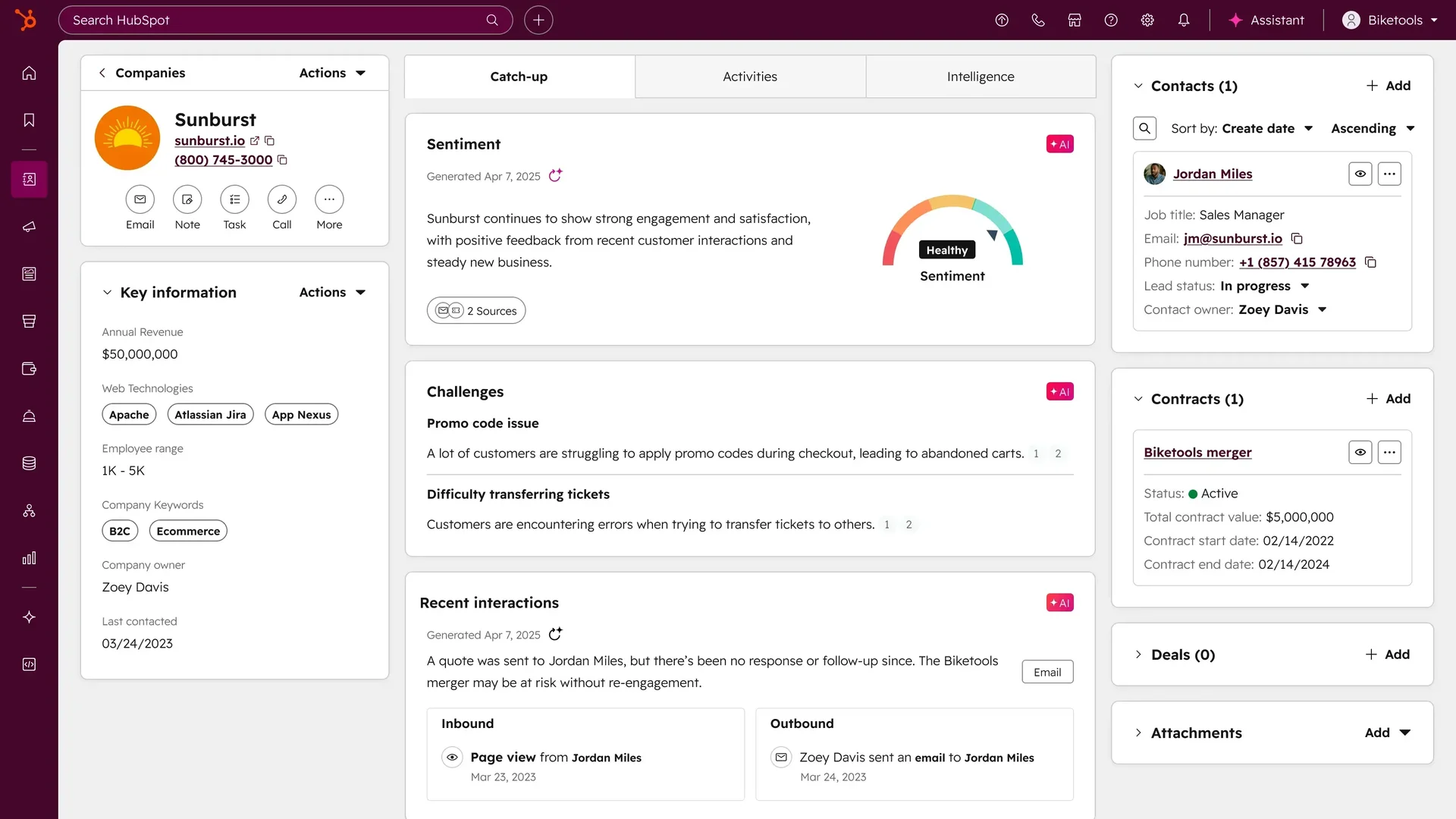
HubSpot is known for its ease of use and strong inbound marketing automation capabilities. It provides a user-friendly customer relationship management system with built-in tools for marketing, sales, and customer support, making it an attractive option for small and mid-sized businesses only getting started with CRM automation. While HubSpot excels in usability, it offers less advanced flexibility and process automation compared to enterprise-focused platforms, which can be a constraint as organizations grow or require more complex workflows.
Pros
- Intuitive interface and fast onboarding
- Strong marketing automation software and email marketing tools
- Good fit for mid-sized and small businesses
Cons
- Limited customization for complex processes
- Automation capabilities are less advanced for enterprise use
- Can become costly as features and the number of contacts increase
- AI tools are only available in the highest-tier pricing plans
See also: Top 10 HubSpot Alternatives & Competitors
Summary
CRM automation significantly improves how businesses operate by streamlining the day-to-day operations of sales, marketing, and customer service teams. With the addition of AI-powered capabilities, CRM automation becomes even more effective in reducing manual effort, supporting smarter decision-making, and driving growth.
The leading CRM automation tools featured in this guide offer various strengths, from enterprise-scale ecosystems to simplicity for growing teams. Platforms that combine intelligent automation, native AI, and flexible customization, such as Creatio, provide the strongest foundation for long-term productivity, scalability, and growth. Schedule a brief demo and discover firsthand how Creatio CRM automation software can enhance your business processes.
