


































































CRM Marketing - Definition, Features, and Benefits + 5 Best Marketing CRM Tools

Creatio CRM: Segment, Personalize, and Boost ROI

Effective marketing is no longer about reaching a broad audience but about engaging the right audiences with relevant, timely experiences. This requires a coordinated marketing strategy built on accurate customer data, connected touchpoints, and continuous optimization.
With customer relationship management (CRM) software, marketing teams can significantly elevates marketing execution by unifying customer data, campaigns, and interactions in one platform. Modern CRM systems support marketing activities across the entire customer journey — from segmentation and automated email campaigns to landing pages and performance tracking — helping teams improve lead nurturing and shorten sales cycles.
In this article, we take a closer look at what CRM marketing is, outline the key benefits of using CRM software for marketing, and review top marketing CRM platforms that help businesses drive engagement and revenue in 2026.
Key Takeaways
- CRM marketing utilizes customer data and CRM capabilities to plan, execute, and optimize marketing activities across the entire customer lifecycle.
- Marketing CRM software is commonly used to segment audiences, run personalized multi-channel campaigns, nurture leads, track performance and connect with other business teams from a single platform.
- The key benefits of CRM for marketing include increased lead generation and nurturing, more consistent customer experience, enhanced analysis and decision-making, and alignment across the teams.
- Leading marketing CRM platforms for enterprises are Creatio Marketing, HubSpot, and Salesforce, known for their scalability and advanced AI capabilities, while software like Pipedrive and ClickUp will be a good fit for simpler marketing tasks and use cases.
What is CRM Marketing?
CRM marketing refers to the use of customer relationship management (CRM) software to support and manage marketing activities using centralized customer data and built-in marketing capabilities. It enables marketing teams to engage target audiences across multiple channels, run personalized campaigns, and measure campaign performance within a single system.
By connecting marketing activities with real-time customer interactions and sales data, CRM marketing improves targeting accuracy, personalization, and overall marketing ROI.
What is a CRM Marketing Strategy?
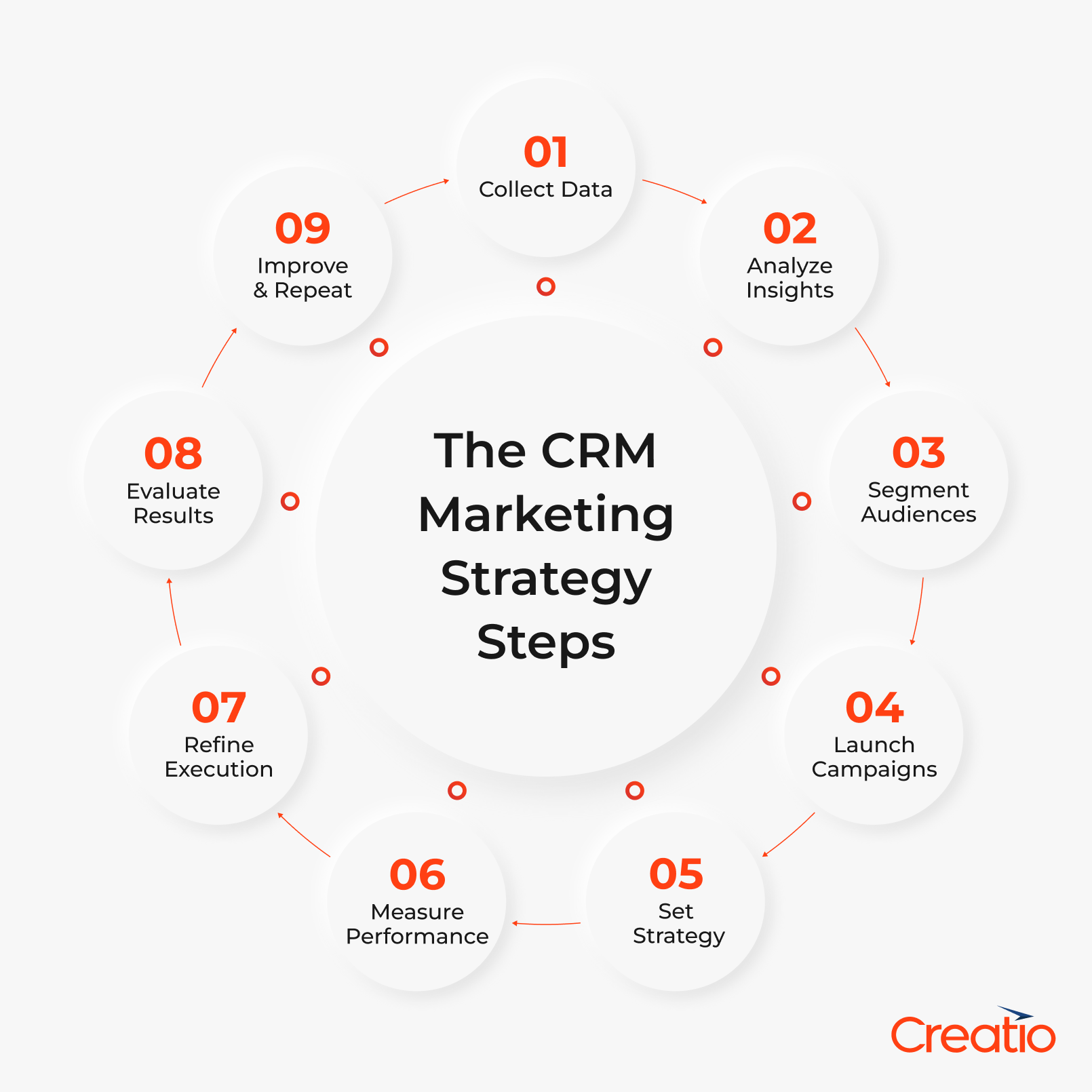
A CRM marketing strategy is a structured approach to planning and coordinating marketing activities using CRM software to nurture leads, drive conversions, and build customer loyalty across the entire lifecycle. It defines how organizations use customer insights, automation, and cross-team alignment to deliver consistent and relevant experiences at scale.
Rather than focusing on individual campaigns, a CRM marketing strategy defines how customer data is used to orchestrate end-to-end journeys, prioritize high-value audience segments, and trigger timely interactions across channels. This allows organizations to improve conversion rates, shorten sales cycles, and increase customer lifetime value.
What Can Marketers Do With CRM Marketing Software?
#1. Gain a Unified View of Customers
CRM software centralizes customer data from multiple touchpoints, such as website activity, email interactions, and purchase history, into a single customer profile. With a 360-degree customer view, marketers gain deeper insight into customer behavior, preferences, and intent, which enables more accurate targeting and more relevant, high-impact campaigns.
#2. Segment Audiences and Personalize Engagement
With access to detailed customer data, marketing teams can segment audiences using multiple criteria — for example, demographics, behavior, engagement level, and sales pipeline stage — to deliver more relevant touchpoints with higher chances of conversion. Modern CRM platforms also offer built-in AI, enabling marketers to generate personalized content, identify optimal send times, recommend next-best actions, and continuously optimize campaign flows to maximize engagement and lead generation.
#3. Manage and Nurture Leads More Effectively
CRM software help marketers track lead activity, score leads based on engagement, and automate nurturing workflows to move prospects through the funnel. Some platforms include embedded AI that analyzes lead behavior and intent in real time, dynamically scoring and routing leads to the right team for follow-up. This allows revenue teams to focus on high-quality opportunities and significantly shorten time to conversion.
#4. Plan, Execute, and Optimize Marketing Campaigns
CRM platforms provide a centralized environment for managing campaigns end to end — from planning and execution to measurement and optimization. By running campaigns directly from the CRM, teams can coordinate messaging across channels, track engagement and MQLs, and continuously optimize campaigns based on real-time performance and data insights.
#5. Automate Repetitive Marketing Tasks
Customer relationship management software can automate routine marketing tasks such as email follow-ups, data updates, campaign scheduling, and lead assignment. With agentic CRM systems, marketing professionals can even deploy autonomous AI agents that generate personalized content, draft emails, or build campaigns from scratch. This automation reduces manual effort, ensures consistent communication, and allows teams to focus on strategy and creative work.
#6. Improve Customer Engagement and Retention
CRM marketing systems can provide real-time analytics on customer engagement across campaigns, channels, and touchpoints. These data insights allow marketers to set up timely follow-ups, create personalized offers, and proactively re-engage customers at risk of churn. Consistent and personalized engagement allows to better manage customer relationships, increases retention, and drives long-term customer value.
#7. Measure Marketing Performance and ROI
With built-in analytics and reporting tools, CRMs empower marketers to track key metrics such as conversion rates, customer acquisition cost, ROI, and customer lifetime value. This visibility enables teams to continuously improve performance and demonstrate marketing’s impact on revenue.
What is CRM Marketing Automation?
CRM marketing automation refers to the use of CRM software to automate recurring marketing activities and customer interactions based on predefined rules or customer behavior. This feature helps teams reduce manual work while ensuring their marketing messages are timely, relevant, and consistent across channels.
For example, when a prospect completes a specific action — such as registering for the upcoming FinServ event — the CRM can automatically trigger the next step in the nurturing flow, like sending a follow-up email. As leads continue to engage with content, the CRM updates lead scores and routes qualified leads to sales, enabling timely outreach and smoother handoffs.
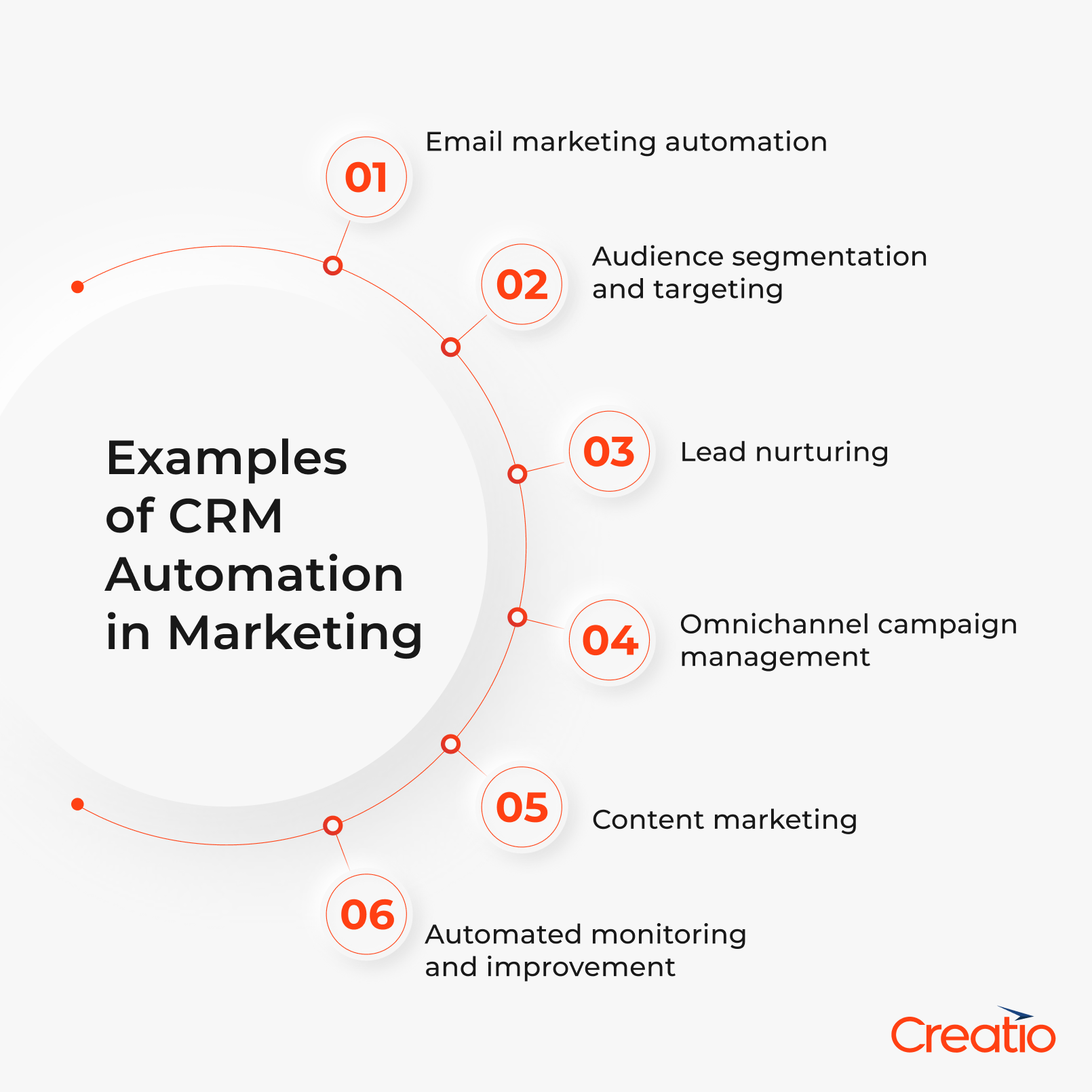
CRM automation:
- Email marketing automation
- Audience segmentation and targeting
- Lead nurturing
- Omnichannel campaign management
- Content marketing
- Automated monitoring and improvement
Today, marketers use CRM to automate a range of different processes. The most popular ones include:
- Automated data collection and analysis: CRM systems continuously collect customer data from multiple touchpoints (i.e., form submissions, email interactions, website activity, and profile attributes) to identify specific behaviors or conditions that trigger CRM marketing automation.
- Dynamic segmentation and targeting: Based on real-time behavior and customer data, leads and customers are automatically assigned to relevant segments. This allows marketers to deliver targeted messaging without manual list management or constant campaign reconfiguration.
- Automated campaign execution: When a trigger occurs, the CRM automatically launches the appropriate action to maintain consistent engagement throughout the customer journey. The most common examples are sending personalized emails, starting nurture sequences with offers, activating multi-channel campaigns, and more.
- Continuous monitoring and optimization: CRM tools track engagement and responses in real time and can recommend next-best actions to improve performance. Marketers use these insights to refine timing, content, and follow-up logic, continuously improving campaign effectiveness and long-term results.
Not all CRM platforms include marketing automation capabilities. However, those that do enable organizations to scale marketing execution, improve operational efficiency, and deliver personalized engagement more consistently across the customer lifecycle.
Key Benefits of Using CRM for Marketing
The CRM system has become an essential tool for teams looking to elevate their marketing efforts. From a business perspective, CRM marketing delivers measurable advantages that go beyond campaign execution.
The most important benefits of CRM marketing are:
- Higher revenue impact from marketing investments. CRM software can improve targeting, nurturing, and conversion, helping marketers generate higher-quality leads and strengthen pipeline contribution.
- Lower customer acquisition and operational costs. Centralized CRM data, automation, and analytics reduce manual work and optimize inefficiencies across marketing and sales teams.
- Faster time to value and market responsiveness. With real-time data and connected workflows, businesses can launch, adjust, and optimize campaigns faster in response to customer behavior or market changes.
- Improved customer retention and lifetime value. Personalized, data-driven engagement through CRM tools helps teams manage customer relationships beyond acquisition, increasing repeat business and long-term customer value.
- Greater visibility and accountability across teams. CRM system helps marketing teams to always stay aligned with other teams, yet provides clear insight into what drives engagement, conversions, and revenue to prove ROI and guide decision-making.
- Scalable growth without adding headcount. Built-in CRM marketing automation and marketing AI capabilities allow teams to scale campaigns, channels, and personalization without increasing operational complexity or team size. Agentic CRM marketing platforms also allow marketers to deploy autonomous agents to handle routine tasks, freeing time for higher-value work such as strategy, optimization, and creative execution.
5 Best Marketing CRM Software [Updated for 2026]
Choosing the right CRM solution is crucial for optimizing your marketing efforts and driving business growth. In this section, we'll explore five of the best marketing CRM software options available in 2026, highlighting their key features, pros, cons, and pricing.
Marketing CRM Vendor | Best for | Rating (out of 5) |
| Creatio | Enterprise and fast-growing teams looking for an all-in-one marketing CRM with no-code and agentic AI capabilities |
|
| Salesforce | Large enterprises with complex, multi-channel marketing needs |
|
| Pipedrive | SMBs and small marketing teams seeking simple CRM with basic marketing workflows |
|
| ClickUp | Marketing teams that need a unified platform with basic CRM and marketing management capabilities |
|
| HubSpot | Small to midsize marketing teams looking for an easy-to-use CRM with lightweight automation functionality |
|
1. Creatio Marketing
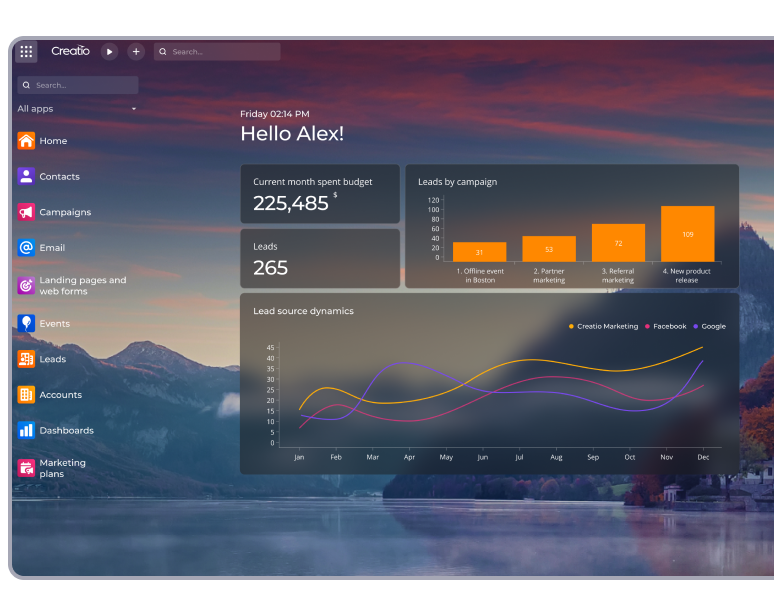
Creatio Marketing is a leading marketing CRM platform that offers robust CRM and marketing automation capabilities to streamline the lead-to-sales process and help teams achieve greater impact with the same resources. Powered by no-code and AI, the platform helps marketing teams plan, execute, and optimize campaigns while maintaining full visibility across the customer journey.
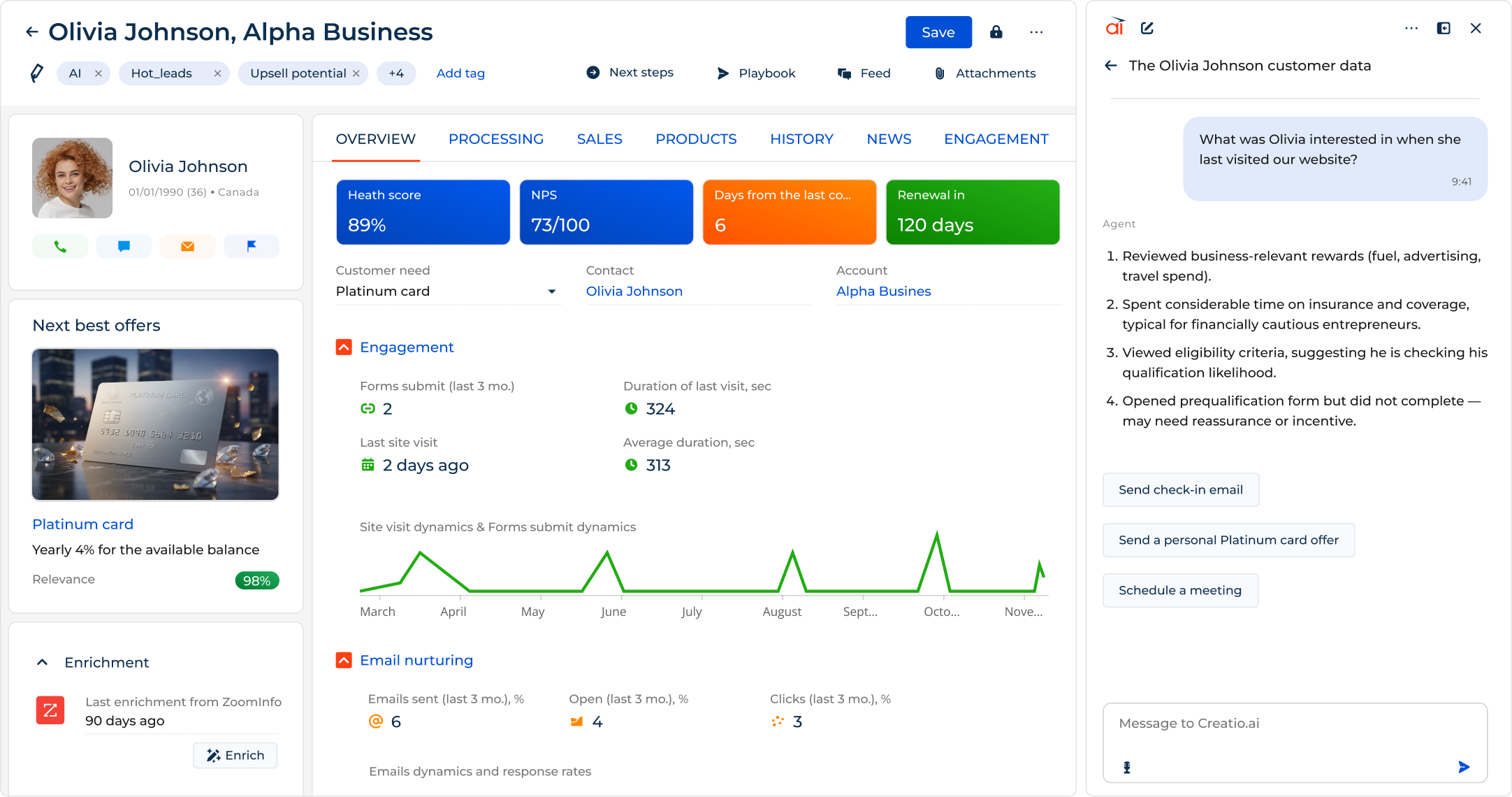
One of the core strengths in Creatio Marketing is its built-in GenAI, Predictive AI and Agentic AI capabilities. These allow marketers to embed AI directly into everyday marketing workflows, such as generating personalized emails, building campaign flows, identifying next-best actions, and analyzing performance. In addition, Creatio enables users to create custom AI agents for specific marketing use cases, which can take on routine tasks related to content generation, campaign execution, and analytics. As a result, marketing teams can spend more time on strategy, creativity, and meaningful customer engagement.
Creatio Marketing integrates seamlessly with Creatio Sales and Creatio Service, forming a unified CRM platform that connects marketing, sales, and service teams around a single customer view.
Features
- Powerful CRM apps for marketing, including customer 360, campaign and event management, email marketing, digital ads, analytics and reporting, and more
- AI-enhanced lead scoring and segmentation
- Omnichannel experience
- Marketing automation features to streamline execution and enhance marketing performance
- Ready-to-use marketing AI agents for content generation, campaign optimization, performance analysis, and next-best-action recommendations
- AI-assisted no-code tools to customize workflows, campaigns, and CRM data models without developer involvement
- Specialized solutions for over 20 industries to support unique processes and regulatory requirements
- 400+ integrations, connectors, and apps available through Creatio Marketplace
Pros
- Built-in agentic AI capabilities that accelerate marketing operations and support complex workflows with minimal manual effort.
- Seamless integration with other Creatio products, enabling extended functionality across marketing, sales, and service within a single platform.
- Intuitive user interface that makes it easy to navigate dashboards, campaigns, and workflows.
- Composable architecture with no-code, allowing extensive customization by business users without technical expertise.
- Highly scalable platform, best fits for fast-growing organizations with complex marketing and operational requirements.
Cons
- Might present a learning curve at first, as the platform’s functionality and customization options may feel overwhelming for new users.
Pricing
Creatio offers composable pricing that allows organizations to pay only for the capabilities they need. The AI-native Creatio platform starts at $40 per user/month, and includes built-in AI and no-code capabilities. Creatio Marketing can be added for $15 per user/month.
2. Salesforce Marketing Cloud
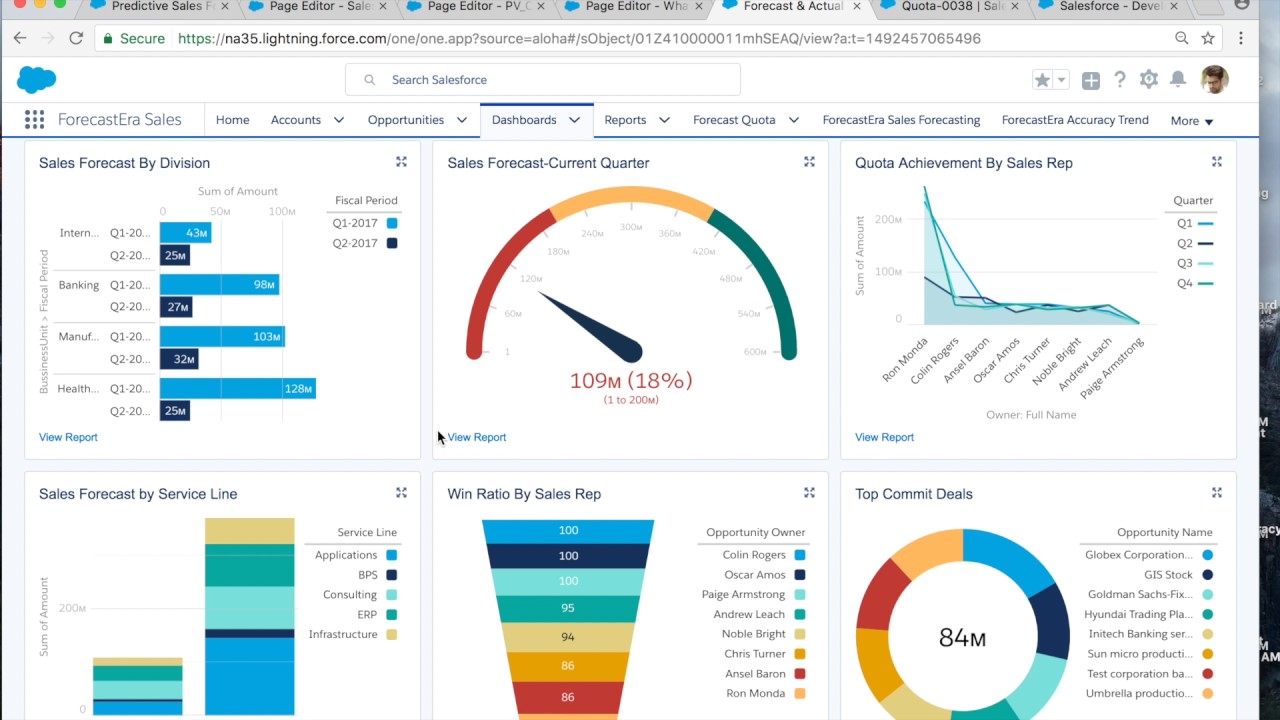
Salesforce is a CRM platform that offers a range of marketing automation solutions to help businesses improve marketing efforts and drive revenue growth.
Salesforce enables marketers to create personalized customer experience, automate tedious tasks, and measure the impact of their marketing efforts.
Features
- client data platform
- marketing AI
- lead scoring
- referral marketing
- campaign management
- loyalty management
Pros
- powerful AI capabilities for lead scoring and grading, account-based engagement, and AI-driven insights into marketing efforts impact, etc.
- multi-channel targeting for mobile app notifications, SMS apps, webinars, etc.
- out-of-the-box reporting capabilities for tracking key areas like pipelines with campaign-influenced revenue
- scalable solution suitable for businesses of all sizes.
Cons
- pricing is complex and varies based on the selected features and add-ons.
- integration with third-party CRM and SFA platforms is limited.
- the platform is not suitable for non-technical users - it requires some level of technical expertise for setup and customization
Pricing
Salesforce pricing may pose a barrier for some businesses, ranging from $1,250 per month to even as much as $108,000 per month.
See also: Salesforce Marketing Cloud Alternatives
3. Pipedrive
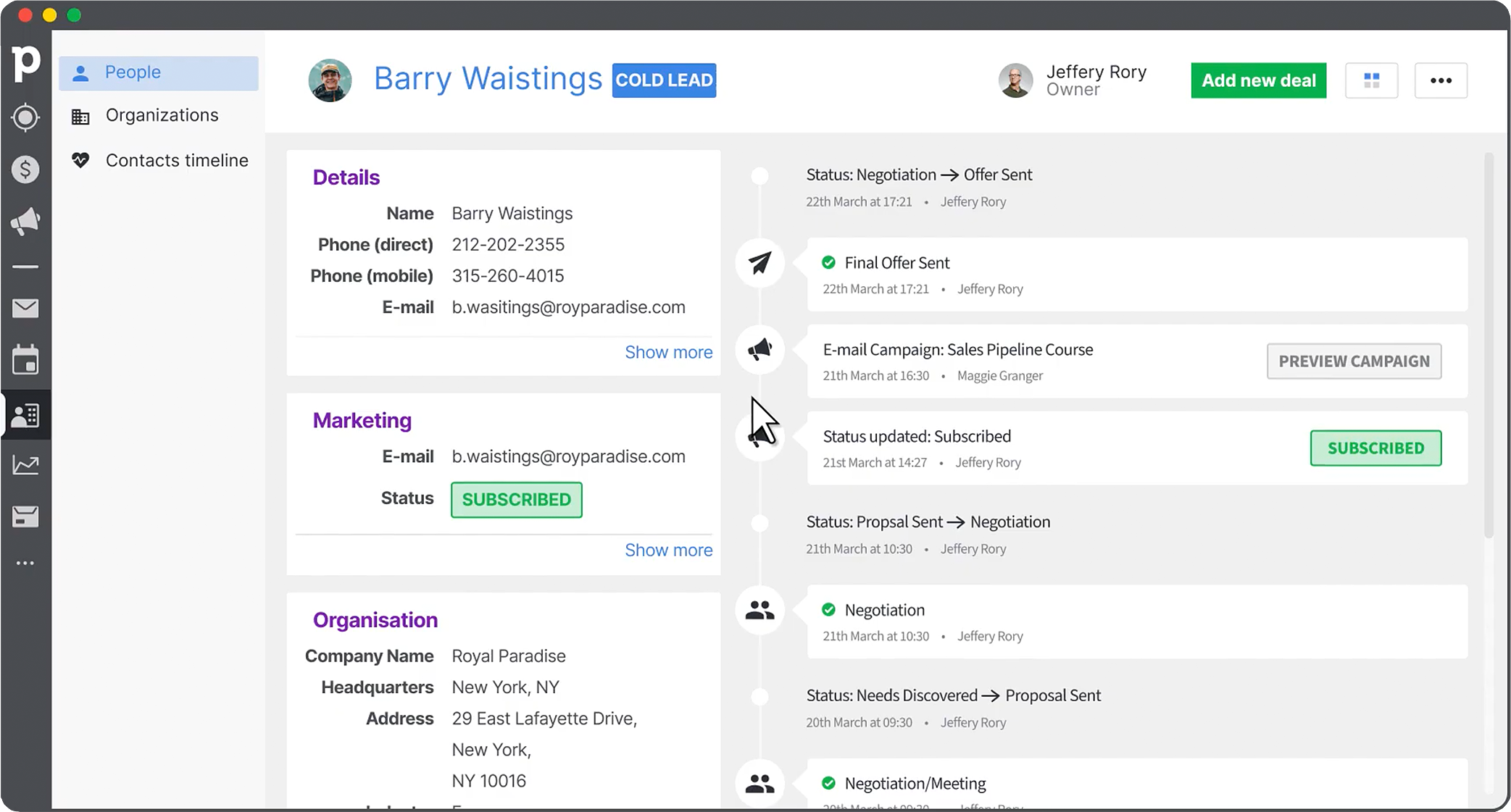
Pipedrive is a user-friendly tool that combines CRM and email marketing software to help businesses manage email campaigns that deliver unbeatable results.
With Pipedrive, businesses can easily create personalized emails, and reach the right customers with the right message.
Features
- email marketing automation
- email builder
- audience segmentation
- analytics and reporting
- campaign management
- marketing workflow automation
Pros
- easy-to-use email marketing tools for sending personalized campaigns and tracking responses.
- out-of-the-box free email templates and intuitive drag-and-drop email editor.
- seamless integration with popular marketing and productivity tools.
Cons
- limited advanced marketing automation features compared to other platforms.
- reporting capabilities may be less robust for complex analytics needs.
Pricing
Pipedrive offers various pricing plans starting from $14 per user per month for the Essential plan and ranging up to $99 per user per month for the Enterprise plan.
4. ClickUp
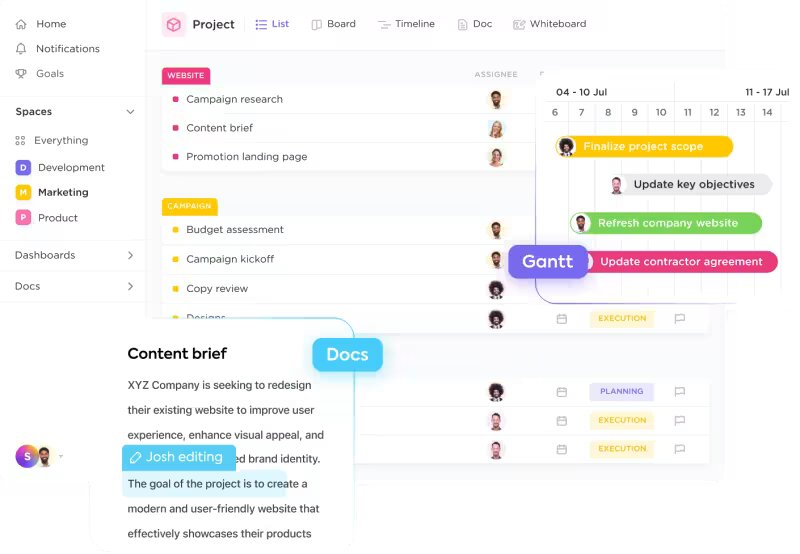
ClickUp is a versatile project management platform that also offers CRM and marketing automation features. It helps businesses streamline their marketing processes and improve collaboration within the organization.
ClickUp's customizable workflows, task automation, and integrated communication tools enable marketing teams to plan, execute, and track their campaigns more efficiently.
Features
- task management and automation
- customizable task lists, boards, and calendars
- collaboration tools
- content marketing management
- event marketing management
- campaign planning and tracking
Pros
- all-in-one productivity platform with project management, CRM, and marketing automation functionalities.
- robust automation features with over 100 pre-made automation workflows to streamline sales and marketing processes.
- integration with more than 1000 third-party applications
Cons
- marketing automation features may be less advanced compared to dedicated CRM platforms.
- user interface and navigation may require some adaptation for new users.
- non-technical users may need help with configuring complex workflows.
Pricing
ClickUp offers various pricing plans starting from free for basic features and $7/user/month for the Unlimited plan.
5. HubSpot Marketing Hub
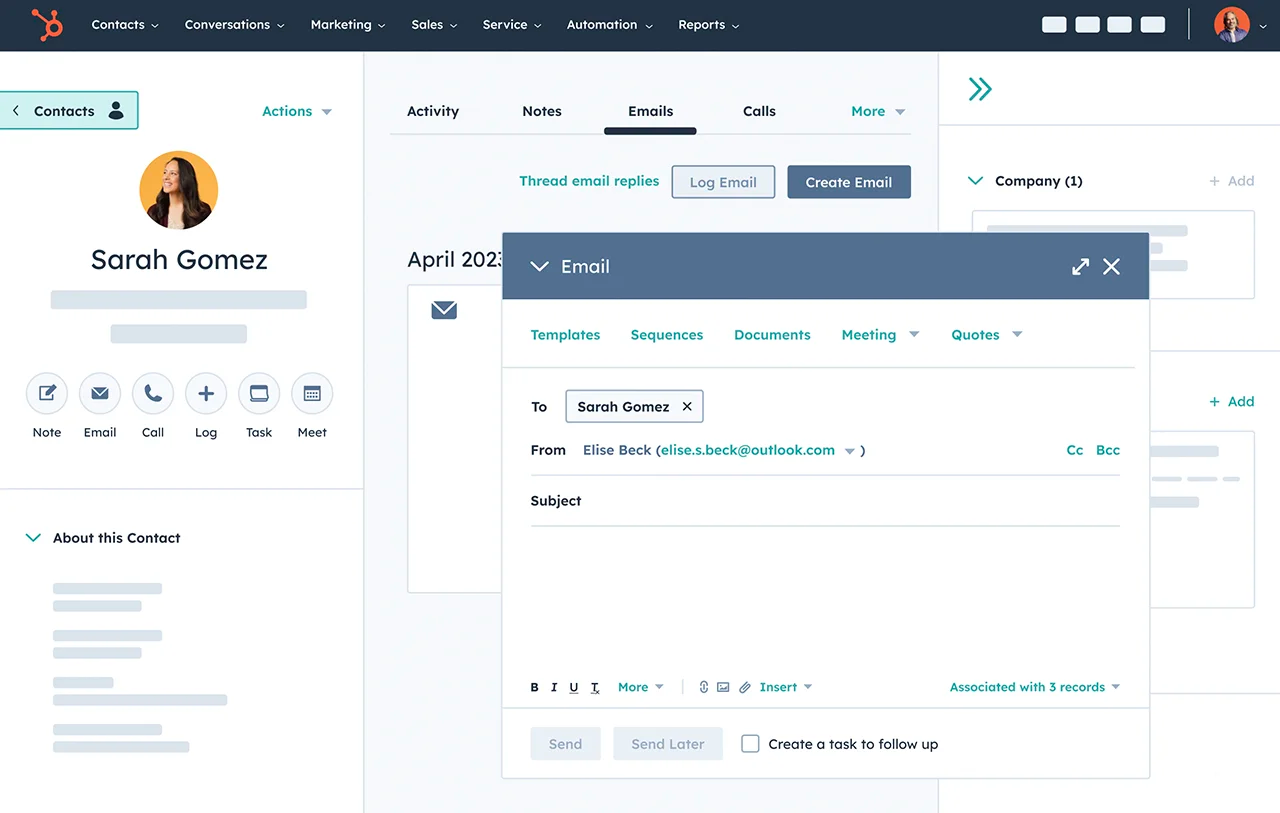
HubSpot is a marketing platform that offers a comprehensive suite of CRM and marketing automation tools to help businesses attract and engage customers.
HubSpot’s Marketing Hub offers a user-friendly interface, automation features, and extensive integrations, empowering marketing teams to create personalized experiences and drive revenue growth.
Features
- lead generation
- multi-touch revenue attribution
- email marketing automation
- ads software
- campaign management
- marketing analytics and reporting
Pros
- seamless integration with HubSpot's suite of sales, customer service, and marketing tools for end-to-end customer management.
- robust marketing automation features, including lead nurturing, and workflow automation.
- extensive library of resources, training, and support for users.
Cons
- pricing may be on the higher end for small businesses, especially for advanced features.
- some users may find the platform's complexity overwhelming.
- limited template customization makes adjusting to brand identity challenging.
Pricing
HubSpot offers various pricing plans starting from $20/ month for the Starter plan and ranging up to $3,600/month for the Enterprise plan. For small businesses, HubSpot provides a free plan with basic functionalities.
See also: Top 10 HubSpot Alternatives & Competitors
Choosing the right CRM solution is crucial for optimizing your marketing efforts and driving business growth. Whether you're looking for advanced automation capabilities, seamless integration with other tools, or user-friendly interfaces, the five CRMs highlighted above offer a range of features and functionalities to meet your marketing needs.
How to Choose the Right Marketing CRM Software
Among the rising number of marketing CRM platforms, choosing the one that will fit your needs becomes a real business challenge. To avoid the complexities, we’ve prepared the seven most essential aspects that will help you find the best CRM system that meets your marketing needs.
- Revenue and growth alignment: Choose a CRM that supports end-to-end customer journeys, advanced automation, and close alignment between the customer-facing and operational teams to maximize GTM impact.
- Unified data view: Make sure the platform unifies customer data across teams to provide a single, trusted view at scale.
- Enterprise-grade scalability and performance: Choose the platform that can scale with complex workflows, multiple regions or brands, and growing data volumes without re-platforming.
- CRM marketing automation and AI capabilities: Prioritize platforms with strong automation and AI capabilities, including agentic AI, to increase efficiency without adding headcount.
- Enterprise integrations: Ensure seamless integration with your existing enterprise tech stack, including analytics, productivity, and data platforms, to avoid silos.
- Security and compliance: Make sure that enterprise-grade security, governance, and regulatory compliance are built in from day one.
- Total cost of ownership: Evaluate total cost of ownership by considering implementation effort, customization, ongoing administration, and the vendor’s long-term roadmap.
Summary
The right marketing CRM goes beyond managing leads and campaigns — it enables sustained growth by connecting data, teams, and execution across the customer lifecycle. By accelerating workflows and improving marketing effectiveness, CRM software becomes a direct driver of revenue growth.
Creatio delivers a comprehensive marketing CRM with built-in AI and no-code capabilities for modern, fast-growing enterprises. Its AI-driven automation, intuitive interface, and flexible no-code customization enable business users to rapidly adapt marketing processes, launch and optimize campaigns faster, and turn customer data into revenue-impacting action without added complexity.
Request a demo with Creatio’s experts to see how you can elevate marketing performance from day one.
