


































































An Ultimate Guide to Pharma CRM + Best Pharmaceutical CRM Software for 2026

Creatio CRM: Ai-Native Platform for Pharma Ops

Pharma CRM has become an essential system for drug manufacturers, wholesalers, pharmacies, and healthcare providers that must manage complex stakeholder relationships in a highly regulated environment. It helps pharmaceutical organizations gain deeper visibility into customer interactions, strengthen sales and marketing strategies, support medical engagement, and coordinate activities such as clinical trial management while maintaining regulatory compliance.
According to Market Report Analytics, the global pharma CRM market is projected to reach $249 million in 2028 and by 2031 will increase to $316 million. This growth is mainly driven by technological advancements, including AI-powered predictive analytics and more advanced relationship management capabilities.
In this article, we explain what pharma CRM is, its key capabilities that matter most, the top CRM systems for the pharmaceutical industry, and how to choose the right solution for your organization.
Key Takeaways:
- Pharma CRM software helps pharmaceutical organizations manage relationships with healthcare professionals (HCPs), healthcare organizations (HCOs), distributors, and partners while ensuring regulatory compliance and coordinated workflow execution across teams.
- The core benefits of pharma CRM are improved HCP and HCO engagement, stronger regulatory compliance, higher field force productivity, more effective marketing programs, AI-driven insights, and better collaboration between commercial and medical teams.
- Essential pharma CRM features include HCP data management, field force automation, compliant marketing tools, regulatory reporting, AI-enhanced analytics and execution, and integrations with enterprise systems.
- Leading CRM platforms for pharma include Creatio CRM, Veeva Vault CRM, and Salesforce CRM, which are designed in line with industry regulations and meet the specific needs of pharma companies.
What is Pharma CRM?
Pharma CRM (pharmaceutical customer relationship management) is a specialized software that helps companies manage relationships with key stakeholders — including healthcare organizations (HCOs), healthcare professionals (HCPs), medical science liaisons (MSLs) and partners — while coordinating commercial, medical, and operational activities across teams.
Unlike general-purpose CRM systems, pharma CRM is designed to support the regulatory, compliance, and operational requirements of the pharmaceutical industry. It serves as a centralized platform for managing field force activities, HCP engagement, sales and distribution workflows, marketing programs, and compliance processes. As a result, CRM for pharma helps organizations standardize operations, improve collaboration between commercial and medical teams, strengthen HCP and HCO engagement, and reduce compliance risk across markets.
Benefits of CRM Software for Pharma
Pharmaceutical CRM software offers measurable value to the companies by centralizing HCP and patient data, improving field force productivity, strengthening regulatory compliance, and enabling AI-driven decision-making. In the pharmaceutical industry, these systems connect multiple teams and stakeholders to improve operational efficiency, reduce risk, and optimize product lifecycle.
Below are the core benefits of pharma CRM systems to keep in mind.
1. Improved HCP and HCO Engagement
Pharma CRM provides a structured 360° view of healthcare professionals (HCPs) and healthcare organizations (HCOs), including interaction history, segmentation data, and program participation. This enables more personalized, compliant communication and supports a more strategic approach to building long-term relationships with key stakeholders.
With centralized engagement data, pharma companies can better understand HCP preferences, tailor outreach across channels, and coordinate interactions between sales, medical, and marketing teams.
2. Streamlined Regulatory Compliance
Pharma CRM embeds governance, documentation, and audit controls directly into commercial and medical workflows. For example, it supports transparency and transfer-of-value reporting requirements such as the U.S. Sunshine Act (Open Payments), the EFPIA Disclosure Code, and other global regulations tailored to pharma, while ensuring compliant promotional and sampling activities.
Built-in audit trails, role-based access controls, automated approval workflows, and centralized consent management aligned with HIPAA and GDPR help reduce compliance risk and ensure audit readiness across markets.
3. Enhanced Sales Efficiency
By providing a shared system for planning, reporting, and follow-ups, pharma CRM improves field productivity and ensures consistent execution across territories. Built-in workflow automation reduces time spent on administrative tasks, allowing teams to focus on high-value tasks like HCP engagement, strategic planning and others.
Advanced CRM platforms may also incorporate AI-powered agents that help prioritize target HCPs, personalize interactions, and optimize territory coverage. For example, Creatio’s CRM agents assist with quote generation, territory planning, next-best-action recommendations, meeting preparation, and automated CRM data updates, helping teams significantly increase productivity without expanding headcount.
4. Stronger Marketing and Promotion
Pharma CRM enables precise HCP and HCO segmentation, personalized communication, and compliant multi-channel campaign management. By centralizing campaign planning, lead tracking, and event coordination in one platform, it allows marketing teams to execute more targeted outreach and ensure seamless handoff to sales teams.
The platform also serves as a unified source of truth for approved marketing and sales materials, ensuring consistency in messaging across channels during product launches and product lifecycle management.
5. AI-Driven Insights and Smarter Decision Making
By consolidating commercial, medical, and engagement data in one platform, pharmaceutical CRMs can provide actionable insights that can guide your company's strategy. Real-time dashboards provide leadership with visibility into KPIs across products, territories, and accounts, enabling faster adjustments to sales strategies, marketing campaigns, and resource allocation.
The AI-powered analytics help field teams analyze engagement patterns, recommend optimal outreach strategies, and improve forecasting accuracy. For example, Creatio CRM offers built-in forecasting and next-best-action agents that help sales teams prioritize opportunities and keep deals on track.
6. Improved Cross-Team Collaboration
Pharma CRM integrates commercial, medical, marketing, and compliance data into a single source of truth for cross-functional teams, eliminating silos and improving coordination across departments. Teams can align outreach strategies, coordinate field activities, and make faster, more informed decisions across regions and product lines.
Essential Features of Pharma CRM Software
To ensure your pharmaceutical CRM provides all the benefits mentioned above, check if it offers the following features:
Customer and HCP Data Management
A pharma CRM should maintain a centralized database of HCPs, HCOs, hospitals, pharmacies, distributors, and other stakeholders for strong relationship development.
- Customer 360 profiles: Maintains detailed profiles including specialty, affiliation, location, prescribing patterns, and engagement history.
- Account management: Identifies relationships between hospitals, clinics, physicians, and partner organizations.
- Segmentation and targeting: Enables grouping of HCPs and institutions based on specialty, prescribing behavior, geography, or engagement level.
- Interaction tracking: Records meetings, calls, emails, events, and other engagement activities across channels.
Advanced platforms like Creatio CRM also provide built-in AI agents that support teams with account research, meeting preparation, and automated CRM data updates, ensuring customer information stays accurate, up to date, and ready for every interaction.
Field Engagement and Sales Automation
Field engagement remains a core activity for pharmaceutical companies. For this reason, your pharma CRM software should support sales representatives and medical teams with tools that streamline planning, reporting, and territory management.
- Rep activity tracking: Records sales reps' interactions with physicians, pharmacists, and other healthcare professionals.
- Territory management: Helps segment HCOs and HCPs based on location and assign reps to certain territories.
- Call planning and visit reporting: Helps sales reps plan visits, log meeting outcomes, and track follow-up activities.
- Scheduling and route planning: Optimizes travel routes and appointment scheduling for field teams.
- Product information management: Provides a comprehensive up-to-date view of your product portfolio with a detailed description of each medicine.
- Sample management: Tracks product sample distribution and ensures compliance with regulatory requirements.
- Sales analytics: Provides insights into sales performance, territory coverage, and engagement effectiveness.
Marketing automation
Pharma CRM platforms should support compliant marketing and educational engagement with healthcare professionals. The must-have features for pharmaceutical companies include:
- Campaign management: Enables the creation and management of personalized marketing campaigns for different audience segments.
- Multi-channel engagement: Coordinates outreach across email, digital channels, webinars, events, and field interactions.
- Content management: Stores and distributes approved promotional materials, product information, and educational resources.
- Medical events management: Facilitates the planning and management of medical conferences, seminars, webinars, and educational events. Tracks attendance and facilitates post-event follow-ups and feedback.
- Marketing analytics: Tracks the performance and results of your marketing campaigns such as prescriptions generated, sales volume, doctor engagement, and ROI from marketing efforts.
Compliance and Regulatory Management
In the highly regulated pharmaceutical industry, CRM systems must embed compliance controls into everyday workflows to ensure compliance and audit readiness.
- Consent and privacy management: Helps manage personal data and ensures compliance with regulations like HIPAA, GDPR, Sunshine Act, and other local and international laws.
- Document management: Centralizes regulatory documents, certifications, and approved promotional materials with version control and access governance.
- Legal case management: Ensure unified format for documents, and optimize legal-related workflows and collaboration process.
- Transparency management: Tracks financial transactions and transfers of value, and manages transparency reporting to support compliance with regulations such as the U.S. Sunshine Act (Open Payments), EFPIA Disclosure Code, and related.
- Certification development: Helps monitor and manage certification processes throughout the entire organization to ensure regulatory compliance.
- Internal audit management: Automates audit workflows across all required healthcare, financial, physical, and legal assets within your organization.
Production Management
Customizable CRM systems for pharma, like Creatio, can be extended to support processes related to production, supply coordination, and internal planning. These capabilities help organizations improve visibility into production workflows and align operational data with commercial planning.
- Research and development management: Enables automation and tracking of R&D projects, helping teams monitor project progress, manage documentation, and improve transparency across research activities.
- Procurement management and automation: Supports production workflows by automating the ordering and tracking of raw materials and other production-related resources.
- Inventory management: Synchronizes product and inventory data across departments and systems to help prevent overstocking or stock shortages across warehouses and distribution centers.
- Performance reporting: Provides visibility into real-time and historical operational performance through dashboards and analytics that monitor production activities, assets, and workflows.
AI Tools and Agentic Capabilities
AI tools and CRM agents in pharma are often used for analyzing large volumes of data, automating routine tasks, and providing AI-enhanced insights. These capabilities help pharmaceutical organizations personalize engagement, improve sales forecasting, and optimize commercial operations. Here are the most impactful features to look for in the AI-driven CRM systems:
- Data-driven HCP targeting: AI systems can analyze prescribing patterns, engagement history, specific data, and market signals to identify high-value healthcare professionals and institutions and help reps prioritize the most impactful accounts.
- Next-best-action recommendations: AI-powered CRM agents can suggest the best engagement approach for each HCP or partner, including recommended follow-ups, relevant content, and the most effective communication channel.
- Sales analysis and demand forecasting: AI models analyze historical sales data, market trends, and engagement signals to support commercial planning.
- CRM data capture: AI agents automatically log meetings, update customer profiles, and extract insights from communications, reducing manual data entry and improving data quality. For example, that comes as a built-in feature of Creatio CRM.
- Compliance monitoring and risk detection: AI tools help monitor interactions with HCPs in real-time and flag potential compliance risks, supporting transparency and regulatory reporting requirements.
- Territory and field activity optimization: CRM agents can analyze territory coverage, engagement trends, and account score to recommend if, when and how to connect with the stakeholder.
Integrations with Third-Party Systems
Pharmaceutical companies often use specific enterprise and third-party software to ensure seamless data exchange across the organization. For this reason, make sure the CRM for pharma can seamlessly operate with the required systems, such as:
- ERP systems for finance, order management, and supply chain coordination
- Marketing automation platforms for campaign execution and lead tracking
- Medical and prescription data providers for market insights
- Electronic Medical Records (EMR) and Hospital Information Systems (HIS)
- Regulatory and compliance systems designed specifically for pharma industry
3 Best Pharma CRM Solutions to Consider in 2026
1. Creatio
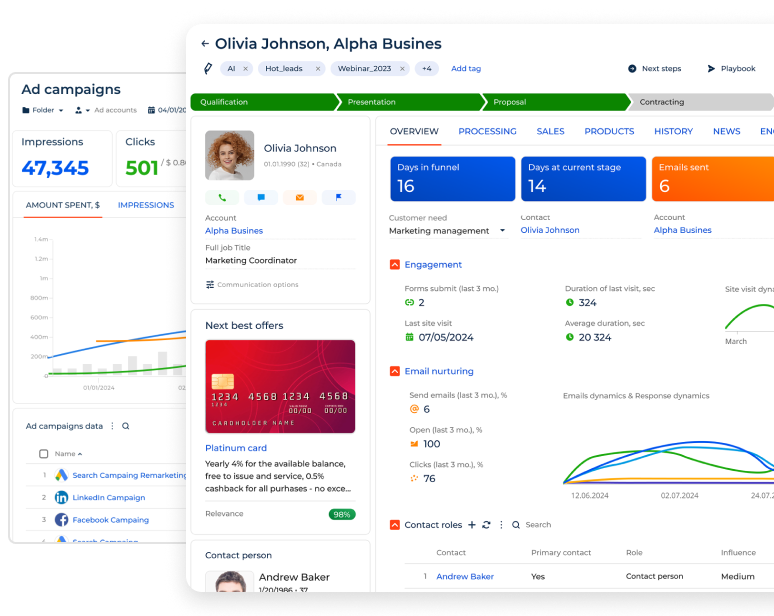
Creatio is a best-in-class agentic platform that enables pharma organizations build and manage end-to-end workflows and CRM with no-code and AI at its core. It helps companies automate complex processes, orchestrate cross-team collaboration, and adapt quickly to evolving regulatory and market requirements.
Designed to meet the operational and compliance needs of the pharmaceutical industry, Creatio can be tailored to support commercial, medical, service, and operational workflows. Pharma organizations use the platform to coordinate HCP and HCO engagement, streamline field force activities, manage marketing programs, and improve collaboration across commercial and medical teams.
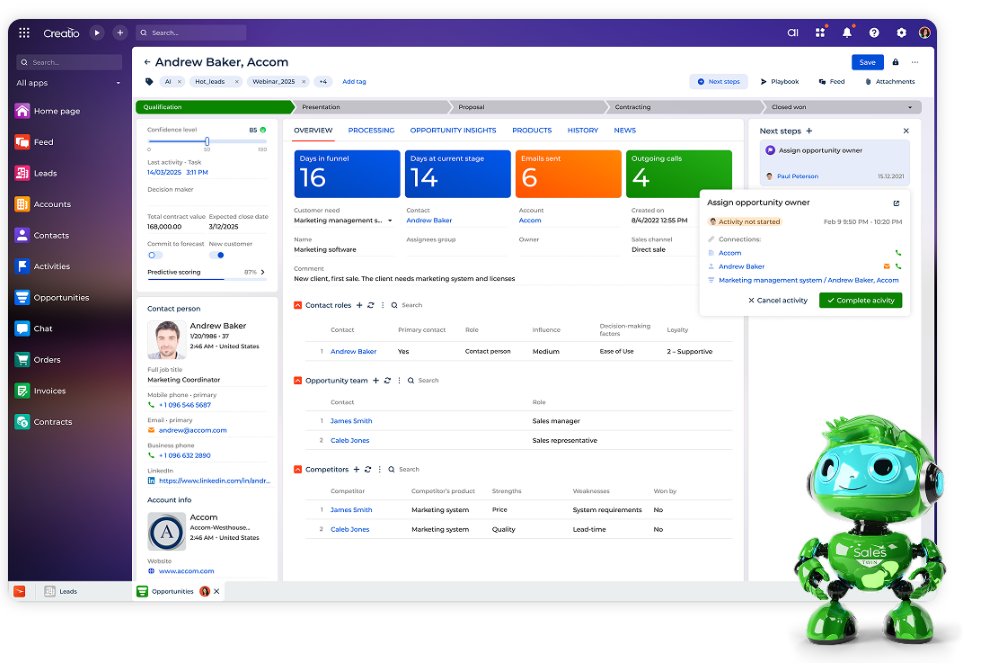
Creatio provides a unified suite of CRM applications — Creatio Sales, Creatio Marketing, and Creatio Service — enhanced with AI agents that assist teams with territory planning, next-best-action recommendations, campaign optimization, case management, and routine task automation. Organizations can also create role-specific AI agents or customize Creatio’s out-of-the-box agents to support their unique processes and workflows.
Built on a composable, AI-native no-code architecture, Creatio enables organizations to design and automate business processes, extend CRM capabilities, and build custom applications using pre-built components and visual tools. Additional functionality can be added through apps, connectors, and integrations available at Creatio Marketplace, allowing companies to tailor the platform to their specific needs.
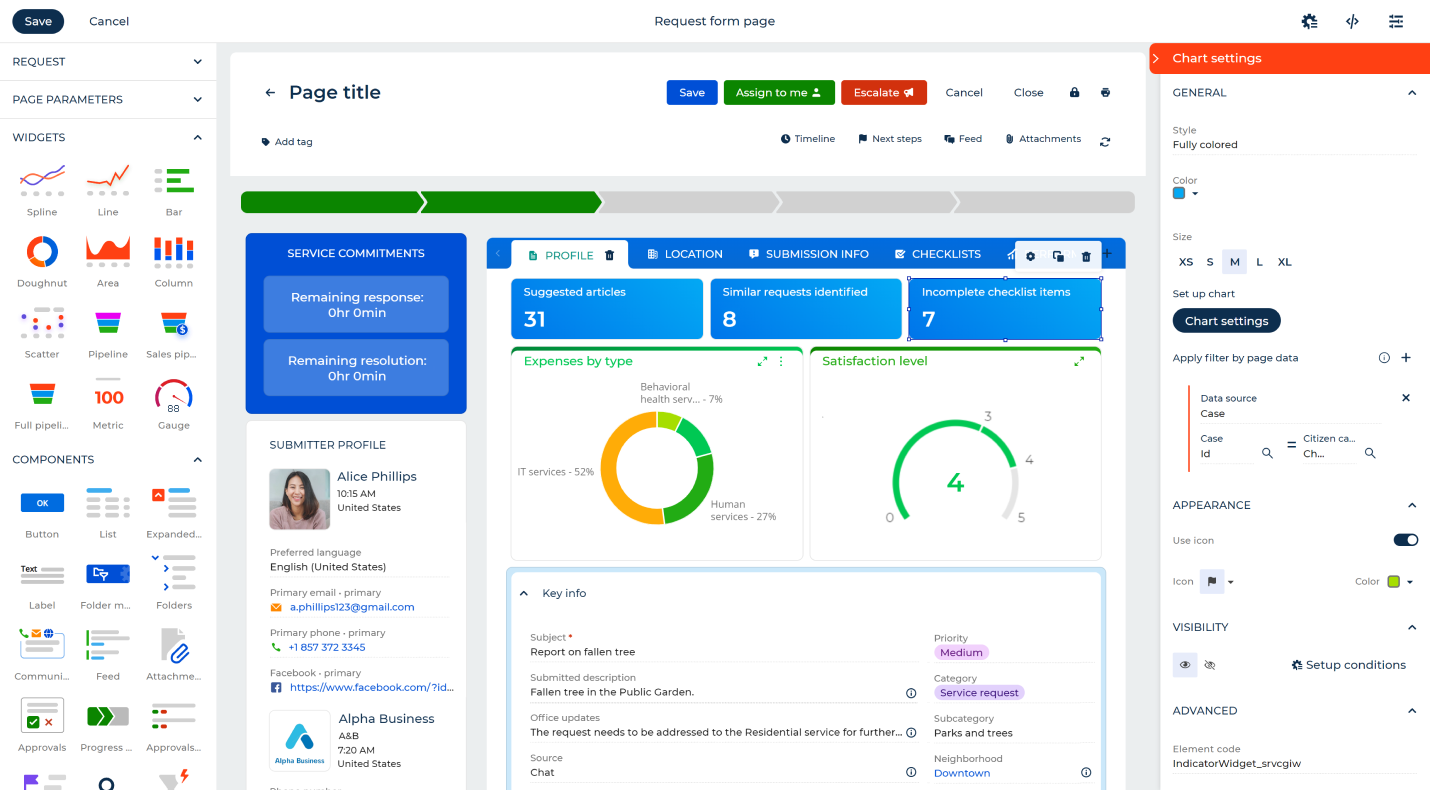
Creatio CRM also provides enterprise-grade security, governance, and built-in GDPR and HIPAA compliance guardrails. Its no-code integration framework allows seamless connectivity with external enterprise and specialized healthcare systems, enabling organizations to innovate and scale without disrupting existing workflows.
Key features:
- Marketing management and automation – Plan multichannel campaigns with A/B testing, segment HCP audiences, and coordinate scientific events with CME tracking and certification.
- Sales and account management – Centralize HCP and institutional profiles, manage account hierarchies, and track product portfolios with regional pricing and packaging.
- Territory & Field force management – Define sales territories, provide mobile CRM access, and monitor rep activities to ensure compliance with visit plans.
- Field work activities – Automate route suggestions and prioritize visits based on HCP tiering and engagement levels.
- Service automation – Manage support requests with automated case summaries, response workflows, and SLA-driven case handling.
- Clinical Trial Management – Track clinical trial stages, protocols, results, and performance of investigators and research sites.
- Manufacturing & Distribution monitoring – Manage procurement and monitor raw materials and finished goods with batch and expiry tracking.
- Comprehensive lead management – Capture interaction feedback, refine messaging, and qualify HCP and HCO leads based on engagement data.
- Ready-to-use AI Agents – Accelerate and streamline routine CRM tasks, such as territory management, next best actions recommendations, meeting preparations, lead scoring, and more.
- Seamless integration of AI tools and agents into productivity apps like Microsoft Outlook and Microsoft Teams to enhance cross-team collaboration and efficiency.
Pricing:
Creatio offers a composable pricing model, allowing pharmaceutical organizations to pay only for the products and capabilities they use. Pricing for the core platform, Creatio Business & AI Studio, starts at $40 per user/month, while each AI CRM application — Creatio Sales, Creatio Marketing, and Creatio Service — can be added at $15 per user/month.
2. Veeva Vault CRM
Veeva offers a range of software products for life sciences, including Veeva Vault CRM, a customer relationship management tool for biopharma, consumer health, and animal health companies.
Veeva Vault unites sales, marketing, medical, and service teams with a shared customer database, supporting primary care, specialty care, key accounts, retail sales, and medical science liaisons.
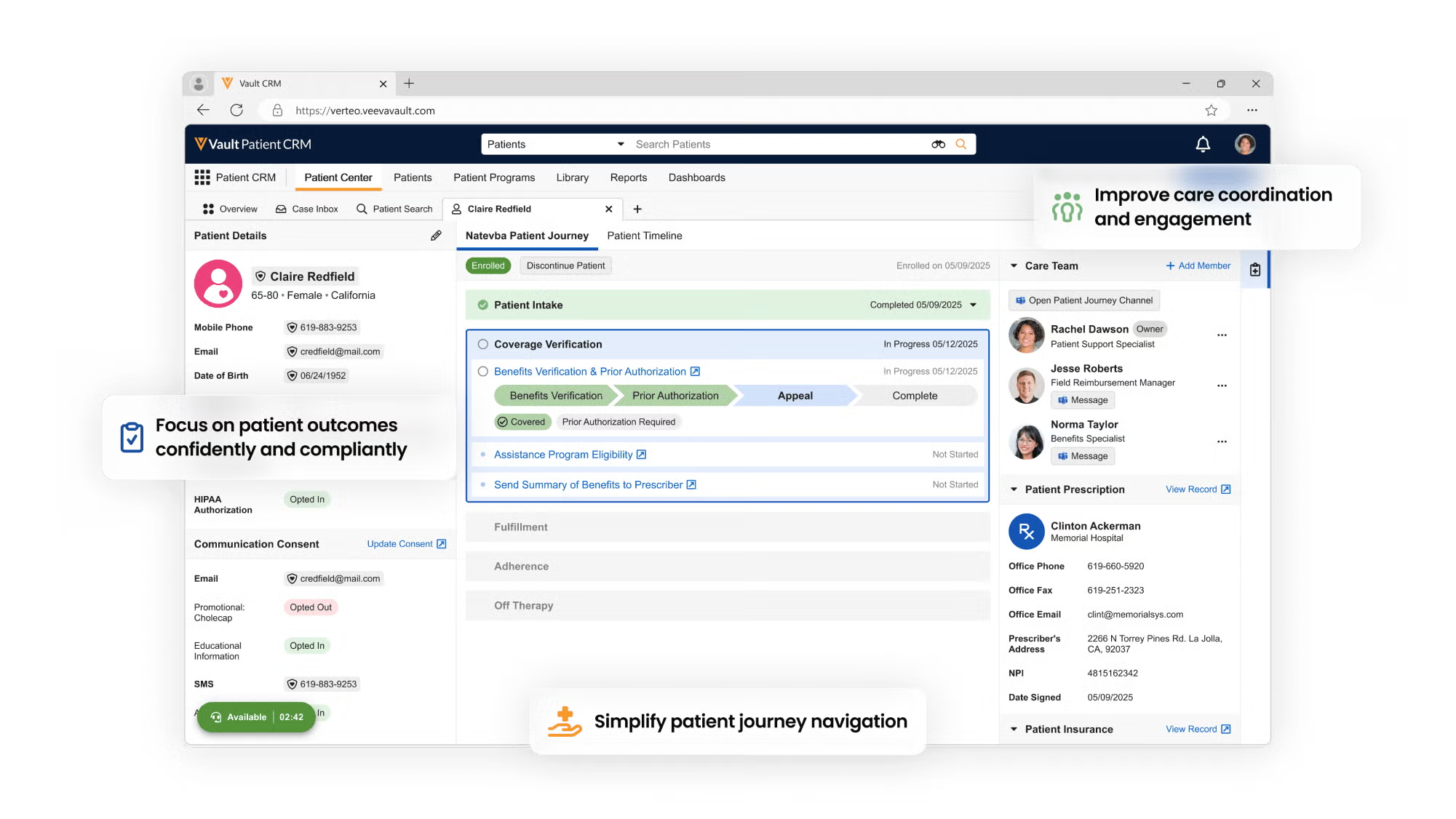
Veeva Vault CRM easily connects with other Veeva products for comliance, data protection, event management, clinical data management and more.
Key features:
- Customer profiling: Manage detailed profiles for HCPs, HCOs, and key accounts, enabling targeted interactions.
- Territory and account planning: Plan and optimize sales territories, assign targets, and develop strategic account plans.
- Sampling management: Track product sample distribution.
- Field engagement tracking: Track reps’ productivity at any location, even without an internet connection.
- MSL support: Manage MSL activities, track relationships, and capture scientific insights.
Pricing:
Pricing is available on request.
3. Salesforce
Salesforce is a cloud-based CRM platform designed to help pharmaceutical companies enhance customer relationships, streamline operations, and drive better health outcomes. It offers tools for sales, marketing, medical, and service teams, enabling personalized engagement with HCPs, efficient management of key accounts, and compliant digital marketing.

Key features:
- Health Cloud: Combine clinical and HCP data on a single platform accessible to all teams.
- Marketing automation: Personalize customer experiences and optimize marketing campaigns.
- Sales automation: Get a 360-degree view of customer profiles and automate event-based interactions and workflows.
- Supply chain monitoring: unify data across R&D, manufacturing, supply chain, and commercialization.
- Omni-channel patient services: Enable patients to access information and support on their preferred channel and mobile device.
- Analytics: Get easy access to data-based insights with reports and dashboards for tracking key performance metrics.
Pricing:
The pricing starts at $325 per user/month.
How to Choose Pharma CRM Software?
Choosing a Pharma CRM involves a few key considerations to ensure that the software aligns with your business needs and industry-specific challenges:
- Identify your goals: Before selecting a CRM, define your specific objectives and KPIs. This will help you focus on CRM solutions that address your needs rather than opting for a feature-heavy platform that might offer unnecessary functionality.
- Compliance and regulatory fit: In the pharmaceutical industry, compliance is crucial. Ensure the CRM has built-in compliance management features that adhere to industry standards and regulatory requirements, such as GDPR, HIPAA, and the Sunshine Act.
- Ease of integration: Look for a CRM that can seamlessly integrate with your existing systems, data sources, and tech stack. Smooth data migration and customization options are critical, so inquire about vendor support for these processes.
- Customization options: Evaluate the CRM's customization capabilities to ensure it can adapt to your unique needs. Check if it allows you to build custom reports, automate workflows, and add tailored features. Customization ensures the software not only meets your requirements but can also streamline processes specific to your company.
- User-friendly CRM: Choose a CRM that offers easy-to-use tools for multi-channel engagement and CRM automation. This capability ensures a high level of adoption and quick time-to-value for your pharma CRM.
- Analytics and reporting: The CRM should provide robust analytics for tracking customer interactions, sales trends, and market insights. Advanced reporting capabilities will enhance your sales and marketing strategies.
- Vendor reputation and support: Assess the vendor’s expertise in the pharmaceutical sector. Check their reputation, client testimonials, and whether they offer ongoing support, including training and software updates.
Summary
Pharma CRM is an ultimate solution for organizations seeking stronger HCP relationships, compliant operations, and more efficient commercial execution. These platforms help pharmaceutical companies centralize stakeholder data, improve field force productivity, automate marketing and sales workflows, and maintain compliance with complex industry regulations.
Creatio empowers pharmaceutical organizations to modernize their operations with an agentic CRM and workflow platform powered by AI and no-code. With its composable architecture, ready-to-use CRM applications, and customizable AI agents, it enables companies to automate pharma workflows, coordinate HCP engagement, and continuously adapt their processes to evolving business needs.
