





































































Commercial Banking CRM - The Backbone of Customer-Centric Banking

Launch Smart Banking Workflows With Creatio CRM

Nowadays, banks' offerings are quite similar, with marginally different interest rates and product terms. That’s why, to stand out in the crowded market, commercial banks need to establish a client-centric approach to attract new clients and build long-term loyalty with existing ones.
To take their customer relationships to a whole new level, commercial banks can benefit from a commercial banking CRM tool. In this article, we explore how commercial banks can use a CRM tool to establish a client-centric approach, boost client loyalty, and improve profitability in the long run.
What is Commercial Banking CRM?
A commercial banking CRM is a customer relationship management system designed to help commercial banks effectively manage relationships with clients and provide personalized financial services.
A CRM designed for commercial banks consolidates customer data into a unified platform, giving bankers a clear and comprehensive view of each client’s interactions and financial profile. This visibility allows them to deliver better service and identify opportunities to offer relevant financial products, such as commercial loans, cash flow solutions or treasury management tailored to the client’s specific needs.
Modern CRMs for commercial banks implement AI solutions to further improve customer relationship management and provide more personalized and timely services.
Benefits of Commercial Banking CRM
Commercial banks can use CRM to improve how they manage relationships with their clients, increase client satisfaction, boost productivity, and drive profit growth.
Here’s an overview of commercial banking CRM benefits:
Enhanced customer satisfaction and loyalty
A commercial banking CRM helps bankers build and maintain strong, long-term relationships with their clients. By providing deep insights into each clients’ financial needs, preferences, and goals, CRM enables more personalized service and tailored recommendations - ultimately driving higher client satisfaction and loyalty.
Additionally, AI can alert customer success agents about potential customer churn and recommend the best actions to strengthen relationships and retain clients.
Enhanced employee productivity
A CRM for commercial banks can increase employees' productivity by automating routine and mundane tasks that typically consume a large portion of their workday. While CRM automates data updates, know-your-customer procedures, document management, and compliance tracking, employees can focus on more strategic work.
Improved employee collaboration
Commercial banking CRM allows employees to work together on the same accounts, which supports faster customer service and timely responses. With customer information gathered in one unified platform, bankers can quickly access customer profiles, transaction histories, and ongoing deals, reducing delays and ensuring a seamless customer experience. This unified view eliminates data silos, allowing relationship managers, credit officers, and service teams to collaborate effectively and provide timely support.
Enhanced revenue growth
CRM tailored for commercial banks helps financial institutions manage their resources effectively, streamline processes, and improve customer relationships, which boosts overall profitability.
By leveraging customer insights provided by the CRM, bankers can identify new sales opportunities and increase revenue through precise cross-selling and upselling strategies. With personalized offers tailored to each client’s needs, they can maximize revenue per customer while improving customer satisfaction.
Streamlined compliance with industry regulations
Commercial banking CRM helps banks manage regulatory processes by centralizing customer records, processing required documentation, and automating steps in KYC and AML workflows. Automated reminders, approval routing, and audit trails make it easier for compliance teams to monitor outstanding requirements and maintain consistent processes.
Stronger security
CRMs for the finance industry provide a robust set of security measures. With strong encryption, multi-factor authentication, and role-based access control, banks can ensure that only employees with appropriate authorization can access sensitive information.
Most Important Features for Commercial Banking CRM
Modern CRM solutions, such as Creatio, are equipped with a suite of dedicated features powered by the newest artificial intelligence technology. Creatio integrates three key AI technologies - agentic, generative, and predictive AI - to help banks take their productivity to the next level, make informed decisions, and provide highly personalized experiences at scale.
In this section, we will explore the core features of commercial banking CRM:
Customer 360
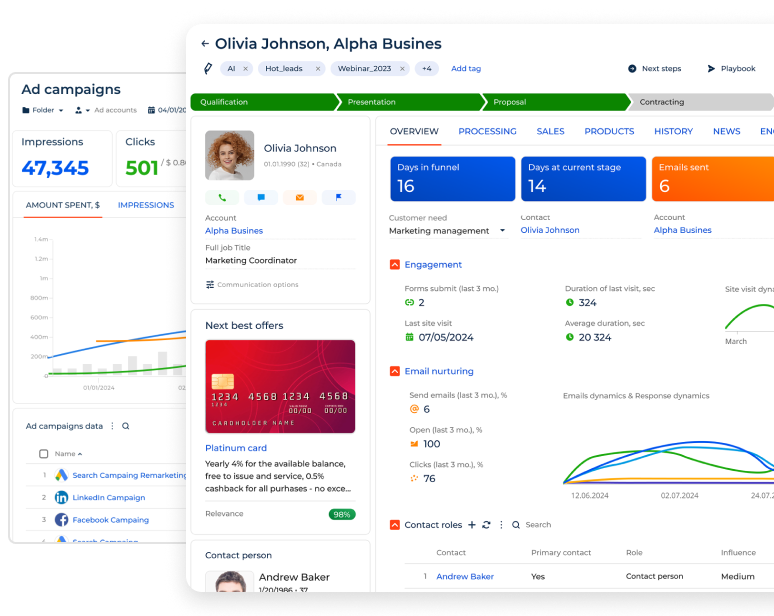
CRMs for commercial banking collect all client information to provide a complete 360-degree view of contacts and account data, with engagement history across the entire customer journey. This centralized repository includes contact information, financial history, current portfolio, and communication records, which helps bankers better understand their clients.
Empowered by AI, CRM systems can further enhance these profiles by autonomously and continuously updating records with insights from various data sources, such as emails and meeting notes. This creates a more comprehensive client profile and enables better relationship management and more personalized service.
Account opening
Commercial banking CRMs offer automated account-opening features that streamline screening and verification processes. With automation tools, bankers can speed up approvals and digitize document management. AI can support faster account opening by analyzing submitted documents for accuracy, flagging inconsistencies or missing information, and verifying identities through intelligent data matching.
Client onboarding
CRM enables bankers to provide a personalized customer onboarding experience for each client with a 360-degree customer view, streamlined offer management, and an automated product catalog. AI tools can also identify potential onboarding bottlenecks and recommend the next-best steps, ensuring a faster, more efficient, and highly personalized customer onboarding experience.
Lead and opportunity management
CRM systems for commercial banks help them track and capture leads from multiple sources to create a unified database. This allows bankers to get a clear understanding of the pipeline, monitor all interactions with potential business clients, manage leads, and create strategies to close complex commercial banking deals faster.
With AI lead scoring capabilities, bankers can prioritize the most promising opportunities, thanks to AI’s ability to quickly analyze lead information, engagement patterns, and compare it to historical deals and similar profiles. AI tools can also suggest personalized outreach strategies, recommend next-best actions, and forecast deal success probability.
Loan management and underwriting
Bankers can use the customer 360 feature paired with automated loan verification to streamline the loan management process from application to post-loan servicing. Commercial banking CRM enables bankers to provide personalized loan terms, quickly collect approvals from the middle office, and automate debt collection processes.
Additionally, CRM software supported by AI tools can further enhance the underwriting process by streamlining the collection, evaluation, and analysis of client financial data to assess creditworthiness. AI automatically analyzes large volumes of data in real time, such as financial reports and transaction patterns to provide more accurate credit scoring. It can also recommend optimal loan terms based on historical data and client profiles and learn from past loans to improve future lending decisions.
Portfolio management
Portfolio management capabilities in a commercial banking CRM help bankers monitor and manage clients’ financial services and products, including loans, credit lines, deposits, investments, and treasury services. The CRM provides a comprehensive view of portfolio performance and risks across accounts, helping relationship managers identify opportunities for growth and mitigate potential issues.
By integrating AI capabilities into portfolio management, bankers can forecast portfolio performance based on historical and real-time data. Additionally, AI tools provide tailored financial product recommendations based on client behavior and market conditions, helping bankers increase portfolio profitability.
Marketing campaign management
Commercial banking CRM systems can help marketers prepare more engaging marketing campaigns and effectively manage them. AI-powered audience segmentation allows marketers to group clients based on shared characteristics to personalize messaging and content to individual customer needs. With generative AI, they can automatically create tailored content for each campaign, while agentic AI handles execution, monitoring, and optimization.
Additionally, predictive AI tools help forecast customer responses and campaign success while recommending the most effective channels and creative variations for each segment to boost ROI.
Cross-selling and upselling recommendations
Cross-selling and upselling are essential strategies for commercial banks to increase the value of existing clients, deepen customer relationships, and increase revenue. CRM systems equipped with AI can significantly enhance these strategies by providing personalized product recommendations based on client data and behavior.
AI analyzes historical client interactions, financial activity, and demographic data to identify opportunities for cross-selling and upselling. For example, if a business client regularly makes large transactions, the CRM may suggest an additional line of credit. Similarly, AI can recommend relevant products, such as insurance or investment solutions, to existing clients based on their evolving needs. These AI-driven recommendations ensure that bankers can offer the right products to the right clients at the right time.
Customer support chatbots
Customer support chatbots are becoming an essential feature in commercial banking CRM systems, enabling banks to offer 24/7 assistance and improve customer engagement. These AI-powered chatbots handle a wide range of customer inquiries, from simple FAQs to more complex service requests, without the need for human intervention.
AI chatbots use natural language processing (NLP) to understand customer intent and engage in more sophisticated conversations, offering personalized recommendations or next steps. These bots can also escalate more intricate issues to human agents when necessary, ensuring a seamless transition between automated and human support.
By automating routine interactions, chatbots help reduce wait times and free up customer service agents to focus on more complex cases. The chatbot can assist with tasks such as account balance inquiries, loan status updates, and transaction history requests, all while providing personalized responses based on the customer’s profile and previous interactions.
Case management
CRM systems for customer banks streamline case management by logging, categorizing, and automatically routing cases to the most fitting customer service agent. AI enhances this process by analyzing case data in real time to prioritize high-urgency cases and suggest the best course of action based on similar cases.
Each case is recorded with a clear audit trail, ensuring that no critical information is overlooked, which enables other team members to pick up a case from where it was left off. By enabling timely, data-driven, and relevant support, AI-powered case management significantly improves client satisfaction.
Fraud detection
CRM systems equipped with AI-powered tools enhance banks’ ability to identify and prevent fraud. AI algorithms continuously analyze transactions in real time and monitor client accounts for suspicious activity, such as unauthorized transactions, irregular account logins, or abnormal spending. When AI identifies potential fraud risk, the system can trigger alerts and even automatically block suspicious transactions for further review.
Document and contract management
Commercial banking deals often require extensive paperwork, and tailored CRM software can help bankers manage large volumes of documents. CRM systems offer built-in document and contract management tools that allow bankers to securely store, organize, and access client files, agreements, and compliance forms in one place.
AI tools can further streamline the document management process by automatically classifying documents, extracting key data points, and flagging missing or outdated information. Additionally, AI can suggest the next steps in the approval workflow and speed up contract turnaround with intelligent document routing and reminders.
Creatio Bank.AI for Commercial Banking
Creatio Bank.AI is a dedicated Banking CRM and AI Platform designed for commercial banks, retail banks, and credit unions. It combines pre-built, customizable banking workflows with AI agents to help commercial banks manage complex corporate relationships, coordinate lending processes, and streamline activities involving multiple accounts, entities, and stakeholders.

The platform brings customer data, relationship management, and banking operations into one environment, giving bankers a complete view of their clients and access to banking AI agents and autonomous agents. Banking AI agents assist with tasks such as document summarization, prospect research, and preparing client insights. Autonomous agents go beyond assistance to execute tasks and orchestrate multi-step workflows, from initiating customer follow-ups to coordinating onboarding activities, within defined controls and approval processes.
For example, the Renewal Agent monitors upcoming renewals and initiates follow-ups, while the Customer Onboarding Agent coordinates document collection, validation, and onboarding tasks. By handling repetitive activities and moving work between teams, these agents help reduce manual handoffs and allow relationship managers to focus on client needs and complex decisions.

Creatio Bank.AI provides a comprehensive set of capabilities tailored to commercial banking:
- Customer 360 and relationship portfolio management – connects business clients, parent companies, subsidiaries, guarantors, accounts, and interaction histories to provide a unified view of each relationship.
- Prospecting and opportunity management – supports prospect research, lead management, and sales pipeline tracking. Bankers can use AI Agents to research potential clients, identify referral opportunities, and initiate relevant outreach workflows.
- Customer onboarding and multi-party workflows – coordinates document collection, information validation, and tasks across relationship managers, onboarding teams, and other stakeholders.
- Cross-selling and relationship expansion – helps bankers identify opportunities across lending, deposits, treasury services, and other banking products, building personalized product recommendations based on customer information and relationship context.
- Lending workflows, renewals, and retention – supports loan-related document collection, internal approvals, and coordination between relationship managers and lending teams.
- Account servicing and case management – gives service teams access to customer histories when handling account requests, treasury inquiries, payment investigations, and complaints.
- KYC, AML, and regulatory workflows – supports beneficial ownership verification, sanctions screening, risk management, regulatory reporting, and internal approvals through structured workflows and connected customer records.
- AI-powered document processing – extract and organize information from banking documents using a dedicated AI agent, checking for completeness, and flagging exceptions for review.
Built on Creatio's composable no-code architecture, the platform allows commercial banks to customize applications, automate complex workflows, and develop AI agents tailored to their needs. With embedded AI Studio, banks can build, deploy, and govern specialized AI agents without extensive coding.
Creatio Bank.AI enables banks and credit unions to extend AI-first automation across relationship management, lending, customer servicing, and operations while maintaining human oversight of sensitive processes and decisions.