

































































Build Faster. Grow Smarter. Try Creatio

Enterprise CRM is at a turning point. Systems that once managed customer data are now expected to drive growth through AI, automation, and hyper-personalized experiences. According to Grand View Research, the CRM market is projected to grow by up to 70% between 2026 and 2030, as organizations prioritize faster response times, lower costs, and better customer relationships.
SAP has long been a cornerstone of customer relationship software systems, known for its scalability, structured processes, and deep ERP integration. But as businesses push for faster innovation, more adaptive customer journeys, and AI-driven execution, many are starting to question whether traditional CRM models can keep up. If your CRM is slowing down change instead of enabling it, it may be time to reconsider your options.
In this article, we break down why companies consider alternatives to SAP CRM, what to look for in a modern platform, and the leading CRM vendors that support global corporations in 2026.
Key Takeaways
- When evaluating alternatives to SAP CRM, look for platforms that offer strong integration capabilities, an intuitive user experience, easy customization, and robust AI capabilities.
- Most common reasons for considering SAP competitors include high total cost of ownership, system complexity, limited flexibility, and scalability challenges.
- A strong SAP alternative should unify data across systems, enable flexible no-code customization, embed AI-driven automation, improve usability, and reduce costs to accelerate time to value.
- The best SAP CRM alternatives in 2026 include Creatio CRM, MS Dynamics 365, HubSpot CRM, Zoho CRM, Oracle Cloud CX, Salesforce, Pega CRM, and Infor CRM.
What is SAP CRM?
SAP CRM (customer relationship management) is an enterprise platform for managing and improving customer interactions across sales, marketing, and service operations. It is considered an industry-standard platform, particularly for organizations that require strong system architecture, extensive integration with external partners, and a stable foundation for complex, multi-system environments.
The platform is widely adopted by mid-sized and large companies — especially those already operating within the SAP ecosystem — because of its robust financial controls, real-time reporting, inventory visibility, and ability to support operations at scale. However, as business needs evolve, some organizations find SAP CRM difficult to adapt, making it less sustainable in the long run.
Why Businesses Consider Switching from SAP CRM?
While SAP CRM remains a powerful platform, many organizations begin to explore alternatives that are easier to use, faster to adapt, and better equipped with built-in AI and automation. Common reasons for switching include:
- Reason #1: High total cost of ownership (TCO). SAP CRM often requires significant investment across licensing, implementation, and maintenance, with costs rising considerably as organizations scale and customize the system.
- Reason #2: Complex user experience and steep learning curve. The platform can feel difficult to use, particularly for non-technical teams or those unfamiliar with SAP, often slowing adoption and increasing training needs.
- Reason #3: Rigid architecture and slower adaptability. For mid-sized and large organizations, updating processes or workflows can take time, limiting how quickly teams can respond to changing business needs.
- Reason #4: Implementation and maintenance challenges. As systems grow and evolve, customizations can become harder to manage, especially in complex environments, often leading to technical debt.
- Reason #5: Performance and scalability limitations. Some organizations report slower performance and challenges scaling SAP CRM efficiently, especially compared to modern cloud-native platforms.
Features to Look for in SAP CRM Alternatives
Organizations using or evaluating SAP are not looking for a basic replacement—they need a platform that matches enterprise-grade capabilities while offering greater flexibility, usability, and innovation. Key features to consider across SAP competitors are:
- Lead and Contact Management – A centralized system to manage 360° customer data, track interactions, and support the full customer lifecycle across sales, marketing, and service. It should also provide omnichannel capabilities to ensure consistent engagement across email, phone, chat, social media, and customer portals.
- Sales, Marketing, and Service Automation – Ensure end-to-end automation of core revenue and service processes, including lead generation, deal management, and customer support.
- AI Tools and Agentic Workflows – Provide AI-driven capabilities in CRM to support decision-making, automate tasks, and enable autonomous, goal-driven workflows across specific functions. With CRM AI agents, enterprise businesses can accelerate routine work, improve response times, personalize customer engagement, and orchestrate complex processes with less manual effort.
- AI-Enhanced Reporting and Analytics – Feature data-driven insights, predictive analytics, and real-time performance tracking to support better decisions and continuous optimization.
- No-Code Customization – Provide the ability to configure workflows, data models, and applications without heavy reliance on developers, enabling faster adaptation to business needs.
- Scalability and Integration Capabilities – Support seamless integration with ERP systems, external partners, and third-party applications, with the ability to scale as the organization grows.
- Ease of Use and User Adoption – Offer an intuitive, user-friendly interface that reduces training time, improves productivity, and drives adoption across business teams.
- Faster Implementation and Time-to-Value – Compared to SAP CRM, the alternative platforms should enable quicker deployment and faster ROI through pre-built components and flexible configuration.
- Transparent and Manageable Cost Structure – Offer predictable pricing models with transparent costs related to customization, maintenance, and scaling.
- Industry-Specific Solutions – Provide pre-built templates, workflows, and compliance features tailored to industries such as banking, manufacturing, or telecom.
Not every organization will prioritize the same features. For some, deep integration with core systems or capabilities like supply chain management will be essential, while others may focus more on AI automation, usability, or faster deployment. The key is to align the platform’s strengths with your business priorities, and once those are clear, you can move forward with evaluating the top SAP competitors.
8 Best SAP CRM Alternatives
CRM system | Primary Strengths | Rating |
| Creatio CRM | Built-in AI capabilities, ready-to-use AI agents, agentic workflow automation, no-code customization and composable architecture |
|
| Microsoft Dynamics 365 | Strong integration with Microsoft ecosystem (Azure, Teams, Outlook), cost-effective for existing Microsoft users |
|
| HubSpot Smart CRM | User-friendly interface, fast deployment, centralized data and process management capabilities |
|
| Oracle Cloud CX | Enterprise-grade scalability, strong data management and analytics capabilities |
|
| Salesforce | High user adoption, extensive app marketplace, advanced AI capabilities (Einstein) |
|
| Zoho CRM | Affordable pricing, broad feature set for growing businesses, and easy customization |
|
| Pega CRM | Strong business process management, AI-drive automation and case management capabilities |
|
| Infor CRM | Industry-focused solutions that require complex automation, high-level customization, and AI-driven personalization |
|
1. Creatio CRM
Best for: Mid-size to enterprise organizations looking for a flexible, AI-native CRM to manage customer and operational workflows with no limits on users, agents, or scale.
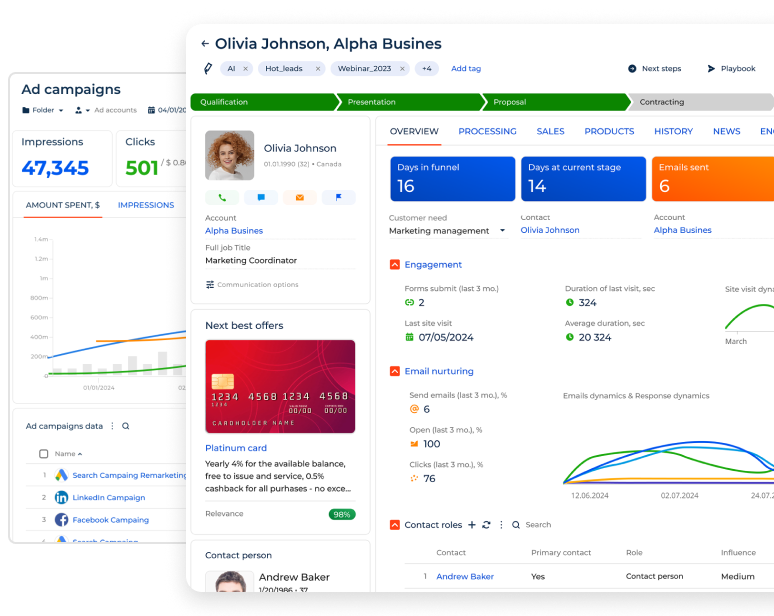
Creatio is a best-in-class alternative to SAP, offering an AI CRM and workflow automation platform that helps organizations manage customer and operational processes across sales, marketing, and service. It combines no-code architecture with embedded AI capabilities, enabling teams to automate workflows, adapt processes, and manage the full customer lifecycle through a unified platform.
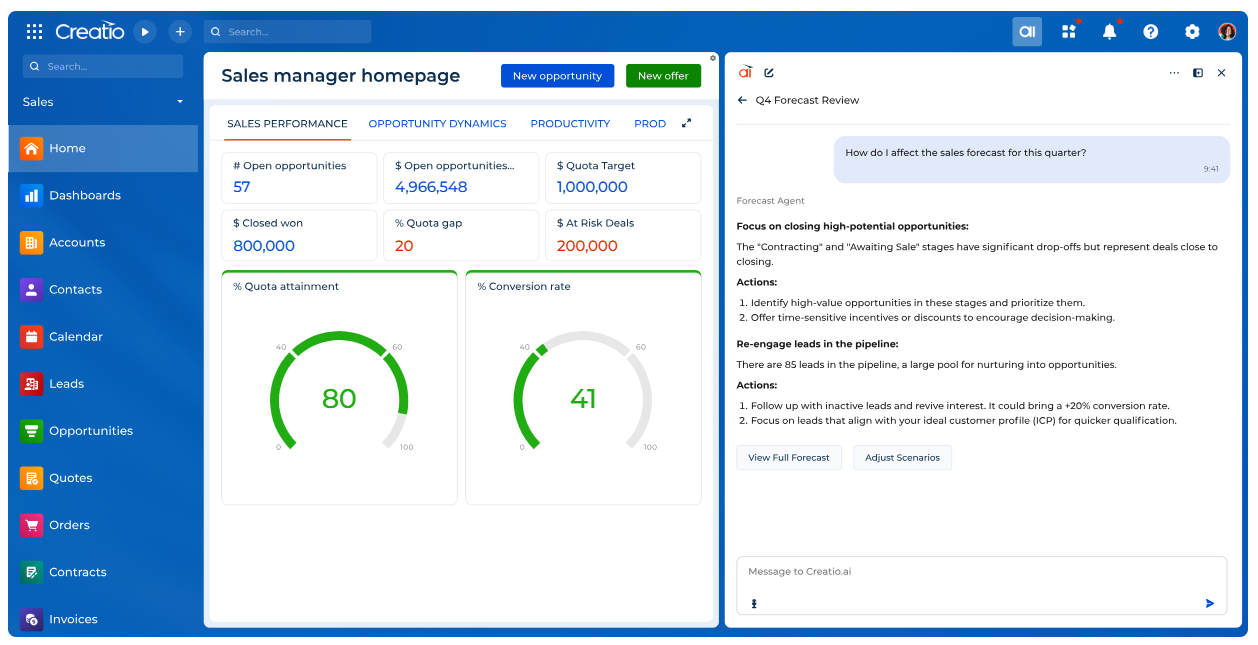
The platform includes three core products that can be deployed as a single CRM bundle or as standalone solutions to fit your company’s exact needs:
- Creatio Sales helps teams manage leads and opportunities, forecast revenue, and accelerate pipeline performance, with built-in AI agents that automate routine tasks and recommend next best actions.
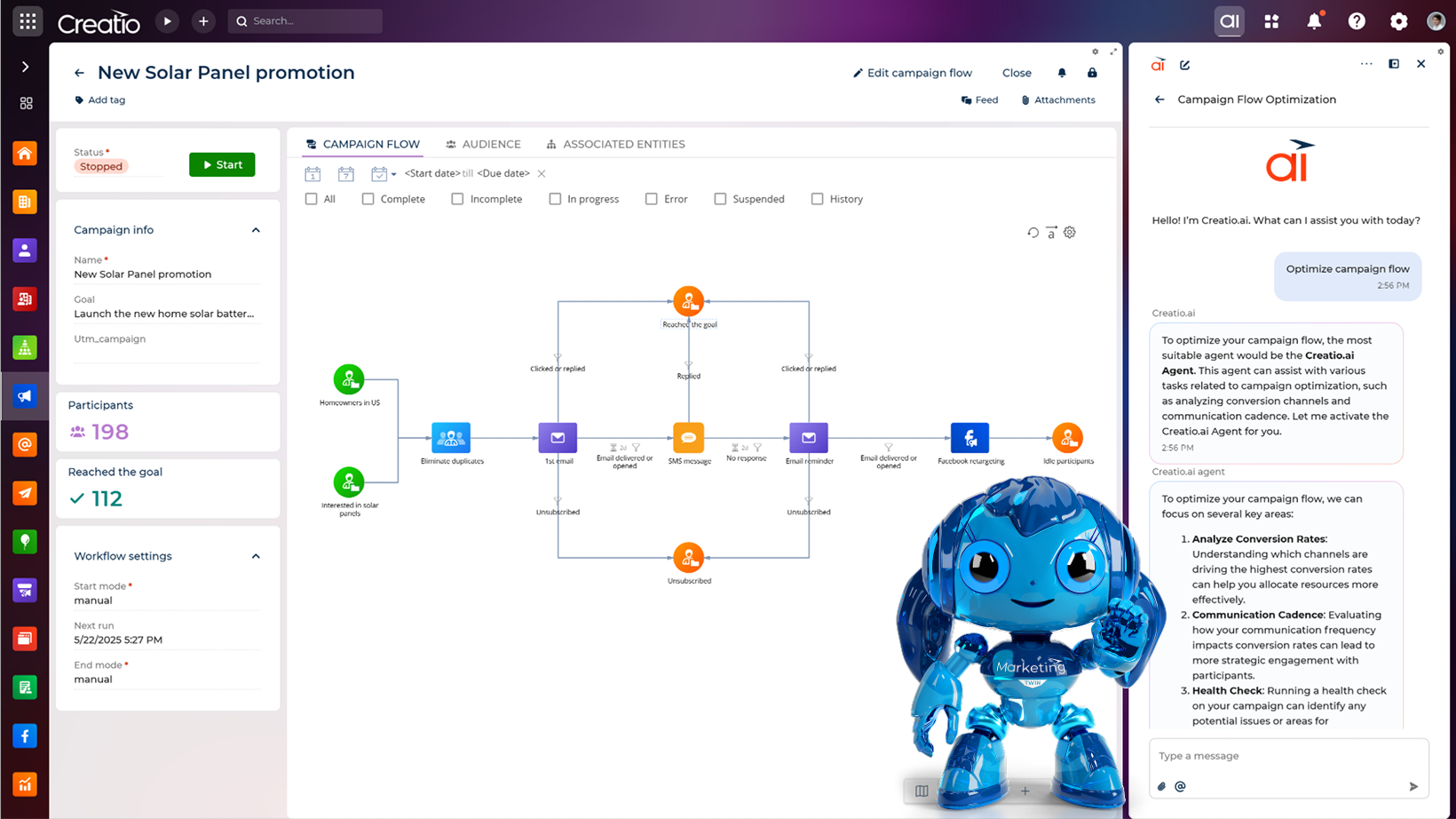
- Creatio Marketing enables personalized, multichannel campaign execution with agentic automation and real-time AI insights to improve targeting, engagement, and lead generation.
- Creatio Service provides a centralized agentic workspace for managing customer requests and delivering consistent, high-quality support across all channels.
A key differentiator of Creatio is its AI-enhanced no-code capabilities and composable architecture, which enable both business users and IT teams to adapt workflows, build applications, and automate CRM processes across different use cases. Unlike traditional systems, it does not require specialized development skills, helping organizations reduce costs, accelerate innovation, and avoid risks tied to IT talent shortages.
Creatio also addresses cost and scalability concerns common in SAP environments, offering a more predictable pricing model and faster implementation. Its composable design ensures the platform can scale with business growth without adding unnecessary complexity.
Recognized by both analysts and customers, Creatio has been named a Visionary in the Gartner® Magic Quadrant™ for Sales Force Automation and a Leader in Marketing Automation Platforms, reinforcing its position as a strong alternative to traditional CRM systems.
Overall, Creatio is a strong option for organizations looking for a flexible, efficient, and cost-effective CRM platform that supports both customer engagement and internal workflow automation. Its combination of customer results, proven use cases, and advanced AI capabilities makes it a compelling alternative to SAP CRM.
Key Features:
- Ready-to-use CRM products for sales, marketing, and service to streamline customer-facing and internal operations
- Prebuilt AI Agents to automate repetitive tasks at scale and improve team productivity
- No-Code AI Agent Builder for designing and deploying custom agents tailored to specific business processes
- AI-driven no-code customization to adapt the platform to unique workflows and operational needs
- Transparent pricing model with clear costs and no hidden fees
- Industry-specific solutions tailored for 20+ sectors
- Tailored solutions for 20+ industries
- Access to 400+ third-party applications and integrations via the Creatio Marketplace
Pricing:
Creatio uses a composable pricing model, allowing you to pay only for the platform and CRM products you need. Pricing starts at $40 per user/month, combining the core platform Creatio Business Studio ($25) with individual CRM modules for sales, marketing and service teams (at $15 each), available
A personalized guided demo can be requested to understand the platform’s essential capabilities.
2. Microsoft Dynamics 365
Best for: Enterprises already using the Microsoft ecosystem and looking for a CRM with strong integration across business tools.
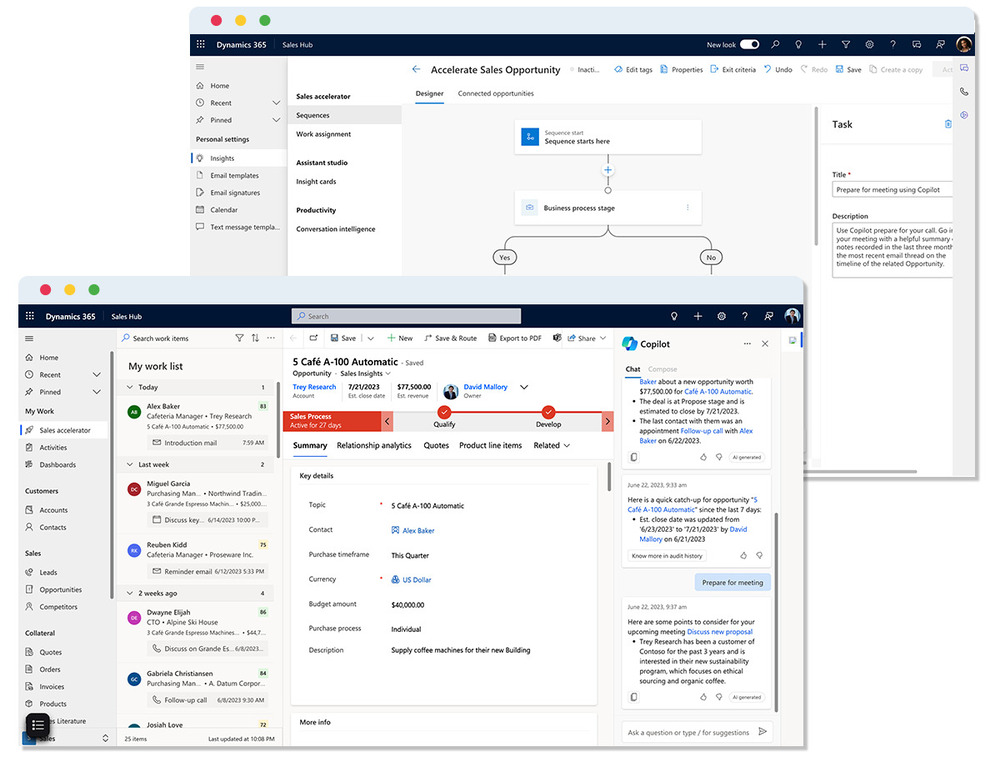
Microsoft Dynamics 365 is a cloud-based suite of CRM applications designed to help businesses manage customer relationships and deliver consistent customer experiences. It includes several core apps such as Sales, Customer Insights, Customer Service, and Contact Center and Field Service, which can be used individually or in a bundle depending on business needs.
The platform supports remote collaboration, real-time data updates, and scalable deployment. Its familiar interface helps teams adopt the system more easily, especially those already using Microsoft products. Deep integration with tools like Outlook, Teams, and SharePoint enables users to manage communications, share documents, and execute workflows seamlessly across teams.
Key Features:
- AI-powered pipeline management and sales forecasting
- Lead, opportunity, and partner management
- AI assistant (Copilot) for lead prioritization, behavior prediction, task automation, and content generation
- Unified CRM & ERP capabilities that combine relationship management and operational tools
- Multichannel campaign management and customer journey orchestration
- AI-assisted customer service and case management
- Advanced analytics and reporting powered by Power BI
Pricing:
Microsoft Dynamics 365 pricing varies by module. Dynamics 365 Sales starts at $65 per user/month, Customer Service at $50 per user/month, and Customer Insights from around $1,700 per tenant/month. Total cost depends on the combination of apps and deployment scale.
3. HubSpot Smart CRM
Best for: Growing and mid-sized businesses looking for an easy-to-use CRM with strong marketing automation and sales pipeline management
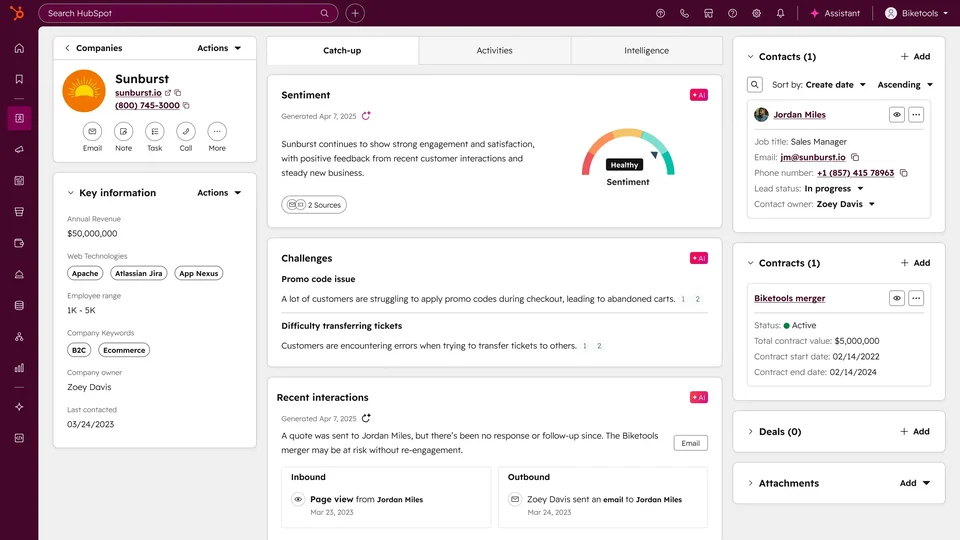
HubSpot CRM is a user-friendly, all-in-one alternative to SAP, designed to help businesses manage customer relationships, marketing campaigns, and sales pipelines. It provides a 360-degree view of customer data and integrates with over 2,000 applications, combining tools for marketing, sales, service, and content management that can scale as the business grows.
The platform is known for its ease of use and quick setup, making it a popular choice for teams that want to get started without complex implementation. HubSpot also includes built-in AI tools that support content creation, automation, and basic predictive insights, though these capabilities are more assistive than fully agent-driven.
Key Features:
- Contact and company management with full interaction history, notes, and tasks in one place
- Visual sales pipeline tracking with customizable deal stages and forecasting
- Live chat and chatbots for real-time customer engagement
- AI tools for content generation, email drafting, and basic insights
- Strong integration ecosystem via HubSpot Marketplace
- Customizable dashboards to track sales, marketing, and customer service performance
Pricing:
The pricing for HubSpot’s Smart CRM starts at $50 per month per seat (Professional plan).
See also: Top 10 HubSpot Alternatives & Competitors
4. Oracle CX
Best for: Organizations with complex data ecosystems that prioritize data governance, security, and compliance.
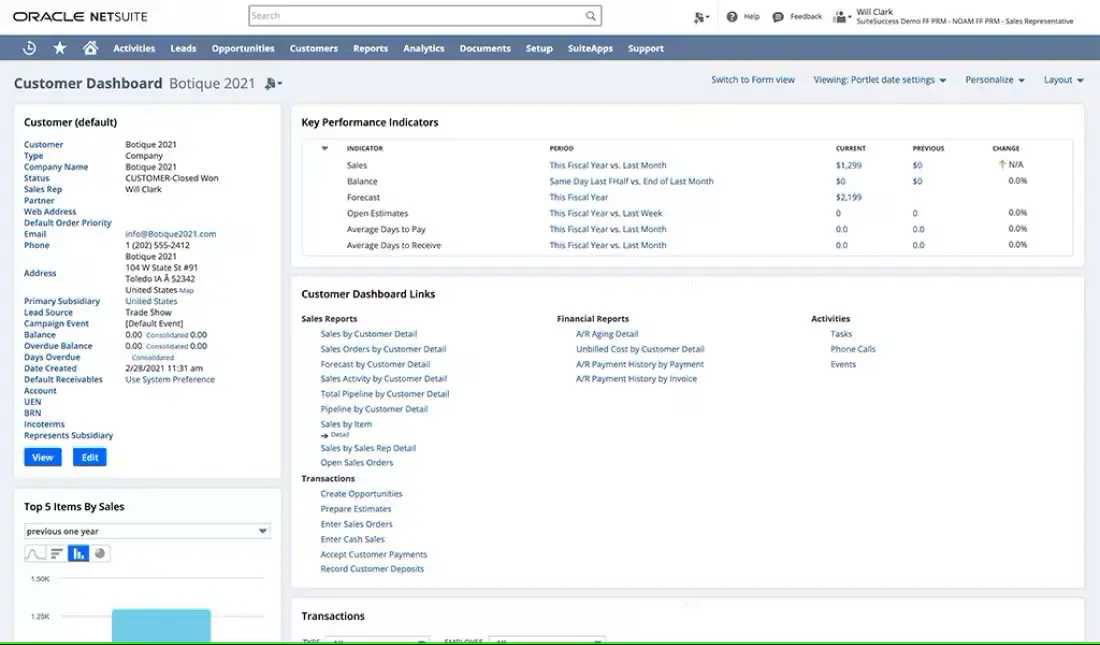
Oracle CX is a comprehensive suite of customer experience applications designed for large enterprises managing complex, data-driven customer journeys. It unifies sales, marketing, service, and analytics on a single platform, connecting front-office interactions with back-office systems such as finance and supply chain to deliver a consistent, real-time view of customers across all touchpoints.
Built with a strong focus on governance, security, and scalability, Oracle CX enables organizations to orchestrate personalized experiences at scale. Its AI-driven insights, unified data visibility, and cross-functional collaboration capabilities help optimize revenue operations, improve customer retention, and support compliance in highly regulated industries.
Key Features:
- Oracle AI Agent Studio to build and run AI automation using reusable Oracle, partner, or external agents
- Real-time 360 degree customer profiles with segmentation and data enrichment
- AI-guided selling with pipeline management and configure price quote capabilities
- Omnichannel service with AI-driven routing and field service optimization
- Revenue intelligence with predictive insights and real-time dashboards
- Cross-channel marketing campaigns with personalization and fatigue management
Pricing:
Oracle CX follows a custom enterprise pricing model based on selected modules, number of users, and deployment scope. The accurate pricing estimates for enterprises are provided upon request.
5. Salesforce
Best for: Large enterprises looking for a scalable CRM system with advanced AI and a broad integration ecosystem.
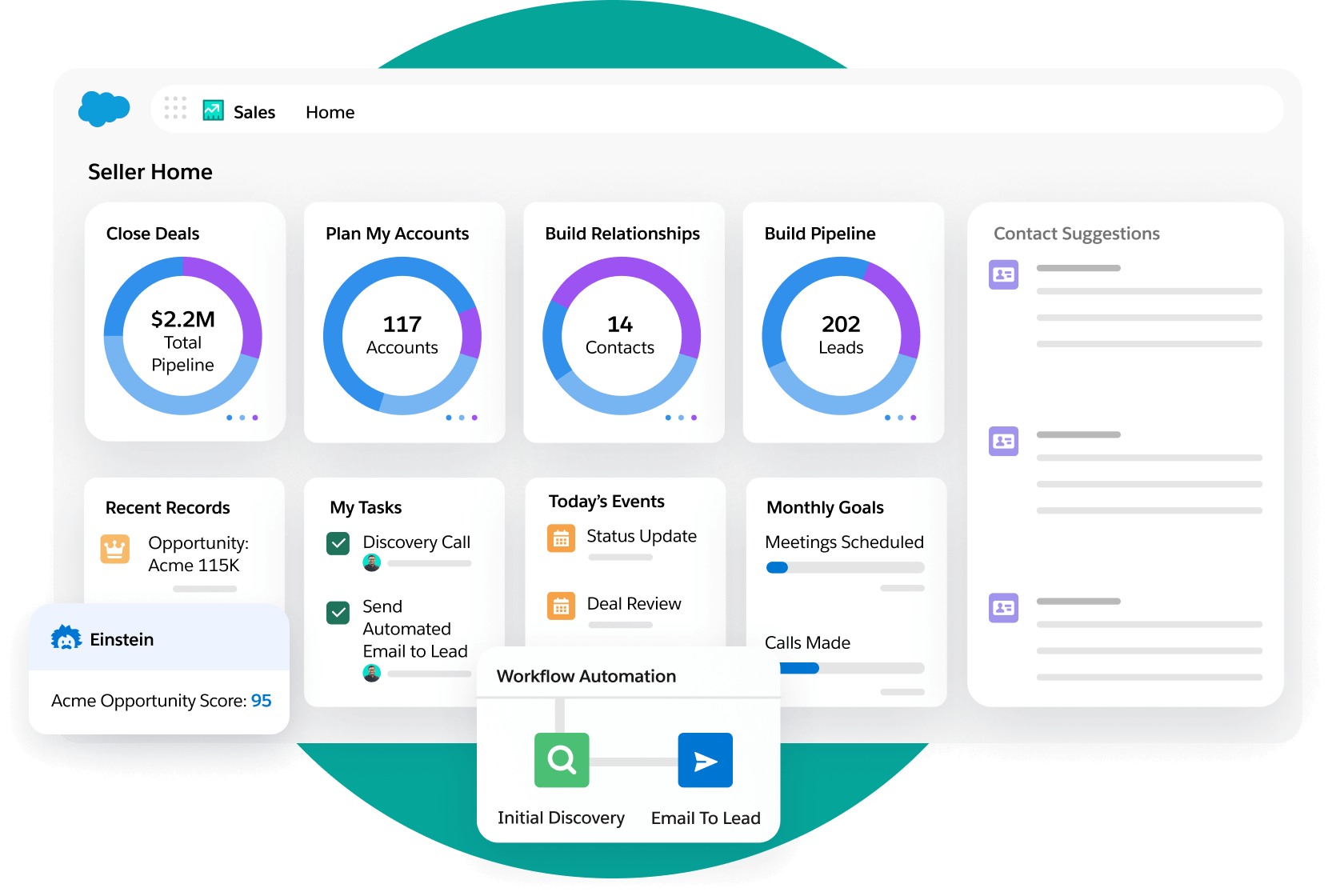
Salesforce is a widely used enterprise CRM platform that brings together sales, service, marketing, and commerce in a unified system. It provides a 360-degree view of the customer, helping teams centralize data, automate workflows, and manage the full customer lifecycle—from lead generation to long-term engagement.
The platform is organized into core products such as Sales Cloud, Service Cloud, Marketing Cloud, and Commerce Cloud, each supporting specific business functions. Salesforce also integrates AI capabilities through Einstein and Agentforce, enabling automation, predictive insights, and more personalized customer interactions. Additionally, Salesforce’s app marketplace offers thousands of integrations to enable organizations extend functionality based on their needs.
Key Features:
- Unified Customer 360 platform for centralized customer data
- Contact, lead, and opportunity management
- AI-powered insights and automation with Einstein and Agentforce
- Workflow automation for tasks, approvals, and notifications
- Real-time reporting and customizable dashboards
- Extensive integration ecosystem via AppExchange
Pricing:
Salesforce CRM pricing varies by edition and features. Plans typically start at around $25 per user/month for basic functionality and can go up to approximately $550 per user/month for advanced enterprise plans with advanced AI capabilities.
See also: Salesforce Alternatives & Competitors
6. Zoho CRM
Best for: Small to mid-sized businesses looking for a cost-effective CRM with solid automation and customization options
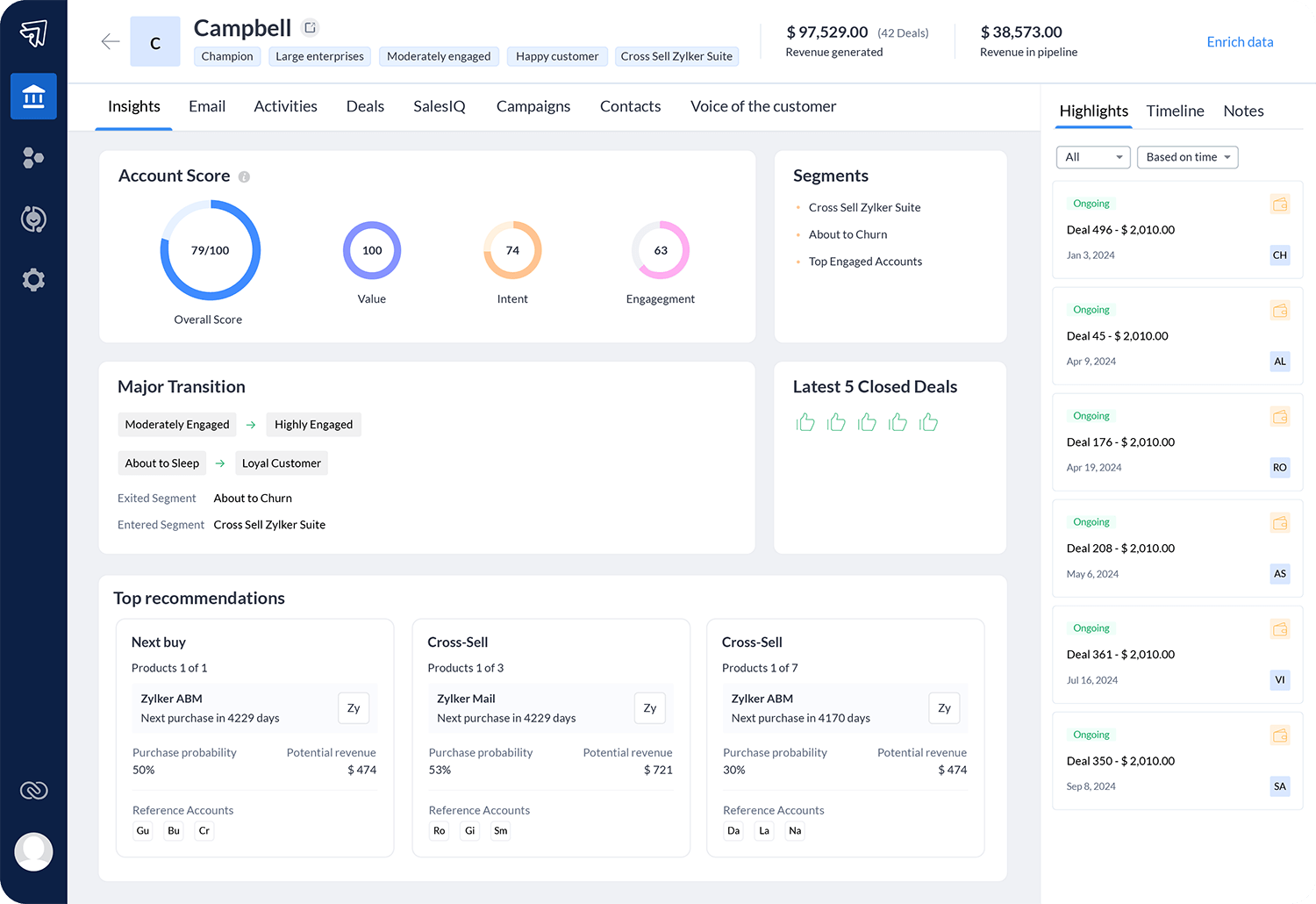
Zoho CRM is another affordable SAP alternative designed to manage sales, marketing, and customer engagement processes within a single system. It helps teams automate routine tasks, track pipelines, and improve decision-making with AI-powered insights through its assistant, Zia. The platform also supports multichannel communication, including email, phone, chat, and social media, allowing businesses to manage customer interactions in one place.
Zoho CRM offers flexible customization, enabling users to tailor modules, fields, and workflows to fit their processes. Combined with its broad ecosystem of Zoho apps and third-party integrations, it can support a wide range of business needs as organizations grow.
Key Features:
- Lead and contact management with full interaction history
- Sales automation for lead assignment, follow-ups, and pipeline updates
- Marketing automation with campaign management and segmentation
- AI assistant (Zia) for predictions, anomaly detection, and recommendations
- Custom dashboards, modules, and workflows
Pricing:
Zoho CRM pricing starts at $20 per user/month, with more advanced plans for enterprise use starting from around $50 per user/month.
See also: Top 10 Zoho CRM Alternatives and Competitors
7. Pega CRM
Best for: Large enterprises looking for advanced AI-driven automation, complex business process management, and high-volume customer service.
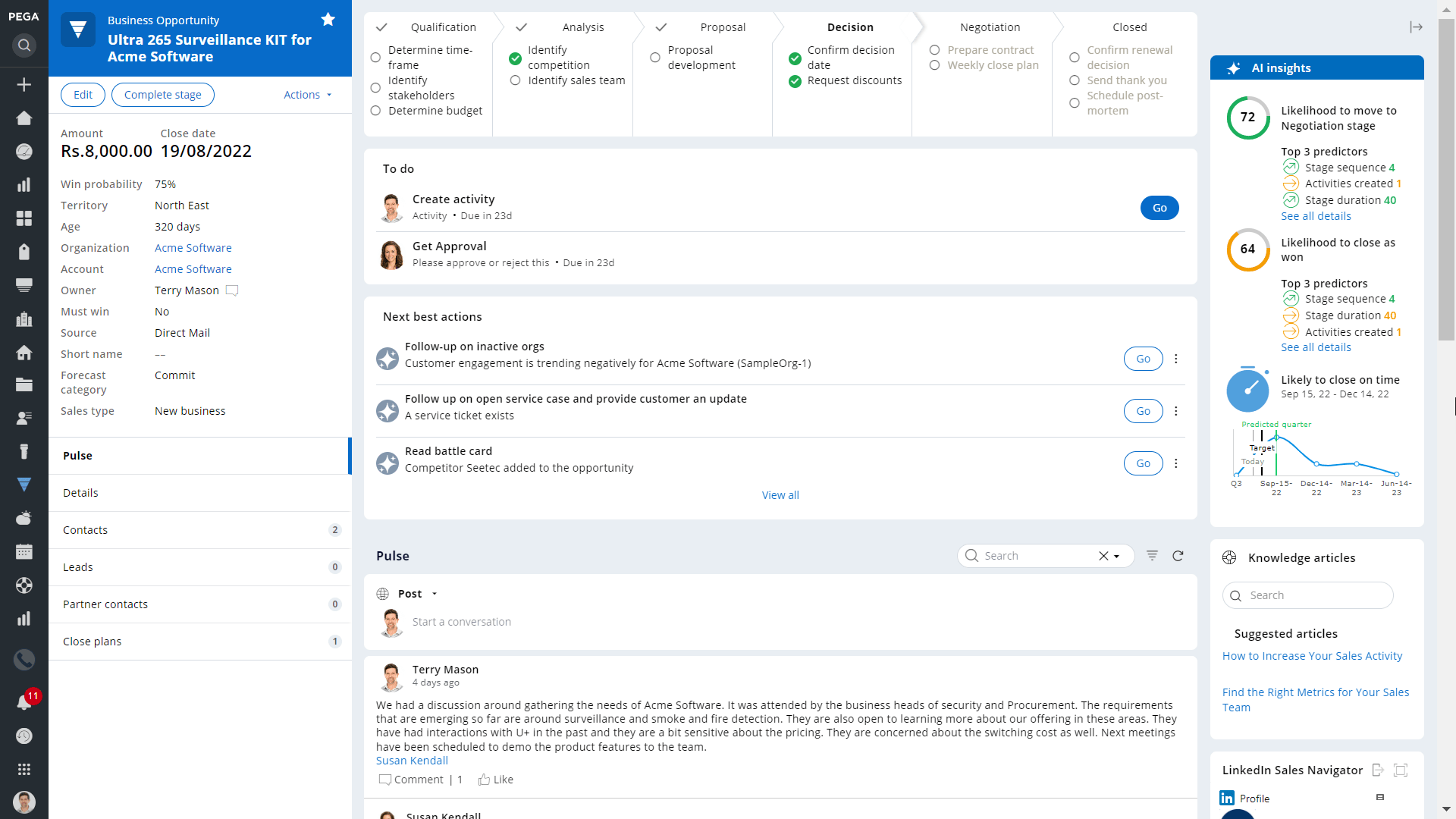
Pega CRM is an enterprise-grade platform designed to manage customer engagement through AI-driven decisioning and process automation. In addition to core CRM capabilities like contact and pipeline management, it enables real-time customer journey orchestration through its Customer Decision Hub, which analyzes behavior, predicts intent, and recommends next-best actions across channels.
By combining AI models, business rules, and workflow automation in a single system, Pega helps organizations personalize interactions and execute complex processes such as onboarding, claims handling, and service resolution. Its strong case management capabilities and industry-specific frameworks make it particularly well-suited for regulated industries that require structured workflows and compliance.
Key Features:
- Low-code tools for building and modifying applications using visual modeling
- Real-time AI decisioning via Customer Decision Hub for data insights and next-best-action recommendations
- Advanced process automation with BPM and robotic process automation (RPA)
- End-to-end AI-enhanced case management for customer service operations
- Sales automation for managing leads, opportunities, and pipelines
Pricing:
Pega CRM pricing is available upon request.
8. Infor CRM
Best for: Organizations requiring deep integration with ERP systems, specifically in manufacturing, distribution, and field service industries
Infor CRM is a customer relationship management platform designed to support sales, marketing, and service operations within a unified environment. It provides a 360-degree view of customer data and integrates closely with Infor ERP solutions, enabling consistent data flow and better visibility across the business.
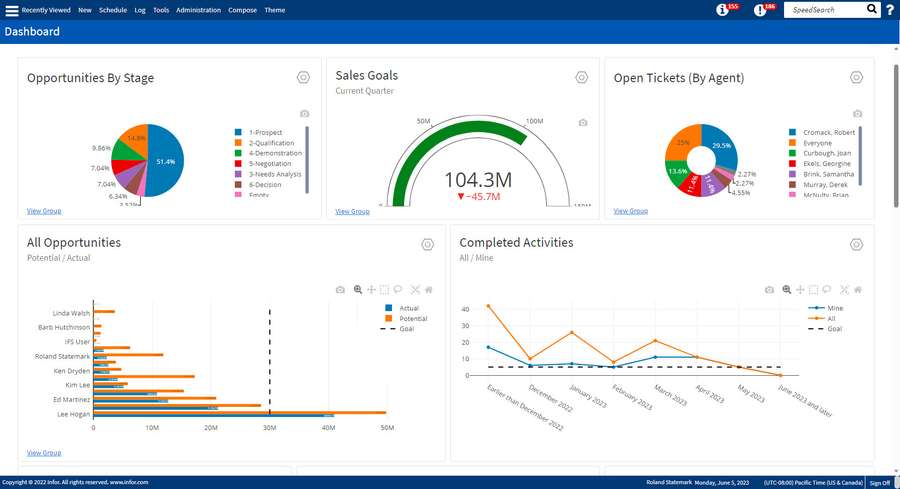
The platform includes AI-powered analytics and insights to support forecasting, decision-making, and account management. Teams can track opportunities, manage territories, and respond to customer needs more proactively using built-in alerts and reporting tools. With mobile access and end-to-end lifecycle management, Infor CRM helps organizations manage customer relationships more efficiently across teams and departments.
Key Features:
- 360° customer view across sales, marketing, and service
- Sales force automation with lead, opportunity, and activity management
- Forecasting, territory management, and performance tracking
- Industry-specific capabilities for manufacturing and distribution, including order and inventory management
- AI-powered insights and virtual assistant for account analysis (v10)
- Mobile app for managing accounts, contacts, and opportunities on the go
Pricing:
Infor CRM pricing is not publicly disclosed and is available upon request, depending on deployment size and business requirements.
What Challenges Should a SAP Competitor Solve?
#1. Breaking down data silos across the systems
Enterprise organizations using SAP often operate across ERP systems, legacy tools, regional databases, and department-specific applications. This creates fragmented data environments, making it difficult to get a complete, real-time view of customers, interactions, and business processes.
Best Practice: Choose CRM platforms that unify data across systems and provide a single, real-time customer view.
#2. Improving flexibility without adding technical complexity
As business needs evolve, updating workflows, fields, approvals, and customer journeys can require significant development effort. In particular, SAP users often leads to long release cycles and growing technical debt, limiting the organization’s ability to adapt quickly.
Best Practice: Look for platforms that offer no-code customization, allowing business users to update workflows, data models, and processes without heavy reliance on IT. For example, no-code platforms can help organizations accelerate development timelines by over 70%, according to Nucleus Research.
#3. Supporting AI-driven decisions and agentic automation
While SAP CRM offers AI capabilities for process and data management, many organizations struggle to move beyond reporting and basic automation. The challenge is enabling deeper AI adoption across workflows.
Best Practice: Prioritize CRM platforms with customizable AI agents and autonomous systems capable of planning, triggering, and executing tasks. This allows teams to drastically increase productivity and accelerate execution.
#4. Making CRM more practical and accessible for business users
A CRM system only delivers value when it becomes part of daily workflows. Complex interfaces, manual data entry, and disconnected tools can limit adoption, reduce data quality, and impact productivity.
Best Practice: Look for platforms with intuitive, customizable interfaces, automated data capture, and conversational AI experiences to improve user adoption.
#5. Reducing cost and improving time-to-value
Many enterprises switching from SAP highlight cost efficiency as a key challenge, particularly when it comes to deploying, customizing, and maintaining the system. Long implementation cycles can delay ROI and increase the total cost of ownership.
Best Practice: Choose CRM systems that simplify implementation, enable faster changes, and offer more predictable cost structures. For example, according to the independent research, organizations adopting Creatio CRM report reductions in TCO of up to 37%.
Summary
SAP CRM continues to support complex enterprise environments, but changing expectations around AI, automation, and adaptability are reshaping how organizations approach CRM. Today, businesses prioritize the ability to quickly adapt processes, improve user adoption, and drive measurable outcomes with less IT dependency.
Many SAP competitors address these needs by combining flexibility, usability, and AI-driven execution. Creatio stands out as an AI CRM and workflow platform for marketing, sales, and service — with no limits on AI agents, workflows, or scale. It enables organizations to automate processes, build and scale workflows with no-code, and unify customer operations across the entire lifecycle.
Request a personalized demo to explore how Creatio can support your CRM transformation today.
