





































































AI for Enterprise. Definition, Use Cases, and Benefits

Scale AI across your enterprise with Creatio AI CRM

Enterprise AI is transforming how large organizations operate, innovate, and approach growth. According to Deloitte, global enterprise investments in generative AI technology are expected to reach US$150 billion by 2027, reflecting the growing importance of AI in enterprise operations. This massive investment underscores the confidence businesses have in AI’s ability to drive growth.
By leveraging advanced AI capabilities, enterprises can streamline processes, reduce operational costs, and speed up their digital transformation.
In this article, we explore the key benefits, use cases, challenges, and future trends of enterprise AI, demonstrating how AI is shaping the next era of business innovation.
Key Takeaways
- Enterprise AI embeds artificial intelligence across an organization to automate processes, augment decision-making, and drive tangible business value at scale.
- The benefits of AI solutions for enterprises include increased operational efficiency, greater resilience and agility, accelerated time-to-market, reduced costs and increased profitability, improved customer experiences, and greater competitive advantage.
- Implementing enterprise AI requires overcoming several barriers, including data quality issues, integration complexity, talent shortages, and regulatory, security, and legal concerns.
- Enterprise AI platforms help overcome AI adoption challenges by providing a unified environment for building, deploying, orchestrating, and governing AI capabilities across the business.
- The future of enterprise AI lies in role-specific agents, multi-agent orchestration, and AI-powered application development, enabling organizations to become AI-first enterprises.
- AI-native platforms such as Creatio AI CRM enable organizations to operationalize AI at enterprise scale and benefit from the Unlimited Enterprise model, where people and AI agents work together to drive productivity, innovation, and growth.
What is Enterprise AI?
Enterprise AI is the implementation of artificial intelligence across an organization to automate and optimize processes, augment decision-making, and drive business value at scale. By integrating AI with enterprise data, systems, and workflows, organizations can improve efficiency, enhance experiences, and accelerate innovation while operating within enterprise-grade security, governance, and compliance requirements.
Enterprise artificial intelligence combines multiple AI capabilities to support different business needs. Agentic AI powers intelligent automation through autonomous agents that can reason and take action with minimal human intervention. Generative AI creates content such as emails, reports, and marketing assets, while predictive AI analyzes data to identify patterns, forecast trends, and guide informed decisions.
Enterprise AI vs. Consumer AI
While both enterprise AI and consumer AI are powered by similar underlying technologies, such as machine learning, natural language processing, and computer vision, they serve different purposes. Consumer AI is designed to help individuals perform tasks such as generating content, answering questions, or improving productivity. Enterprise AI, by contrast, is built to support organization-wide processes, decisions, and workflows at scale and must uphold the highest security and governance standards.
Category | Consumer AI | Enterprise AI |
| Primary purpose | Personal productivity and assistance | Automating processes and driving business outcomes |
| Users | Individual users | Teams, departments, and entire organizations |
| Data sources | Public or user-provided data | Enterprise data, systems, and business context |
| Workflows | Standalone tasks | End-to-end business processes and workflows |
| Security | Basic user-level controls | Enterprise-grade security, access controls, and data protection |
| Governance | Limited oversight | Centralized governance, monitoring, and policy enforcement |
| Compliance | General-purpose use | Industry and regulatory compliance requirements |
| Scale | Individual or small-team usage | Enterprise-wide deployment |
What is an Enterprise AI platform?
An enterprise AI platform is a unified environment that enables organizations to build, deploy, orchestrate, and govern AI capabilities within a single software. Instead of managing multiple standalone tools, teams can design AI-powered workflows, create and manage AI agents, connect AI to business applications, and coordinate interactions between people, systems, and AI. By bringing these capabilities together in one environment, organizations can accelerate AI adoption, reduce complexity, and scale AI initiatives more effectively across the enterprise.
Modern enterprise AI applications are AI-native by design, meaning AI is embedded in the platform's core architecture rather than added as a separate layer. This eliminates the need for complex integrations and fragmented user experiences, allowing organizations to leverage AI within the same applications, workflows, and business processes they use every day.
To support enterprise-wide adoption, enterprise AI platforms provide centralized governance through solutions such as an AI Command Center, giving organizations visibility and control over AI usage, performance metrics, security, and compliance. This enables businesses to use AI across the business without compromising trust or oversight.
Key Capabilities of AI for Enterprises
- Enterprise-grade scalability - AI tools for enterprises can handle vast amounts of data, thousands of users across global operations, and multiple complex enterprise operations. They can be easily scaled up to accommodate the growing needs of the business and incorporate additional users, data, and workflows with no slowdowns or downtime.
- High flexibility - enterprise-grade AI is highly flexible and can adapt in real-time to changing business needs, organizational goals, market trends, and other changes thanks to AI’s ability to continuously learn from new data.
- Seamless integration - enterprise AI can seamlessly integrate with enterprise software and third-party tools typically used by large organizations, such as ERP, CRM, and HCM, regardless of the extent of the technology stack. AI can be integrated across the whole organization, including multiple business processes, departments, teams, and branches.
- Top-class security - enterprises house large pools of sensitive customer data, including their financial and health information. With enterprise-grade AI, businesses can rest assured that the company data is safe and will not be made available to the public or used to train the AI model.
- Enterprise-grade compliance - enterprises need to adhere to rigorous industry regulations such as GDPR or HIPAA, strict protection, and data governance standards. Large organizations typically operate in many different markets across the globe which might have different regulations (for example, USA vs. EU data protection policies). Enterprise AI offers compliance on the enterprise level, making sure businesses follow all the regulations, no matter how many markets they operate in.
- Strict governance - enterprise AI models should be governed by policies and responsible AI practices that ensure compliance with ethical standards and legal requirements. This provides accountability and fairness in AI decision-making processes.
Enterprise AI Use Cases
Enterprise AI solutions can automate various business workflows using AI agents and support organizations by providing data-driven insights for researching, forecasting, and making informed decisions.

Automating workflows
AI solutions for enterprise help businesses automate even the most complex processes. Thanks to the AI’s capability to analyze data, learn from it, and make decisions, it can streamline business workflows and increase employees' productivity.
Here’s a list of example processes that can be automated using AI:
- customer support - AI-powered chatbots can answer typical customer queries regarding prices, shipment, returns, etc., 24/7 without human intervention.
- case routing - AI can analyze more complex cases and assign them to the most fitting customer support agent with a summary of previous interactions and issues.
- designing marketing campaigns - The AI model can design a flow of new marketing campaigns and optimize them for maximum effectiveness.
- recruiting - AI can assist HR departments in recruiting new employees by analyzing resumes based on job position descriptions and highlighting the best-suited candidates.
- employee onboarding - enterprise AI can streamline onboarding processes by automatically creating new accounts, providing access permissions, creating onboarding steps, and generating training programs tailored to job roles.
- document approval - AI can speed up the approval processes by automatically routing documents to the appropriate stakeholders, sending reminders, and forwarding documents once they’re approved.
- invoice processing - AI models can pull out data, validate it, and process invoices, reducing manual data entry.
- expense management - enterprise AI can be used to analyze and categorize business expenses, flag anomalies, and streamline approvals
- automated compliance audits - AI continuously monitors systems for compliance with industry-related regulations such as GDPR, HIPAA, or SOX.
Generating content
Businesses can use enterprise AI to create various personalized content pieces to fit specific customer groups or individual clients. Using generative AI solutions powered by large language models, they can generate at scale:
- Marketing materials aligned with brand voice, including newsletters, product descriptions, social media posts, ad copy, images, etc.
- Sales outreach content such as personalized sales emails, proposals, and follow-ups.
- Customer communication including responses to typical questions, support articles, FAQ pages, etc.
- Reports containing data analysis and actionable insights to support informed decisions.
Research and data analysis
Enterprises can benefit from AI’s capability to analyze vast amounts of data and generate actionable insights. AI-powered research helps organizations process unstructured data, identify patterns and trends, and generate reports much faster.
AI can analyze research papers, legal documents, financial reports, etc., and summarize crucial information. It can also monitor competitors, analyze pricing strategies, and customer sentiment to derive real-time insights.
In product development, AI systems can assist organizations by analyzing raw data, scientific research, and innovation trends. For example, AI solutions can help organizations design, test, and create new products. AI can generate product concepts based on customer needs and competitor analysis. It can select the best materials, test prototypes, and streamline quality control processes.
Forecasting
AI solutions for enterprises provide forecasting capabilities that can be used to predict future demand and sales, optimize inventory management and supply chain, and streamline maintenance processes.
AI models derive insights from thousands of gigabytes of data to help organizations predict the future.
- Sales forecasting - enterprise AI analyzes historical sales, market trends, and customer behavior to accurately predict future revenue. This way, organizations can set realistic targets and allocate resources to the most promising opportunities.
- Inventory optimization – predictive analytics can forecast changes in demand for products or services and provide recommendations regarding inventory management to prevent shortages or overstocking.
Risk management
Enterprise AI helps organizations proactively manage risk by continuously monitoring business environments, systems, and operations for unusual behavior and potential threats. By analyzing large volumes of data in real time, AI can identify anomalies, detect emerging risks, and alert teams before issues escalate into costly incidents. In cybersecurity, AI can help identify phishing attempts, uncover vulnerabilities, and contain threats early, reducing the impact of security breaches.
Decision-making
Enterprise AI helps businesses make data-driven decisions thanks to the capabilities to analyze large amounts of data and continuously learn and adapt.
In finance, enterprise AI systems can help optimize budget allocation by analyzing past expenditures and forecasting future financial needs. Sales teams can use AI to set competitive pricing based on competitors' analysis, and customer service professionals can use it to analyze customer feedback and determine new support channels. Marketing teams can leverage AI to optimize advertising spend, ensuring campaigns target the right audience with the right message at the right time.
AI also plays a crucial role in strategic business decisions. It helps organizations decide whether to expand to new markets, assess the potential of mergers and acquisitions, and determine the best areas for growth. By analyzing industry trends, customer demand, and competitors, AI supports key executives in making informed decisions about entering new regions, launching new product lines, or changing business strategies to stay ahead of the competition.
Developing business applications
AI enterprise systems enable organizations to create applications simply by describing goals and functionalities in natural language. Powered by generative AI solutions and machine learning models, these systems translate business requirements into functional workflows, application logic, automation scripts, and user interfaces.
According to the report by OpenAI, 75% of surveyed workers report they can now complete tasks they previously could not perform, including programming support, code review, technical tool development, troubleshooting, and custom agent design.
Enterprise AI development can be used to create desktop and mobile apps such as:
- chatbots for customer support
- automated invoice processing
- business trip expense reimbursement
- employee request processing
Benefits of Enterprise AI
Enterprise AI offers organizations multiple benefits, from increased productivity to reduced costs and improved customer experience.

Increased operational efficiency
The productivity benefits of AI are already becoming evident. According to Deloitte's State of AI in the Enterprise 2026 report, 66% of organizations report continuous improvements in productivity and efficiency from their AI initiatives.
With enterprise AI, organizations can automate repetitive tasks that typically consume a lot of employees’ time. From AI-empowered financial reporting to automated customer service and lead scoring, businesses can streamline processes and allow employees to focus on creative and strategic tasks. According to the State of Enterprise AI report from OpenAI, enterprise users report saving, on average, 40–60 minutes per day.
Enterprise AI systems support process automation and streamlining of the organization's end-to-end business workflows. In this approach, AI becomes an integral part of the processes rather than simply a virtual assistant to automate individual tasks. Thanks to enterprise AI’s flexibility and scalability, it can be deployed even in the largest organizations, supporting cross-functional teams, departments, and branches.
Greater resilience and agility
Enterprise AI helps organizations become more agile and quickly adapt to changing market conditions, customer needs, economic fluctuations, and operational challenges. By continuously analyzing vast amounts of data in real-time, AI can detect emerging opportunities and issues as soon as they arise. It can also help businesses adjust their strategies by suggesting the best course of action, supporting data-driven decisions, and automating time-consuming tasks.
For example, AI-powered supply chain management systems can predict potential disruptions such as material shortages or transportation delays, and suggest alternative sources of materials.
Accelerated time to market
Enterprise AI helps organizations bring new products, services, and business applications to the market faster by automating development processes.
In product development, AI can significantly speed up research and prototyping. It can analyze customer needs, market trends, and competitors’ offers to find new product ideas and help businesses create and test multiple variations.
Reduced costs and increased profitability
Enterprise AI enables organizations to reduce operational costs by up to 40% and maximize profitability by automating tasks, optimizing resource allocation, and enhancing efficiency across departments.
Businesses that implement enterprise AI systems can reduce the need for manual labor in repetitive tasks such as data entry, answering typical customer inquiries, inventory management, etc. Instead, their employees can focus on strategic tasks that help generate more income.
Additionally, AI helps optimize processes and increase their efficiency. It allows businesses to reduce waste, better allocate resources and budgets, and ensure consistent performance, driving long-term financial growth and sustainability.
According to the report commissioned by Google Cloud in the fall of 2024, 74% of enterprises that use GenAI are seeing ROIs, and 86% of organizations that use Gen AI in production are seeing revenue growth estimated at 6% or more gains to overall annual revenue.
Improved customer experience
Enterprise AI helps organizations improve customers’ experiences by providing fast, personalized, and seamless experiences across multiple touchpoints. AI-driven automation ensures customers receive quick responses, tailored recommendations, and efficient support, boosting satisfaction and loyalty.
In 2026, 38% of organizations surveyed by Deloitte reported improved customer relationships as a result of integrating AI into customer service interactions. These gains are expected to accelerate as AI becomes increasingly capable of handling customer inquiries autonomously. According to Gartner, by 2029, AI will resolve 80% of common customer service issues without human intervention.
Increased competitive advantage
Businesses can increase their competitiveness by implementing enterprise AI across the organization. AI can support making faster and more accurate decisions, improve operational efficiency, and help innovate business strategies.
Companies that successfully implement AI can adapt more quickly to new opportunities and challenges, anticipate customer needs, and optimize operations better than those relying on traditional methods. A BCG study found that organizations that invested in AI early significantly outperform AI laggards, achieving 1.7x higher revenue growth, 3.6x greater three-year total shareholder return (TSR), and 1.6x higher EBIT margins.
AI-driven predictive analytics allows businesses to forecast demand, identify emerging trends, and make data-driven strategic decisions ahead of the competition. In product and service development, AI ensures faster time to market and a stronger competitive position. Companies using AI-powered personalization and automation deliver superior experiences, making it harder for competitors to match their level of engagement and service.
By leveraging enterprise AI solutions, organizations stay ahead in their industries, increase market share, and continuously evolve in response to shifting business landscapes.
Challenges of Enterprise AI
Integrating AI across the enterprise offers significant advantages, but its implementation comes with several challenges that organizations must address.
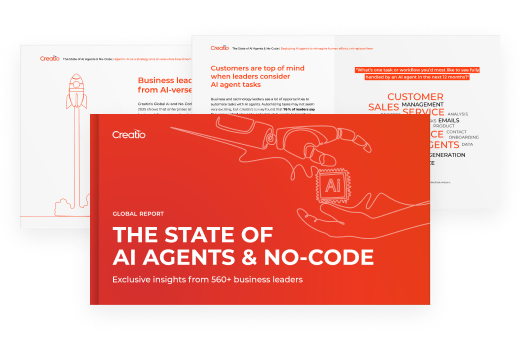
According to Creatio’s State of AI Agents and No-Code 2025, the most common challenges reported by business and technology leaders include data quality/system integration, regulatory, security, and legal concerns, and a lack of internal expertise and training.
Lack of high-quality data
AI outcomes depend on the quality of the underlying data available to the models. In many organizations, data is fragmented across departments and systems, resulting in inconsistencies, gaps, and duplicate records that limit the effectiveness of implementing AI. According to Creatio's survey, 51% of business leaders identified the quality of organizational data as the biggest challenge related to deploying AI strategies.
Organizations can address this challenge by improving data readiness through a unified foundation that connects enterprise data across systems, improves quality, and provides AI with access to trusted information.
Complex integration with existing systems
Many organizations struggle to integrate AI into their existing technology stack. Enterprise data is often spread across multiple applications, databases, and legacy systems, making it difficult to connect AI models to the information and processes they need to deliver value. As a result, organizations frequently rely on custom integrations, standalone AI tools, and disconnected workflows that increase complexity and slow adoption.
An enterprise AI platform addresses this challenge by providing a unified environment where AI, business applications, data, and workflows work together seamlessly, enabling organizations to deploy and scale AI faster across the enterprise.
Regulatory, security, and legal concerns
As organizations scale AI across business processes, concerns around data privacy, regulatory compliance, intellectual property, and AI governance increase. According to The State of AI Agents & No-Code 2025 global survey by Creatio, 41% of business and technology decision-makers cite these concerns as the top challenge to wider AI adoption.
To address these risks, organizations need centralized visibility into how AI is being used, what data it can access, and how decisions are made. This is driving demand for AI Command Centers that ensure responsible AI usage by providing a single control panel to monitor, govern, and manage AI models across the enterprise.
Skills and talent shortages
Many organizations face a shortage of AI talent, making it difficult to implement, manage, and scale enterprise AI initiatives. According to Creatio's survey, 43% of business and technology decision-makers cite skills and talent shortages as their key challenge to implementing AI across the organization.
Traditionally, deploying AI required specialized expertise in data science, machine learning, and model management, often requiring organizations to hire experienced data scientists or invest heavily in upskilling existing employees. Enterprise AI solutions help address this challenge by providing no-code tools, prebuilt AI capabilities, and ready-to-use AI agents that enable business and technology teams to build, deploy, and optimize AI-powered processes without relying exclusively on specialized AI talent.
Future of AI in Enterprise
Enterprise AI is rapidly changing, and its capabilities are constantly evolving. That’s why it will be an increasingly important part of enterprise operations and customer interactions. 86% of C-level decision-makers surveyed by Creatio believe AI agents will be strategically important in the next two to three years.
The future of enterprise AI will include the following trends:
AI as a core part of business operations
In the near future, AI will no longer be just a supporting tool used to automate single tasks. Enterprises will incorporate AI models into their core operations to drive efficiency and growth. AI will continue to automate increasingly more complex workflows across all departments, streamlining end-to-end business workflows.
According to Creatio’s 2026 Enterprise Automation Trends Report:
2026 is the year enterprises stop experimenting with AI and start rebuilding around it. Instead of adding AI features to existing workflows, organizations begin reorganizing their operating models around autonomous agents, verticalized AI systems, and multi-agent ecosystems capable of executing work end-to-end.
Organizations that do not recognize the importance of AI technology may fall behind and struggle to remain competitive.
Role-specific AI agents in a single orchestration hub
At Creatio, we believe the future of enterprise AI lies in role-specific agents that support specific job functions, providing employees with AI capabilities tailored to their responsibilities, goals, and workflows. In the near future, most knowledge workers will work alongside AI twins that understand their workflows, assist with daily execution, and continuously evolve as role requirements change.
As organizations deploy growing networks of specialized AI agents, they will need a central environment to coordinate interactions, share business context, and orchestrate work across teams and processes. In its 2026 Enterprise Automation Trends Report, Creatio predicts that enterprise CRM will evolve beyond a system of record into a multi-agent orchestration hub where people and AI agents work together to execute customer-facing and operational processes.
This transformation is already underway. Through its AI CRM, Creatio provides AI agents for sales, marketing, and customer service that act as digital coworkers throughout the customer lifecycle.
Multi-agent systems designed for specific industries
As AI adoption matures, organizations are moving beyond general-purpose assistants toward industry-specific AI agents that understand specialized processes, regulations, and customer journeys. These agents are designed to execute tasks and workflows unique to a particular industry, delivering greater accuracy and business impact.
Moreover, according to Creatio’s 2026 Enterprise Automation Trends report, enterprises will shift from deploying isolated agents to coordinated multi-agent systems built around specific industry domains, such as banking, manufacturing, or the public sector. These agent networks collaborate, share context, and dynamically divide tasks to achieve business outcomes autonomously.
For example, Creatio's Bank.AI includes autonomous agents purpose-built for banking operations, supporting activities such as customer onboarding, loan processing, customer retention, renewal management, referral generation, and servicing workflows.
Gen-AI-empowered business applications development
By 2028, Gartner predicts that 80% of GenAI-based business applications will be developed using existing enterprise data management platforms. Leveraging existing infrastructure will reduce complexity and cut implementation time by 50%. Organizations will increasingly utilize their own data assets to develop enterprise AI applications with tools such as coding agents from Creatio.
For example, according to Vivek Mishra, a senior member of the professional association IEEE, in the future, gen AI tools will be trained on financial firms' data to help its investors choose investments or on unique company’s processes to create an agent to coach employees on workflows.
The rise of AI-first enterprises
In the future, more and more enterprises will become AI-first businesses. These are the companies that build their entire business models, services, and products around AI capabilities. Think about companies such as Netflix and Amazon, which leverage AI to personalize user experiences and provide tailored recommendations.
AI-first businesses will develop enterprise AI strategies and use advanced AI models to streamline business decisions, enhance customer interactions, and create innovative products at an unprecedented pace.
Creatio Enterprise AI Solution
Creatio is an AI CRM and workflow platform where people and AI agents work together — with no limits on users, agents, or scale. Designed for the AI era, Creatio enables organizations to orchestrate customer and operational workflows across sales, marketing, service, and industry-specific processes on a single platform.
With its Unlimited Enterprise operating model, Creatio helps organizations move beyond traditional software models designed around user licenses and siloed applications. Instead, businesses can scale work across people and AI agents, automate end-to-end processes, and rapidly adapt to changing business needs without the constraints of seat-based software. The platform supports unlimited users, AI agents, workflows, and applications, enabling organizations to scale execution across the enterprise.
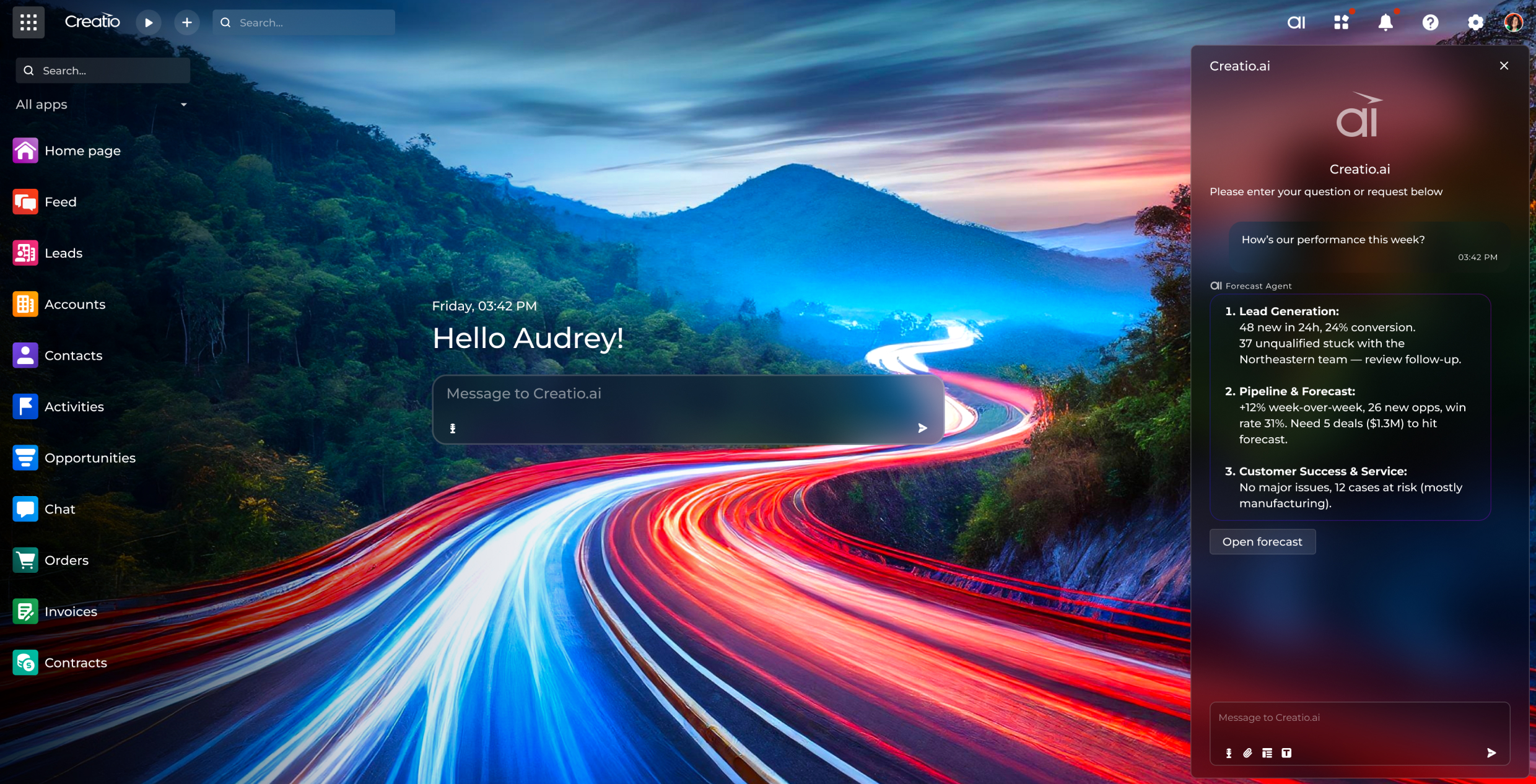
At the core of the Creatio platform is an AI-native CRM, which embeds AI into customer-facing workflows across sales, marketing, and service. Pre-built AI agents work alongside employees to automate tasks, provide recommendations, generate content, execute workflows, and help teams deliver more personalized and efficient customer experiences. Creatio also delivers industry-specific AI solutions such as Bank.AI, which provides prebuilt autonomous agents for banking workflows, including customer onboarding, loan processing, customer retention, and servicing operations.
Moreover, Creatio AI Studio enables organizations to build, customize, and deploy new agents, AI skills, and AI-powered applications using a combination of AI-assisted development and no-code tools. This allows both business and technology teams to rapidly create and customize solutions without relying on extensive development resources or specialized data science teams. Creatio AI Studio ensures full flexibility, allowing organizations to select AI models from leading providers, such as OpenAI, Anthropic, Google, and Azure AI, or bring their own custom AI model to support specific business, regulatory, and industry requirements.
To support enterprise-wide AI adoption, Creatio provides an AI Command Center that serves as a centralized control panel for managing agents and AI operations. Organizations can monitor usage, govern AI capabilities, manage permissions, and optimize performance from a single environment, ensuring AI initiatives remain aligned with business objectives.
Creatio enables organizations to operationalize AI at enterprise scale and prepare for a future where every employee is supported by AI agents and every business process is intelligently orchestrated. In this new era of enterprise operations, AI is no longer a tool employees use occasionally—it becomes a trusted collaborator that helps organizations execute faster, innovate continuously, and achieve outcomes that were previously impossible to scale.
Summary
Enterprise AI is transforming how organizations operate, enabling them to automate processes, augment decision-making, and drive business value at scale. As AI adoption accelerates, organizations are moving beyond standalone tools and pilot projects toward enterprise-wide AI technologies that embed intelligence directly into business operations.
However, scaling AI successfully requires overcoming challenges related to data access, integration complexity, talent shortages, and regulatory concerns. Enterprise AI solutions address these challenges by providing a unified environment for deploying, orchestrating, and governing AI across the organization.
Looking ahead, the future of AI solutions for enterprises will be shaped by role- and industry-specific agents that work alongside employees to execute tasks, automate workflows, and deliver specialized expertise. As organizations deploy growing networks of agents, CRMs will evolve into multi-agent orchestration hubs where people and AI agents collaborate seamlessly across business functions.
Creatio is helping organizations realize this vision through its AI CRM and workflow platform, enabling businesses to operationalize AI at enterprise scale and build a powerhouse to drive productivity, innovation, and growth with no limits.
