




































































Best Agentforce Alternatives in 2026: Top AI Agent Platforms Compared

Drive Quicker ROI & Lower TCO with Creatio.ai

Most enterprises evaluating AI agents consider Agentforce because it is deeply embedded in the Salesforce ecosystem. However, being Salesforce-native does not automatically make it the best option.
Despite Salesforce's massive investment in Agentforce — including advertising, global event sponsorships, and bundled sales motions — only 8% of eligible Salesforce customers have deployed Agentforce in production. This statistic confirms that many organizations are still evaluating the complexity, cost, and operational requirements of enterprise deployments before moving beyond pilot projects.
The good news is that the market has matured. Today, organizations can choose from a growing number of enterprise-grade Agentforce alternatives, such as Creatio Business & AI Studio, Microsoft Copilot Studio, HubSpot Breeze, and other AI agent platforms that offer different approaches to autonomy, flexibility, scalability, and cost.
Key Takeaways:
- The common reasons why users consider alternatives to Agentforce
- The leading Agentforce alternatives in 2026 include Creatio, Microsoft Dynamics 365, HubSpot Breeze, Now Assist by ServiceNow, and Oracle AI Agent Studio.
- To find the best alternative to Agentforce, organizations should evaluate AI capabilities alongside workflow automation, integration flexibility, governance, scalability, and long-term cost of ownership.
- Nucleus Research found that organizations moving from Salesforce to Creatio experience dramatic gains in efficiency, agility, and value, including a 37% reduction in technology costs and a 70% reduction in implementation timelines.
What Is Agentforce?
Agentforce is Salesforce's AI agent platform that enables organizations to build, deploy, and manage autonomous AI agents across business functions. Introduced in 2024, it builds on Salesforce's Einstein AI capabilities and broader platform ecosystem to help organizations automate work using agentic AI. Agentforce is powered by the Einstein Trust Layer, Salesforce's framework providing built-in security, governance, and compliance controls for AI interactions.
While Einstein has traditionally focused on AI-powered predictions and analytics, Agentforce is focused on autonomous execution through AI agents. It enables organizations to build agents that can understand requests, create plans, and execute tasks using enterprise data, business rules, workflows, and connected systems. According to Salesforce, these agents can handle tasks such as answering customer inquiries, qualifying leads, resolving service cases, updating CRM records, drafting communications, and initiating business processes, while also escalating work to employees when needed.
The platform natively supports the Model Context Protocol (MCP), allowing AI agents to securely access Salesforce data and interact with external systems, tools, and resources. Agentforce is powered by the Einstein Trust Layer, which provides built-in security, governance, and compliance controls for AI interactions.
Salesforce Agentforce uses a combination of per-user and per-conversation pricing: $2 per Conversation or $500 per 100,000 Flex Credits, with credits consumed based on agent actions and usage. Organizations may also need additional Salesforce licenses and add-ons depending on their deployment. For companies planning to deploy AI agents at scale, estimating total cost can be challenging due to multiple pricing components and usage-based charges.
Why Look for Agentforce Alternatives?
1. High Total Cost of Ownership
With Agentforce, the license is only the starting point. Organizations may also need Data Cloud, Einstein AI, implementation services ($50,000–$150,000+), training, certifications, and ongoing consulting support — all of which can significantly increase costs over time.
The challenge doesn't stop after deployment. Agentforce's usage-based pricing model means costs grow as agents perform more actions. For example, a 100-user mid-sized company handling just three cases per workday could spend roughly $1,800 per month on Flex Credits alone, making long-term budgeting and ROI harder to predict.
2. Dependence on the Salesforce Ecosystem
Agentforce delivers the most value when used alongside Salesforce products such as Data Cloud, Flow, and Service Cloud. While Agentforce can connect to external systems, some capabilities and use cases rely heavily on Data Cloud functionality to unify, access, and ground enterprise data for AI agents.
For organizations already running on Salesforce, this can be a significant advantage. However, enterprises with multi-platform stacks like Jira, Zendesk, SAP, ERP platforms, data warehouses, and custom applications may need add-on integrations and Salesforce services to support cross-platform AI workflows. As a result, many organizations evaluate alternatives that offer a more vendor-neutral approach to AI agent deployment and orchestration.
3. 20-Agent Ceiling
Even on Enterprise plans, Agentforce limits organizations to 20 active agents per Salesforce org. For large organizations that need agents for routing, claims, billing, compliance, customer service, and escalation management simultaneously, the limit can be exhausted before covering primary use cases.
Agentforce also restricts each agent to 15 topics and 15 actions per topic. As the number of use cases expands, organizations often need to move away from a single, all-purpose agent and adopt more complex multi-agent architectures, where an “orchestrator” agent coordinates specialized headless “execution” agents (e.g., a Claims Agent and a Customer Service Agent). While effective, this approach adds complexity to the implementation and maintenance of enterprise AI agents.
4. Long Time to Value
Agentforce deployments often require clean CRM data, Data Cloud configuration, workflow design, Salesforce-certified administrators, and external consulting support. As a result, implementation can take months before organizations realize measurable business value.
Average Agentforce deployment runs 4–7 months and often requires significant preparation, integration, and governance work before agents can be deployed at a company scale. During a Dreamforce media Q&A, Salesforce disclosed that only 8% of eligible customers had deployed Agentforce in production, underscoring the challenges of the platform’s enterprise-wide adoption.
5. Scope Limited to Salesforce Workflows
Agentforce is most effective when automating workflows that live within the Salesforce ecosystem. However, real enterprise processes rarely start and end in CRM. Customer onboarding, claims processing, order fulfillment, and service delivery often span ERP, ITSM, billing, data, and other operational systems.
An AI agent that automates only the Salesforce portion of a workflow still leaves employees in charge of the remaining steps. For organizations pursuing end-to-end automation, automating 30% of a process is often not enough to deliver the expected business impact.
What to Look for in an Agentforce Alternative?
The right Agentforce alternative is rarely the platform with the best demo or pricing. For high-volume teams, long-term success depends on how well the platform scales, integrates, and operates in real-world environments.
- Level of autonomy — Support for both task-specific AI agents and autonomous agents that can reason, take action, and complete end-to-end business processes.
- Multi-agent orchestration — Native support for agent-to-agent collaboration, allowing specialized agents to delegate tasks, share context, and execute end-to-end business processes at enterprise scale.
- Platform independence — The ability to add AI agent layer across existing CRM, ERP, ITSM, data, and business systems without replacing your technology stack, migrating data, or increasing vendor lock-in.
- Coverage across functions — Enables enterprise deployments across sales, marketing, customer service, specific industry operations and business functions from a unified agentic platform.
- Ease of configuration — Allows non-technical teams (and not only developers) to quickly customize and evolve AI agents through visual tools, reducing reliance on developers and accelerating adoption across the business.
- Predictable pricing — A clear and sustainable cost model that allows organizations to scale AI agents across teams and use cases without introducing budgeting uncertainty.
- Governance, Security, and Human Oversight — Enterprise-grade controls that keep AI agents compliant and accountable through audit trails, role-based access, approval workflows, human-in-the-loop, and compliance controls.
- Time to value — The ability to deploy AI agents quickly without extensive implementation effort, specialized technical resources, or major system redesign. Leading platforms accelerate deployment through visual designers, prebuilt templates and integrations, reusable workflows, and intuitive AI agent builders.
- Enterprise scalability — Ability to support growing numbers of agents, workflows, users, and use cases with no architectural constraints.
Top Agentforce Alternatives in 2026: Honest Review
Here are the closest alternatives to Salesforce Agentforce that provide agent-building capabilities within broader enterprise systems:
Platform | Best for | Average Vendor Ratings |
| Creatio | Organizations seeking a unified AI-native platform that combines AI agents, CRM, and industry workflows without extensive development effort. | |
| Microsoft Dynamics 365 | Microsoft-centric enterprises that want to integrate automation and real-time intelligence across CRM, ERP, productivity, and business operations. |
|
| HubSpot Breeze | SMB and mid-market deployments that prioritize simple out-of-the-box AI capabilities within HubSpot CRM and Hubs. |
|
| ServiceNow Now Assist | Enterprises prioritizing GenAI and simple agentic processes across IT, employee, customer service, and operational workflows. |
|
| Oracle AI Studio | Organizations already using Oracle Fusion Applications that want to build and orchestrate AI agents across ERP, finance, HR, supply chain, and customer operations. |
|
1. Creatio
Creatio is the top alternative to Agentforce that provides an AI CRM and workflow platform where people and AI agents work together to continuously automate processes, orchestrate workflows, and scale execution across the enterprise.
Unlike Agentforce, which extends Salesforce solutions with AI agents, Creatio embeds agentic, generative, and predictive AI directly into its platform. This enables organizations to design, deploy, and scale AI-powered workflows, applications, and agents without relying on multiple products, additional AI layers, or complex licensing models.
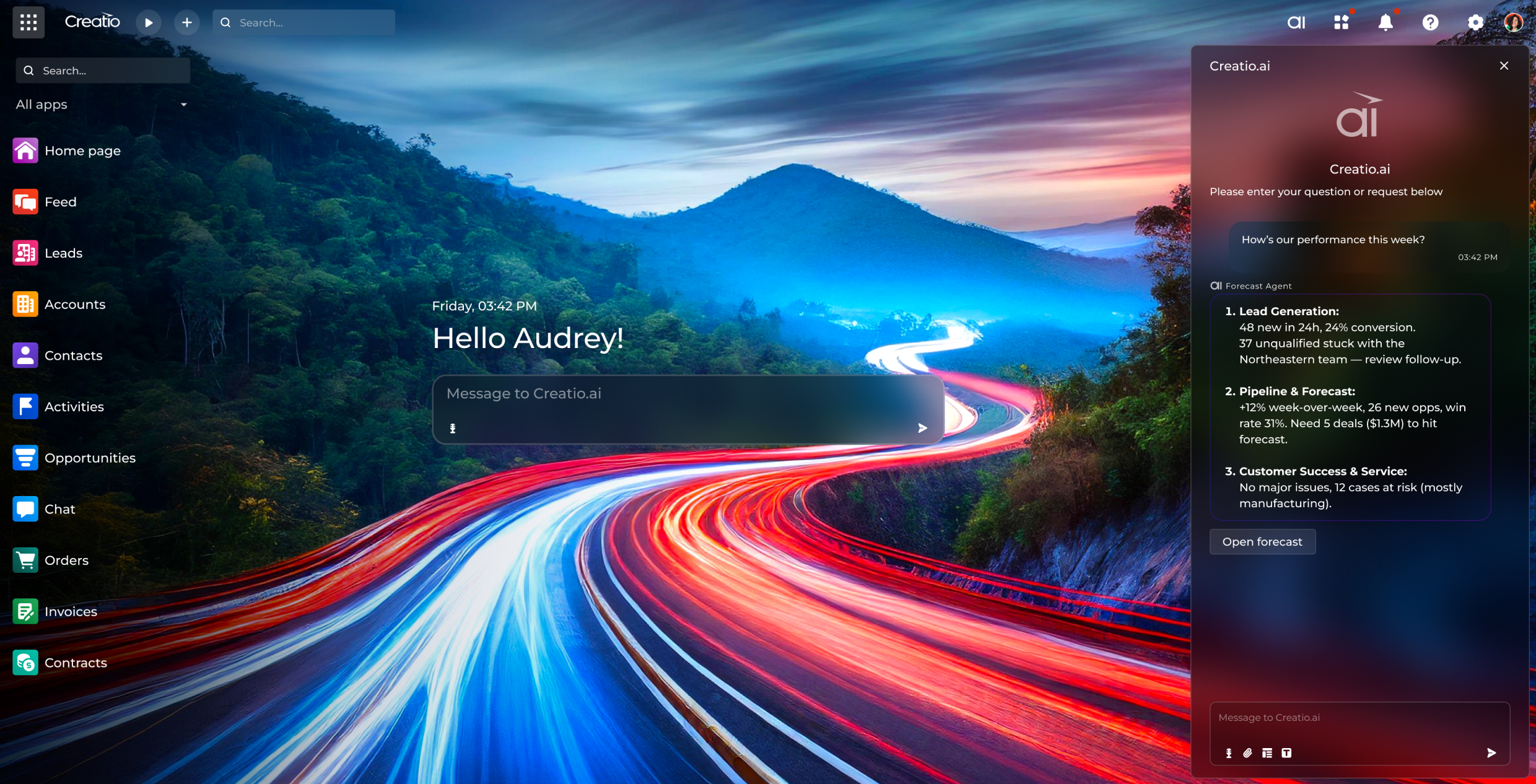
Creatio offers several AI-native solutions for different business needs:
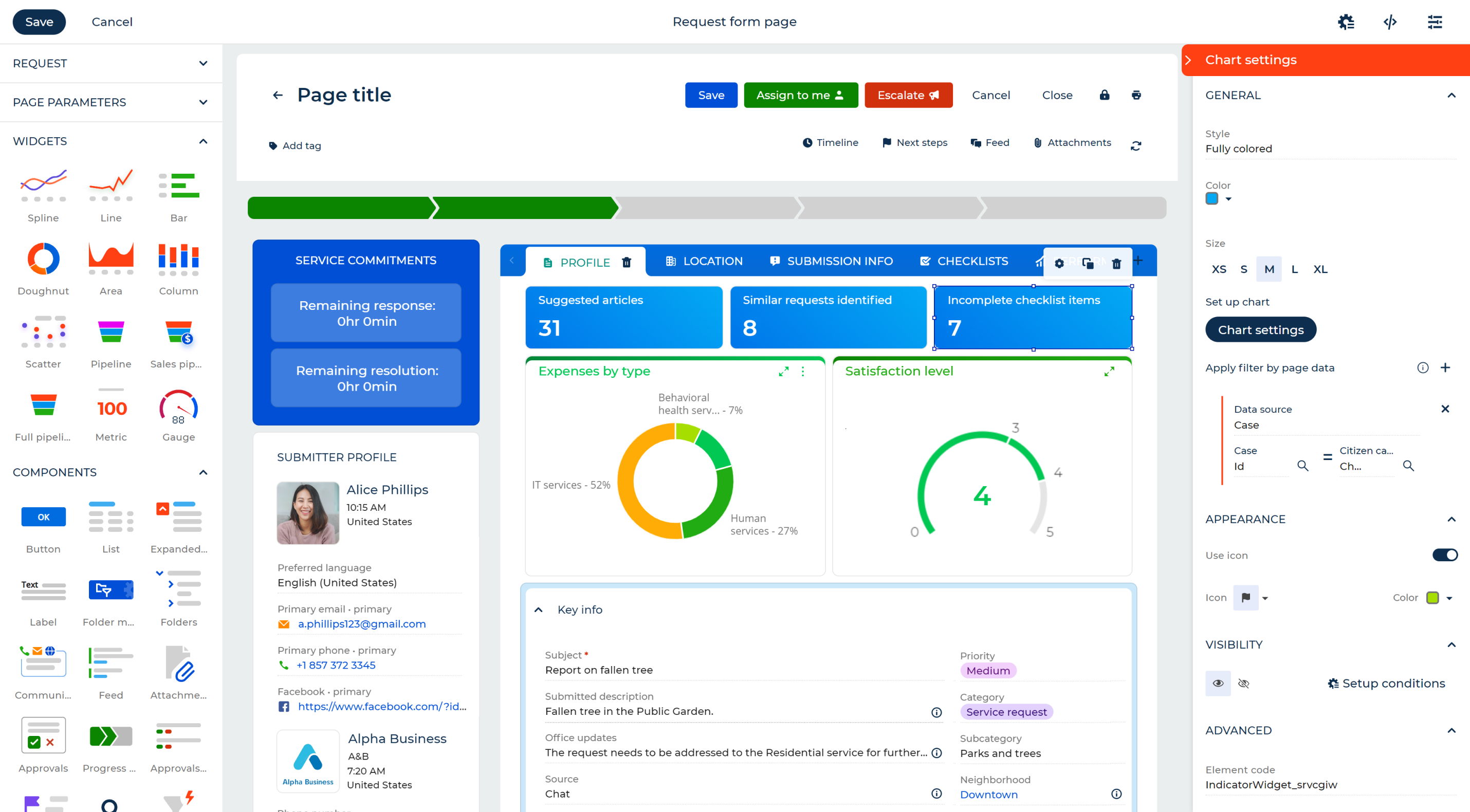
- Creatio Business & AI Studio – an AI-native platform to build applications, automat workflows, create and orchestrate custom AI agents through natural language and no-code visual designers.
- Creatio CRM – an AI CRM and workflow platform for sales, marketing, and customer service that unifies customer data, business processes, CRM agents, and automation in a single environment. Its products — Creatio Sales, Creatio Marketing, and Creatio Service — can be deployed individually or as a unified CRM suite.
Organizations can create custom AI agents and extend platform capabilities using natural language, no-code visual designers, and AI coding agents in Creatio Business & AI Studio, or accelerate adoption with ready-to-use CRM agents embedded within Creatio CRM. Sales teams use Creatio AI agents to qualify leads, research accounts, generate follow-up activities, and manage sales opportunities. Marketing teams can leverage AI agents to create content, build audience segments, and optimize campaign performance. CX teams use AI agents to accelerate case resolution, assist service representatives, and deliver more personalized customer experiences.
A key differentiator is Creatio's composable no-code architecture, which enables business and IT teams to rapidly build applications, automate workflows, and deploy AI agents without specialized development skills. Combined with flexible pricing and support for unlimited users, agents, workflows, applications, and API calls through its Unlimited Enterprise model, Creatio provides a scalable foundation for enterprise-wide AI adoption.
Creatio has also received industry recognition, including being named a Visionary in the Gartner® Magic Quadrant™ for Sales Force Automation Platforms. According to Nucleus Research, organizations moving from Salesforce to Creatio reported a 37% reduction in technology costs and implementation timelines that were approximately 70% faster.
Key Features:
- Unified platform for orchestrating human-led and agentic workflows across CRM and industry operations
- Prebuilt CRM AI agents that automate repetitive work, improve productivity, and accelerate time to value
- Autonomous AI agents for 24/7 execution of business processes and operational tasks
- AI-native architecture with advanced no-code tools for building applications, workflows, and AI agents 10x faster
- Open and composable platform that supports any LLM and enables seamless integration with existing systems
- Enterprise-grade governance, security, compliance, and observability for responsible AI execution
- AI coding agents that help create custom applications, workflows, and AI agents using natural language and visual designers
- Industry-specific solutions designed for more than 20 sectors
- Creatio Marketplace with 400+ applications, integrations, and connectors
Pros:
- Agentic, generative, and predictive AI are embedded directly into the platform’s core.
- AI capabilities are included across all Creatio products.
- No-code tools and AI coding agents accelerate development and deployment.
- Strong CRM, BPM, and workflow automation capabilities.
- Supports custom AI agent development without extensive coding.
- Unlimited scale for users, AI agents, workflows, and applications.
Cons:
- The breadth of platform capabilities may create a steeper learning curve for new users.
- Organizations may require governance and change management processes to scale AI adoption effectively.
Pricing:
Creatio Business & AI Studio starts at $40/user/month and serves as the foundational platform for building AI agents and AI-native applications. Creatio CRM products — including Creatio Sales, Creatio Marketing, and Creatio Service — are priced at $15/user/month each. All plans include core platform functionality and built-in AI capabilities.
For organizations scaling AI and automation enterprise-wide, Creatio also offers an Unlimited pricing model that provides access to the full platform, all CRM products, and AI capabilities — with no per-user limits.
2. Microsoft Dynamics 365: AI + Copilot
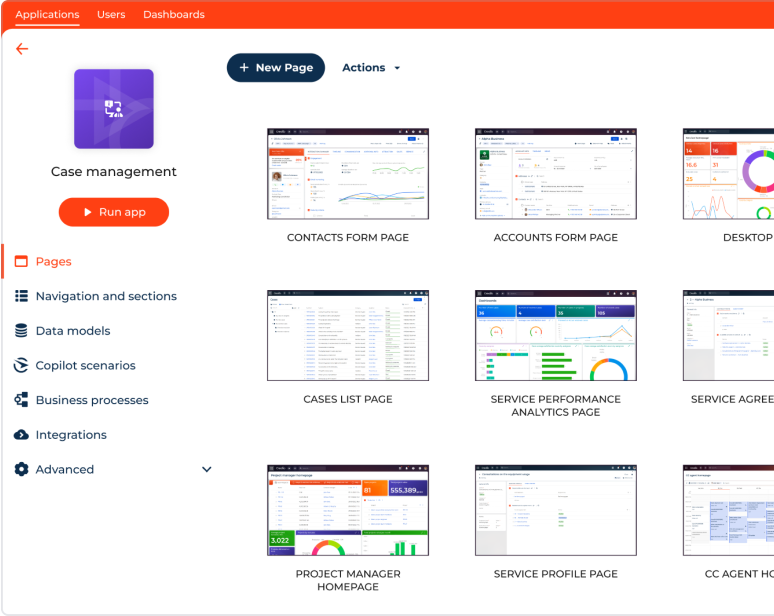
Like Agentforce, Microsoft enables organizations to build AI agents, automate workflows, and embed AI into business processes. However, while Agentforce extends the Salesforce ecosystem with a primary focus on AI agents, Microsoft's approach combines AI agents, copilots, workflow automation, and business applications across the broader Dynamics 365 and Power Platform ecosystem. Microsoft embeds AI capabilities throughout its CRM and ERP applications while providing Copilot Studio as a low-code platform for building custom AI agents and copilots.
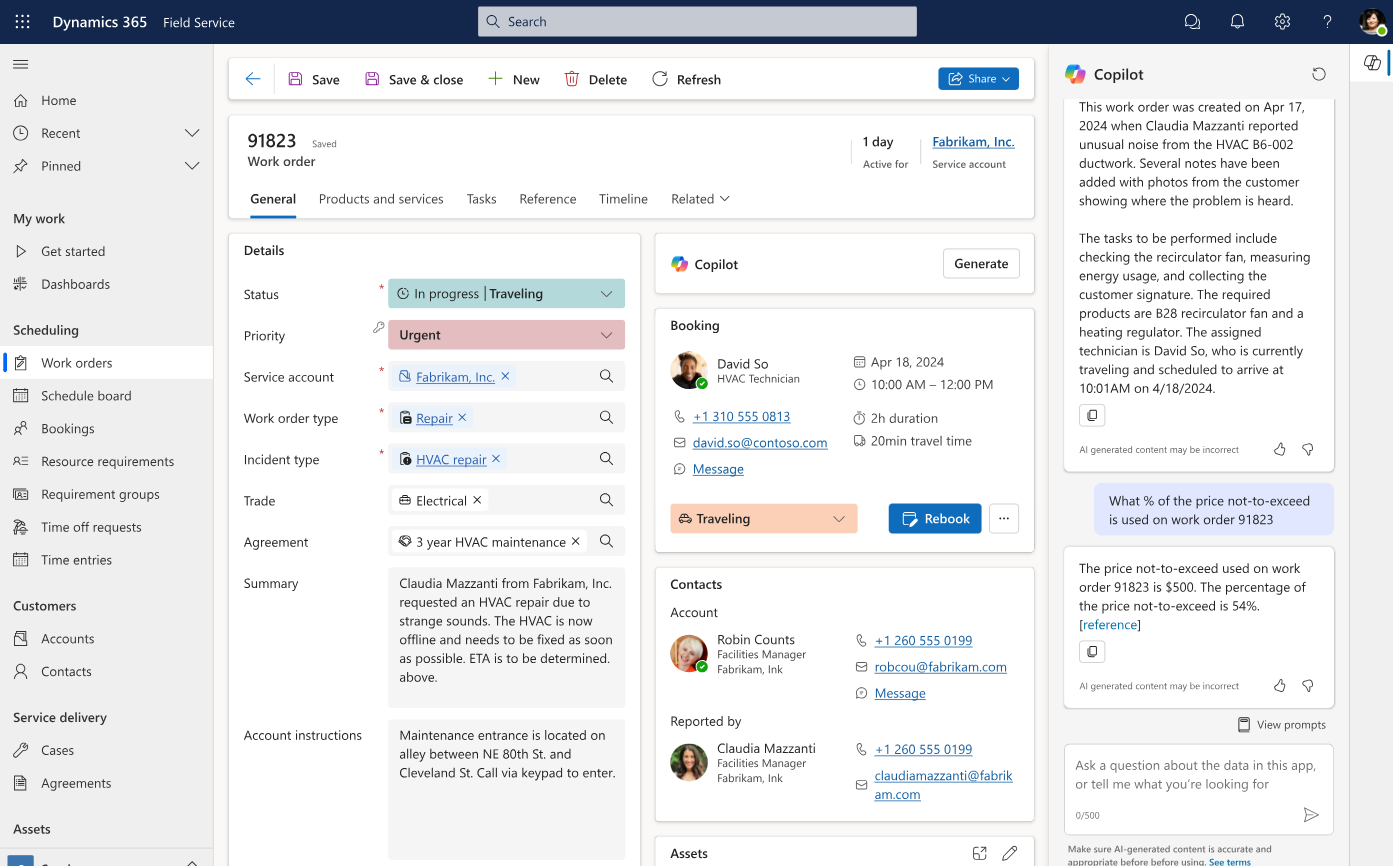
Organizations can use built-in AI capabilities across Dynamics 365 Sales, Customer Service, Finance, Supply Chain Management, Field Service, and other applications, or build custom AI agents with Copilot Studio. These agents can automate tasks, execute workflows, generate content, summarize records, and support decision-making using business data from Microsoft Dataverse and Power Platform. Basically, these capabilities make Microsoft a strong option for organizations already using Dynamics 365 and the broader Microsoft ecosystem.
Key Features of Microsoft’s Agents, Copilot, and AI:
- Custom AI agents and copilots with Copilot Studio
- Intelligent lead, opportunity, case, and record summarization
- Autonomous task execution and workflow automation
- AI-powered assistance for sales, service, finance, and operations teams
- Generative AI for email drafting and content creation
- Human-agent collaboration and oversight
- Unified business data management through Dataverse
- Embedded AI capabilities across the Dynamics 365 suite
Pros:
- Deep integration across multiple Microsoft applications.
- Broad AI coverage across CRM, ERP, productivity, and collaboration workflows.
- Low-code customization through Copilot Studio and Power Platform.
- Strong enterprise security, governance, and compliance capabilities.
- Well-suited for organizations already invested in the Microsoft ecosystem.
Cons:
- Requires significant configuration and customization to unlock full value.
- Full functionality often depends on multiple Microsoft products, increasing ecosystem complexity.
- Some built-in AI capabilities provide limited value without custom agent development and workflow design.
- AI effectiveness depends heavily on data quality and consistency across systems.
- May require specialized expertise in MS products (Dynamics 365, Power Platform, and Dataverse), increasing implementation and administration effort.
Pricing:
Microsoft Dynamics 365 AI and Copilot features are generally included natively within enterprise-grade application licenses (starting at around $105 per user/month, paid yearly), while some advanced or external AI agent development and automation are locked in Microsoft Copilot Studio (starting at $30.00 per user/month, paid yearly) and AI Builder credits (usage-based billing).
3. HubSpot Breeze
HubSpot Breeze is a built-in AI suite to automate and streamline marketing, sales, and customer service workflows natively within HubSpot CRM and Hubs. It includes conversational assistants, specialized AI agents, and embedded features to help teams automate customer interactions, generate content, enrich CRM data, and support customer-facing teams without extensive technical support.
Compared to Agentforce, HubSpot Breeze focuses on practical AI capabilities that can be deployed quickly within customer-facing workflows. For example, Breeze Customer Agent helps improve ticket deflection by answering common customer questions using website content, knowledge base articles, and CRM context, reducing the volume of routine inquiries that reach support teams. In contrast, Agentforce Support Agent — embedded within Salesforce Service Cloud — is designed to autonomously handle complex service tasks and multi-step customer interactions.
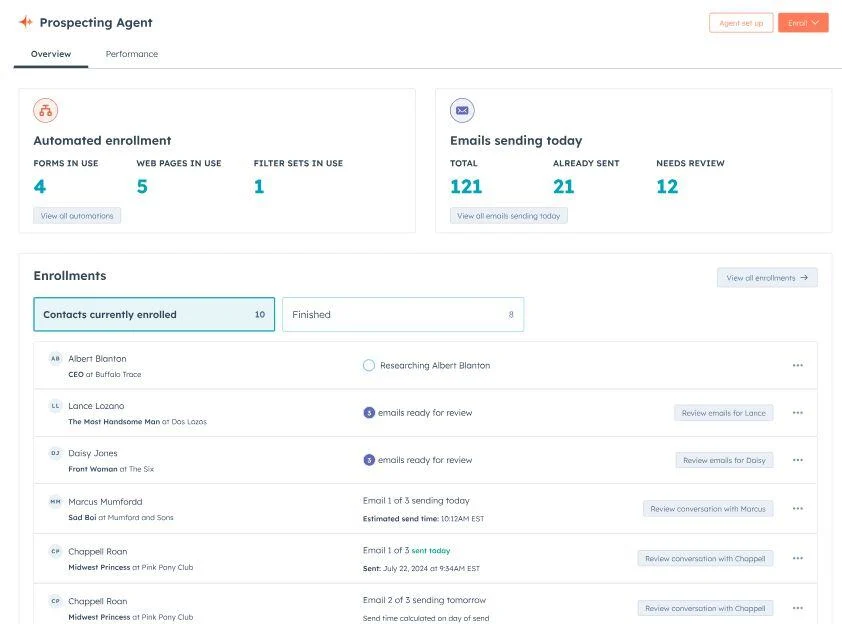
HubSpot Breeze can be a great option for SMB and mid-market companies looking for ease of deployment, minimal configuration, and fast time to value.
Key Features of HubSpot Breeze:
- Breeze Copilot for AI-powered assistance with tasks, writing, summaries, and finding information.
- Breeze Agents for customer support, prospecting, content creation, and knowledge base management.
- Breeze Intelligence for CRM enrichment, buyer insights, intent signals, and data quality improvements.
- GenAI tools for content generation, summarization, personalization, and recommendations inside HubSpot.
- Embedded AI across HubSpot CRM and Hubs.
- Natural-language interactions and human agent assistance for day-to-day activities.
- Centralized dashboard for monitoring Breeze feature usage, adoption, and activity across teams.
Pros:
- AI capabilities are natively embedded across the HubSpot platform.
- Easy to adopt and use with minimal technical expertise.
- Strong support for sales, marketing, and customer service use cases.
- Unified customer data, automation, and AI within a single platform.
Cons:
- Less suitable for highly complex enterprise workflows and multi-agent orchestration.
- Limited customization compared to dedicated AI agent development platforms.
- AI capabilities are primarily focused on customer-facing functions.
- Certain AI features require additional subscriptions, seats, or HubSpot Credits.
- Some Breeze agents and capabilities are currently available only in beta.
Pricing:
HubSpot follows a mixed pricing model for Breeze AI capabilities. While some features are included within HubSpot subscriptions, others consume HubSpot Credits ($10 per additional pack of 1,000 credits or $0.01 per credit on a pay-as-you-go basis), making costs dependent on feature usage and adoption.
See also: Top 10 HubSpot Alternatives & Competitors
4. ServiceNow Now Assist
Verdict: Best for enterprises prioritizing GenAI and simple agentic processes across IT, employee, customer service, and operational workflows.
Now Assist is ServiceNow’s suite of generative AI (GenAI) capabilities for the Now Platform. Built directly into the Now Platform, it acts as an intelligent assistant, automating workflows and repetitive tasks across IT, HR, customer service and software development.
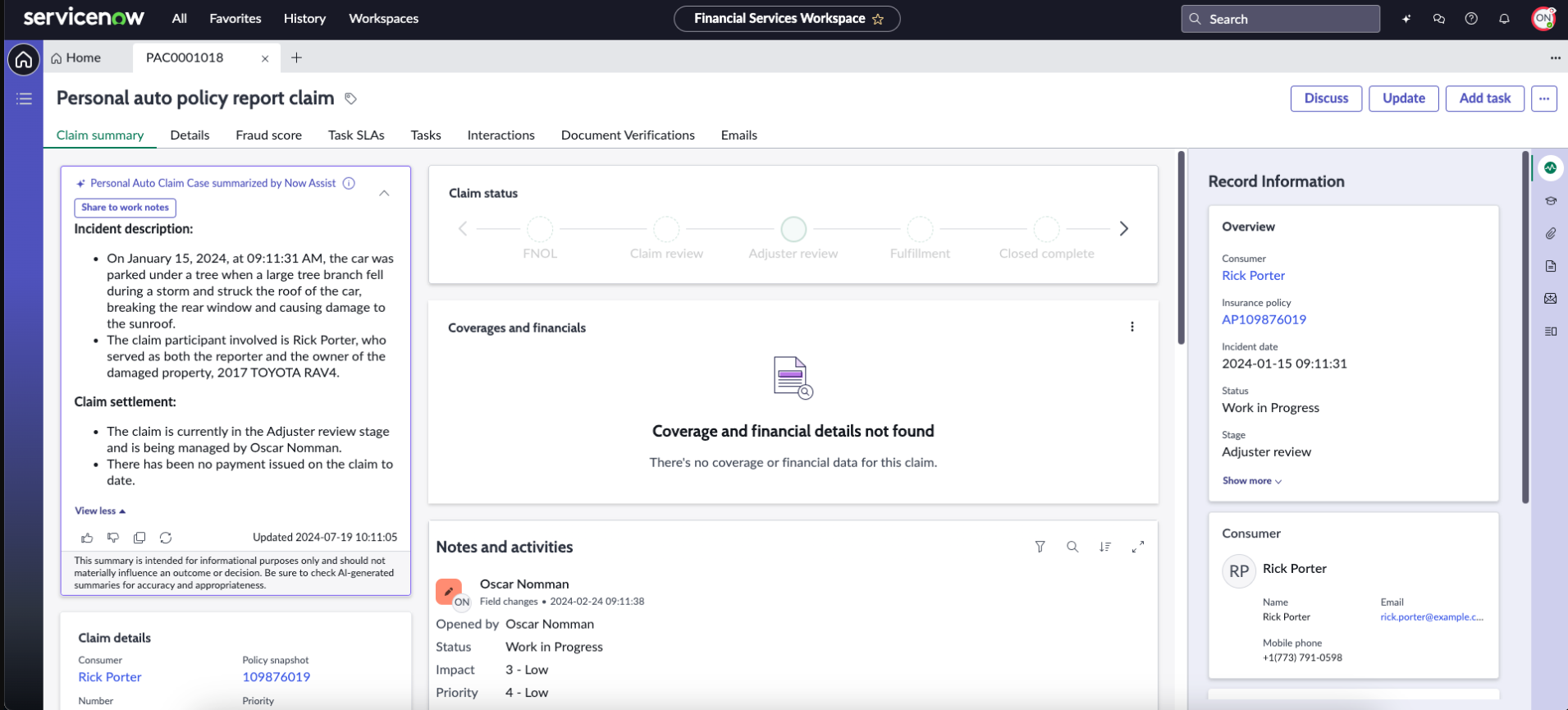
Most teams use Now Assist through targeted AI skills, such as summarizing case histories, logs, and chat transcripts; drafting knowledge articles and resolution notes; and assisting with script generation and code-related tasks. It also supports AI-enhanced conversational flows that help users analyze issues, automate actions, and navigate workflows more efficiently. Employees remain in control and can review, edit, override, or delete AI-generated outputs before taking action.
Key Features of ServiceNow Now Assist:
- Embedded generative AI across ServiceNow products
- Single-platform architecture and shared data model
- Role-specific AI experiences for customers, employees, agents, developers, and administrators
- Human review and override of agent behavior and AI-generated outputs
- Built-in AI guardrails and transparency mechanisms
- Context-aware AI that accesses only the data required for a task
- AI administration, configuration, and usage monitoring through the Now Assist Admin Console
Pros:
- Highly configurable platform that can support complex enterprise workflows.
- Unified platform connecting ITSM, IT operations, asset management, HR, risk, and other business functions.
- Strong CMDB, discovery, and service mapping capabilities.
- Extensive integration ecosystem and automation capabilities.
- Widely adopted platform with a large talent pool and partner ecosystem.
Cons:
- Expensive licensing and commercial agreements.
- Can be overly complex for smaller organizations or simpler use cases.
- Risk of over-customization, which can increase maintenance effort and platform complexity.
- Implementation and administration often require specialized ServiceNow expertise.
- Organizations may struggle to realize full value if they only use a small portion of the platform.
Pricing:
Custom pricing, available upon request.
5. Oracle AI Agent Studio
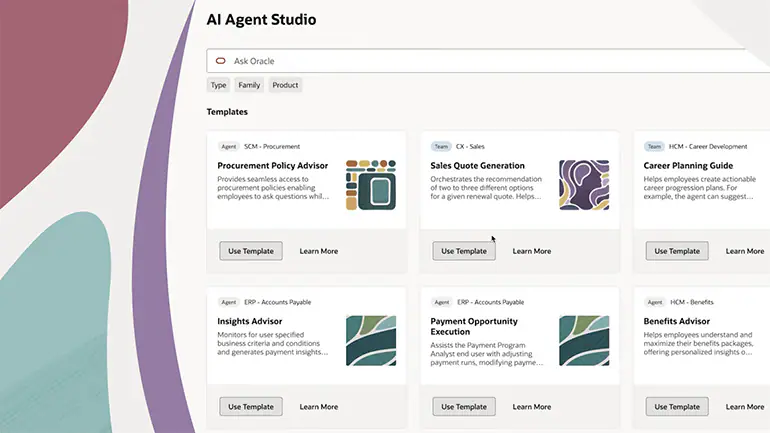
Oracle AI Agent Studio is a design-and-build platform that enables teams to create, customize, and deploy AI agents and GenAI-powered features across Oracle Fusion Applications. Teams can extend pre-built agent templates, create custom AI agents, and orchestrate multi-agent workflows, leveraging Oracle Fusion business data, APIs, tools, and knowledge sources. Because AI Agent Studio is natively integrated with Fusion apps, agents can be embedded directly into business workflows and operational processes. Oracle also provides an AI Agent Marketplace for Fusion Applications, which allows organizations to accelerate deployment speed with ready-to-use partner solutions.
Key Features of Oracle’s AI Agent Studio:
- Prebuilt agent templates for common business tasks
- Multi-agent orchestration and workflow execution
- Agentic Application Builder for defining business objectives using natural language
- Security guardrails, role-based access controls, and built-in monitoring tools for agent performance, latency, and accuracy
- Testing and evaluation framework to trace agent reasoning, measure semantic accuracy and token usage, and validate agents before deployment
- Native access to Oracle Fusion business objects, APIs, tools, and knowledge sources
- AI Agent Marketplace with pre-certified partner solutions
Pros:
- Native integration with Oracle Fusion Applications, business objects, APIs, and user roles.
- Well-suited for organizations already using Oracle ERP, HCM, SCM, Finance, and CX applications.
- Supports both custom AI agents and multi-agent workflows.
- Agents can directly access Oracle Fusion data, APIs, and deep links.
- Strong AI governance, monitoring, and security capabilities.
Cons:
- Building, tracing, and orchestrating multi-agent workflows may require specialized technical expertise.
- Steeper learning curve compared to some low-code AI agent platforms.
- Oracle's usage-based pricing model is available only for AI Agents
- Usage-based pricing can make long-term AI costs more difficult to forecast at scale.
- Less suitable for organizations seeking a platform-independent AI agent solution.
Pricing:
Oracle AI Agent Studio access is included in both Oracle AI pricing models. Oracle offers a usage-based model for AI Agents and Agentic Apps, measured in AI Units (AU), with 20,000 AUs/month included for Fusion customers and additional units priced at $1,000 per 100,000 AUs. Oracle also offers user-based pricing for AI Agents only, starting at $5/employee/month or $150/named user/month.
How to Choose the Right Alternative to Agentforce?
The right Agentforce alternative depends on whether you want to extend your existing Salesforce environment or replace it altogether.
Plan A: Keep Salesforce, Add a Dedicated AI Agent Platform
If Salesforce remains your CRM and system of record, focus on platforms that can extend your Salesforce environment with advanced AI agents and agentic automation capabilities.
Key considerations include:
- Start with the use cases: Prioritize platforms that support the use cases you need today, whether CRM agents, industry-specific agents, workflow agents, or autonomous agents.
- Avoid creating another dependency: Look for Agentforce alternatives that deliver value without requiring additional Salesforce products, data migrations, or complex architecture changes.
- Think beyond Salesforce workflows: The biggest gains often come from agents that can work across CRM, ERP, ITSM, and other business systems.
- Prioritize speed to value: Favor platforms with prebuilt agents, no-code tools and visual designers, and straightforward implementation.
- Understand the long-term cost model: Ensure costs remain predictable as AI adoption, agent usage, and automation volumes increase.
The goal is to extend Salesforce with enterprise AI capabilities while avoiding additional complexity, platform sprawl, and unexpected costs.
Plan B: Replace the Salesforce Stack with a Unified AI-Native Platform
Many organizations start evaluating alternatives when the cost and complexity of the Salesforce ecosystem begin to outweigh its benefits. If that's the case, look for platforms that can replace multiple systems while providing a stronger foundation for AI-driven operations.
- Look for full-stack replacement capabilities: Prioritize platforms that combine CRM, workflow automation, AI agents, and customer data rather than requiring multiple products.
- Evaluate operational simplicity: Assess how much administration, integration work, and specialized expertise the platform requires to operate and maintain.
- Assess business-wide coverage: Ensure the platform can support sales, marketing, service, operations, and industry-specific processes from a single environment.
- Prioritize AI-native architecture: Look for platforms where AI agents, workflows, and business processes operate together rather than being layered on top of existing systems.
- Consider long-term scalability: Ensure the platform can support growing numbers of users, agents, workflows, and use cases without introducing additional complexity.
This path is best suited for organizations that want to simplify their technology stack and make AI a core part of their operations. Instead of adding more layers to Salesforce, they can adopt a solution that unifies workflows, automation, and AI within a single platform.
Why Customers Choose Creatio Over Agentforce?
Organizations evaluating Agentforce alternatives are often looking for more than just AI agents. They need a platform that can connect data, workflows, automation, and AI while remaining easy to deploy, scale, and manage across the business.
Here’s why many organizations choose Creatio over Agentforce and other Salesforce products:
#1. One AI-Native Platform
Unlike Agentforce, which extends the Salesforce ecosystem with AI capabilities, Creatio does not treat AI as a separate product or add-on. AI is embedded into the core of the platform, making CRM data, workflows, business processes, and automation natively available to AI agents.
Because AI is built into the platform, organizations can deploy AI agents, automate workflows, and add AI across business processes without purchasing separate products, managing additional AI layers, or navigating complex licensing requirements. This enables faster AI adoption and a more consistent experience across the organization.
#2. Up to 70% Faster Implementation
Long implementation cycles are one of the biggest barriers to enterprise AI adoption. Creatio's AI-native architecture — combined with AI coding agents, no-code visual designers, industry workflows, and Creatio Marketplace add-ons — helps organizations deploy and scale AI-powered solutions faster without extensive technical resources.
One customer reported that its Creatio implementation was approximately 70% faster than its previous Salesforce deployment, allowing the organization to accelerate time to value while reducing implementation complexity.
#3. Flexible Pricing and Unlimited Scale
Creatio offers flexible pricing options, including traditional per-user licensing and an Unlimited plan for enterprise-wide adoption. Unlike consumption-based pricing models, organizations can scale AI initiatives without constantly tracking conversations, actions, or usage-based costs.
Built for the AI era, the Unlimited Enterprise model includes unlimited users, AI agents, workflows, applications, custom objects, and API calls. This enables organizations to expand automation, deploy more AI agents, and scale execution across the business without introducing new licensing constraints as adoption grows.
#4. Lower Total Cost of Ownership
According to Nucleus Research, Creatio customers reported a 37% reduction in costs, driven by lower implementation effort, reduced IT overhead, streamlined integrations, and a transparent pricing structure. By reducing the operational overhead and complexities associated with Salesforce, organizations can lower TCO and reinvest resources into AI innovation and growth initiatives.
#5. Faster Adaptation to Change
Organizations also choose Creatio for its ability to evolve processes and automation without relying heavily on developers or external consultants. Its flexible no-code framework enables enterprise teams to rapidly deploy solutions, optimize processes, and automate complex workflows while responding quickly to changing business requirements. This flexibility helps organizations scale operations, adapt faster to change, and continuously improve business performance.
#6. Strong Integration Capabilities
Another key reason organizations choose Creatio is its integration flexibility. Customers noted Creatio's ability to seamlessly fit into diverse technology ecosystems, making it easier to connect new AI-powered capabilities with existing business systems. As organizations expand AI adoption, this helps maintain a seamless flow of data while allowing legacy systems and modern technologies to operate together without extensive back-office support or deep IT expertise.
Summary
Organizations evaluating Agentforce alternatives are often looking for more than enterprise AI agents. They need a platform that unifies AI, workflows, data, and automation while remaining easy to deploy, manage, and scale.
Creatio offers a compelling alternative to Agentforce by natively integrating AI and agentic capabilities into a single CRM and workflow automation platform. It enables organizations to build AI-powered processes with no limits on users, agents, workflows, or scale – and achieve unmatched time-to-value.
Looking for an Agentforce alternative without added complexity? Request a Creatio demo to see how people and AI agents work together to enhance productivity and drive business growth.
