





































































CRM for Distributors: Best CRM Software for Distribution Companies in 2026

Power Revenue Teams with Creatio’s Agentic CRM

Distribution companies manage much more than customer relationships. Every day, sales teams coordinate orders and pricing, operations teams manage inventory and fulfillment, while field reps oversee territories and customer accounts — often across multiple systems. With data scattered across spreadsheets, ERP systems, and disconnected tools, teams spend too much time searching for information and coordinating tasks manually.
CRM software helps distributors bring these processes together in one system. Basically, it allows companies to centralize customer and operational data, improve visibility across teams, streamline workflows, and automate repetitive processes across sales, service, and operations. As adoption continues to grow, the distribution CRM market is projected to nearly double, reaching $19.2 billion by 2033.
In this article, we explore what distribution CRM software is, the key features and use cases that matter most, the role of AI in distribution operations, and how to choose the right CRM platform for your business.
Key Takeaways
- A CRM for distribution helps companies manage customer relationships, sales activities, quotes, orders, service requests, and operational workflows in one connected system.
- Key CRM features for distributors include customer and account management, quote-to-order workflows, territory management, ERP and inventory integration, forecasting tools, AI automation capabilities, and no-code customization.
- CRM software empowers distributors to improve operational visibility, streamline workflows, automate repetitive tasks, improve forecasting, and strengthen customer relationships.
- AI capabilities are becoming an integral part of distribution CRM systems, helping automate follow-ups, approvals, forecasting, communication with customers and partners, and core operational workflows.
- Top CRM software for distributors in 2026 includes Creatio AI CRM, Microsoft Dynamics 365, Salesforce, Oracle NetSuite, and Infor CRM SLX.
What Is CRM for Distributors?
A CRM for distribution is specialized software that helps distribution companies manage customer relationships, sales activities, quotes, orders, service requests, and operational workflows in one connected system. Unlike generic CRM software, distribution-focused CRMs are designed to support complex sales cycles and integrate with ERP systems and other operational software to provide visibility into inventory, SKU-level data, invoices, and customer interactions across the business.
For medium and large distribution companies, CRM system is becoming a strategic platform for scaling operations, improving customer retention, and increasing visibility across teams, territories, and channels. Powered by AI, machine learning, and workflow automation, CRM software helps distributors streamline operations, improve forecasting, and make faster, data-driven decisions.
In the distribution industry, CRM systems are commonly used to:
- Manage sales pipelines, customer accounts, and distributor relationships
- Track quotes, orders, invoices, and customer interactions across the sales lifecycle
- Automate follow-ups, approvals, and repetitive sales or service workflows
- Improve forecasting and identify cross-sell and upsell opportunities
- Connect CRM with ERP, inventory, and e-commerce systems to improve operational visibility and collaboration across teams
CRM for Distribution vs Wholesale CRM: What’s the Difference?
Although the terms are often used interchangeably, CRM for distribution and wholesale CRM are designed to support different business models and operational requirements.
CRM software for distribution is built to support broader operational complexity, cross-functional coordination, and ERP-connected workflows across sales, service, logistics, inventory, and partner management. In contrast, wholesale CRM systems are typically better suited for organizations focused primarily on bulk ordering, customer account management, and repeat sales processes.
| Criteria | CRM for Distribution | Wholesale CRM |
| Primary focus | End-to-end distribution operations across sales, service, logistics, and partner management | Wholesale transactions, customer account management, and repeat ordering |
| Operational scope | Supports complex multi-location operations, territories, channels, and cross-functional workflows | Primarily focused on sales and order management processes |
| System integrations | Deep integration with ERP, inventory, e-commerce, and supply chain systems | Typically centered around sales, invoicing, and order workflows |
| Workflow capabilities | Advanced automation for forecasting, approvals, service coordination, and operational visibility | Basic sales automation and customer communication workflows |
| Goal | Improve operational efficiency, customer retention, forecasting accuracy, and organizational visibility | Improve sales productivity and account management efficiency |
Why Distribution Companies Need a CRM?
CRM systems help distributors centralize complex customer data, improve sales efficiency, and bridge the gap between sales and inventory teams. As operations grow, these platforms help organizations unify customer and sales information, improve visibility, and streamline day-to-day operations.
Without a CRM, distribution companies often struggle with:
- Scattered data across multiple systems
- Limited visibility into pipelines, orders, and account activity
- Manual follow-ups, approvals, and administrative tasks that slow down sales processes
- Poor coordination between sales, customer service, operations, and finance teams
- Inaccurate forecasting caused by disconnected sales and operational data
- Difficulty managing large account portfolios, territories, and pricing structures
- Limited ability to identify cross-sell, upsell, and customer retention opportunities
By connecting data, workflows, and operational processes in one system, customer relationship management platforms help distributors improve scalability and consistency across teams, locations, and channels.
Popular Use Cases of a CRM in the Distribution Industry
#1. Managing Complex Buyer and Partner Networks
Distributors often work across manufacturers, suppliers, dealers, retailers, partners, and end customers simultaneously. CRM systems help centralize account data, manage account hierarchies, and maintain visibility across regions, channels, and business units.
#2. Coordinating Field Sales and Territory Operations
Customer relationship management systems are often used by field sales teams, helping them manage territories, track customer visits, monitor account activity, and prioritize opportunities in real time. This allows companies to improve sales productivity, increase territory coverage, and ensure consistent management of business accounts.
#3. Streamlining Quote-to-Order Processes
Distributors use CRM to automate quote generation, pricing approvals, order tracking, and customer communication throughout the sales cycle. This helps reduce manual work, accelerate sales processes, and improve customer responsiveness.
#4. Improving Demand Forecasting and Inventory Planning
By connecting CRM with ERP and inventory systems, distributors gain better visibility into customer demand, purchasing patterns, and sales pipelines. Better visibility into customer demand, buying patterns, and order trends helps companies reduce stock issues, improve planning, and align inventory levels with expected sales activity.
#4. Identifying Upsell and Cross-Sell Opportunities at Scale
CRM software helps distributors analyze customer purchasing behavior, account activity, and sales trends to uncover new revenue opportunities across existing accounts. AI-powered insights and AI agents can further help sales teams recommend relevant products and engage customers proactively.
Key Features of CRM Software for Distributors
Distributors need CRM software that supports customer management, quotes and orders, inventory visibility, forecasting, and coordination between sales and operations teams. Here are the must-have CRM features that distributional companies should look for:
- Customer & Account 360° View — centralized customer records, lead management, account hierarchies, pricing information, order history, and communication tracking
- Order & Quote Management — quote generation, pricing approvals, invoice visibility, and quote-to-order workflows
- Territory & Pipeline Management — territory assignment, opportunity tracking, field sales coordination, and sales forecasting
- ERP Integration & Inventory Visibility — ERP connectivity, real-time inventory data, SKU synchronization, and product availability tracking
- Reporting & Demand Forecasting — dashboards, sales analytics, pipeline reporting, and demand forecasting tools
- AI Agents & AI Automation Capabilities — AI-powered account research, next-best-action recommendations, automated follow-ups, approvals, and cross-functional process automation across sales, service, and operations teams
When evaluating CRM vendors, pay close attention to customization and scalability. Distribution companies often require flexibility across sales workflows and ERP environments, so the platform should adapt to existing operations and scale as the business grows.
The Role of AI in Distribution
Like many industries, distribution is increasingly adopting AI to improve operational efficiency, automate repetitive work, and make faster decisions across sales, service, and inventory processes. Today, distributors use AI to improve demand forecasting, identify sales opportunities, automate follow-ups, reduce manual data entry, and provide teams with faster access to customer and operational insights. According to Distribution Strategy Group research, 93% of distributors expect AI usage to increase, yet only 16% have moved from exploration to implementation.
Alongside the growing adoption of AI tools, distributors are also exploring AI agents — systems capable of executing specific tasks and workflows with minimal human involvement. In distribution, AI agents can monitor inventory levels, trigger replenishment workflows, route service cases, prioritize sales opportunities, coordinate customer communication, and automate operational tasks across departments.
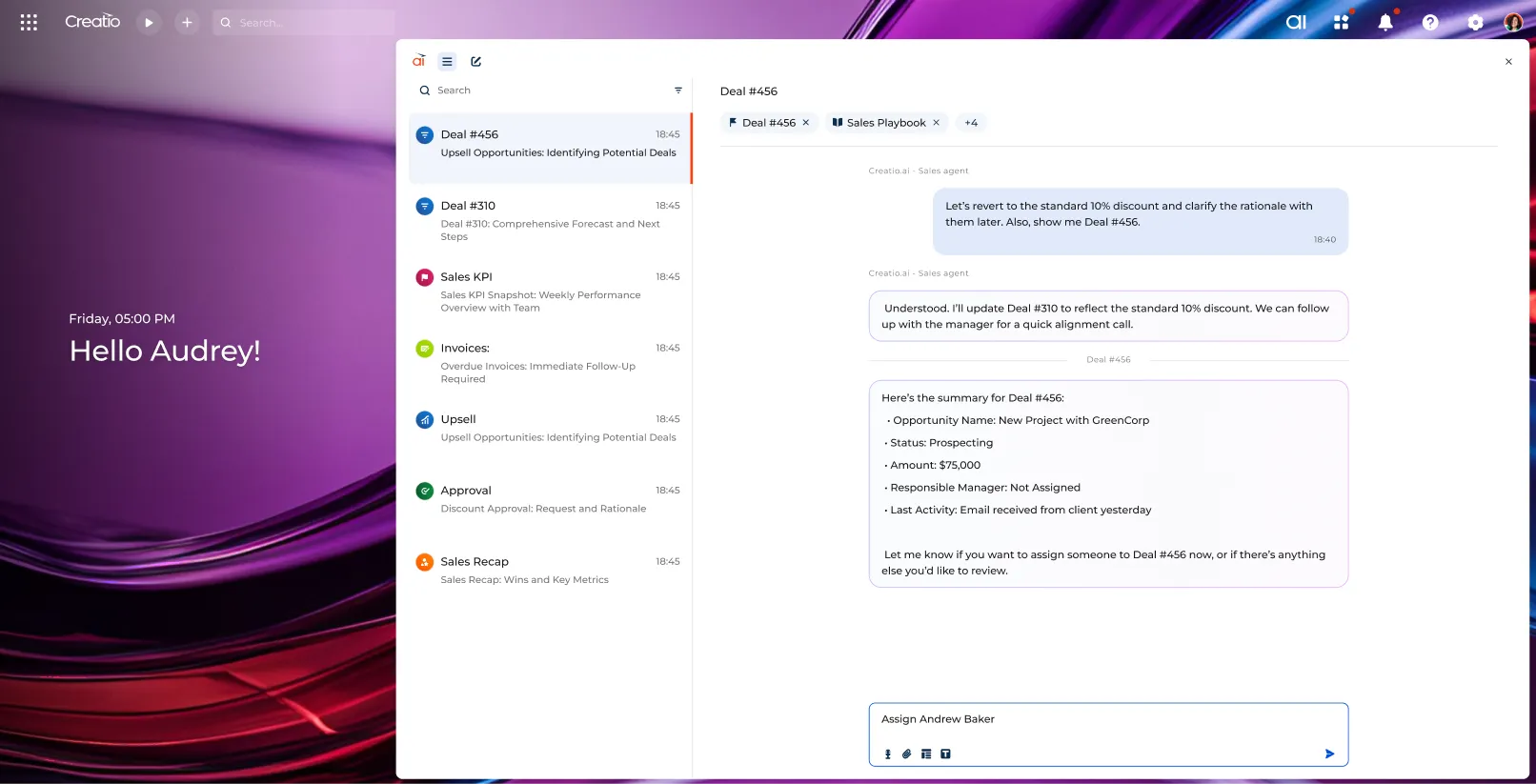
Modern CRM platforms are already embedding these capabilities into everyday workflows. For example, Creatio provides built-in AI agents designed to support sales, service, and marketing operations across distribution businesses.
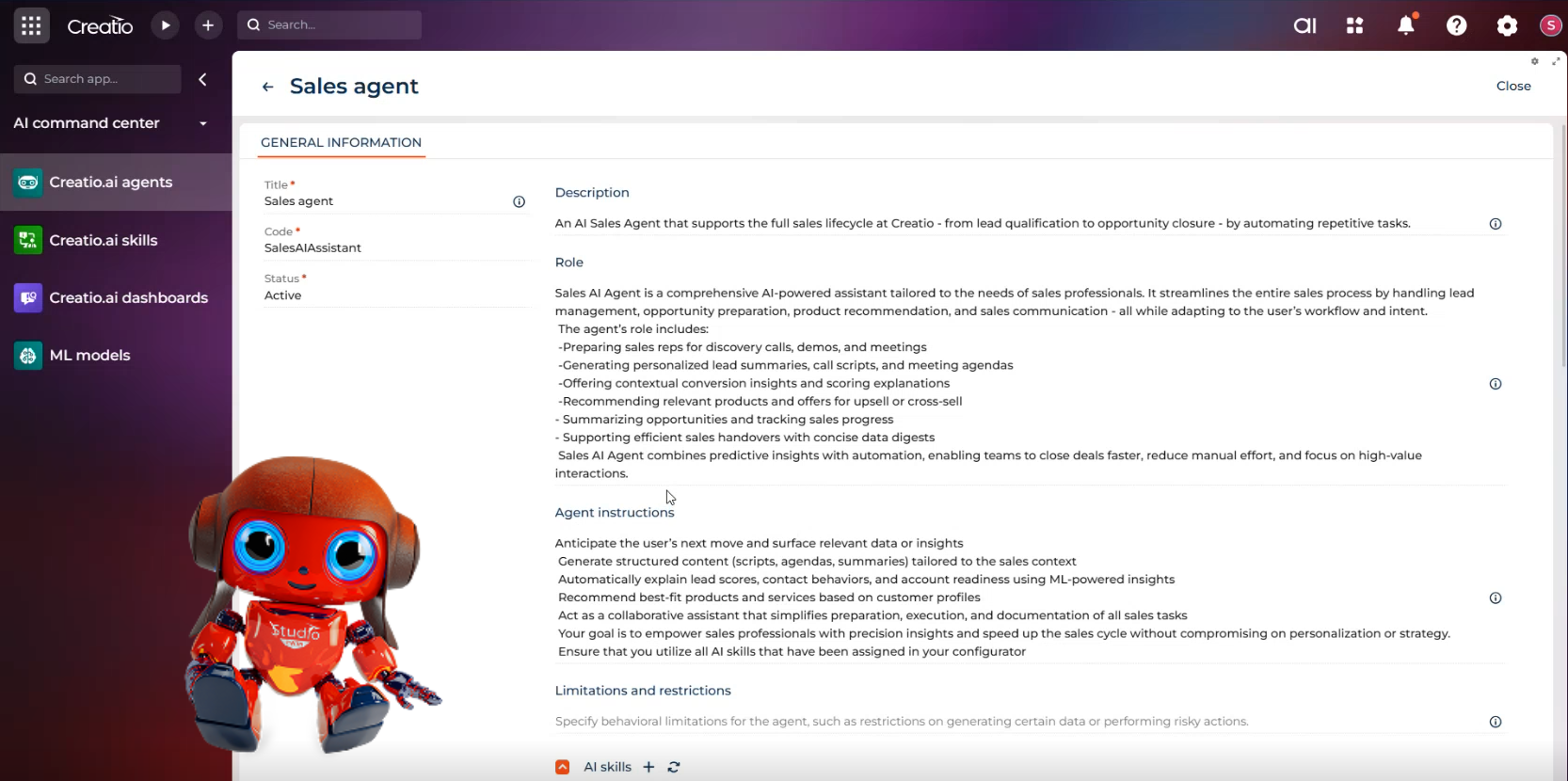
- Sales AI Agents support tasks such as account research, quote generation, meeting preparation, forecasting, territory management, lead scoring, CRM data updates, and next-best-action recommendations.
- Service AI Agents help automate case classification, case resolution, knowledge base support, service playbooks, and next-best-action guidance for customer service teams.
- Marketing AI Agents assist with campaign planning, email generation, marketing content creation, lead scoring, and lead distribution workflows.
Additionally, Creatio allows distributors to build custom AI agents tailored to their own workflows, approval structures, and operational processes — helping every user automate highly specific distribution tasks using natural language and an intuitive interface.

Benefits of CRM for Distribution Companies
By centralizing real-time data, workflows, and operational processes on a single platform, distributor CRM software helps companies improve operational visibility, accelerate sales execution, optimize inventory planning, and strengthen customer relationships.
Key benefits of CRM adoption for distributors are:
- Better operational visibility by connecting customer data, orders, inventory, pricing, and sales activity – all in one system
- Faster quote-to-order execution through automated approvals, AI-assisted quoting, and streamlined order workflows
- More effective territory and account management with real-time visibility into pipeline performance, sales activity, and customer engagement
- More accurate forecasting and inventory planning by connecting CRM with ERP and inventory management tools
- Higher efficiency across teams through automation of routine tasks like follow-ups, approvals, service routing, and data updates
- More revenue opportunities within existing accounts by identifying cross-sell, upsell, and retention opportunities from customer and sales data
Over time, CRM helps distributors build more scalable and efficient operations, improve customer responsiveness, and drive long-term revenue growth.
Best CRM Software for Distributors in 2026
Creatio AI CRM
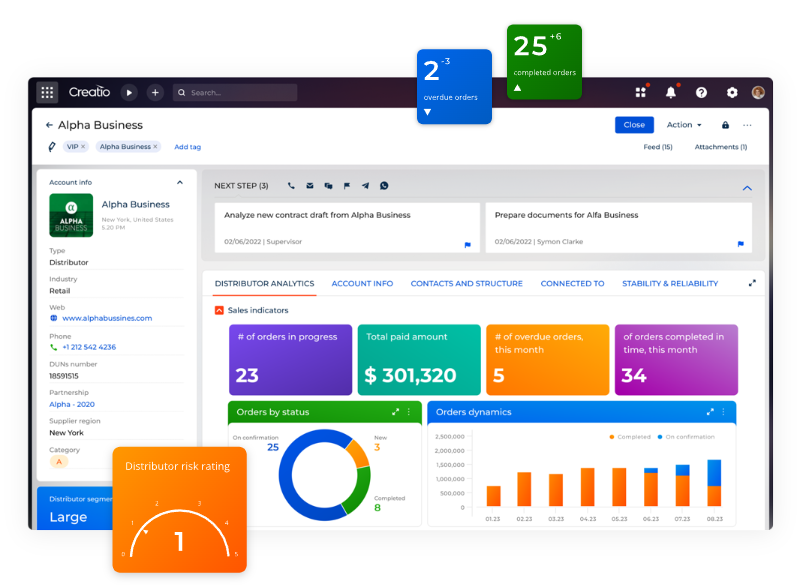
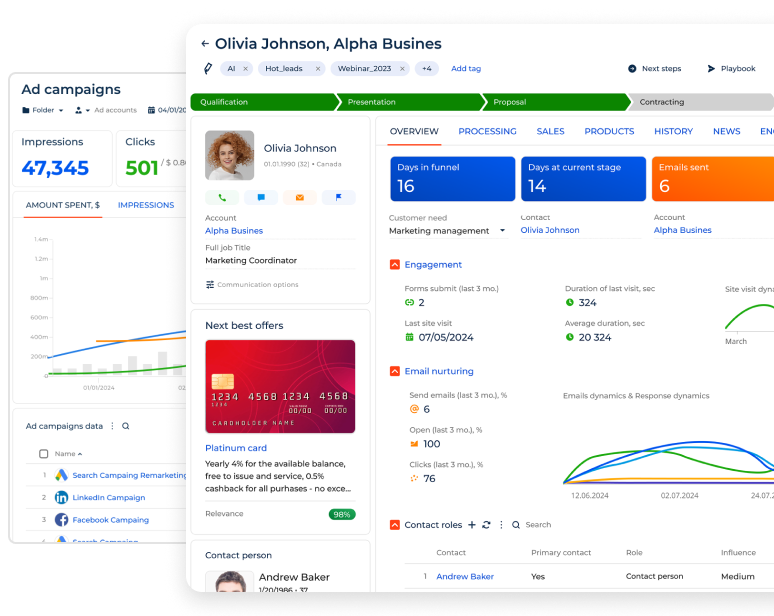
Creatio is a best-in-class AI CRM and workflow automation platform for distributors that supports complex operations across sales, service, inventory visibility, and operational workflows. By connecting customer data, sales processes, and operational systems in one environment, Creatio helps distribution companies improve visibility, streamline coordination across teams and territories, and strengthen relationships with customers, suppliers, and partners.
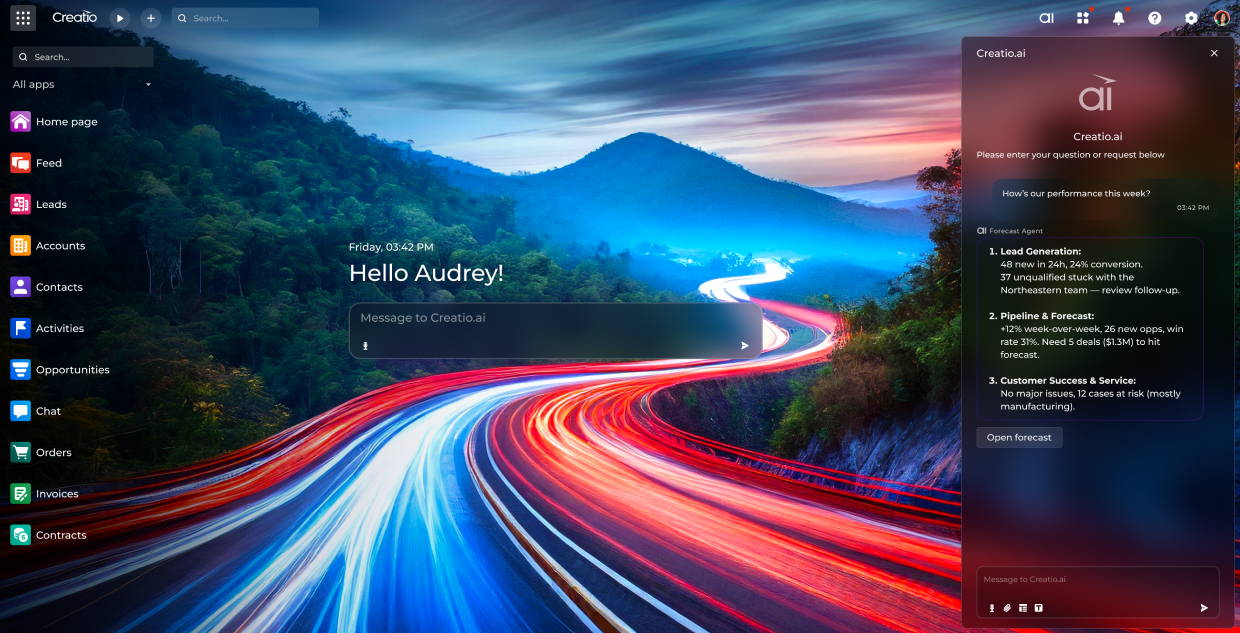
Distribution companies use Creatio to accelerate quote-to-order execution, improve territory and pipeline management, automate workflows, and improve coordination between business teams. Creatio’s built-in AI capabilities and AI agents help teams enhance forecasting, prioritize sales opportunities, streamline approvals and follow-ups, and execute routine tasks with less manual effort.
Creatio also supports enterprise-grade security and compliance requirements, including certifications such as SOC 2 Type II and ISO 27001. The platform includes role-based access controls, multi-layered encryption, and governance capabilities that help companies maintain security and regulatory compliance across operations.
Creatio is a strong choice for medium and large distribution companies looking for a flexible and scalable AI CRM platform. The company was recognized as a Visionary in the 2025 Gartner® Magic Quadrant™ for Sales Force Automation Platforms for its ability to execute and completeness of vision, which again underlines its quality and performance.
Core features:
- Unified agentic CRM and workflow automation platform to streamline sales, service, marketing, and operational processes in one environment
- 360-degree customer view with centralized account data, order history, interactions, and customer insights across the entire lifecycle
- Territory and field sales management for coordinating sales teams, tracking account activity, and managing regional performance
- Pipeline tracking and AI-enhanced forecasting with real-time visibility into opportunities, sales performance, and win projections
- ERP and third-party integrations to connect CRM with external business systems
- 700+ applications and integrations in Creatio Marketplace to extend platform functionality and connect third-party systems
- Ready-to-use CRM AI agents and AI agent builder for automating routine tasks, surfacing insights, and accelerating workflows
- AI-enhanced no-code architecture that enables business users to customize workflows, automate processes, and scale operations without extensive development resources
AI and Automation capabilities:
Creatio embeds AI and workflow automation capabilities directly into the core CRM platform to help distributors reduce manual work and improve team efficiency. For example, built-in AI capabilities assist with account research, quote generation, forecasting, customer insights, follow-ups, and next-best-action recommendations, helping sales and service reps work faster and make more informed decisions.
Workflow automation tools help distributors streamline approvals, onboarding, service routing, customer communication, and other repetitive processes across teams. Creatio also allows distributors to build custom AI agents tailored to specific workflows, business rules, and operational requirements using natural language and visual designers – without coding.
Pricing:
Creatio Business Studio pricing starts at $40 per user/month and serves as the foundational platform layer for building AI agents, applications, and automated workflows using AI coding agents and no-code visual designers. Creatio’s CRM platform — including its products Creatio Sales, Creatio Marketing, and Creatio Service — can be added on top of the platform and start at $15 per user/month each. This composable architecture allows distribution companies to deploy only the products they need and expand capabilities over time.
For organizations scaling automation and AI adoption, Creatio also offers an Unlimited pricing model. Unlike traditional seat-based licensing, the Unlimited plan includes unlimited users, AI agents, workflows, applications, custom objects, and API calls.
For distribution companies operating across multiple territories, warehouses, suppliers, and service teams, this model can provide more flexibility to scale workflows, automation, and AI usage without continuously increasing user-based licensing costs. Top of FormBottom of Form
Microsoft Dynamics 365
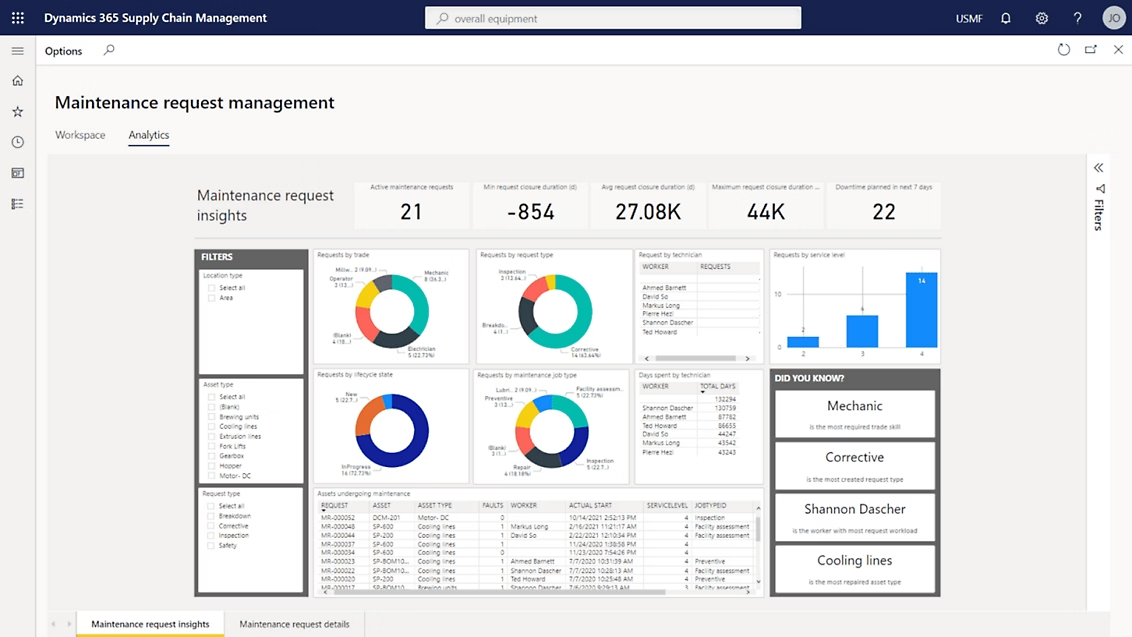
Microsoft Dynamics 365 is a CRM and business applications platform widely used by enterprise distribution companies to manage sales, customer service, field operations, and customer data within one connected ecosystem. One of its biggest strengths for distributors is deep integration across the Microsoft environment, allowing teams to work across CRM, reporting, communication, and operational systems without constantly switching between tools.
Rather than offering a unified CRM product, Dynamics 365 combines multiple applications that companies can adopt based on operational needs. For enterprise distributors, the most relevant products include Dynamics 365 Sales, Customer Service, Customer Insights, and Field Service. Together, these applications help manage sales pipelines, customer accounts, forecasting, service workflows, territory operations, and field teams from a centralized platform.
Dynamics 365 also integrates closely with Microsoft Teams, Outlook, Excel, Power BI, Azure, and ERP systems, making it especially attractive for organizations already standardized on Microsoft technologies and looking for strong reporting, operational visibility, and workflow automation capabilities.
Core features:
- Territory and sales performance management
- Route optimization for new leads
- AI-assisted sales forecasting and pipeline insights
- Sales playbooks and guided selling
- Custom dashboards, reporting, and Power BI analytics
- Workflow automation through Power Automate
- Integration with Microsoft products
* based on the Dynamics 365 Sales product.
AI and Automation capabilities:
Microsoft Dynamics 365 offers Copilot AI and Power Platform automation tools that focus on forecasting, customer engagement, and sales execution. Its AI capabilities help distributors summarize customer interactions, draft emails, identify sales risks, prioritize opportunities, recommend next-best actions, and generate sales insights. The platform also includes conversation intelligence, predictive scoring, automated CRM data capture, and workflow automation tools that help reduce manual work across teams.
Pricing:
Microsoft Dynamics 365 pricing varies depending on the selected products, number of users, AI capabilities, and integrations.
For example, Dynamics 365 Sales pricing typically starts at around $65/user/month, while more advanced enterprise plans can exceed $150/user/month with additional AI, customer intelligence, and advanced customization capabilities. The pricing for Dynamics 365 Service ranges from $50 to $195/user/month, while Customer Insights is priced at $1,700/tenant/month.
Salesforce CRM
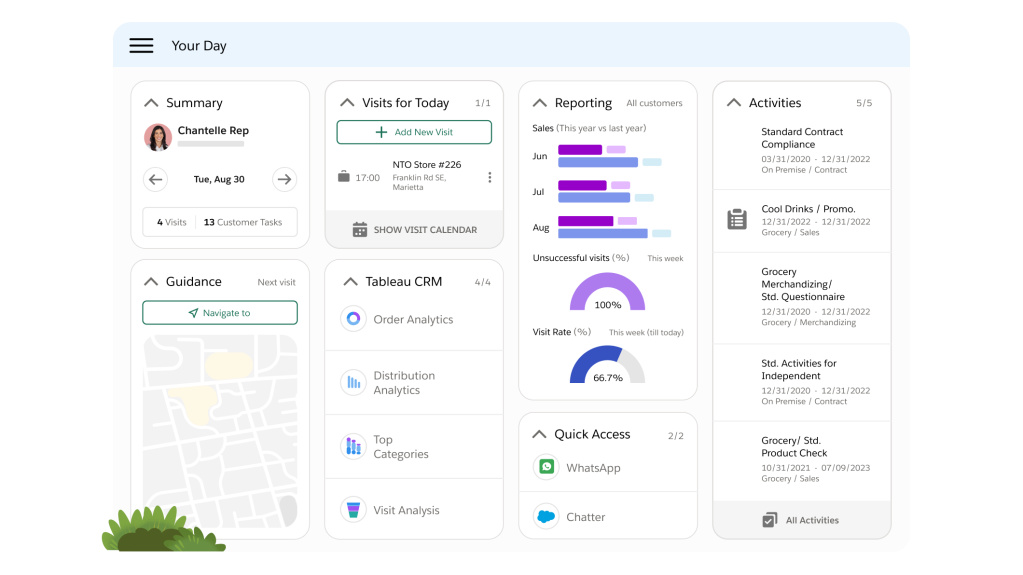
Salesforce is a popular CRM platform that enables companies to manage sales operations, customer relationships, service workflows, marketing activities, and commerce processes in one connected ecosystem. The platform offers an all-in-one suite of foundational CRM tools, as well as specialized solutions such as Sales Cloud, Service Cloud, Marketing Cloud, Commerce Cloud, and Data Cloud, allowing organizations to manage customer engagement and operational workflows across multiple business functions.
Salesforce is also highly extensible and designed to integrate with external applications, ERP systems, e-commerce platforms, and third-party technologies. Its AppExchange ecosystem provides thousands of integrations and add-ons, making the platform flexible for complex distribution environments.
Core features:
- Account, contact, lead, and opportunity management
- Customizable reports and dashboards
- Built-in sales flows and lead routing
- Knowledge management
- Dynamic email marketing, forms, and analytics
- Sales quoting and forecasting
AI and Automation capabilities:
Salesforce embeds AI capabilities through Agentforce and Einstein AI. Its AI tools help distributors improve forecasting, identify upsell opportunities, automate customer interactions, generate sales insights, and prioritize opportunities across sales and service operations. Advanced generative AI and Agentforce capabilities are typically available through additional product-specific add-ons across Salesforce Clouds.
Pricing:
Salesforce pricing for foundational CRM tools starts at $25/user/month for the SMB Starter Suite and scales up to $550/user/month for AI-powered enterprise plans and specialized Cloud products. Additional costs may apply for Agentforce AI capabilities, advanced automation, integrations, and third-party AppExchange applications.
NetSuite CRM
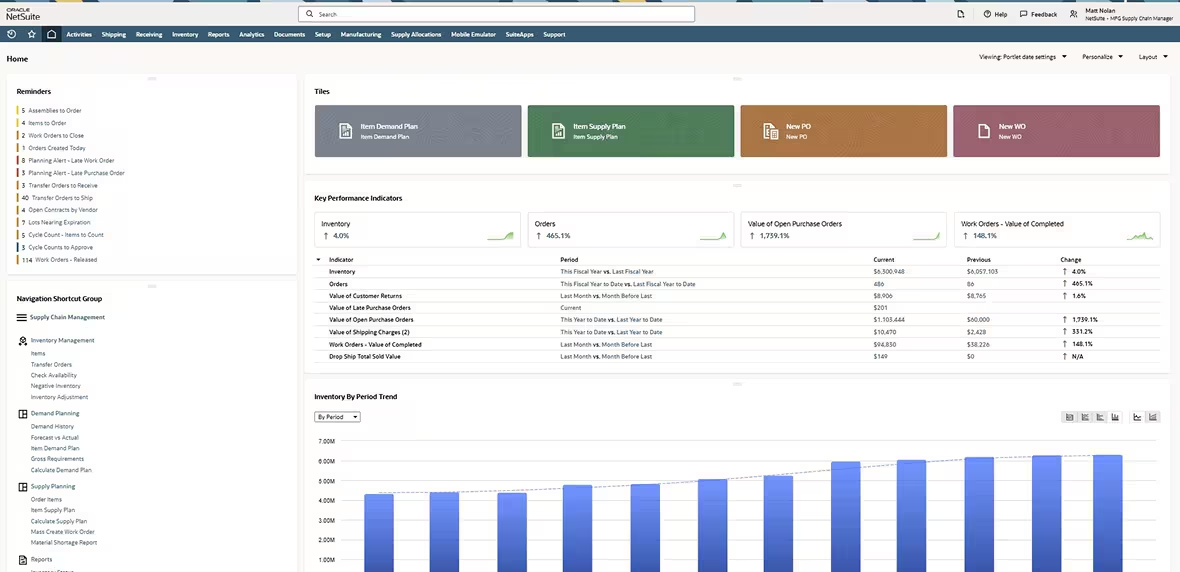
NetSuite CRM is a cloud-based customer relationship management platform that helps mid market distributors manage sales, marketing, customer service, forecasting, and partner relationships in one system. It is natively connected with the broader NetSuite ERP platform, allowing distributors to access operational and financial data from a unified environment.
For distribution companies, NetSuite CRM improves visibility into customer and partner interactions, quotes, orders, and sales activity while supporting better coordination between teams. The platform is particularly useful for distributors that need stronger alignment between customer-facing processes, financial and operational workflows.
Core features:
- Sales force automation capabilities
- Upsell, quote and order management
- Reporting and analytics
- Customer service and support with a full customer view
- Sales forecasting and quota management
- Partner relationship management
- Marketing tools for automation
- Mobile access
AI and Automation capabilities:
NetSuite embeds AI capabilities across its CRM and broader platform to help distributors improve decision-making, forecasting, and operational efficiency. AI tools support predictive analytics, next-best-action recommendations, generative AI content assistance, chatbots, sentiment analysis, and a natural language AI assistant that helps users search data, generate insights, and perform actions conversationally.
The platform also supports automation capabilities for opportunity, quote, and order management, commission and territory management, lead generation and nurturing, case management, self-service portals, and workflow rules — helping distributors reduce manual administrative work across teams.
Pricing:
NetSuite CRM is typically licensed through an annual subscription model, with pricing available upon request. Costs vary depending on the number of users, selected modules, integrations, and implementation scope.
Infor CRM SLX
Infor CRM is a customer relationship management platform focused on improving visibility into customer interactions, sales activity, service operations, and field sales processes. The platform integrates with the broader Infor ecosystem, including ERP, warehouse management, supply chain, e-commerce, and analytics solutions.
Infor CRM software helps centralize customer and account information, manage opportunities and quotes, coordinate field sales activities, and improve decision-making with comprehensive analytics. The platform is a great option for organizations already using Infor solutions that want better alignment between sales, customer service, and operational workflows.
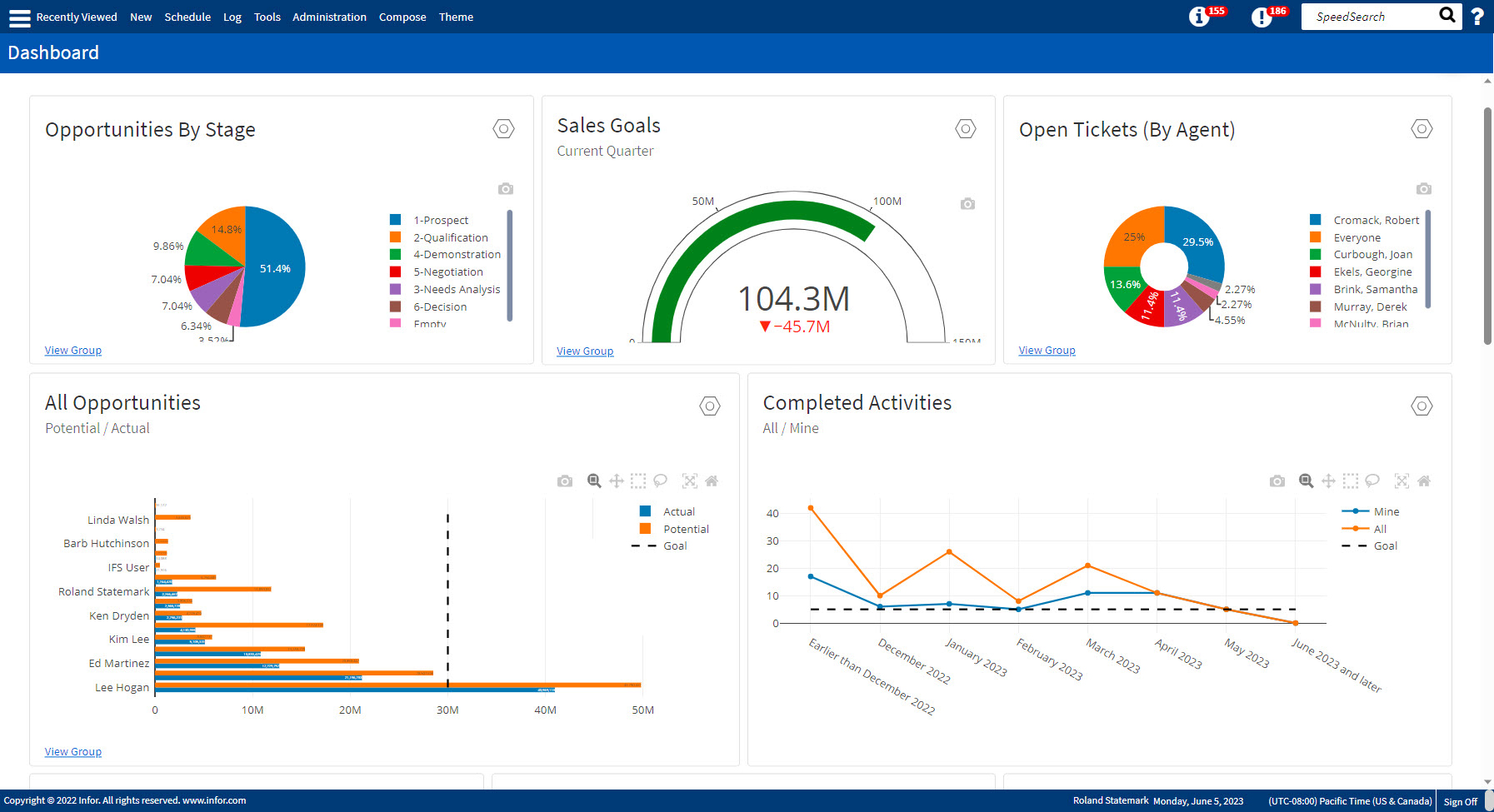
Core features:
- 360º customer views
- Customer-focused reporting and analytics
- Integration with business management, desktop productivity, e-marketing, and social media tools
- Sales management tools
- Email integration for Microsoft® Outlook® and Gmail
- Reports, dashboards, and analytics for sales
- Superior mobile and tablet functionalities
AI and Automation capabilities:
By leveraging AI and automation features, Infor CRM helps distributors improve forecasting, identify customer trends, automate workflows, and reduce manual administrative work. AI tools support predictive analytics, KPI tracking, proactive alerts, generative AI assistance, and natural language queries. At the same time, automation capabilities streamline lead nurturing, customer communication, workflow orchestration, and repetitive cross-functional processes across sales, marketing, and service teams.
Pricing:
Infor CRM uses custom quote-based pricing depending on deployment requirements, number of users, selected modules, integrations, and implementation scope. Pricing information is available upon request.
How to Choose the Right CRM for a Distribution Business
1. Prioritize Industry Capabilities
Look for CRM platforms that support distribution-specific workflows such as quote-to-order processes, territory management, account hierarchies, pricing structures, inventory visibility, and field sales operations. This helps validate the platform’s fit for distribution environments and reduces the need for extensive customization later on.
2. Evaluate ERP Integration and Operational Connectivity
Ensure the CRM integrates with ERP, inventory management, ecommerce, and order management systems. Real-time access to inventory, pricing, invoices, and order status is critical for sales accuracy and operational visibility.
3. Assess Workflow Automation and AI Capabilities
A distribution software solution should support automated approvals, follow-ups, service routing, onboarding, and other repetitive operational tasks. Prioritize AI-powered CRM systems that go beyond automation by providing data-driven insights, improving forecasting accuracy, prioritizing sales opportunities, and reducing manual work for sales reps, service, and operations teams.
4. Support Territory and Account Management at Scale
Distribution businesses often operate across multiple territories, branches, sales teams, and large account portfolios. That’s why the CRM should provide strong capabilities for pipeline visibility, account segmentation, field sales coordination, and territory management across regions and business units.
5. Ensure Flexibility and Scalability
Distribution processes rarely stay static. As companies expand into new regions, add product lines, restructure sales territories, onboard new suppliers, or change pricing and approval models, CRM requirements evolve as well. A system that works today should continue supporting the business long term without creating operational bottlenecks or requiring costly redevelopment.
Look for a customizable CRM that can adapt workflows, approval chains, account structures, dashboards, and operational processes to match the way your business operates. Platforms with no-code development capabilities provide additional flexibility by allowing teams to modify workflows and launch process changes faster, reducing dependency on IT resources and accelerating operational improvements.
Summary
In the distribution landscape, CRM software plays a key role in managing customer relationships, sales operations, inventory visibility, forecasting, and cross-functional workflows. By connecting real-time data, processes, and teams in one system, distributors can improve operational efficiency, accelerate sales execution, strengthen customer relationships, and make faster, data-driven decisions.
Creatio provides an AI CRM and workflow automation platform where people and AI agents work together to support modern distribution operations. Enhanced with AI agents, no-code customization, and seamless integration capabilities, Creatio helps distributors streamline operations, accelerate sales execution, and scale faster in the age of AI.
Request a guided demo to explore Creatio’s AI CRM for distribution companies.
