





































































Banking Automation 101: Use Cases, Benefits, and How It Works

Creatio: Power Banking Ops With AI & No-Code

In modern banking, execution defines performance. The ability to process transactions at scale, enforce compliance without gaps, and manage risk in real time determines the real industry leaders. Yet fragmented banking systems and manual handoffs continue to constrain performance, limit visibility, and expose operations to unnecessary risk.
Banking automation enables institutions to execute core processes — such as onboarding, lending, payments, compliance, and service — consistently and at scale. Autonomous workflows and intelligent systems provide the exact visibility, governance, and resilience that every organization needs to support sustainable business growth.
In this article, we explain what banking automation is and how it transforms core processes across financial institutions. You will also learn the most impactful banking automation use cases and the technologies organizations are implementing today.
Key Takeaways:
- Banking automation refers to the use of technologies and governed workflows to streamline and coordinate high-volume, rule-based processes across financial institutions. The technologies enabling it include AI, machine learning, workflow orchestration platforms, robotic process automation (RPA), and others.
- Main benefits of automation in banking are faster process execution, reduced operational risk, stronger regulatory compliance, improved scalability, better data consistency, and enhanced customer experience.
- The key adoption areas of banking automation include customer onboarding and KYC, loan processing, fraud detection, compliance reporting, payment reconciliation, account maintenance, customer service, and marketing and sales enablement.
- A great example of banking automation software is Creatio, which empowers CRM and financial workflows with no-code and agentic capabilities to help banking organizations implement governed, enterprise-wide automation at scale.
What is Banking Automation?
Banking automation is the use of software and AI-driven technologies — such as artificial intelligence (AI) and machine learning (ML), robotic process automation (RPA), workflow orchestration or business process management (BPM) systems, intelligent document processing, and system integrations — to automate and coordinate routine, manual, and rule-based activities across banking operations.
In practice, banking automation supports processes such as:
- Customer onboarding and KYC verification
- Loan origination, underwriting, and servicing
- Payments and transaction management
- Customer service and case management
- Risk management, fraud detection, and compliance operations
- Regulatory reporting and disclosures
- Back-office and operational workflows
By executing these processes through governed, end-to-end workflows, banks improve efficiency, reduce operational risk, and scale operations across the enterprise while maintaining visibility and control.
How Banking Automation Really Works
In banking, automation helps redesign and optimize core workflows across systems and teams. It standardizes execution and scales operations without compromising governance and compliance.
Banking automation typically involves the following stages:
- Step 1: Identify automation opportunities. Banking automation starts with identifying repetitive, manual, or high-volume processes — such as customer onboarding, loan processing, payments, or compliance reporting — that slow operations, increase costs, or introduce risk.
- Step 2: Design end-to-end workflows. Each process is then mapped into a structured, digital workflow that defines the required steps, decision points, approvals, and exceptions handling across teams and systems. Modern banking CRM and automation platforms allow these workflows to be configured visually, reducing reliance on custom development and accelerating implementation.
- Step 3: Connect systems and data. Automation platforms integrate core banking systems, CRM, document management tools, and external services through APIs or connectors. This ensures consistent data flow, removes manual handoffs, and creates a unified operational view.
- Step 4: Automate tasks and support decisions
Once workflows are designed and integrated, processes are automated using the appropriate technologies for each task — such as AI, machine learning, or RPA. These technologies handle routine execution and support data-driven decisions, including risk assessment, fraud detection, and document classification. Human oversight remains embedded for approvals, exceptions, and regulatory controls where required. - Monitor, govern, and optimize
Automated workflows run within governed frameworks that provide audit trails, performance metrics, and real-time visibility. This allows banking institutions stay compliant, manage risk proactively, and continuously improve their efficiency.
Key Banking Challenges That Automation Can Solve
Automation resolves a range of challenges in banking, particularly the ones that impact regulatory exposure, operational performance, and competitive positioning:
- Rising regulatory and compliance pressure: Manual compliance checks increase the risk of errors, inconsistencies, and audit findings. Banking automation embeds regulatory controls directly into workflows and generates clear audit trails, strengthening oversight and reducing exposure.
- Fraud and financial crime exposure: Real-time digital transactions significantly increase fraud and AML risk. Automated monitoring systems continuously analyze activity, flag anomalies, and trigger investigation workflows immediately, improving response speed and accuracy.
- Slow and inconsistent banking processes: Manual handoffs and fragmented systems slow down onboarding, loan approvals, payments, and service requests. Automation connects these operations into structured digital workflows, helping banks operate faster and more efficiently.
- Fragmented legacy systems and data silos: Core banking platforms, CRM applications, and third-party tools often operate in isolation, creating reconciliation challenges and limited visibility. Banking automation integrates these environments, improves data consistency, and streamlines cross-system coordination.
- Limited scalability without rising costs: Growing transaction volumes often require additional staffing and infrastructure investments. Automation handles routine and rule-based tasks, enabling banks to scale operations without proportional increases in cost.
- Lack of operational visibility: Without real-time insight, leaders struggle to identify bottlenecks and risk exposure. Automated workflows provide performance tracking, metrics, and transparency across functions.
- Inconsistent cross-channel execution: Customers expect continuity across digital and physical channels. Automation in banking standardizes workflows across touchpoints, reducing friction and improving retention and conversion.
Departments That Need Banking Automation
Banking automation is rarely owned by a single department. In most cases, it becomes valuable for the teams responsible for execution, control, and revenue performance.
The departments below are typically the first to see measurable impact:
Department | Why it matters |
| Operations | Standardize high-volume workflows and reduce manual rework. |
| Risk & Compliance | Embed automated controls into processes and maintain audit traceability. |
| Fraud & Financial Crime | Strengthen monitoring and investigation coordination. |
| Lending & Credit | Improve decision speed while enforcing underwriting policies. |
| Customer Service | Reduce case handling time and ensure consistent execution. |
| Marketing & Sales | Activate customer data for compliant, timely engagement; identify cross-sell and upsell opportunities and prioritize accounts with the highest score. |
| IT & Digital Transformation | Orchestrate workflows across legacy systems without increasing complexity, particularly through no-code banking platforms. |
| Executive Leadership | Gain real-time visibility into automated workflows, performance metrics, and risk exposure. |
Banking Automation Use Cases
Many banking workflows are structured, high-volume, and governed by strict regulatory policies, which makes them well-suited for automation. Modern banking platforms now allow banks to coordinate these processes end-to-end with greater speed, accuracy, and oversight.
1. Customer Onboarding and KYC
Onboarding typically involves identity verification, document collection, sanctions screening, and internal approvals. With banking automation platforms, teams can autonomously capture customer data, verify documentation, and trigger real-time KYC reviews and risk checks. Approved profiles are created automatically, while exceptions are escalated to compliance officers for review. As a result, banks accelerate onboarding timelines without compromising security or regulatory compliance.
2. Loan Processing and Credit Approval
Loan applications require structured data collection, credit checks, document validation, and underwriting coordination. With automation, bankers can seamlessly collect and structure applicant data, check eligibility, and coordinate approvals across teams. Risk models can support decision-making while maintaining full traceability from submission to final decision.
3. Customer Service and Case Management
In banking, service teams manage high volumes of requests and often spend significant time on manual ticket routing, repeated data collection, and follow-ups. These inefficiencies slow resolution and impact customer satisfaction.
Structured automation helps banks classify incoming requests, assign them based on predefined rules, and track case progress across teams. Agentic AI is increasingly used in this area: according to banking professionals, customer service and call centers represent the top use case for agentic AI (59%). For example, banking AI agents can resolve routine inquiries like balance checks or account updates, and escalate complex cases with full context attached.
4. Fraud Detection and Investigation
Automated fraud monitoring systems analyze transaction patterns in real time and flag anomalies based on predefined risk thresholds. When suspicious activity is detected, the system immediately triggers investigation workflows, assigns cases to the appropriate analysts, and generates required documentation to support regulatory compliance and auditability.
5. Compliance and Audit Management
Regulatory compliance and security lie at the heart of the banking industry, and require accurate, structured reporting across the enterprise systems. Collecting and validating financial data manually is essential, but also time-consuming and prone to error.
Automation platforms enable banks to consolidate required data and generate standardized regulatory reports that document each action and approval step. When regulations evolve, workflow rules can be updated centrally across the entire banking ecosystem.
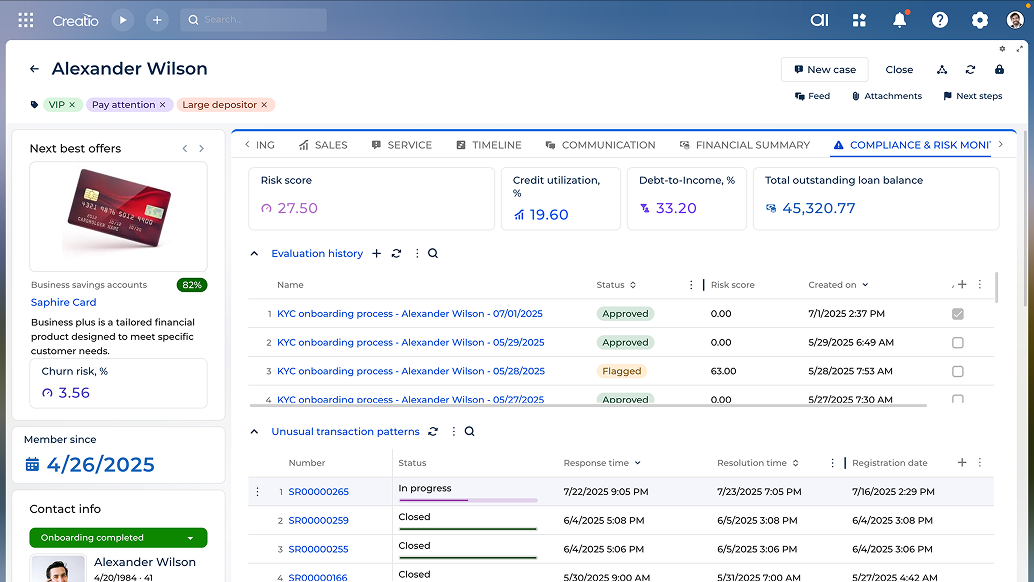
Compliance and Risk Monitoring – Creatio for Banking Automation
6. Payment Processing and Reconciliation
Payment operations depend on precise coordination between core banking platforms, clearing systems, card networks, and external partners. Even small mismatches between records can delay settlement and create financial exposure. Automation validates and matches transactions across systems in real time, flags discrepancies immediately, and routes them for resolution with full traceability. This helps banks settle payments faster and maintain stronger control over transactions.
7. Account Maintenance
Routine requests such as address changes, limit adjustments, or account modifications follow predictable rules but still require coordination across multiple banking systems and compliance checks. Updating these changes manually often creates delays and inconsistencies.
Autonomous AI agents can assist bankers in collecting relevant account data, validating inputs against predefined policy rules, and preparing a structured summary for review. Standard updates are applied automatically across connected systems, while higher-risk changes are highlighted for human approval. As a result, it minimizes manual intervention, reduces the risk of errors, and improves processing speed.
8. Marketing and Sales Enablement
Banks manage large volumes of customer data, yet much of it remains underutilized for proactive engagement and revenue generation. Intelligent automation in banking helps segment customers and prospects based on their behavior, transaction history, and lifecycle stage, turning raw data into real business opportunities.
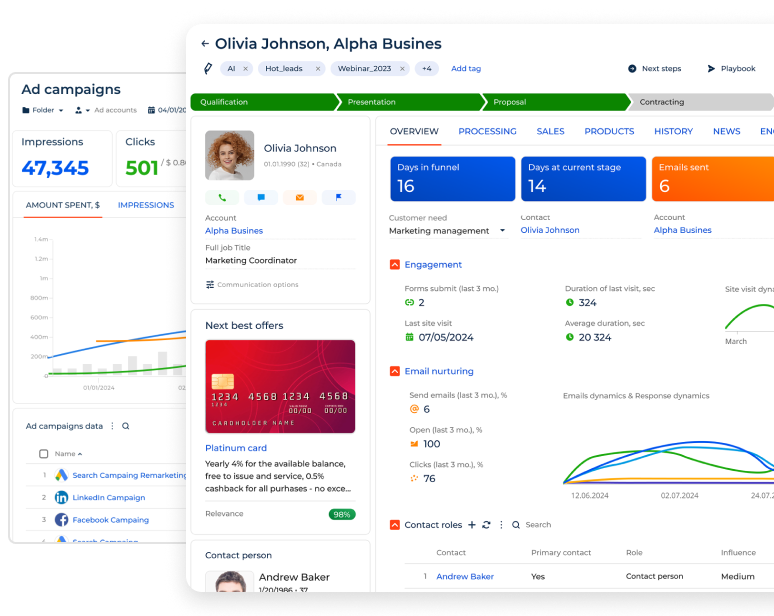
AI-driven recommendations help bankers identify cross-sell and upsell potential, create personalized offers, and prioritize outreach based on next-best-action guidance. This allows marketing and sales teams to engage their clients at the right moment, improve conversion rates, and deliver more relevant, consistent experiences across channels.
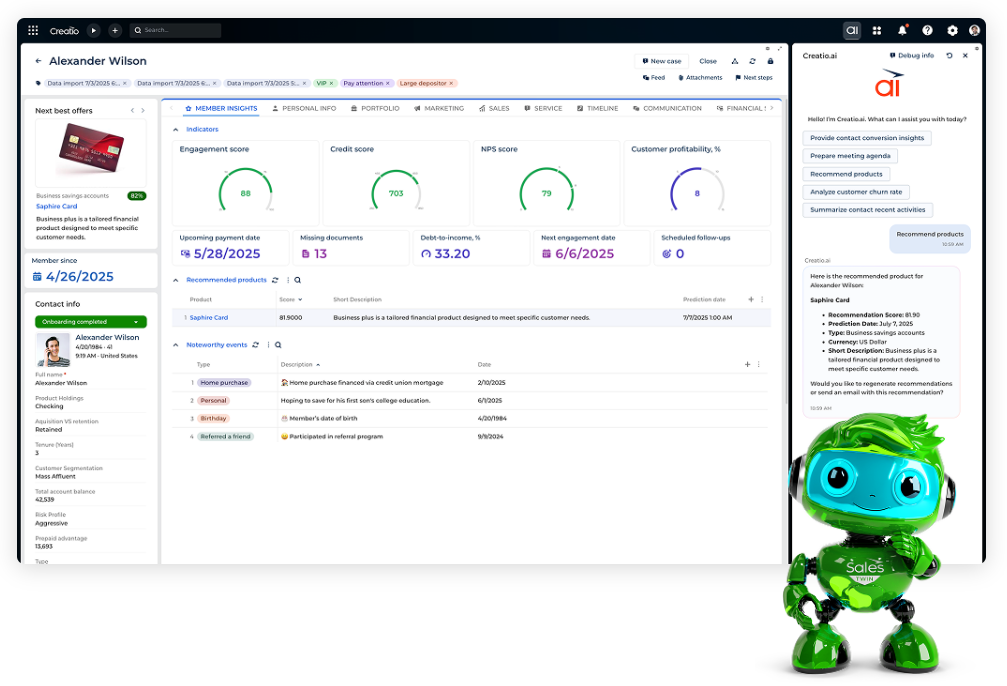
Sales and Revenue Growth – Creatio for Banking Automation
Benefits of Banking Automation
Banking automation delivers value where financial institutions feel pressure most: operational efficiency, regulatory control, risk management, and customer experience. When processes are structured and coordinated through automation, banks improve execution without compromising governance.
The key automation benefits across financial institutions include:
- Faster process execution – Reduces delays across the core banking workflows, such as onboarding, lending, payments, and service workflows.
- Lower operational risk – Embeds policy rules and controls into every process, minimizing errors and inconsistent decision-making.
- Stronger regulatory compliance – Generates structured audit trails and standardized reporting, improving transparency during reviews and inspections.
- Improved cost efficiency – Enables banks to scale routine operations without proportionally increasing staffing or infrastructure costs.
- Greater data consistency – Accelerated data entry and updates across systems, reducing reconciliation issues and reporting discrepancies.
- Enhanced customer experience – Shortens response times and ensures consistent, personalized services across digital and branch channels.
- Better operational visibility – Provides real-time insight into workflow performance, bottlenecks, and risk indicators.
The opportunities that automation brings to the financial industry are undeniable. Industry analysts such as Forrester predict that by 2030 banking will become increasingly invisible, connected, and purpose-driven, with AI automation playing a central role in proactive customer engagement.
How Creatio Supports Banking Automation
Creatio is a best-in-class banking CRM and workflow automation platform that empowers financial institutions to design, execute, and govern end-to-end banking processes with no-code and AI at its core. It provides a unified, agentic platform that orchestrates operations across onboarding, lending, payments, compliance, and service workflows without adding technical complexity.
Its composable architecture and visual no-code tools enable banks to design and adapt workflows in line with evolving regulatory, operational, and customer requirements. Creatio’s built-in AI capabilities support advanced automation and data-driven decision-making, while maintaining human oversight for approvals, exceptions, and regulatory controls.
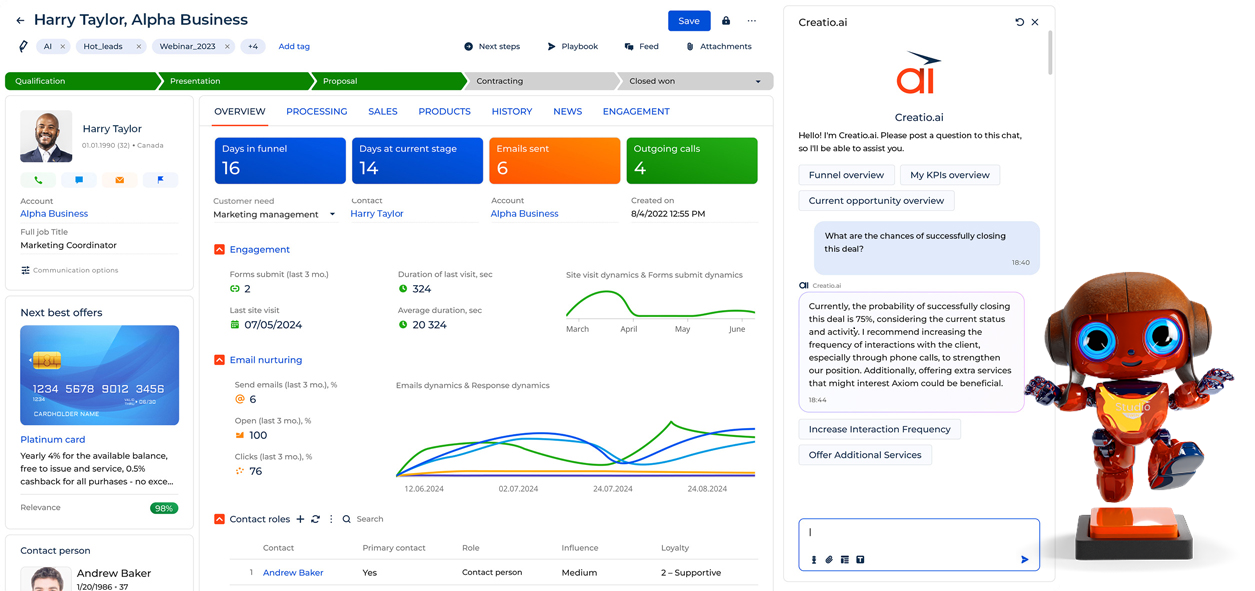
Creatio’s Agentic No-Code Platform for Banking
Creatio can seamlessly integrate with core banking systems, loan origination platforms, underwriting engines, payment systems, and document repositories, ensuring a consistent data flow across the enterprise. It can be deployed in cloud or on-premises environments, enabling banks to modernize their systems within existing infrastructure constraints.
Key Creatio Features for Banking Institutions:
- Ready-to-Use banking workflows for customer lifecycle management, product fulfillment (deposits, loans, mortgages, credit cards, wealth products), operations and servicing, and risk and compliance management.
- Enterprise-grade governance and security supporting role-based access control, data encryption, audit trails, and compliance alignment with standards such as SOC 2, GDPR, and ISO 27001 to ensure regulatory readiness and operational resilience.
- 360° customer view consolidating customer, product, and interaction data across systems to support informed decisions.
- Seamless connectivity and integration with core banking systems, loan origination, underwriting, payment processing, and document management platforms.
- AI-enhanced no-code development to create, configure, and scale autonomous AI agents and applications for banking without heavy development cycles.
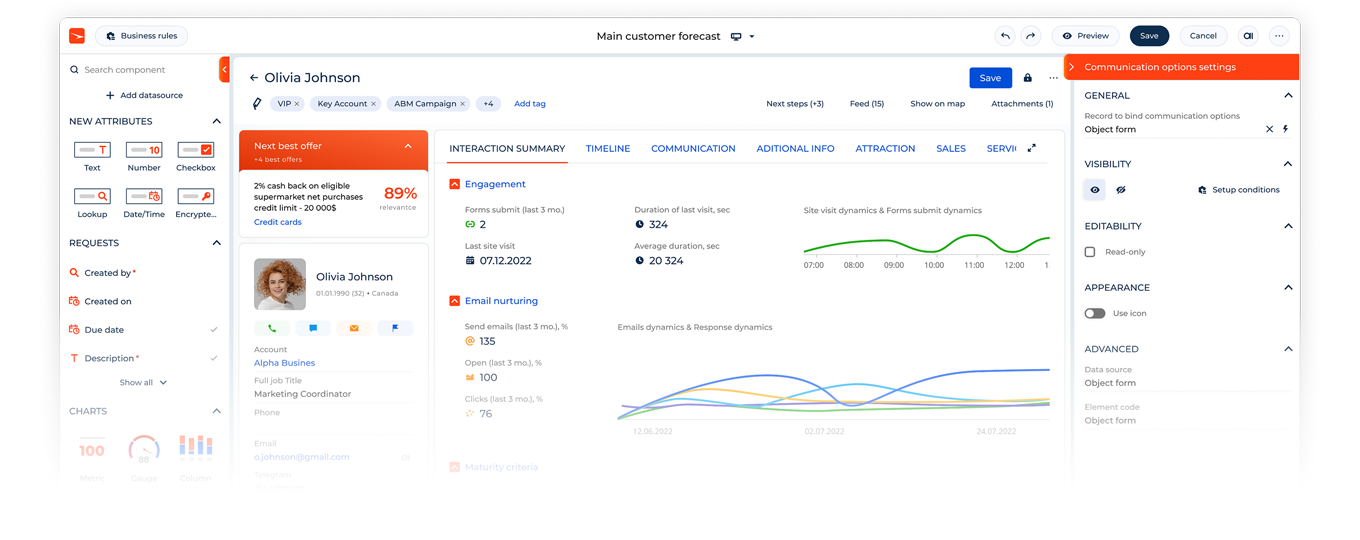
Creatio’s AI-Enhanced No-Code in Action
Creatio’s AI and Agentic Capabilities for Banking:
Creatio applies AI-native automation as a force multiplier for banking teams, automating routine tasks, generating predictive insights, and coordinating workflows across systems while maintaining human oversight for regulated decisions. Financial institutions can build custom AI agents tailored to their specific processes or leverage pre-configured agents for banking, such as:
- Referral Agent – Identifies and tracks cross-sell opportunities through to conversion
- Renewal Agent – Monitors renewals and guides personalized offer execution
- Retention Agent – Detects early churn signals and initiates retention actions
- Customer Onboarding Agent – Validates data and pre-verifies documentation to accelerate approvals
- Loan Preparation Agent – Structures application data and validates eligibility
- Loan Servicing Agent – Manages servicing events, automates payments, and provides timely customer updates
- … and other
Creatio.ai provides predictive insights such as next-best-action recommendations and performance forecasting which support faster, data-driven decisions while maintaining human-in-the-loop control and regulatory compliance.
According to a new benefit study by Nucleus Research, organizations using Creatio’s agentic no-code platform deliver workflows up to 70% faster and reduce technology costs by 30%. By consolidating multiple legacy systems into a single platform, banks can achieve rapid time-to-value and transform deployment timelines from months to just weeks.
Key Banking Automation Trends for 2026
At the recent Autonomous AI Agents for Financial Services event, industry leaders highlighted how banks approach automation through governed, agent-driven execution. The trends below reflect the direction financial institutions are now pursuing.
Here are the top trends that shape automation in banking today:
1. Shift from AI Assistants to Autonomous Agents
Instead of AI “co-pilots” that simply assist with tasks, financial institutions now prioritize autonomous agents that coordinate structured, multi-step workflows across systems. These agents execute structured tasks, prepare decision context, and manage handoffs within defined regulatory controls and human oversight.
2. Focus on Measurable Outcomes and ROI
Banks are shifting away from buying AI for the sake of productivity boosters and are instead focusing on tangible business outcomes. Organizations are prioritizing initiatives that directly impact two key areas:
- Revenue Generation: Using agents for referrals (cross-selling), renewals of maturing products, and customer retention.
- Operational Excellence: Automating labor-intensive processes like mortgage preparation, customer onboarding, and loan servicing to reduce costs and processing times.
3. Emergence of AI-focused Organizational Roles
As digital agents scale, the AI governance models are evolving. Banks are appointing Chief AI Officers and introducing formal oversight structures. New roles are emerging to train, monitor, and orchestrate AI agents to ensure compliance, accuracy, and accountability.
4. AI as a Unifying Layer for Legacy Systems
Rather than undergoing massive, slow system replacements, banks are using AI as a unifying layer that sits on top of existing legacy infrastructures and data lakes (like Snowflake or Databricks). This trend allows for a faster "time to value" by augmenting current systems with agentic capabilities.
5. Rapid Adoption and Scaling of AI Agent Systems
The pace of adoption is accelerating, and according to Gartner, 40% of financial services institutions will have deployed agents in some fashion by the end of 2026. This urgency is driven by margin pressures, the need to preserve institutional knowledge as the workforce ages, and rising consumer expectations for real-time, personalized digital experiences.
Summary
Banking automation has evolved from simple task digitization to governed, enterprise-wide orchestration of core banking processes. By combining AI-driven technologies, structured workflows, and system integration, financial institutions can execute onboarding, lending, payments, compliance, and service operations with greater speed, accuracy, and control.
At Creatio, we support financial institutions with an agentic CRM and workflow platform that combines autonomous agents, no-code capabilities, and ready-to-use banking applications. This enables banks to modernize and automate end-to-end workflows while maintaining strong governance, security, and regulatory compliance.
Ready to experience agentic banking automation in action?
Request a personalized demo and explore what AI and autonomous agents can unlock for your business.
