








































































Transform Business Ops with Creatio’s AI Agents for FinServ

The financial services industry is at a turning point. Increasing customer expectations, regulatory complexity, cost pressures, and competition from digital-first players are forcing institutions to rethink how they operate. Traditional models built on legacy systems, manual processes, and fragmented data are no longer sufficient to keep pace with the speed of innovation in the digital age.
At the center of this shift are rapid advances in digital technologies such as artificial intelligence, cloud computing, and agentic platforms. These innovations are enabling financial institutions to move from reactive, siloed operations to proactive, end-to-end process orchestration, unlocking new levels of efficiency, agility, and customer experience.
This article explores the key drivers behind digital transformation in finance, the emerging technologies shaping its evolution, and the strategies finance leaders can adopt to successfully navigate this journey.
Key Takeaways
- Digital transformation in finance is the shift to AI-powered, automated, and data-driven financial operations, replacing legacy systems and manual processes.
- The benefits of finance digital transformation include increased operational efficiency, reduced costs, faster decision-making, improved compliance, and enhanced customer experience.
- Finance digital transformation is powered by the introduction of digital technologies, such as artificial intelligence, SaaS platforms, and robotic process automation (RPA), enabling end-to-end workflow automation.
- Successful transformation requires assessing digital maturity, selecting a unified platform, establishing a single source of truth, implementing hyper-automation, and enabling workforce upskilling with strong AI governance.
- The future of digital transformation in finance is marked by developments in AI, which will become the core operating layer with autonomous agents executing workflows, hyper-personalization at scale, and human-AI collaboration.
- Creatio is the best finance digital transformation solution that combines an agentic no-code platform, CRM, and AI agents in a single environment, accelerating the design, automation, and optimization of end-to-end financial processes while enabling institutions to scale faster, reduce costs, and deliver superior customer experiences.
What Is Digital Transformation in Finance?
Digital transformation in finance is the process of modernizing operations, enhancing data-driven decision-making, efficiency, and the customer experience through technologies such as AI, cloud computing, and robotic process automation (RPA). The key drivers behind this transformation are the shift from manual, spreadsheet-based work to data-driven agentic automation, the adoption of advanced analytics, and the introduction of AI for predictive analytics, fraud detection, and personalized customer service.
Digital transformation is essential for financial institutions, with over 68% of customer interactions happening across 5-9 digital channels per client, according to Deloitte. This growing complexity makes it critical to eliminate manual work and build a connected ecosystem where data flows seamlessly across systems, enabling consistent, efficient, and real-time customer experiences.
By automating operations and unifying data, digital transformation enables finance teams to increase productivity and shift from routine tasks, such as manual data entry, to insights, strategy, and value creation, an impact further amplified by technologies such as generative AI, which McKinsey Global Institute estimates could add $200–340 billion annually to the banking sector through productivity gains.
What’s Behind the Need for Digital Finance Transformation
The financial sector is undergoing rapid change driven by digital technology, evolving customer needs, and increasing regulatory pressure. Digital transformation is no longer optional, it is essential for staying competitive and resilient.
Key drivers behind this shift include:
- Rising customer expectations - clients expect seamless, personalized, and real-time digital experiences similar to those offered by big tech companies. Traditional, slow, or fragmented services lead to customer dissatisfaction and churn.
- Legacy systems and operational inefficiencies - many financial institutions still rely on outdated infrastructure that is costly to maintain, difficult to integrate, and limits innovation. These systems slow down product development and increase operational risk.
- Increasing regulatory and compliance pressure - regulatory requirements are becoming more complex and dynamic. Manual processes make compliance costly and error-prone, while digital solutions enable automation, transparency, and faster reporting.
- Growing competition from fintech and digital-first players - agile fintech companies are disrupting traditional banks with faster, cheaper, and more user-friendly services. Established institutions must modernize to remain competitive.
- Data utilization and decision-making challenges - financial organizations generate vast amounts of data but often struggle to leverage it effectively. Digital transformation enables advanced analytics, AI-driven insights, and better risk management.
- Pressure to reduce costs while improving productivity - increasing margin pressure is forcing organizations to do more with less. Automation, straight-through processing, and digital workflows reduce manual work, lower operational costs, and significantly improve employee productivity.
The Most Important Benefits of Digital Transformation in Finance
Digital transformation delivers tangible, measurable value across financial organizations, enabling them to overcome traditional challenges and operate more efficiently, compete effectively, and respond faster to market changes.
Increased operational efficiency and productivity
Automation of manual processes, integration of systems, and adoption of digital workflows streamline day-to-day operations. This reduces errors, shortens processing times, and allows finance professionals to focus on higher-value activities instead of repetitive tasks.
Example: A bank automating loan approval workflows can reduce processing time from several days to just a few hours while minimizing human error. According to Deloitte, 33% of surveyed AI users reported a significant increase in efficiency and productivity thanks to streamlined business processes.
Radical cost reduction
By digitizing processes and reducing reliance on legacy infrastructure, organizations can significantly lower operational and maintenance costs. Cloud adoption, automation tools, and optimized resource allocation contribute to leaner, more scalable cost structures.
Example: Migrating from on-premises systems to the cloud can reduce IT infrastructure costs while eliminating the need for expensive hardware upgrades and maintenance. According to Forrester, in 2024, 77% of financial institutions had adopted data analytics and AI in some form, resulting in $447 billion in cost savings.
Data-driven agility and risk management
Digital transformation enables real-time access to high-quality data and advanced analytics. Finance leaders can make faster, more informed decisions, better anticipate risks, and quickly adapt to changing market conditions.
Example: Using AI-driven risk models, insurers can quickly analyze financial data, assess claims in real time, and detect fraud patterns that would be missed with traditional analysis. By leveraging an AI-powered solution, Mastercard boosted fraud detection rates by an average of 20% and reduced false positives by over 85%.
Proactive compliance and security
Advanced tools support automated compliance monitoring, audit trails, and real-time reporting. At the same time, adopting new and advanced cybersecurity frameworks helps protect sensitive customer data and reduce exposure to fraud and regulatory penalties.
Example: Automated compliance tools can instantly flag suspicious financial transactions and generate reports aligned with regulatory requirements, reducing manual audit effort.
Better customer experience
Digital capabilities and data analytics allow institutions to better understand customers and deliver personalized, seamless, and omnichannel experiences. Faster onboarding, intuitive interfaces, and tailored financial products improve customer satisfaction and strengthen long-term relationships.
Example: A fully digital onboarding process with eKYC enables customers to open an account in minutes via mobile devices, without visiting a branch. According to Gartner, by 2028, AI agents will handle 20% of interactions across the buyer's journey.
Technologies Driving Finance Digital Transformation
Digital transformation in finance is powered by a combination of advanced technologies that enable automation, intelligence, scalability, and continuous innovation. Among them, artificial intelligence is emerging as the key differentiator, redefining how financial institutions operate and deliver value.
Artificial Intelligence and AI Agents
AI and machine learning are at the core of modern financial transformation. From predictive analytics and fraud detection to hyper-personalization and intelligent decision-making, AI enables institutions to move from reactive to proactive operations.
The next evolution is AI agents in finance, autonomous or semi-autonomous systems that can execute tasks, make decisions, and interact across workflows. These agents can handle complex processes such as credit assessments, customer support, compliance monitoring, and financial advisory.
For example, AI-powered agents can automatically analyze customer data, recommend personalized financial products, and trigger next-best actions in real time, improving both finance teams' efficiency and customer engagement. Modern solutions, such as an agentic platform from Creatio, embed AI directly into business processes, allowing organizations to design, deploy, and manage AI-driven workflows without heavy coding, accelerating adoption and time-to-value.
Find out more about AI in finance and how it transforms finance operations.
SaaS platforms
Software-as-a-Service (SaaS) platforms provide the foundation for scalable, flexible, and rapidly deployable digital solutions. They eliminate the need for heavy upfront infrastructure investments and enable continuous updates, innovation, and integration with other systems.
SaaS platforms also support composability, allowing finance institutions to quickly build and adapt applications to changing business needs. A SaaS-based CRM or process automation platform can be deployed in weeks rather than months, enabling a faster rollout of new digital services.
No-code SaaS platforms like Creatio empower business and IT teams to collaboratively build applications, automate workflows, and continuously optimize operations without technical expertise. According to research by Nucleus, Creatio can be delpoyed 70% faster than legacy platforms, while enabling 37% lower total cost of ownership.
Robotic automation
RPA and intelligent automation technologies streamline repetitive, rule-based tasks across finance operations. When combined with AI, automation evolves from simple task execution to intelligent process orchestration. This reduces manual workload, minimizes errors, and significantly increases operational speed and consistency.

Strategy for Finance Digital Transformation
A successful digital transformation in finance requires more than adopting new technology. It demands a structured approach that aligns processes, data, systems, and people around clear business goals. The most effective digital transformation strategy is to treat transformation as a step-by-step journey rather than a one-time technology project.
Digital maturity audit & benchmarking
Before investing in new digital tools, finance leaders need a clear understanding of where they stand today. That starts with a digital maturity audit focused on processes, systems, data flows, and operational bottlenecks.
The first priority should be identifying every manual hand-off, duplicated task, spreadsheet-based workaround, and disconnected workflows currently embedded in daily operations. These inefficiencies often reveal the real barriers to speed, visibility, and scalability.
Benchmarking against industry peers or best practices can also help organizations understand which capabilities are missing and where finance transformation will create the greatest impact. Without this foundation, technology investments risk solving the wrong problems. Moreover, businesses should establish realistic expectations regarding their budgets and capabilities to effectively plan digital transformation initiatives.
Choosing the digital transformation software
Once pain points and maturity gaps are clear, the next step is selecting the right software foundation. In 2026, finance digital transformation requires more than a standalone system for one specific finance function. Organizations increasingly need flexible platforms that combine workflow automation, data management, AI capabilities, and integration in one environment.
The right solution should support end-to-end process orchestration, connect easily with current systems, and enable continuous adaptation as business needs evolve. No-code platforms, cloud-based architectures, and embedded AI are becoming essential requirements rather than optional extras.
Instead of choosing software solely based on current needs, financial leaders should look for platforms that can support future growth, regulatory changes, and increasing automation demands.
Establishing the single source of truth
Digital finance transformation cannot succeed without reliable data. If critical information is fragmented across departments, spreadsheets, legacy systems, and disconnected applications, decision-making becomes slower and less accurate.
Establishing a single source of truth means creating a consistent, trusted data foundation across the organization. This involves cleaning existing data, standardizing definitions, eliminating duplication, and ensuring that financial teams work from the same version of key financial and customer information.
Operational hyper-automation
Once processes and data are standardized, organizations can move toward hyper-automation by automating high-volume, repeatable tasks across finance operations. This is where technologies such as workflow automation, RPA, and agentic AI can deliver substantial gains.
Routine activities such as document handling, financial transaction processing, reconciliations, approvals, case routing, and reporting can be automated to reduce manual effort, increase speed, and improve consistency.
The goal is not simply to automate isolated tasks, but to orchestrate entire processes across systems and teams. This creates a more scalable operating model while allowing employees to focus on analysis, strategy, and customer-facing work.
The “human-centric” upskilling & governance
Technology alone does not transform an organization, people do. That is why digital transformation strategies must include a human-centric approach to adoption, training, and governance. Employees need the skills and confidence to work effectively with new digital tools, automation, and AI-driven processes. Additionally, clear communication about the benefits of digital tools is essential to overcome resistance to change.
At the same time, organizations must establish clear governance frameworks for AI use, decision accountability, compliance, data protection, and ethical oversight. As automation becomes more advanced, strong governance becomes essential for building trust and controlling risks.
The most successful digital finance transformation programs combine workforce upskilling with clear operating principles, ensuring that technology enhances human performance rather than creating confusion or resistance.
Finance Digital Transformation with Creatio
Creatio is a finance CRM and workflow platform with no-code and AI at its core, enabling financial institutions to navigate finance digital transformation seamlessly. It provides a unified environment where organizations can design, automate, and optimize end-to-end financial processes while maintaining full control over sensitive data, compliance, and operations.
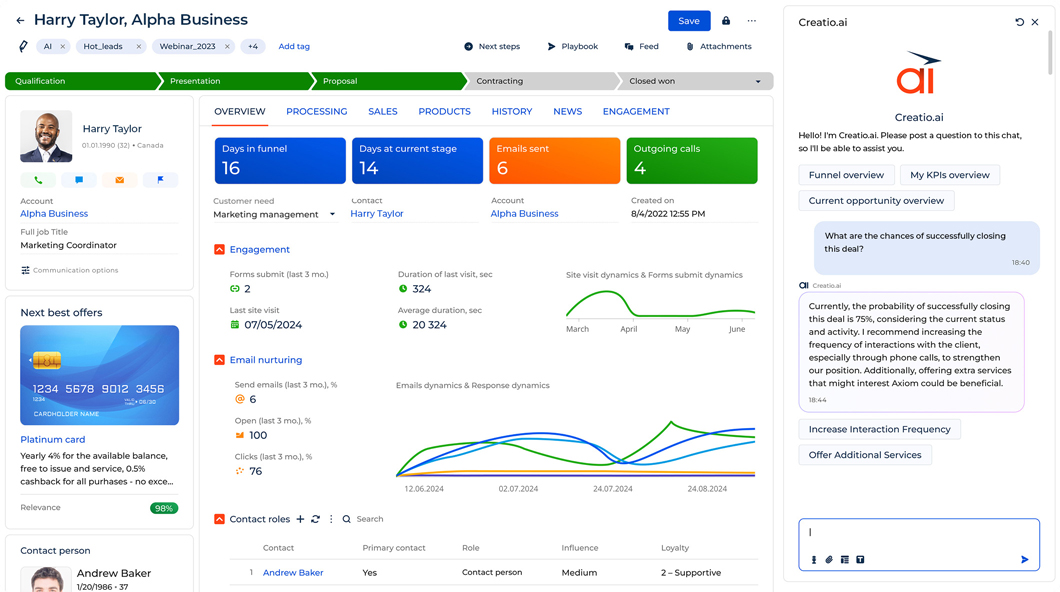
By combining an agentic no-code platform with CRM, workflow automation, and native AI, Creatio enables financial organizations to streamline and enhance their operations. With customer relationship management, process automation, and intelligent capabilities in a single platform, it eliminates the need for fragmented systems and manual hand-offs.
Creatio provides a comprehensive set of CRM capabilities tailored for financial institutions, covering the entire customer lifecycle, product management, operations, and compliance processes. With ready-to-use workflows, organizations can accelerate transformation while maintaining consistency and control across all processes:
- Customer lifecycle - pre-built workflows support every stage of the banking journey, from marketing and sales to onboarding, service, and contact center operations.
- Product fulfillment - out-of-the-box workflows streamline the delivery of financial products, including deposit accounts, loans, credit cards, mortgages, wealth management, and insurance.
- Operations - dedicated workflows help optimize day-to-day operations, including account maintenance, payment processing, commercial sales, and product servicing.
- Risk & compliance - built-in workflows support compliance management, risk mitigation, and regulatory reporting. Financial institutions can ensure transparency, enforce policies, and respond quickly to evolving regulatory requirements.
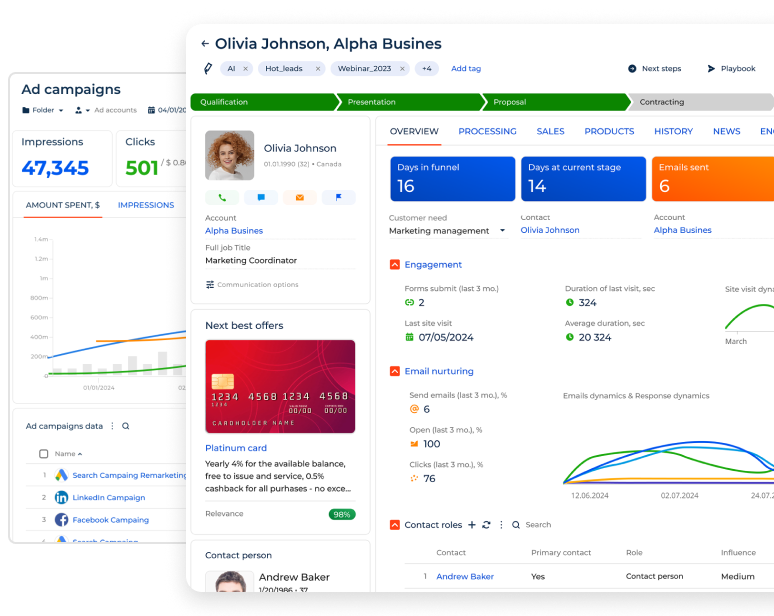
The platform’s no-code approach empowers both business and IT teams to rapidly build and customize applications, workflows, and AI agents without extensive development cycles. This allows organizations to respond quickly to regulatory changes, launch new financial products faster, and continuously improve operational efficiency. At the same time, embedded AI capabilities enhance decision-making and execution across processes. Whether supporting customer-facing teams with timely insights and recommendations or automating operational workflows, AI agents become a natural extension of everyday work rather than a separate layer of technology.


At the core of the platform are powerful AI agents designed to support CRM functionality, as well as autonomous agents that execute financial-industry-specific workflows across the customer lifecycle and operations.
CRM agents automate repetitive tasks, provide valuable insights, and help deliver personalized customer experiences:
- Marketing agents streamline audience segmentation, manage leads, optimize campaigns, and assist with content creation.
- Sales agents support teams by qualifying leads, improving forecast accuracy, and recommending next-best actions to drive conversions.
- Service agents automatically categorize incoming requests, generate case summaries, and accelerate resolution times.
Creatio’s autonomous agents support revenue generation and operational excellence, helping banks and financial institutions scale faster and operate more efficiently. Some of the examples include:
- Acquisition agents identify high-potential prospects and orchestrate personalized outreach to drive new customer acquisition.
- Customer onboarding agents simplify KYC procedures, automate data collection, and accelerate account setup.
- Expansion agents uncover cross-sell and upsell opportunities based on customer data and support targeted engagement.
- Loan lifecycle agents assist with underwriting, document handling, payment processing, and ongoing loan servicing.
- Referral, renewal, and retention agents identify growth opportunities and help maximize customer lifetime value.
- Operational agents automate routine processes, improving efficiency and reducing manual effort across teams.
- Customer consultation agents handle routine inquiries and provide always-on support, escalating complex cases when needed.
— responsibly, measurably, and at scale.

With a strong focus on governance, security, and a human-in-the-loop approach, the platform ensures that all processes, automated or AI-driven, operate within clearly defined rules and compliance frameworks. This enables organizations to scale digital finance transformation initiatives while maintaining trust, control, and regulatory alignment.
Creatio also supports a gradual finance digital transformation approach by integrating with existing financial systems, allowing financial institutions to modernize at their own pace without disrupting critical operations. This flexibility is particularly important in complex financial environments where legacy infrastructure cannot be replaced overnight.
Find out how financial institutions use the Creatio agentic platform to deploy workflows 70% faster and cut tech costs by 30%
Future of Digital Transformation in Finance
The future of digital transformation in finance will be defined by the convergence of AI, automation, real-time financial data, and platform-based operating models. What was once considered innovation is quickly becoming the new baseline, with financial institutions moving from experimentation to large-scale execution.
AI becomes the core operating layer
Artificial intelligence is no longer an add-on; it is becoming the foundation of how financial institutions operate. AI adoption in finance has grown rapidly, from around 45% of institutions in 2022 to approximately 85% by 2025, according to Forrester, with the majority of banks already using AI in at least one core finance function. Additionally, Gartner predicts that by 2028, 33% of enterprise software applications will include AI agents, enabling 15% of day-to-day work decisions to be made autonomously.
Going forward, AI will evolve from supporting routine tasks to executing end-to-end processes, with agentic AI acting as a digital workforce embedded across financial operations. Organizations are shifting from isolated use cases to fully orchestrated AI-driven systems that automate decision-making, workflows, and customer interactions.
The rise of agentic and autonomous systems
The next phase of transformation is driven by AI agents capable of operating across systems, making decisions, and coordinating processes. According to Accenture, 57% of banking IT executives expect broad or fully embedded AI agent adoption in risk, compliance, and fraud detection within the next three years.
In finance specifically, this will enable:
- Fully automated onboarding and KYC
- Real-time fraud detection and prevention
- Autonomous financial advisory and service interactions
The future is not just about automating individual tasks but orchestrating entire ecosystems of processes, systems, and AI agents. Organizations are already moving from pilot projects to scaled AI deployment, with most initiatives now focused on delivering measurable business outcomes rather than experimentation. This shift will redefine productivity, enabling a “10× workforce” where employees manage AI-driven processes rather than execute them manually.
Explosive market growth and investment
The scale of investment reflects the importance of this transformation. The global AI in banking market reached approximately $34.6 billion in 2025 and is expected to grow nearly 10 times by 2034, making it one of the fastest-growing segments in financial services.
According to Gartner, the banking industry will invest over $28 billion in AI software by 2027, underscoring its commitment to AI-driven transformation. AI is also expected to deliver significant economic impact, with Forbes estimating up to $1 trillion in annual savings for banks by 2030 through automation and efficiency gains, and Statista predicting AI adoption could add up to $170 billion to the global banking sector’s profit by 2028.
Hyper-personalization, decentralized finance, and blockchain technology
Customer expectations will continue to rise as AI enables hyper-personalized, real-time financial experiences. Banking will become more contextual, predictive, and integrated into everyday digital ecosystems. AI-driven interfaces, such as conversational assistants and digital advisors, will increasingly act as the primary interaction layer, delivering tailored recommendations and proactive support.
At the same time, financial services will become more decentralized and embedded into non-financial platforms thanks to blockchain technology, blurring finance industry boundaries. Decentralized finance (DeFi) enables users to access services such as payments, lending, and investments without relying on traditional intermediaries, offering greater transparency and lower costs.
As adoption grows, with the global DeFi market projected to exceed $600 billion by 2033, financial services will increasingly be integrated into digital ecosystems, making them more accessible, seamless, and globally available.
The future of digital transformation in finance is not just digital; it is intelligent, autonomous, and continuously evolving. Institutions that successfully integrate AI into their core operations, while maintaining strong governance and data foundations, will define the next generation of financial services.
Summary
Digital transformation in finance is a strategic shift toward AI-powered, automated, and data-driven operations that replace legacy systems and manual processes. Driven by rising customer expectations, regulatory pressure, and cost constraints, financial institutions are adopting key technologies such as AI, SaaS platforms, and robotic automation to streamline processes, increase efficiency, reduce costs, and enhance customer experience.
Looking ahead, AI and autonomous agents will become the core operating layer of financial services, enabling end-to-end process execution and real-time decision-making. Agentic platforms like Creatio support this shift by unifying CRM, workflow automation, and AI in a single environment, allowing financial institutions to accelerate transformation and operate more efficiently at scale.
